 AI Firms Are Buying Rare Books, Slicing the Spines Off, and Shredding Them — On Purpose
AI Firms Are Buying Rare Books, Slicing the Spines Off, and Shredding Them — On PurposeA Dutch bookshop got a spreadsheet asking for 3,001 titles shipped to China. He thought it was spam. It was the future eating the past.
One leaked internal doc literally reads: “Project Panama is our effort to destructively scan all the books in the world.” And the follow-up line? “We don’t want it to be known that we are working on this.”
So yeah. The machines that write your essays are being fed by chopping up the last physical copies of books nobody’s reprinting. Some of these titles have like… three copies left on Earth. Read that again.
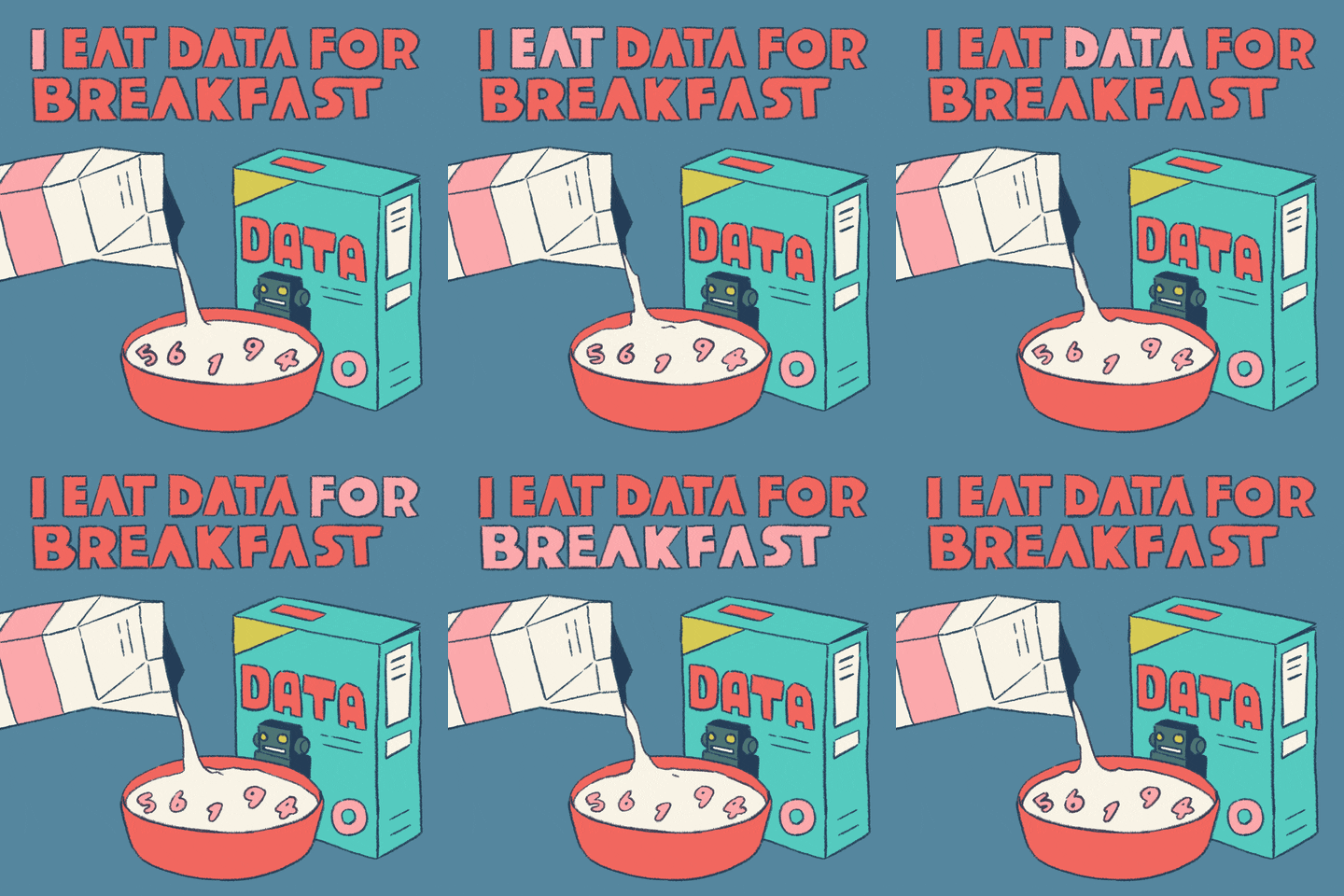
Okay so. You know how everyone keeps saying “AI is trained on the whole internet”? Yeah, turns out the internet ran out. So now these companies are going after the stuff that was NEVER online — dusty out-of-print books, weird academic journals, niche manuals — buying them in bulk, running them through a machine that cuts the spine off like a guillotine, scanning every page, and then throwing the paper in the recycling. Gone. Forever. I mean. WHAT.
And the wildest part? They know it’s ugly. That’s why one company literally wrote “we don’t want it to be known.” You’re not ready for how deep this goes.
🧩 Dumb Mode Dictionary (read this first, everything clicks)
| You’ll hear… | It actually means… |
|---|---|
| Destructive scanning | Slicing a book’s spine off so the loose pages feed through a fast scanner. Cheaper than careful scanning. The book does not survive. |
| Training data | The giant pile of text an AI reads to “learn.” More rare text = smarter (and more unique) AI. |
| Out-of-print | A book nobody’s printing anymore. Once the last copies vanish, that’s it. |
| ISBN | The barcode number on the back of a book. One number = one exact title. They shop by ISBN. |
| Project Panama | Anthropic’s internal codename for “scan every book in the world, destructively.” Real quote. |
| Fair use | The legal excuse for using stuff without paying. A judge said training on books mostly counts. That ruling opened the floodgates. |
📜 How the hell did we get here?
- AI companies got sued for pirating millions of books online. Anthropic got hit with a $1.5 billion bill for storing pirated copies.
- But the same judge (William Alsup, Bartz v. Anthropic) ruled that training on legally-owned books is fair game.
- So the play flipped: instead of pirating, buy the physical book, scan it, done. Legally clean.
- Cheapest way to scan fast = cut the spine off and feed loose pages. The original book gets tossed.
- Now firms are hoovering up rare and “less common” titles on purpose — because unique text nobody else has = a smarter model your rivals can’t copy.
🇳🇱 The Dutch bookseller who thought it was a scam
Pieter de Vries runs an old-book shop in Haarlem, Netherlands. He gets an email with a spreadsheet: 3,001 titles, mostly 2020–2021 academic stuff from big publishers (Elsevier, Wiley, Oxford, Routledge). Instructions: match the titles, quote a price, estimate shipping to China.
He figured it was phishing and ignored it. Weeks later a Fortune journalist told him the truth: a company called 2077AI wanted to buy his inventory to shred it for AI training. Man just found out he was standing next to a bonfire and didn’t feel the heat.
📊 The receipts (the numbers that should freak you out)
| Thing | Number |
|---|---|
| Titles requested from ONE Dutch shop | 3,001 |
| Anthropic’s piracy bill | ~$1.5 billion |
| Project Panama’s goal | “all the books in the world” |
| Copies remaining of some targeted titles | as few as a handful |
| Preservation method used by actual libraries / Internet Archive | non-destructive (book survives) |
| Preservation method used by AI firms | spine goes bye-bye |
🗣️ What the timeline's saying
- Librarians and archivists are losing it — they call it burning the library of Alexandria “one PDF at a time.”
- Book people point out the gross irony: real libraries spent decades scanning gently so the physical copy lives. These guys do the opposite for speed.
- Some folks shrug: “the text is preserved digitally, who cares about the paper?” Counterpoint: a scan misses margins, bindings, edition quirks — and if the scan’s private, nobody but the AI ever reads it again.
- Snopes checked it. The Project Panama documents are real, from unsealed lawsuit filings. Not a hoax.
🧠 The part a senior nerd goes 'huh' at
Here’s the sneaky bit nobody’s saying out loud: rare physical books just became a raw material. Like lithium or copper. There’s now a giant, cash-rich buyer for the exact stuff that’s been sitting in charity shops for $1. And most sellers (like poor Pieter) don’t even know the buyer exists yet.
That gap — between “this is worthless clutter” and “this is AI fuel” — is where the money hides. And gaps like that don’t stay open long. Keep reading.
Cool. The Suits Are Shredding History For Robot Food… Now What the Hell Do We Do? (ง •̀_•́)ง
Look, we’re not gonna cry about it (okay, maybe a little). While the suits treat 400-year-old paper like printer refills, there’s a weird open window here for anyone paying attention. Here’s five plays. None of them require money you don’t have.
📦 The Dead-Stock Book Scout
AI data buyers want specific out-of-print titles by ISBN, in bulk. Charity shops, estate sales, and library discard piles are drowning in exactly this — priced at basically zero because the public thinks old academic books are trash.
You become the middleman: buy cheap, match what buyers want, flip the finder’s fee.
 Example: A 24-year-old in Manila hits Sunday church rummage sales and Facebook Marketplace, grabs boxes of 2019–2021 academic paperbacks for pennies, lists lots on AbeBooks and eBay tagged with clean ISBNs and “bulk academic lot.” Data brokers and resellers who supply them come hunting. He clears ~$600 on a box that cost him $12.
Timeline: First flip in 2–3 weeks once you learn which categories move. Margins fatten for maybe 6–12 months — then thrift-shop pricing catches up and the free lunch shrinks.
🕳️ The Front-Runner (ride the ISBN list)
The lawsuit documents and leaked buyer spreadsheets basically tell you what they’re hunting: recent academic titles, “less common” editions, specific publishers. That’s a shopping list handed to you for free.
Buy those exact categories now, while they’re still $1 and nobody else has clued in. Sit on them till demand spikes.
Example: A 27-year-old in Lagos reads the public court filing summaries, notes the publishers and year-ranges AI firms target, then sweeps university-town used shops for those niches. Warehouses 300 titles at avg $2. When bulk-buyers post wanted-lists, he’s the guy already holding.
💾 The Gentle Scanner (save it before they shred it)
Some out-of-print stuff is genuinely useful and public domain or orphaned (old repair manuals, regional histories, hobby guides). You scan it non-destructively — phone + a free app — and sell clean PDFs to the tiny communities who desperately want them.
You’re literally doing the opposite of the shredders, and getting paid for it.
Example: A 22-year-old in Kraków uses the free vFlat scanning app to digitize public-domain and orphaned trade manuals, sells tidy searchable PDFs to vintage-machine and restoration hobby forums via Gumroad. $8 a pop, a few niche titles, quiet ~$400/month. (Stick to public-domain / orphaned works — check status here — don’t scan stuff that’s still copyrighted.)
📇 The Extinction Index
When a news wave creates a new panic (“which books are about to vanish?!”), the first person to build the clean, searchable list owns the search traffic. Be the dictionary for “endangered books.”
A simple public database: title, why it’s rare, where copies still exist, links to buy. Monetize with bookshop affiliate links + a “find-me-this-book” concierge tier.
Example: A 25-year-old in Bengaluru builds a free Notion or Airtable site listing single-copy and near-extinct titles, cross-linked to sellers with AbeBooks affiliate links. Collectors find it via search, pay a $15 “track down this book” fee. Becomes the SEO anchor for the whole niche.
🔧 The Buried-Knowledge Dealer
Here’s the reverse-the-data-flow play: some knowledge exists ONLY in out-of-print physical books — obsolete machine repair, discontinued-craft techniques, old regional trade methods. That info never made it online. It’s about to get locked inside a private AI or shredded entirely.
Extract it, rewrite it into plain guides, sell to the exact people who need it.
Example: A 28-year-old in São Paulo buys out-of-print sewing-machine and small-engine service manuals, turns the key procedures into clean illustrated how-to guides, sells them to repair hobbyists on Etsy and niche Discord communities. Sells the guide, keeps the book. ~$700/month from knowledge that was rotting in a box.
🛠️ Follow-Up Actions
| Step | Do this |
|---|---|
| Learn the demand | Skim the Bartz v. Anthropic filings for targeted categories |
| Find cheap stock | Facebook Marketplace, estate sales, library discard shelves |
| List it right | AbeBooks + eBay with clean ISBN + “bulk lot” |
| Scan it clean | Free vFlat app, sell PDFs on Gumroad |
| Check it’s legal | Public-domain lookup via Project Gutenberg |
 Quick Hits
| If you want… | Then do this |
|---|---|
 Fast cash flip Fast cash flip |
Scout cheap academic book lots, resell by ISBN on AbeBooks |
 Slow steady income Slow steady income |
Scan public-domain manuals, sell PDFs on Gumroad |
 Own a niche Own a niche |
Build the “endangered books” index in Airtable |
| Just understand it |
Read the Futurism deep-dive |
 Save real history Save real history |
Support the Internet Archive doing it the gentle way |
They’re shredding the last copies to build a machine that remembers everything. Somebody’s gonna profit off the ashes — might as well be the reader who saw it coming.
 !
!