 Australia Banned Teens From Social Media — 60% Still Have Access 5 Months Later
Australia Banned Teens From Social Media — 60% Still Have Access 5 Months LaterThe world’s first nationwide social media ban for kids got beaten by a $3 mesh mask from Temu and Mom’s Face ID
60% of Australian teens who had social media before the ban still have it. Two-thirds say the platforms took “no action” to kick them off. Cyberbullying complaints went UP 26%.
In December 2025, Australia became the first country to outright ban anyone under 16 from social media. Five months later, the Molly Rose Foundation surveyed 1,050 kids ages 12-15 and found: the ban barely moved the needle. TikTok, Instagram, and YouTube each kept over half their underage users. The government’s now investigating all five major platforms. And other countries — France, Greece, Spain, the UK, eight US states — are watching this trainwreck before copying it.
🧩 Dumb Mode Dictionary
| Term | What It Actually Means |
|---|---|
| Age verification | A system that checks if you’re old enough — usually by scanning your face or asking for ID |
| Facial estimation | Software that guesses your age from a photo of your face (spoiler: it’s bad at guessing near the cutoff age) |
| VPN | A tool that makes your internet traffic look like it’s coming from a different country |
| eSafety Commissioner | Australia’s internet cop — the government body enforcing these rules |
| Mesh face mask | A thin printed mask you wear over your face that tricks camera-based age checks |
| Compliance report | A government document that checks whether companies are actually following the law |
📜 How We Got Here
- November 2025: Australia passes the Online Safety Amendment Act — banning under-16s from social media. First country to do it nationwide.
- December 2025: Ban goes live. Platforms given 12 months to build age verification systems or face fines up to $49.5 million AUD per violation.
- February 2026: NPR reports early signs the ban isn’t sticking. Kids are finding workarounds fast.
- March 2026: Australia’s eSafety Commissioner opens investigations into Facebook, Instagram, Snapchat, TikTok, and YouTube for non-compliance.
- April 2026: Molly Rose Foundation drops the survey bomb — 60%+ of teens still online.
📊 The Receipts
| Stat | Number |
|---|---|
| Teens surveyed (ages 12-15) | 1,050 |
| Teens who still have access to at least one banned platform | 60%+ |
| Platforms that kept over half their underage users | TikTok, YouTube, Instagram |
| Young users who say platforms took “no action” | ~66% |
| Increase in cyberbullying complaints (Jan 2025 → Jan 2026) | +26% |
| Max fine per platform violation | $49.5M AUD (~$32M USD) |
| Countries watching Australia’s experiment | 8+ (France, Greece, Spain, UK, 8 US states) |
🎭 How The Kids Are Beating It
The bypass methods are almost embarrassingly simple:
- Mom’s Face ID: A 14-year-old in New South Wales told reporters she just uses her mother’s facial recognition to log into Snapchat and Instagram. The phone sees Mom’s face, the app sees an adult. Done.
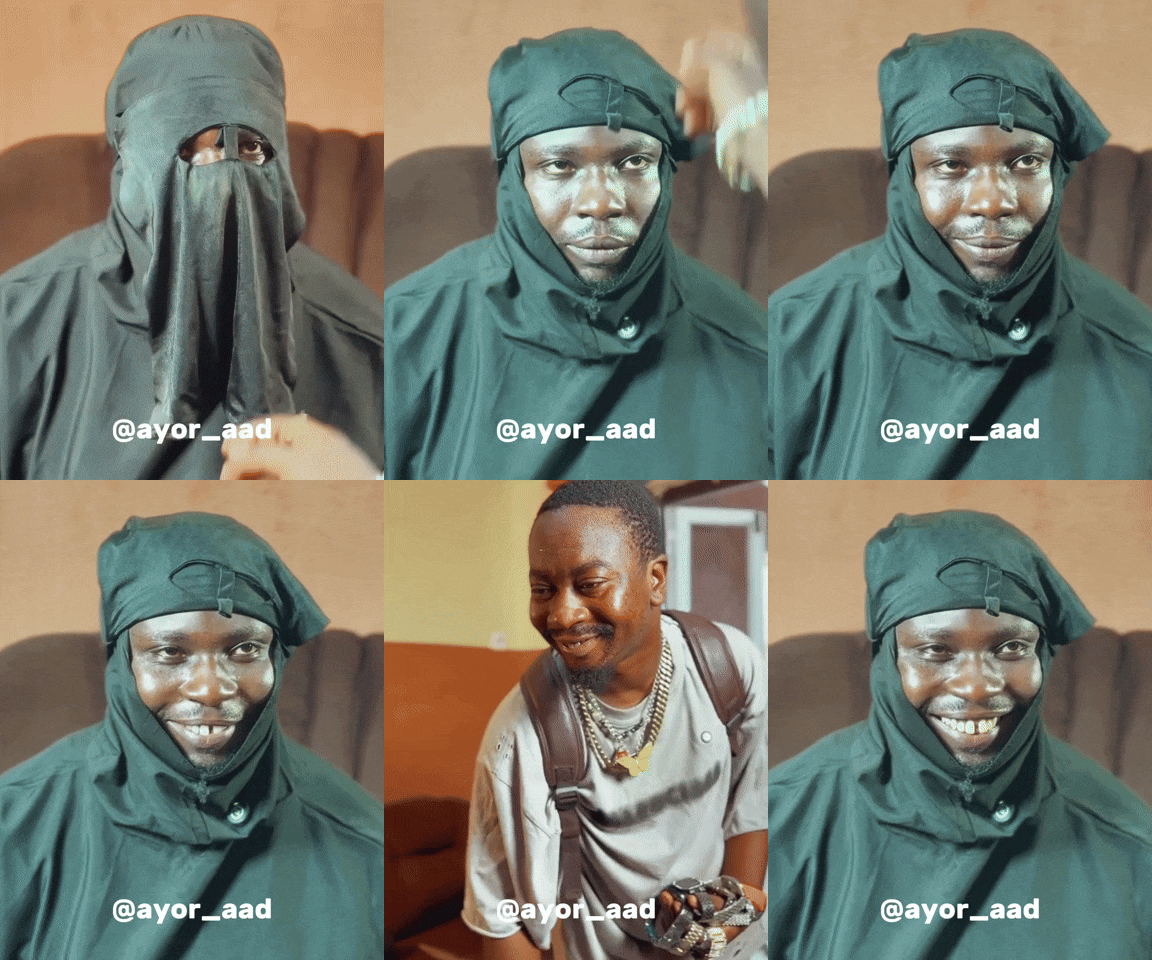
- $3 Temu Masks: Reddit threads started circulating printed mesh face masks — thin enough to see through, detailed enough to fool facial estimation software. Cost: about $3 from Temu.
- VPNs: Kids route traffic through other countries. Though platforms are getting better at blocking known VPN endpoints, free VPNs still slip through.
- Fake Birthdays: The oldest trick. Just type 2005 instead of 2012. Nobody checks.
- “Age Correction” Loophole: Some platforms actually prompted kids who had previously declared themselves under 16 to “correct” their age using low-confidence facial estimation. So the platform literally helped them re-enter.
🗣️ What People Are Saying
“These results raise major questions about the effectiveness of Australia’s approach.”
— CEO, Molly Rose Foundation
“Facial estimation is known to produce inaccurate results near the 16-year threshold.”
— Australia’s eSafety Commissioner compliance report
The Proton VPN blog raised a different concern entirely: age verification systems that scan your face create a massive biometric database. So the “fix” for teen safety is… giving a private company a faceprint of every citizen? The data shows that’s potentially a worse problem than the one they’re trying to solve.
But here’s the thing nobody mentions: cyberbullying complaints went up 26% after the ban. Not down. That suggests the kids who stayed online are now in a less supervised environment — because the ban pushed moderation resources toward age-gating instead of content-policing.
🌍 The Domino Effect
Australia isn’t alone. Multiple countries are drafting similar legislation:
- France — Age verification bills in committee
- Greece, Spain, Austria — Proposed restrictions on under-16 access
- UK — Already has Online Safety Act, watching Australia for enforcement lessons
- 8 US states — Various teen social media restriction bills in progress
- Indonesia — Draft proposals circulating
Every one of these governments is watching Australia’s 60% failure rate. The question isn’t IF they pass bans — it’s whether they copy Australia’s broken approach or try something new. And right now, nobody has a “something new.”
Cool. So Governments Can’t Keep Teenagers Off the Internet. Now What the Hell Do We Do? ( ͡° ͜ʖ ͡°)
🕳️ The Compliance Snitch Toolkit
Age verification laws are rolling out globally, but platforms are half-assing compliance. Companies need to PROVE they’re checking ages — and most can’t. Build a dead-simple compliance auditing script that tests whether a platform’s age gate actually works (can a minor get through?), document the results, and sell the reports to law firms filing class-action suits against non-compliant platforms. The $49.5M AUD fine per violation means lawyers are HUNGRY for this evidence.
 Example: A 24-year-old cybersecurity student in Melbourne creates automated test profiles (with consent, using legal test accounts) that probe age verification flows on 15 platforms. Documents that 9 of them let a declared 14-year-old through. Sells the compliance audit package to three law firms chasing eSafety Commissioner enforcement actions. Pulls $8,200 AUD in the first month from retainer fees.
Timeline: First paid audit within 14 days of setting up test methodology. Scales fast as more countries pass similar laws. Window closes when platforms actually fix their systems — probably 12-18 months.
🎣 The Parental Panic Goldmine
60% of teens beat the ban. That means millions of parents THINK their kid is off social media but they’re wrong. Parents are desperate for answers — and Australia’s official tools are useless. Create hyper-local “digital safety audits” for schools and parent groups. Not generic “here’s what TikTok does” talks — actual hands-on sessions where you sit with parents, check their kid’s device for hidden accounts, secondary browsers, VPN apps, and alt profiles. Charge the school PTA, not individual parents.
Example: A 28-year-old IT support tech in Brisbane pitches 3 local primary schools on a “Digital Reality Check” evening. $500 per session, 45 minutes, shows parents exactly how to spot VPN apps, hidden app folders, and duplicate accounts on their kid’s phone. Word spreads through parent Facebook groups. Books 11 sessions in 6 weeks at $500 each = $5,500 AUD.
📡 The Age-Gate Arbitrage
Here’s the weird market gap: platforms need age verification tech, but the good solutions are expensive and the cheap ones don’t work. The eSafety Commissioner’s compliance report specifically called out “low-confidence” facial estimation as inadequate. That means there’s a procurement wave coming — platforms will need to BUY better age verification. Position yourself as the middleman. Aggregate the top 10 age verification API providers, build comparison sheets with accuracy rates, pricing, and compliance scores, and sell this market intelligence to mid-tier platforms (dating apps, gaming sites, forums) that can’t afford to research this themselves.
Example: A 22-year-old in Jakarta who follows Australian tech regulation news builds a Notion database comparing 12 age verification APIs (Yoti, Jumio, Onfido, etc.) with real accuracy benchmarks, pricing tiers, and which ones pass the eSafety Commissioner’s standards. Publishes a free summary, gates the detailed comparison behind a $149 one-time purchase. Targets indie app devs and mid-size platforms via LinkedIn. Moves 38 copies in the first month = $5,662.
🪟 The Pre-Ban Country Sprint
France, Spain, Greece, and 8 US states are ABOUT to pass their own teen social media bans. Australia just proved these bans create chaos. That chaos = demand for solutions that doesn’t exist yet. Before each country’s ban goes live, create localized “ban survival guides” in the local language — not for kids trying to cheat, but for PARENTS trying to understand what’s changing and what they need to do. SEO-optimize for “[country] social media ban parents guide.” You become the first Google result in a market where demand is about to spike from zero to millions overnight.
Example: A 26-year-old content writer in Lisbon sees France’s social media age bill advancing. Creates a 15-page French-language PDF: “Guide Parental: Ce Que Change La Loi Social Media 2026” — covers what’s banned, what parents need to set up, which apps are affected, and links to official resources. Pushes it via French parenting Facebook groups. Free PDF captures 4,200 emails in 3 weeks. Monetizes with a €9/month “updates” newsletter as the law evolves. 310 subscribers in month one = €2,790/month.
🎰 The Biometric Panic Play
Here’s the angle nobody’s talking about: to verify your age, platforms need your FACE. Proton VPN already flagged this — age verification is building the world’s largest biometric database, and it’s being held by private companies with mixed security track records. Privacy-conscious adults are going to freak out. Start building a “biometric rights” resource hub — simple explainers about what data these age checks collect, which companies store it, for how long, and what rights you have to delete it. Monetize through privacy tool affiliate links (VPNs, identity protection services, data deletion tools) and sponsored content from privacy-focused companies.
Example: A 23-year-old privacy blogger in Berlin launches “AgeCheckExposed.com” — a single-page site that explains in plain language what happens to your faceprint when you verify your age on Instagram, TikTok, etc. Includes affiliate links to Proton VPN, DeleteMe, and Surfshark. Pushes the site to r/privacy, Hacker News, and European digital rights Twitter. 12,000 visitors in the first week. Affiliate conversions hit $1,400 in month one with zero ad spend.
🛠️ Follow-Up Actions
| Want | Do |
|---|---|
| Track which countries are passing bans next | Follow eSafety Commissioner updates and EU digital regulation news |
| Research age verification APIs | Start with Yoti, Jumio, Onfido — compare accuracy claims vs. independent audits |
| Understand the privacy risks of age checks | Read Proton’s breakdown of biometric data collection |
| Monitor bypass methods emerging in real-time | Watch r/australia, r/privacy, and Australian tech Twitter |
| Get into compliance consulting | Study the eSafety Commissioner FAQ and Australia’s Online Safety Amendment Act text |
 Quick Hits
| Want | Do |
|---|---|
 Check if YOUR age verification data is stored Check if YOUR age verification data is stored |
Request a data access report from every platform where you verified your age |
| See how your country’s proposed ban compares |
Search “[your country] social media age verification bill 2026” |
 Protect your biometric data now Protect your biometric data now |
Use Proton VPN or similar to avoid face-scan gates where possible |
 Spot the next compliance market Spot the next compliance market |
Watch France and UK — they’re closest to enforcement |
 Track the real stats Track the real stats |
Bookmark the Molly Rose Foundation for quarterly survey updates |
Australia spent years building a wall around social media. The kids climbed it in 5 minutes with a $3 mask and their mom’s face. Maybe the real age verification was the friends we made along the way.
Source: Fortune | eSafety Commissioner | NPR | Proton Blog
 !
!