BBC Found 180+ Hidden Cameras in Chinese Hotels Livestreaming Guests to 10,000 Telegram Subscribers — For $65/Month
A man browsed an adult site and found a video of himself and his girlfriend — secretly filmed in their hotel room and sold to thousands of strangers.
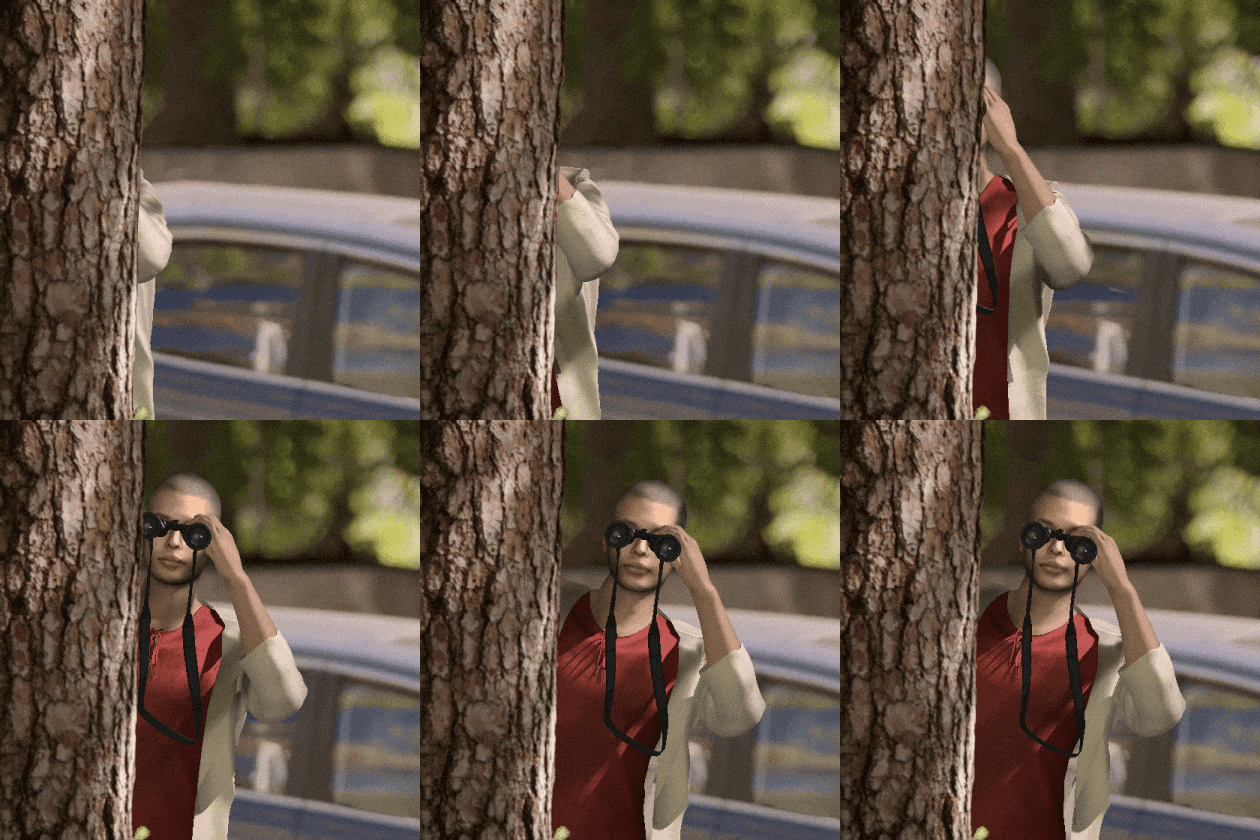
What Happened (And Why You Should Be Furious)
BBC journalists spent 18 months undercover and found a whole industry hiding cameras inside hotel rooms across China. Not one creepy guy — a full operation with camera installers, sales agents, and streaming platforms.
Here’s what they uncovered:
- 180+ hidden cameras across hotel rooms, streaming live to paying subscribers on Telegram
- 10,000 subscribers paying ~$65/month to watch guests in real-time — sleeping, changing, everything
- One victim (“Eric”) found a video of himself and his girlfriend on an adult site — filmed during a hotel stay they thought was private
- The cameras turn on automatically when you swipe your room keycard — they’re wired directly into the hotel’s own power system
- A professional hidden-camera detector couldn’t even find one that was stuffed inside a wall vent
- The main operator (“AKA”) had 6,000+ recorded clips going back to 2017 and earned at least $22,000 since April 2024 — nearly 4x China’s average annual income
- When BBC told Telegram about it, Telegram said it “violates our terms.” The channels stayed up.
- China passed a law in April 2024 requiring hotels to scan for cameras. Nobody’s enforcing it.
The worst part? When one camera went dark, subscribers complained online. The operator had a replacement running within hours.
How to Actually Check Your Hotel Room (Anywhere in the World)
Forget the apps. Forget the gadgets for a second. Here’s what you can do right now, for free, with just your phone:
The Free Phone Trick (works tonight)
- Turn off every light in your room — lamps, bathroom, TV, everything. Make it pitch black.
- Open your phone camera (use the front-facing camera — it usually doesn’t have an infrared filter).
- Slowly scan the room through your screen — especially pointed at smoke detectors, alarm clocks, USB chargers, air vents, and anything facing the bed or shower.
- Hidden cameras using infrared (night vision) will show up as a glowing purple/white dot on your phone screen that you can’t see with your naked eye.
This won’t catch every camera (the BBC found one that was completely hidden inside a wall vent). But it catches the majority of cheap spy cams, which use infrared LEDs to record in the dark.
The $2 Flashlight Method (catches what your phone misses)
Any bright flashlight works — even your phone’s flashlight in a pinch.
- Turn off all lights.
- Hold the flashlight at eye level and slowly sweep it across every surface — especially reflective spots near the bed, bathroom, and desk.
- Camera lenses are made of glass. When light hits them at the right angle, they reflect back a distinct bright dot — different from normal reflections because it stays consistent from multiple angles.
- Check: smoke detectors, power outlets, USB ports, picture frames, tissue boxes, clocks, air fresheners, and anything with a tiny hole.
Pro move: an infrared flashlight (literally $1.50 online) makes camera lenses glow even more obviously. Normal flashlights work, but IR flashlights are specifically designed for this.
The Nuclear Option (for frequent travelers or the justifiably paranoid)
- Dedicated lens finder (~$20-40): These use a ring of red LEDs and a viewfinder. You look through it and sweep the room — any camera lens lights up bright red. Way more reliable than phone apps. Search “camera lens detector” on Amazon.
- Check the WiFi: Connect to the hotel WiFi and scan for connected devices (apps like “Fing” do this for free). If you see devices labeled as cameras or unknown streaming devices, that’s a red flag.
- Unplug everything you didn’t bring. Alarm clock? Unplug it. USB charger built into the nightstand? Unplug. If it has power and you didn’t put it there, it could be feeding a camera.
- Cover what you can’t check: A piece of tape over any suspicious holes costs nothing and blocks any hidden lens behind it.
9 Ways People Are Already Making Money Off This Story
Not hypothetical. These are real plays people have run during previous spy-cam scandals — and this BBC story is about to make them all relevant again.
1. The 'IR Flashlight' Flip — Easiest Entry Point
Infrared flashlights show hidden camera lenses glowing in the dark. They cost about $1.50 on AliExpress.
The play: Buy in bulk, post a 15-second TikTok/Reels demo showing a camera lens glowing when you shine the light → sell on TikTok Shop or Amazon for $12-18. The demo video sells itself.
Real example: A TikTok seller in Nigeria bought 500 IR flashlights at about $0.50 each, posted a 15-second demo — sold out in 9 days at $4.70 each.
Why now: This BBC story is going viral. “Hidden camera detector” searches are about to spike. The news cycle IS your ad budget.
2. The 'Travel Privacy Kit' Bundle — Higher Margins
Combine: a lens detector + webcam cover stickers + a portable white noise machine + a signal-blocking phone pouch → package as a “Travel Privacy Kit” on Etsy or Amazon for $60-80. Total cost per kit: ~$12.
Bundles always outsell individual items because people don’t want to research 4 separate products.
Real example: A couple in Portugal selling “Digital Nomad Safety Kits” on Etsy moved 340 units in late 2025 at about $58 each — their cost was $12 per kit including packaging.
3. The 'Camera Detector Reseller' Play — Proven Model
Buy bulk RF/lens detector devices from wholesale suppliers for $3-5 each → repackage with travel-friendly branding → sell on Amazon or Shopee for $25-40.
Real example: A seller in Malaysia listed rebranded detectors on Shopee after a spy-cam scandal in South Korea — moved 1,200 units in 3 weeks at $19 each, cost was $3 per unit.
4. The 'Hotel Room Check' Content Play — Zero Cost
Make a TikTok/Reels series: “How to check your hotel room in 60 seconds” — link to detection gadgets in your bio (affiliate commissions).
This BBC story = free trending topic. The content practically writes itself.
Real example: A travel creator in the Philippines posted a 45-second hotel room camera check tutorial after a similar scandal — 2.8 million views, earned about $3,200 in affiliate commissions from a single product link.
5. The 'Hotel Privacy Audit' Side Gig — Sell Your Time
Learn basic camera scanning (free YouTube tutorials, about 2 hours) → offer “privacy sweeps” to Airbnb hosts and boutique hotels → charge $50-150 per room.
Hotels will pay to advertise “camera-free certified” rooms. It’s a competitive edge that costs them almost nothing compared to a scandal.
Real example: A freelancer in Bangkok started offering $42 privacy audits to hostels after Thailand’s 2024 hidden camera arrests — now does 15-20 sweeps per week for boutique hotels across the city.
6. The 'Hidden Camera Detector' App — For Builders
Most “camera detector” apps on the App Store are garbage. Build a decent one (or hire someone for ~$200 on Fiverr) that uses your phone’s built-in magnetic sensor to detect camera electronics → charge $2.99.
Real example: A developer in Poland launched “CamScan” after South Korea’s spy cam crackdown — hit 400,000 downloads in 6 months, earning roughly $8,000/month from ads + a paid tier.
7. The 'Spy Cam Research Report' — Sell Knowledge
Document how these spy-cam networks actually operate on Telegram — the channels, pricing, promotion methods, payment flows → package it as a professional threat report → sell to hotel chains, privacy organizations, or journalists for $500-2,000.
This is exactly the kind of research news organizations pay freelancers for.
Real example: A cybersecurity researcher in India compiled a similar report on Telegram-based black markets — sold it to three companies for $1,400 each. Total research time: under 40 hours.
8. The 'Corporate Travel Safety' Consulting Gig — Big Tickets
Pitch companies that send employees to Asia: “I’ll write your corporate travel security policy + train your staff on checking hotel rooms” → $1,000-5,000 per client.
Companies are terrified of liability. This BBC story is the perfect cold-email hook.
Real example: A security consultant in Germany landed three corporate clients within two weeks of a similar BBC story in 2023 — charged about $3,700 each for a policy document + a 90-minute Zoom training.
9. The 'Hotel Privacy Review' Blog — Long Game
Write hotel privacy reviews for popular destinations (Shenzhen, Bangkok, Bali, Seoul) → rank on Google for searches like “is [hotel name] safe from cameras” → make money from security tool affiliate links.
Nobody is writing this content yet. It’s a wide open search niche.
Real example: A blogger in Indonesia started writing privacy reviews of Bali hotels after a 2023 Airbnb hidden camera controversy — now earns about $940/month from VPN affiliate links alone.
The 30-Second Version
180+ cameras in Chinese hotels are livestreaming guests to paying Telegram subscribers. A standard detector can’t even find them. China passed a law about it. Nobody’s enforcing it.
Protect yourself tonight: Turn off the lights, open your front phone camera, scan the room. Hidden cameras with night vision show up as glowing dots on your screen.
Make money this week: Buy infrared flashlights for $1.50, film a TikTok showing how they reveal hidden camera lenses, sell them for $12+. This story is your free marketing.
Source: BBC News
 )
)


 !
!