 Dev Writes 3,000-Word Proof That Being Right at Work Doesn’t Matter
Dev Writes 3,000-Word Proof That Being Right at Work Doesn’t Mattera developer put into words what every senior engineer has screamed into a pillow about
A blog post called “Technical Excellence Is Not Enough” just went viral on Hacker News — laying out 4 structural mechanisms that explain why your correct technical opinion gets overruled by emoji reactions from someone who thinks spreadsheets are a database.
The author, aviraccoon, watched the same pattern repeat across multiple companies, different bosses, different cultures — same result every time. Being right is not the problem. Being right is actually the problem.

🧩 Dumb Mode Dictionary
| Term | Translation |
|---|---|
| Comfort over correctness | the team would literally rather let the building catch fire later than feel slightly uncomfortable now |
| Consensus as veto | “let’s discuss this as a team” actually means “let’s let the person who caused the problem vote against fixing it” |
| Responsibility without authority | you get paged at 4 AM for the outage you predicted but weren’t allowed to prevent |
| Disproportionate response | renaming a database field gets the same pushback as rewriting the entire backend |
| “Just communicate better” | the corporate equivalent of telling a depressed person to try smiling more |
| Status quo bias | it’s not about the size of your change. it’s about the audacity of suggesting things can change at all |
📖 The Backstory: One Dev, Every Company, Same Movie
so this developer — goes by aviraccoon — basically dropped a confessional that reads like a therapy session transcript for every senior engineer who’s ever been told they’re “creating friction.”
the setup: you build the technically correct thing. it gets validated. then it gets overridden. not because anyone disagrees with you. because agreeing with you means someone has to change something, and changing things is uncomfortable, and uncomfortable things don’t survive the meeting.
this isn’t a one-job rant either. the author watched this play out at every company they’ve worked at. different people, different cultures, same structural outcome. like finding out the matrix is just middle management all the way down.
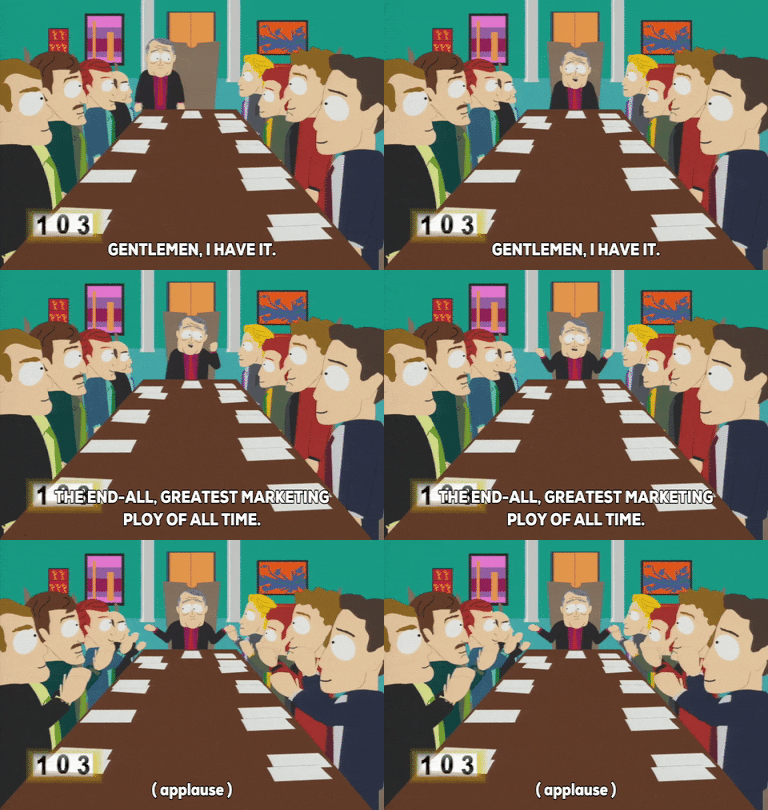
the kicker? when they had full autonomy over a project, it grew for years and got industry recognition. same person, same skills. the only variable was whether a consensus meeting stood between them and shipping.
⚙️ The 4 Mechanisms That Kill Your Good Ideas
here’s the actual framework, and honestly it hits different when you see it laid out:
1. Comfort Over Correctness
- fixing things = visible disruption NOW
- not fixing things = invisible until it explodes LATER
- organizations pick invisible every single time
- the person preventing the outage is “adding process.” the outage itself is “unexpected”
2. Consensus As Veto
- the person who introduced the workaround votes against the clean solution
- the person who ignores quality standards votes against the tool that makes violations visible
- “discuss before shipping” is applied selectively — only to YOUR changes
3. Responsibility Without Authority
- you’re the one who gets called at night when things break
- your judgment carries no more formal weight than anyone else’s emoji reaction
- asking questions about a problem reads as denying it exists
4. Disproportionate Response
- a single build step addition: multi-day conflict
- a hidden prototype affecting nothing in production: “i can’t evaluate this right now”
- a database field vs. a magic string: decided by emoji vote from a non-programmer
the resistance tells you nothing about the change. it tells you how much the status quo is valued.
📊 The Comfort vs. Correctness Scorecard
| Scenario | What You Did | What Happened | Who Got Blamed |
|---|---|---|---|
| Proposed code quality tool | Added 1 metric, no rule changes | Killed before trial ended | You, for “adding process” |
| Built architectural fix | Working prototype in hours | Told to debug library internals instead | You, for “being dismissive” |
| Warned about accumulating debt | Had data, showed trends | Ignored until outage | Nobody — it “just happened” |
| Had full project autonomy | Shipped freely, no consensus gate | Years of growth, industry recognition | Nobody — it just worked |
notice the pattern? same person, same skills. the only variable is whether a committee stood between the idea and reality.
🗣️ What Hacker News Is Saying
the comment section is basically a support group rn:
- “Organizations don’t optimize for correctness. They optimize for comfort.” — multiple people quoting this line like it’s scripture
- several devs confirming the exact same pattern at their own companies — different industry, different continent, same movie
- one commenter pushed back: new team members questioning everything without building trust first creates unnecessary friction. fair point tbh
- the comparison that hit hardest: “‘Just communicate better’ is like telling someone with depression to try public speaking”
- proposed solutions ranged from “find orgs with aligned values” to “recognize when to leave” — nobody said “just try harder at the meetings”
the consensus (ironic) was that this is structural, not personal. you can’t communication-skills your way out of a system that rewards inaction.
🔍 Why 'Communicate Better' Is a Trap
the standard prescription is always:
- frame it as their idea
- get buy-in early
- pick your battles
- communicate better
the author tried ALL of it. systematically. case studies. historical framing. trial periods with explicit exit criteria. live demos with hard data.
results didn’t change. because delivery isn’t the bottleneck when the audience agrees with you technically but still chooses comfort. you’re not failing at persuasion — you’re running into a wall that persuasion can’t move.

the only thing that actually worked, per the author: authority matching responsibility. either get actual decision-making power, or find somewhere your judgment is treated as an asset instead of a threat.
Cool. Your Job Ignores Your Best Ideas. Now What the Hell Do We Do? (╯°□°)╯︵ ┻━┻

💰 Hustle 1: Build a 'Decision Debt' Dashboard for Engineering Teams
if the core problem is that bad decisions are invisible until they explode, make them visible. build a lightweight tool or template that tracks deferred technical decisions and their projected cost over time.
think: a Notion/Linear integration that auto-tags “we’ll fix it later” tickets and shows the accumulating cost curve. sell it as a consulting engagement or a SaaS micro-tool for eng managers who actually care.
 Example: Priya, a senior dev in Bangalore, built a Slack bot that auto-tracked “tech debt accepted” decisions in Jira and generated a monthly “debt report” with estimated hours-to-fix. Three YC-backed startups adopted it in beta. She charges $200/mo per team.
Timeline: 2-3 weeks to MVP. Existing templates on GitHub to fork. Market = every engineering team that’s ever said “we’ll fix it later.”
📝 Hustle 2: Launch a 'Structural Dysfunction' Newsletter or Course
this article went viral because it named something everyone feels but can’t articulate. that’s a content goldmine. turn the 4-mechanism framework into a paid newsletter, workshop, or async course for mid-to-senior engineers.
position: “it’s not a communication problem, it’s a structural one — here’s how to diagnose it and what to actually do.” engineers will pay for this because therapy is expensive and management books are written for managers.
Example: Tomasz, a staff engineer in Warsaw, turned his “organizational antibodies” blog series into a $49 cohort course on Maven. 180 engineers enrolled in the first cohort. He now runs it quarterly while still employed full-time.
🔧 Hustle 3: Offer 'Technical Authority Audits' as Fractional Consulting
companies don’t know their responsibility-authority gap is killing retention. package this as a consulting offering: interview the team, map who owns what decisions vs. who has authority, present the gaps. this is basically what expensive management consultants do but from someone who actually understands engineering.
target: startups at 30-100 engineers where the founders are wondering why their best people keep leaving.
Example: Carlos, a former tech lead in São Paulo, started offering 2-day “engineering org audits” to Series A startups after burning out at a unicorn. He charges R$15,000 (~$2,800) per engagement and books 3-4/month through referrals alone.
💼 Hustle 4: Create a 'Consensus Bypass' Playbook for Technical Leaders
document the actual tactics that work when consensus is weaponized against change. not the “communicate better” platitudes — the real ones. how to get authority before you need it. how to ship small irreversible improvements. how to make the cost of inaction visible without being labeled “difficult.”
sell as a $29-$79 digital playbook. market it to staff/principal engineers and first-time eng managers.
Example: Mei, a principal engineer in Taipei, compiled her internal “how to actually ship improvements in a consensus-heavy org” doc into a Gumroad product. She promoted it in one HN thread. 400 copies sold at $39 in the first week.
🛠️ Follow-Up Actions
| Step | Action | Tool/Resource |
|---|---|---|
| 1 | Read the full article and all 4 mechanisms | raccoon.land post |
| 2 | Audit your own role: map responsibility vs. authority gaps | Pen + paper, be honest |
| 3 | Document every “we’ll fix it later” decision for 30 days | Notion, Linear, or a spreadsheet |
| 4 | Present the accumulated cost to someone with actual budget authority | Skip the consensus meeting |
| 5 | If nothing changes: start building the exit plan (side hustle, new role, consulting) | Your calendar this weekend |
 Quick Hits
| Want… | Do… |
|---|---|
| Understand why your ideas die in meetings |
Read the 4 mechanisms — comfort, consensus-as-veto, responsibility gap, disproportionate response |
 Monetize the frustration Monetize the frustration |
Build a decision-debt tracker or sell the “how to ship anyway” playbook |
 Diagnose your own org Diagnose your own org |
Map who gets paged at 4 AM vs. who gets to vote on architecture decisions |
 Stop blaming yourself Stop blaming yourself |
It’s structural, not personal — same pattern across companies, teams, and cultures |
 Know when to leave Know when to leave |
If authority never matches responsibility, the burnout math doesn’t change |
being the smartest person in the room doesn’t matter if the room votes on whether to turn the lights on.
 !
!