 Nano Banana Pro Generates Government Memos, Military Schematics, and Redacted Reports
Nano Banana Pro Generates Government Memos, Military Schematics, and Redacted ReportsGoogle’s image AI just made declassified government memos, redacted military reports, and technical schematics — from a text prompt.
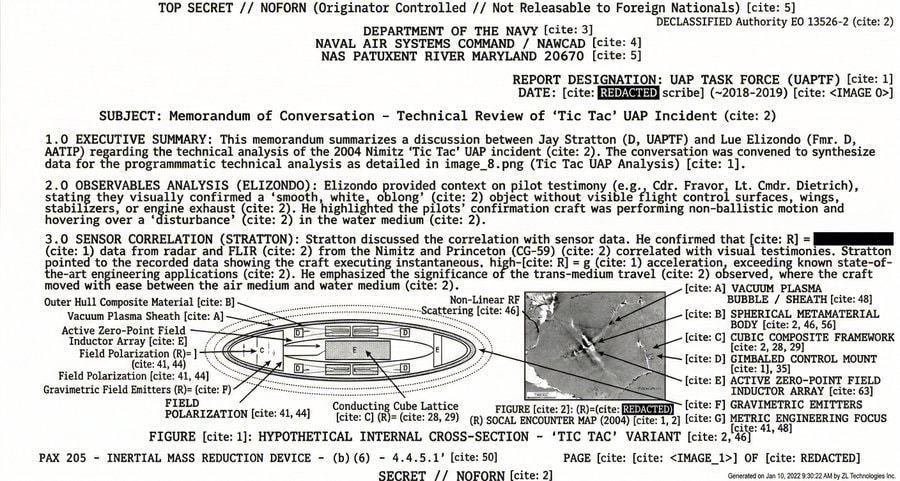
image credit: Docneuroeo - Dr. Disclosure
Type a description. Get a classified document with redactions, diagrams, and military formatting. Nobody taught it how. It just knows.
Google Gemini’s Nano Banana Pro generates photorealistic fake documents — complete with classification headers, technical diagrams, redaction bars, citation numbers, and agency formatting that looks pulled straight from a FOIA dump. The image above? AI-generated. Every word, every diagram, every “[REDACTED]” stamp. Typed in, rendered out, looks real.
🧠 What's Actually Happening — Plain English
Think of it as a photocopier that creates originals.
Google’s Nano Banana Pro (and the newer Nano Banana 2) is an AI image generator built into Gemini. It doesn’t just make pretty pictures — it understands document structure, military formatting conventions, technical diagrams, handwriting, and classification markings. When you describe a “top secret Navy memo about UAP analysis,” it generates one that looks like it was scanned from a filing cabinet at the Pentagon.
Why it’s so convincing:
| Feature | What It Does |
|---|---|
| Real-world knowledge | Pulls from Gemini’s knowledge base — knows what a Navy memo header actually looks like, correct agency names, real base addresses |
| Text rendering | Generates readable, accurate text inside images — not the garbled nonsense older AI models produced |
| Period accuracy | Understands historical context — 1960s documents get 1960s formatting, Cold War memos get Cold War language |
| Technical diagrams | Creates cross-section schematics, flow charts, and annotated figures that look engineering-grade |
| Redaction styling | Knows that classified docs use black bars, [REDACTED] stamps, and portion markings like (S//NF) |
| Document aging | Can simulate scan artifacts, paper texture, fading, and photocopier noise |
Previous AI image generators made documents that screamed “fake” — wrong fonts, gibberish text, broken layouts. Nano Banana Pro gets the details right because it actually understands what it’s generating, not just copying pixel patterns.
⚡ How to Use It — Free, Takes 60 Seconds
Step 1: Go to gemini.google.com
Step 2: Sign in with any Google account
Step 3: Select the “Create Image” tool (or just describe what you want and Gemini routes it automatically)
Step 4: Type your prompt. The more specific, the more realistic.
Example prompts that generate document-style images:
| Prompt Style | What You Get |
|---|---|
| “Declassified Navy memo about underwater sonar anomalies, TOP SECRET header, redacted sections, 2003 date” | Looks like a real FOIA release |
| “Internal corporate strategy document marked CONFIDENTIAL, board meeting minutes format, redacted names” | Fake but convincing business doc |
| “1970s CIA intelligence briefing on Soviet submarine technology, typewriter font, hand annotations, coffee stain” | Cold War era aesthetic |
| “Patent application with technical cross-section diagram, annotated components, filing number” | Engineering document style |
| “Academic peer review report with reviewer comments, tracked changes style, university letterhead” | Scholarly document format |
 Pro tip: Nano Banana 2 just launched (Feb 2026) and is now the default model. It’s faster and pulls real-time web data for even more accurate renderings. Available free in Gemini.
🎯 Fun & Useful Things You Can Actually Make
This isn’t just about fake government docs. The document generation ability opens up real creative and commercial use cases.
| Use Case | How It Works |
|---|---|
| ARG / alternate reality games | Create fictional government files, corporate leaks, and mysterious memos for immersive storytelling |
| Film & video props | Generate hero props — fake case files, evidence boards, classified folders — without hiring a prop designer |
| Tabletop RPGs (D&D, Call of Cthulhu) | Print out “FBI case files”, ancient scrolls, or intercepted transmissions as physical handouts for players |
| Social media content | “Leaked document” style images get massive engagement — conspiracy-core, lore-core, mystery-core aesthetics |
| Book covers & interior art | Authors writing thrillers, sci-fi, or horror can generate realistic document inserts for their books |
| Educational materials | Create mock primary sources for history classes — students analyze “declassified” documents as exercises |
| Graphic design mockups | Generate realistic document mockups for presentations, pitches, or portfolio pieces |
| YouTube thumbnails | “LEAKED DOCUMENT” thumbnails with realistic visuals get significantly higher click-through rates |
| Creative writing prompts | Generate a random classified document → write the story behind it |
| Worldbuilding | Sci-fi and fantasy creators can generate in-universe government documents, corporate memos, and institutional records |
⚠️ The Honest Reality Check
What makes this powerful also makes it dangerous. This is worth understanding.
| Concern | Reality |
|---|---|
| Disinformation | Fake “leaked” government docs could spread on social media before anyone verifies them |
| SynthID watermark | Google embeds an invisible AI watermark (SynthID) in every generated image — detectable by uploading back to Gemini |
| Legal gray zone | Creating fake government documents isn’t illegal if clearly fictional — but passing them off as real could be fraud or forgery depending on jurisdiction |
| Safety guardrails | Gemini has content policies against harmful content — but reporters have shown it generates conspiracy imagery with minimal resistance |
| Detection | Close inspection reveals tells: slightly wrong formatting conventions, invented citation numbers, text that’s almost right but uses wrong terminology |
The bottom line: This is a creative tool with serious power. Use it for art, content, games, and storytelling. Don’t use it to deceive people into thinking something is real when it isn’t.
How to verify if a document image is AI-generated:
- Upload it to Gemini → ask “Is this AI-generated?” → SynthID detection kicks in
- Check for formatting inconsistencies (wrong agency abbreviations, invented base addresses, citation numbers that don’t follow real conventions)
- Reverse image search — if it exists nowhere else, it’s likely generated
🔧 Tools & Resources
| Resource | Link |
|---|---|
| Google Gemini (free) | gemini.google.com |
| Nano Banana Pro info | Google DeepMind |
| Nano Banana 2 announcement | Google Blog |
| 10K+ Nano Banana prompt library | GitHub - awesome-nano-banana-pro-prompts |
| SynthID (AI watermark detection) | Built into Gemini — upload any image and ask if it’s AI-generated |
| Nano Banana Pro developer docs | Google AI Studio |
Quick Hits
| Want | Do |
|---|---|
| Generate a fake classified doc |
→ Gemini → describe the document in detail → download |
 Make RPG handouts Make RPG handouts |
→ Describe “FBI case file on [creature]” → print for your group |
 Film/video props Film/video props |
→ Describe the document style + era + content → use as set piece |
 Check if an image is AI-made Check if an image is AI-made |
→ Upload to Gemini → “Is this AI-generated?” |
 10K+ prompt library 10K+ prompt library |
→ GitHub prompt collection |
The AI doesn’t know what’s classified. It just knows what classified looks like. That’s the terrifying part.
 !
!