Every answer you’re about to get says “contribute consistently, be patient.” That’s a shop with no footfall — and it’s why the question keeps getting asked.
Flip which side you’re reading. The demand side is already public, machine-readable, and dated.
|
points at |
readable? |
has a deadline? |
| Your contribution graph |
you |
barely |
no |
| Their manifest + advisory + removal date |
them |
fully, by API |
yes, to the day |
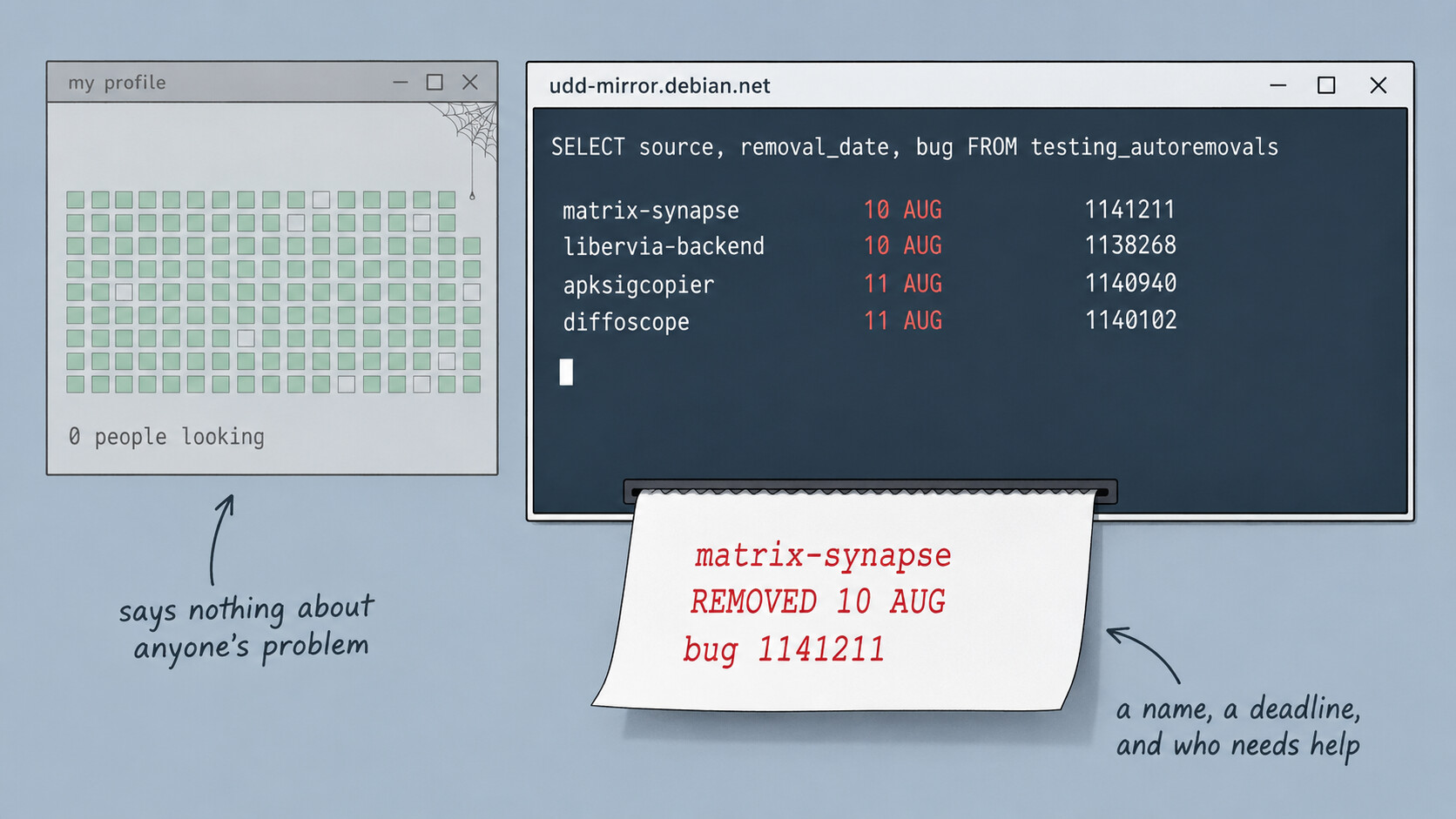
 Paste this. It returns work with a date on it.
PGPASSWORD=udd-mirror psql -h udd-mirror.debian.net -p 5432 -U udd-mirror -d udd -tA \
 -c "SELECT source, to_timestamp(removal_time)::date, bugs FROM testing_autoremovals ORDER BY removal_time LIMIT 6;"
Real output, run today:
matrix-synapse   | 2026-08-10 | 1141211
libervia-backend | 2026-08-10 | 1138268
apksigcopier     | 2026-08-11 | 1140940
diffoscope       | 2026-08-11 |
That’s a named package · the exact bug killing it · the date it gets deleted. Nobody had to be discovered for that to appear. No account, no token — Debian leaves a read-only Postgres open to the world.  The credentials every copy of this gets wrong: it’s
 udd-mirror / udd-mirror, not udd/udd — that role is IP-locked to Debian’s own infra and fails with a pg_hba error.
No psql? Same data, browser only → autoremovals.yaml
⋈ The whole method is one join
who runs it ✕ what dies, and when = a named org, a scoped job, and a deadline they didn’t choose — arrived at before they wrote the ticket.
 Where a real deadline exists — all six of them
Be honest about this, because it’s the part that makes it work: an ordinary abandoned library has no date. No registry assigns one. Hard, externally-authored, non-negotiable dates live in exactly six places:
| Feed |
The date it hands you |
| Debian autoremovals |
package deleted from testing on this day |
| Fedora orphans |
six-week auto-retirement clock, already ticking |
| CRAN checks |
fix it or the package is archived |
| CISA KEV |
dueDate — the only legally mandated remediation date in existence |
| endoflife.date |
460+ runtimes/frameworks, support ends then |
| Homebrew |
disable_date — formula stops working on that date |
Everywhere else, “urgent” is a word you wrote. In these six, it’s a field you read.
🔎 HALF A — pull the list of who actually runs a thing (verified endpoints)
 Any public repo hands you its full resolved dependency list, with no token at all:
curl -s https://api.github.com/repos/<org>/<repo>/dependency-graph/sbom \
  | jq -r '.sbom.packages[] | "\(.name) \(.versionInfo)"'
SPDX 2.3, minted on demand — the org never had to publish anything. 60/hr anonymous, 5,000/hr with any free token. Everyone assumes this needs auth and scopes; it doesn’t.
Sweep every public manifest at once — regex across 2M+ repos, no account:
curl -s -G -H 'Accept: text/event-stream' 'https://sourcegraph.com/.api/search/stream' \
  --data-urlencode 'q=context:global file:^requirements\.txt$ ^Django==3\. count:all' \
  --data-urlencode 'v=V3' --data-urlencode 't=regexp' | grep -o '"repository":"[^"]*"' | sort -u
Anchors: file:^go\.mod$ · ^pom\.xml$ · ^Gemfile\.lock$ · ^composer\.json$ · ^Cargo\.toml$ · ^\.github/workflows/.*\.ya?ml$ · \.tf$ — plus repo:^github\.com/<org>/.* to scope to one company. (Defaults exclude forks/archived — add fork:yes archived:yes.)
Registries that answer natively — the only four that do:
├─ crates.io · Rust
├─ RubyGems · the whole reverse edge set in one GET
├─ Packagist · PHP — and it carries the abandoned flag naming the replacement, so it answers both halves at once
└─ pub.dev · Dart/Flutter, via the dependency: qualifier
Ranking, not naming — deps.dev v3alpha returns dependent counts (the stable /v3/ path 404s — use v3alpha). Counts tell you blast radius; they never list a name.
github-dependents-info — GitHub’s own “Used by” page as a CLI, because that page has no API.
Named institutions, if you want slow-but-certain buyers: code.gouv.fr/data/deps.json maps French ministries to the libraries they run; Comptoir du Libre names the public bodies deploying each tool.
💣 HALF B — what is breaking, right now or on a schedule (verified endpoints)
Advisories → instant blast radius
curl -s -X POST -H 'Content-Type: application/json' \
  -d '{"package":{"name":"lodash","ecosystem":"npm"},"version":"4.17.20"}' \
  https://api.osv.dev/v1/query
(POST only — a GET returns 405 and people conclude it’s dead.) Batch 1,000 per call. Companion: GitHub Advisory REST, no auth, filterable by published=>.
Abandonment, scored
├─ OpenSSF Criticality Score bulk CSV — dependent count and months-since-update in the same row. Sort it and the top of the list is “hugely used, nobody home.”
├─ Scorecard API — the Maintained check as an abandonment probe
└─ issues.ecosyste.ms — exposes active_maintainers, i.e. bus factor as a number
Broken this minute
├─ OSS-Fuzz status — ~300 major projects currently failing, with last-success dates. Zero skill, opens in a browser.
├─ Koschei — Fedora rebuilds that broke because an upstream dependency changed
├─ ci.debian.net — autopkgtest status dump
└─ check-runs, anonymously: curl -s https://api.github.com/repos/<org>/<repo>/commits/main/check-runs — proves a named repo has been red since a date
Scheduled to break
├─ Red Hat lifecycle · no auth, no subscription
├─ Pluto versions.yaml · the exact Kubernetes version each API vanishes in
└─ Hackage deprecated · formal deprecation outside the npm/PyPI monoculture
Cross-distro state: Repology — 403s on a naive curl, 200 the moment you send -A 'yourname/1.0'. That one missing header is why the only free cross-distro index sits unused.
osv-scanner — point it at other people’s public repos and SBOMs, not your own. That’s the whole shift in one tool.
What this does not hand you
Worth more than another endpoint:
├─ An org name is not a person. All of it stops at a repo owner. The last mile — org → someone who can authorise a payment — is manual, every time.
├─ Nothing here measures willingness to pay. 500k dependents and zero maintainers is a fact; that anyone will fund it is your assumption. Adoption queues (Debian ITA, Fedora Take) are unpaid volunteer seats — don’t mistake them for demand.
├─ Private code is invisible, and that’s where the budgets are. Every source above reads public manifests.
├─ Stale lists lie. Some dependency dumps are months to years old. Re-verify a lead live before you contact anyone, or you’ll pitch a dependency they dropped last year.
└─ The endpoints are obscure; the output isn’t scarce. Anyone reading this can run the same query. Speed and the follow-up are the moat, not the URL.
☠️ Traps — things that look alive and aren't (all re-checked today)
├─ ecosyste.ms usage / dependent_packages → 402 Payment Required. Freshly walled: x-ratelimit-remaining: 4994, so it’s not a rate limit. The index routes and advisories/issues/docker still answer free; the dependent lists don’t. Every write-up recommending them predates this.
├─ libraries.io dependents → HTTP 200 with body {"message":"Disabled for performance reasons"}. A 200 carrying a refusal, so scripts “succeed” and get nothing. The single most-cited endpoint in every English article.
├─ grep.app API → 429 + a bot checkpoint page. Browser UI works, scripts don’t.
├─ GitHub “Used by” page → no API at all, in either REST or GraphQL. Everyone tries it first and burns a day.
├─ GitHub code search API → 401 unauthenticated, and the regex search you perfect in the UI cannot be scripted — the API runs the legacy engine.
├─ npm has no reverse-dependency API, and never did — the browse page is 403 Cloudflare. Biggest ecosystem, zero first-party answer.
├─ deps.dev /v3/…:dependents → 404 version not found. Only the undocumented /v3alpha/ serves it.
├─ PyPI and crates.io have no deprecation concept at all — yanked means “don’t resolve to this version”, never “this project is dead.”
├─ GH Archive / ClickHouse carries no CI events — the event enum has no CheckRun/CheckSuite. Run metadata is public; log bodies are 403 forever.
├─ BigQuery github_repos → snapshot ~2023, and one careless regex eats the 1TB free allowance in a single query.
└─ npms.io returns 200 and looks healthy — payload says analyzedAt: 2022-12-03. Frozen for years.
Nobody pays you for the graph. They pay whoever noticed the deadline first.
 !
!