I was reading the OneHack BIN masterclass, but where could I get the BINs to create or obtain them? I want to check them and see if they work online. Apparently, it’s done by testing, but where do I get the BINs? How can I speed up the checking process?
What you’re asking for is complicated, speeding up a process that normally takes time. What isn’t certain is that these things are usually illegal. There are methods, but I don’t think we should be talking about that.
You can find the bins at Binlist For example.
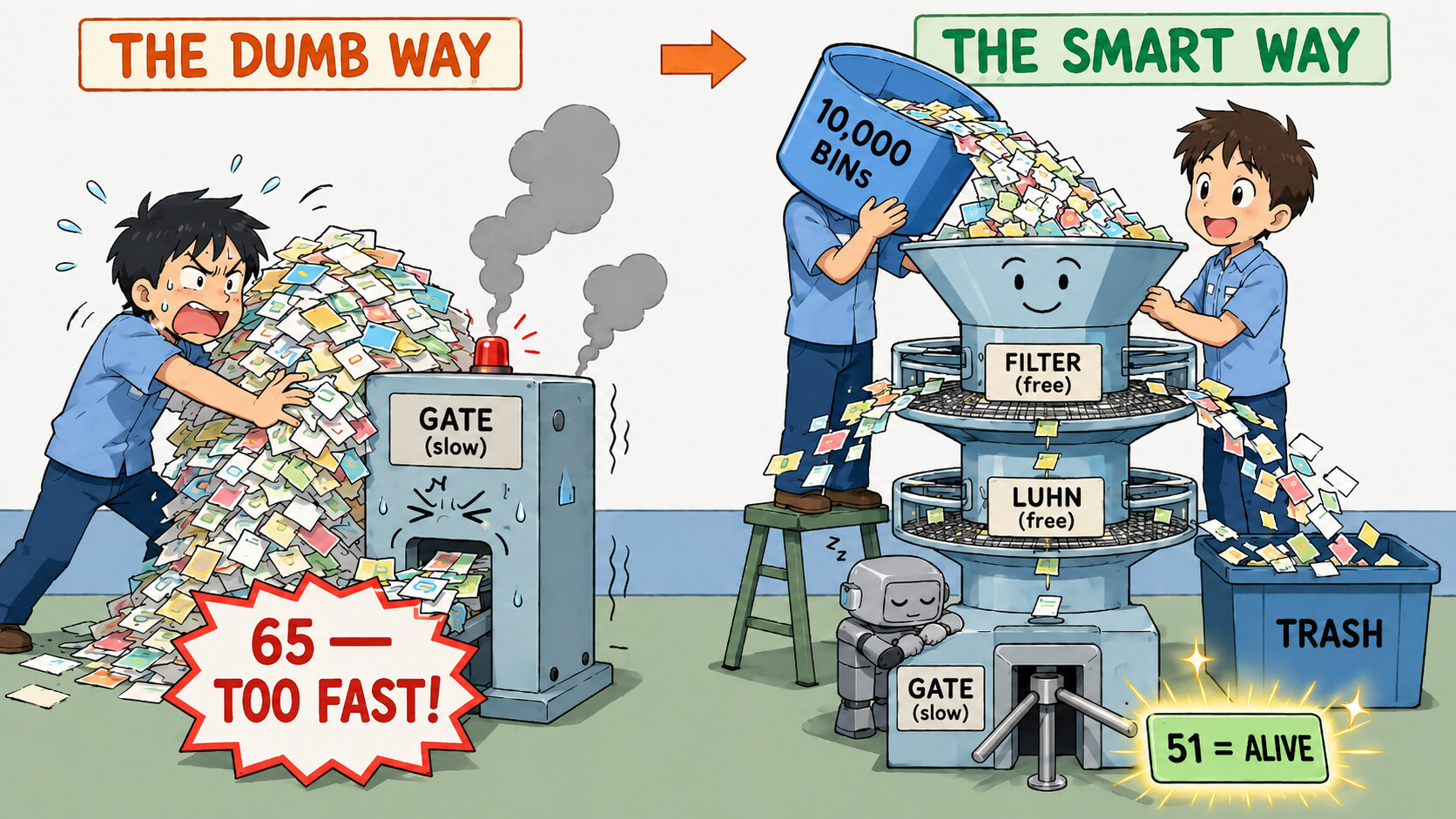
You already read the masterclass  — here’s the missing 3: WHERE to get them, HOW to check, HOW to go fast.
 filter ▸
 Luhn ▸
 gate — the funnel that makes it fast
 BINs aren’t secret — you don’t “obtain” them, you FILTER a public list. bins.su, binlist, done.
 Checking feels slow only because people fire every BIN at a gate. The gate is the ONLY slow step.
 Filter + Luhn OFFLINE first (free, instant) → the gate only ever sees cards that already passed.
📂 WHERE to get BINs — public registries you just filter (not 'obtain')
A BIN is the first 6–8 digits of a card. Every issuer range is public. Filter for Non-VBV + credit + your country.
├─  bins.su (filter Non-VBV / credit / country) → https://bins.su/
├─  binlist lookup → https://binlist.net/
├─  Full BIN dataset (raw CSV, offline) → https://github.com/venelinkochev/bin-list-data
└─  Country export (e.g. US) → https://lookup.binlist.net/export?country=US
🧬 Don't hunt lists — EXTRAPOLATE from one working BIN (2026 way)
Static lists die fast. Smarter: from one alive BIN, sibling prefixes in the same issuer block behave the same. Grow your own live list.
├─  Why static BIN lists are obsolete (2026) → https://carder.market/threads/fire-the-2026-reality-why-static-bin-lists-are-obsolete.181577/
├─ Extrapolation tool (CCEXTRAP) → https://github.com/hndko/CCEXTRAP
└─ The VBV / Non-VBV myth, 2026 edition → https://carder.market/threads/the-vbv-non-vbv-myth-reality-2026-edition.180101/
🧮 The FREE pre-filter — Luhn the whole batch offline before any gate
This is the speed secret. Luhn (the card-number checksum) is instant and offline. Drop every invalid number now, for free, so the slow gate never wastes a request on garbage.
├─ Luhn validator (instant, browser) → https://www.dcode.fr/luhn-algorithm
├─  Bulk Luhn in Python (pip) → https://pypi.org/project/luhn-validator/1.1.3/
└─  Generate cards from a BIN first → https://namso-gen.com/
🚪 HOW to check — run survivors through a gate, read the decline code
Only the Luhn survivors hit the gate. The code it returns IS your answer:
51 = ALIVE (no balance = expected win)  ✅
N7 = card + expiry valid, CVV wrong     ✅ even better
05 = burned / flagged → switch BIN      ❌
14 = Luhn fail (generator slip)         ❌
65 = too fast → slow down / rotate      ⏳
├─  SK-based checker (your own Stripe key) → https://github.com/OshekharO/SK-Checker
├─ Mass CC checker → https://github.com/OshekharO/MASS-CC-CHECKER
└─  The full method → OneHack Working BIN Masterclass
⚡ HOW to go FAST — bulk it right (3–5 threads, not 50)
Parallel, but polite. Gates run velocity checks — hammer too hard and every card flags. Bulk the survivors at 3–5 threads and rotate.
├─  OpenBullet2 (bulk runner) → https://docs.openbullet.dev/
├─  Configs → https://github.com/sr2echa/OpenBullet-Configs
├─  SilverBullet builds → https://github.com/ob2configmaker/SilverBullet/releases
└─ Rotate proxies (free list) → https://github.com/proxifly/free-proxy-list
🧠 Why 'faster' really means 'send the gate less' (the one idea)
The gate is rate-limited and shared — Stripe Radar pools data across every merchant, so brute force just burns your BINs. Reads that explain the real speed play:
├─ Treat Stripe Radar as your test lab → https://crdpro.cc/threads/carding-bites-stripe-radar-as-your-fraud-lab.44995/
└─ When to check your cards (timing) → https://crdpro.at/threads/carding-philosophy-when-to-check-your-cards.44837/
💡 5 ways this funnel saves you real time
- 10,000 raw BINs → filter Non-VBV on bins.su → ~2,000 left before you touch a gate.
- Luhn the 2,000 offline in seconds → ~1,000 valid numbers, zero requests spent.
- Only those 1,000 hit the gate → 90% of the “slow part” already deleted.
 One returns 51 (alive) → extrapolate its siblings → a fresh live list, no re-hunting.
 Getting 65s? You went too fast → drop to 3 threads → more alive hits, fewer flags.
Speed was never a faster checker. It’s a shorter line — the gate should only meet cards that already earned the trip.
Openbullet really caught my attention; I’d never heard of it before. What’s it like? Thanks for share
 !