Looking for rapid growth hacks to scale a Facebook Group with a US audience. What loopholes or algorithm tricks are working right now to get American members fast?
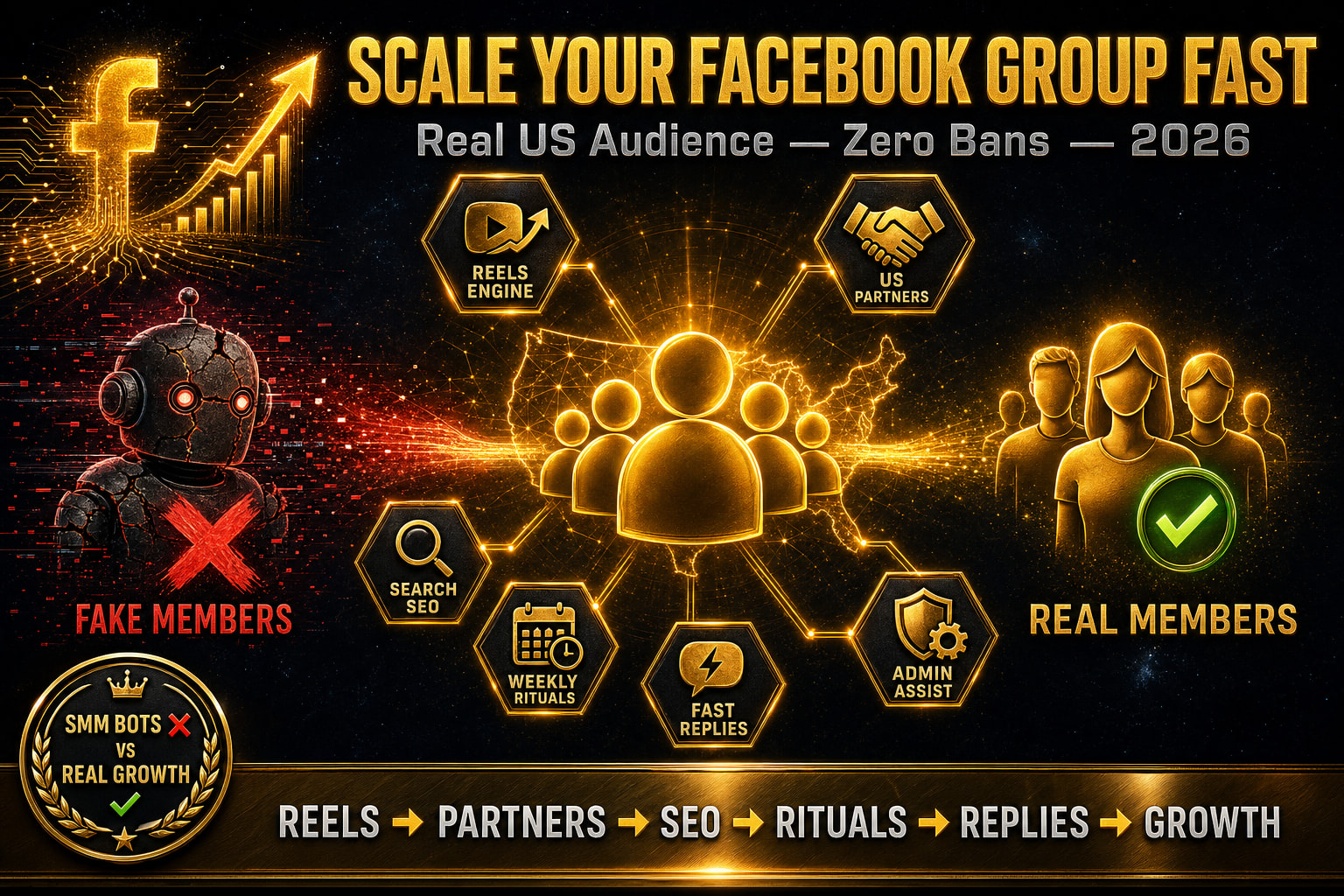
Straight answer: there’s no magic loophole left in 2026 — Meta’s AI kills fake-member clusters in 24–48h and disables the whole group, so the “5,000 members overnight” panels lose you everything. But the real tactics actually grow a US group faster than the fake ones ever did.
The whole playbook’s below — open the box you need. 
💀 The 'growth hacks' that'll get your group nuked — skip these
Everything marketed as a loophole is now a fast track to a disabled group:
❌ SMM panels selling 5,000+ fake members
❌ Bot auto-join extensions
❌ "Like if you agree" engagement-bait
❌ Mass-invite / scraping tools
Why they’re dead: Meta’s AI flags fake-account clusters in 24–48h, groups get disabled entirely (not just shadowbanned — you lose everything), and fake members wreck your engagement ratio, which the algorithm then punishes across your whole group. Not worth it.
🎬 Your real acquisition engine — native Reels (this is the #1 lever)
Reels are the only content type Facebook pushes to people who aren’t already members — so they’re how you reach new Americans at all.
DO:
  → Upload NATIVELY (never share a YouTube/TikTok link — it kills reach)
  → 15–30 sec, hook in the first 3 seconds
  → Chase SAVES (highest-weight signal), Shares-to-Stories, long comments

DON'T:
  → "Like if..." bait → actively de-prioritized
  → generic engagement farming

CADENCE THAT WORKS:
  → 3 Reels/week + 2 feed carousels/week + daily Stories
  → consistency beats volume, every time
🇺🇸 Get AMERICANS specifically — 3 targeting plays
- Partner cross-posting (fastest): find 5–10 US-based pages/creators in your niche → cross-post or do joint Lives → you tap straight into their warm, already-engaged American audience.
- Search optimization: put US-relevant keywords in your group name + About + pinned post (Facebook search indexes these heavily) → people searching your niche + “US”/city/state names find you organically.
- Weekly ritual content: AMA Mondays · Wins Wednesday · Friday office hours → rituals = return visits → the algorithm reads that as quality retention and boosts your reach.
🛠️ Set the group up so it grows itself
- Pin your best engagement thread → new joiners instantly see a live community.
- One-line promise in the name + cover (“who it’s for + the outcome”) → converts the second someone lands on your page.
- 1–2 membership questions → filters bots, lifts quality, barely slows growth.
- Reply to comments in the first hour → signals “live conversation” to the algorithm → directly boosts organic reach.
- Admin Assist → auto-screens joins & spam so quality stays high with zero manual work.
📊 Every tactic side by side
 Tactic Tactic |
 Speed Speed |
 Cost Cost |
 Risk Risk |
 Quality Quality |
|---|---|---|---|---|
| Native Reels | Fast | FREE | None |  |
| Partner cross-posting | Fast | FREE | None | |
| Search optimization | Slow | FREE | None | |
| Weekly ritual content | Medium | FREE | None | |
| SMM panel fake members | Instant | Paid |  BAN BAN |
|
| Bot auto-join | Instant | Paid | BAN |
|
😎 Why the 'slow' way is the fast way
- A few hundred real engaged Americans out-earns 50,000 bots — because Meta suppresses the whole group’s reach when your engagement ratio is fake.
- Reels put you in front of strangers on autopilot; a paid member list just sits there, dead.
- One joint Live with the right US creator drops more warm members than any panel — and they actually post.
- First-hour comment replies quietly train the algorithm to push that post to more feeds — free reach you’re leaving on the table.
- Real members compound: they invite friends, rituals pull them back, and none of it can vanish in a ban wave.
✅ Do this in order
- Kill any fake-growth shortcut — it’s a ban waiting to happen.
- Start 3 native Reels/week, hooks in 3 seconds, built for saves.
- Line up 2–3 US creators for cross-posts / a joint Live.
- Load US keywords into name/About/pinned, add 1–2 membership questions + turn on Admin Assist.
- Lock in weekly rituals + first-hour replies — then let it compound.
Bottom line: skip the loopholes (they burn the whole group), treat Reels as your engine, borrow warm US audiences via creator partnerships, and run weekly rituals so real Americans keep coming back.
The old loopholes don’t grow groups anymore — they bury them. Reach real people on purpose, and the algorithm does the growing for you. 
Facebook’s “suggested groups” strip has an internal name — Groups You Should Join (GYSJ) — and it’s an auction slot, not a directory listing. US geography is a patented grid field, not a guess.

Everything below is free, downloadable and US-specific. Links, not theory.
🎯 GYSJ auction mechanics — Meta's own ranking papers
your group ──▶ candidate pool ──▶ bids against Home Feed
                                  + Friend Requests ──▶ one slot
| Link | What it gives you |
|---|---|
| Learning to Bid and Rank Together | Names GYSJ as a live production surface that bids against Home Feed and Friend Requests. Reinforcement learning (a system that learns by trial + reward). Result: +14.7% groups joined. |
| Actions Speak Louder than Words | Meta’s 2024 shift: ranking as next-action prediction over your behaviour history. 1.5T params, +12.4% live. What someone did 10 minutes ago now outweighs your About page. |
| The code, runnable | HSTU + M-FALCON. Runs on one 24GB GPU on public datasets. |
| Reels RecSys + survey feedback | Why raw engagement gets discounted against stated interest. Engagement-bait plateaus by design. |
| Unconnected content pipeline | Content understanding → retrieval → ranking. The exact path a stranger takes to reach your group. |
| Ranking & recommendations index | Filter this quarterly. |
📜 Patents — geo-grid targeting, candidate selection, friend-join signal
Least-gamed source that exists. Zero SEO pressure, claim-level detail.
| Patent | Mechanism |
|---|---|
| US20180314976 |  Groups partitioned into a geographical grid. Topics inferred from member attributes + posted content. Membership criteria = attributes. This is the US-only mechanism. Read the claims. Groups partitioned into a geographical grid. Topics inferred from member attributes + posted content. Membership criteria = attributes. This is the US-only mechanism. Read the claims. |
| US8935346 | Candidate selection: your traits + your friends’ traits + group traits. Also covers who to invite. |
| US10257308 | “Your friends recently joined” as a conversion lever. |
| Maschmeyer filings | Inventor-pivot — whole family on one page. |
| Live query, newest first | Patents land years before features. |
| Espacenet | EU/WO twins of the same invention, different claim wording. |
🇺🇸 Free US datasets — county group types, ZIP friendship matrix, Pew rates
| Dataset | Use |
|---|---|
| Geography of FB Groups in the US | Meta researchers. Four county-level group types: small/private/friend-dense · very-local/small · large/public/age-mixed · partly-local/medium. Pick yours before picking a tactic. |
| The dataset itself | Per-county: participation by group type, member locale/age/gender diversity, admin settings. |
| Social Connectedness Index | US ZIP → US ZIP friendship-probability table. Have members in one ZIP? This names the ZIPs socially next door. Your expansion map. |
| SCI toolkit (R) | Mapping code + ZCTA crosswalks, maintained. |
| Social Capital Atlas | 70M+ US FB users at county, ZIP, high school, college level. |
| Pew fact sheet | 71% of US adults on Facebook. Peaks 80% at ages 30–49. Women 78% / men 63%. Niche skews male + under 30 → wrong platform, no tactic fixes it. |
| Census ACS | Join to Pew rates = real reachable FB population per metro, per demographic. |
| Facebook City pipeline | Code for discovering + geo-locating place-named groups. Point it at any US metro. |
🔟 Cluster-invite method — KDD 2006, Centola RCT, relational organizing stack
Every independent source lands on the same finding.
| Source | Finding |
|---|---|
| Backstrom / Kleinberg, KDD 2006 | Join probability depends on friends inside and how connected those friends are to each other. Author later ran FB News Feed. |
| Centola field experiment | Behaviour tested = joining an online forum. Clustered networks spread faster and farther than random. |
| Aral — the counter-check | Influencer seeding is routinely overrated; homophily gets mistaken for influence. |
| Christakis, Science 2024 | 176 villages, 24,702 people, randomized by seed choice. |
Same mechanic, already industrialized for US geo-targeted recruitment:
| Tool / study | Number |
|---|---|
| Trusted-messenger research | Friend-to-friend +8pp. Door-knocking +6pp. Own-network contact vs random volunteer +13.2pp. |
| Empower | 9M friend-to-friend conversations in 2024. Free for nonprofits. 86% contact rate vs 18% conventional. |
| Impactive | Friends-and-family messaging, target-low-frequency-contacts, RSVP-in-script. |
| Reach | “My Network” — each supporter builds a personal matched contact list. |
| Turnout Captains | Each person commits to exactly 10. Tested number. |
| Spoke (open source) | MoveOn’s P2P messaging platform. Architecture for one-to-one at scale without spam flags. |
| Analyst Institute | The RCT archive behind all of the above. |
The play: 20 seed members × 10 people each who already know each other = 200 members whose friend-graph reads native.
🔍 Group discovery stack — keyword→group lists without FB search
FB killed keyword group search in the API. These route around it.
| Tool | Method |
|---|---|
| Apify group search scraper | Keyword → groups via DuckDuckGo → scrapes each About page. Steal the external-search relay. |
| DuckDuckGo SERP API | site:facebook.com/groups "niche" "Texas" at scale. Cheapest full-niche census. |
| Bing SERP API | Indexes About pages differently. Run both, catch what neither catches alone. |
| Wayback CDX API | Historical captures of group About pages include member counts. Diff them = growth curve for every competitor. Nobody has done this. |
| Common Crawl index | Prefix query facebook.com/groups/. |
| Free version | Add city names, intitle:. Closest thing to a public group directory. |
| kevinzg/facebook-scraper | Best-maintained public scraper. |
| Its issues tab | Live log of what FB broke this month. Higher signal than any blog. |
| Topic feed, sorted by update | Append ?o=desc&s=updated to any GitHub topic URL. Filters out dead repos. |
🚨 CopyCatch + SynchroTrap — why bought members lower your ranking
Facebook published its detectors. Nobody in the growth scene reads them.
| Paper | Mechanism |
|---|---|
| CopyCatch (Meta) | Detects lockstep using only the user↔object map + edge timestamps. No content check, no profile check. Just: who moved together, when. |
| Full text + the bound | Includes the mathematical ceiling on brute-force coordination before it becomes visible. |
| SynchroTrap — search it on Meta’s index | Clusters by action similarity over time — tight lockstep not required. Live across 5 FB/IG apps. 2M+ accounts, 1,156 campaigns, one month. Runs continuously. |
| Plain-English breakdown | UCL security researchers on both systems, plus where they fail. |
| Where detection loses | Slow, spread-out, mixed-target activity beats co-clustering. The honest limit. |
| Full detector family | CopyCatch, SynchroTrap, fBox, SpokEn in one place. |
Double hit nobody spells out: bought members also poison the two inputs GYSJ reads — member-locale consistency and early engagement rate. Join-to-active ratio drops → your bid drops. You paid to rank lower.
Dense friend clusters inviting each other over days are structurally invisible to these detectors, because there’s nothing to detect.
💸 Group acquisition market — $0.046–$0.533 per member, escrow transfer
Ownership transfers by admin handover, so groups are tradeable assets.
| Link | Detail |
|---|---|
| The only case study with numbers | 54,000-member acquisition. $0.046–$0.533/member. Escrow, 50/50 fees, <24h transfer. An admin can’t remove other admins — outgoing owner must step down voluntarily. That’s why escrow exists here. |
| Escrow.com | The settlement layer this market runs on. |
| Seller checklist, read inverted | Member count, daily posts, avg likes/comments, growth history = your due-diligence list. |
| Flippa · Empire Flippers | Live comps + published valuation methodology. |
| PlayerUp listings | Use as a price index, not a shop. |
| BHW reality thread | Scam density is real; Meta actively shuts down companies servicing this trade. |
Acquired members never opted into your topic. Ranker measures early engagement, not headcount. Bought 50k with dead members can rank below a live 800.
🎯 Paid rail — DMA/ZIP targeting, engagement-weighted lookalikes
Organic infers geography. Ads filter on it. Only place “United States only” is a hard setting.
| Link | Use |
|---|---|
| geo_locations spec | zips, geo_markets (DMA codes = TV market zones), custom_locations (lat/lng + radius). |
| Lookalikes | Seed with best members, constrain to US. |
| Value-based lookalikes | Weight by engagement instead of purchase value → quality-optimized funnel. Almost nobody does this. |
| Engagement custom audiences | Free retargeting pool built from organic reach. |
| Reach & frequency | Size the US audience before spending. |
| Page → Group linking | Biggest free lever FB hands you. Link Page → invite → reminder resend loop. |
| Ad Library, US filter | Who’s paying to reach the people you want free. |
📈 Metrics the ranker reads — WAM/MAM, activation, 30-day retention
Members-per-week isn’t an input. These are.
| Link | Target |
|---|---|
| Group Insights | Growth, engagement, top contributors, member locations — your direct US-targeting readout. |
| WAM/MAM · DAM/MAM | Weekly-active ÷ monthly-active: ~50%. Daily ÷ monthly: ~20%. Insights has the inputs; nobody computes the ratio. |
| Health scorecard | 4+ replies/thread · 30%+ 7-day activation · 40%+ 30-day retention · top-10% creators under 60%. |
| FeverBee retention study | Killing automated notifications did not reduce participation. Default to “latest posts,” not “top posts.” |
| CMX industry reports | 7 annual editions, free. |
| Insights API | Log daily. The derivative predicts recommendation, not the level. |
🧰 Tool ladder — free API tier → discovery → self-hosted → session hygiene
Start at tier 1. Drop a tier only when the one above stops working.
| Tier | Tool | When |
|---|---|---|
| 1 · sanctioned | Graph API Explorer | Find out what your token can actually see. |
| 1 | Groups API docs | Read/write on groups you admin. |
| 2 · discovery | Apify FB actors | Proxy rotation + scheduling handled. |
| 2 | Phantombuster | Member extraction, auto-join flows. |
| 3 · self-hosted | Invite bot | Batched friend→group invites, randomized delays. MIT. |
| 3 | FB automation toolkit | group_invite.py, spam_decline.py, group finder. No browser. |
| 3 | GraphQL scraper | Date-windowed posts + reaction/comment counts. |
| 4 · hygiene | undetected-chromedriver | Session flagged instantly. |
| 4 | rebrowser-patches | Patches CDP leaks stealth plugins miss. |
| 5 · glue | n8n | Daily metric + competitor logging, self-hosted. |
| SDK | python-business-sdk | Programmatic audiences + geo targeting. |
Tiers 3–4 are ToS-gray, account risk is real. Tiers 1–2 and the ads rail are not.
🕳️ Seven unbuilt tools — every input already free and public
- GYSJ impression logger. Browser extension recording which groups FB suggests to you, daily, with position + timestamp. Built once for politics in 2020, then abandoned. Extension pattern is open.
- Wayback growth curves. CDX API → member counts over time for every group in a niche. Weekend build.
- SCI expansion map. ZIP→ZIP matrix is a free download. Done for economics research, never for community growth.
- Join-prediction model. SNAP ground-truth communities — 3M nodes, 15M real communities. Backstrom features specified. Bridge unpublished.
- Clustered-vs-random invite test. Two matched groups, same day, one invites dense clusters, one invites random spread. Never published.
- Pew × ACS reachable-population calculator. Both inputs free. Doesn’t exist as a tool.
- WAM/MAM from Group Insights. Standard ratios, applied where nobody applies them.
💡 Five real situations where this changes the outcome
- Local trade business, 40 members, stuck. Pull the ZIP friendship matrix, find the 4 ZIPs socially linked to yours, rename the group after the metro covering all four. The geo-grid now has something to match.
- You bought 3,000 members and reach dropped. Not bad luck — join-to-active ratio is a ranking input. The detector papers explain it. The fix is pruning, not adding.
- Deciding whether a niche is worth a month of work. Wayback CDX gives competitor member counts across years. See if the niche grew or flatlined before you start.
- You have 4 loyal members and nothing else. Ask each to bring 10 people who already know each other. 200 members with a native-looking graph — the +13.2pp effect, not a guess.
- Build vs buy. $0.046–$0.533/member is a real comp. Price your own hours per acquired member and compare honestly.
🗺️ Your situation → the one link to open first
| Where you are | Open this |
|---|---|
| No group yet | Pew fact sheet → then county dataset |
| Under 500 members | The +8pp cluster method — no tools needed |
| Stuck at 1–5k | Page→Group invite rail + map the niche |
| Members but dead | Fix WAM/MAM + kill notifications |
| Have budget | Engagement-weighted lookalikes |
| Speed over all | Buy a group, then run retention fixes same week |
| Tempted by member panels | Read this first |
| Want to build something new | Gap #1 or #2 above |
Ten independent sources — Meta engineers, patents, leaked internals, EU-forced disclosure, algorithm audits, randomized field trials, and Facebook’s own fraud papers — all land on one line: people join because a tight cluster of people they already know is already inside.
Coordination gets flagged. Friendship gets ranked. Same graph — only the origin differs.
 !
!