 Hypervisor Cracks — How “Free Games” Can Give Attackers Full Control of Your PC
Hypervisor Cracks — How “Free Games” Can Give Attackers Full Control of Your PCThe new method for bypassing game protection works — but it opens a door that can’t be closed.
Every pirated game using a hypervisor crack requires you to disable your PC’s security first.
Think of it like this — someone hands you a free key to a building, but the key only works if you remove all the locks from your front door first. The game works. But so does everything else that wants in. And the person who made that key? You don’t know them. You can’t see what’s inside the key. You’re just trusting them.
🧠 What's a Hypervisor? — The 30-Second Version
Think of your computer like a building with floors:
- Top floor = your apps (Chrome, games, Spotify)
- Middle floor = Windows itself (the operating system)
- Basement = the kernel (the deepest part of Windows that controls hardware)
- Sub-basement = the hypervisor (sits BELOW Windows — controls everything, including Windows itself)
A hypervisor is software that runs underneath your entire operating system. It’s like a puppet master — Windows thinks it’s in charge, but the hypervisor is actually pulling the strings.
Normally, hypervisors are used for legitimate stuff — running virtual machines, enterprise security, cloud servers. But cracking groups figured out they can use this same deep-level access to trick Denuvo (game copy protection) into thinking the game is legit.
The problem: Anything running at the hypervisor level has total control over your hardware — CPU, memory, everything. If someone hides malicious code in there, your antivirus literally cannot see it, because your antivirus runs on a higher floor than the hypervisor.
🎮 What's Denuvo and Why Does This Matter?
Denuvo is anti-piracy software that game publishers pay for. It makes games extremely hard to crack. For years, only a few elite groups could break it — and it often took weeks or months.
The old way: cracking groups would reverse-engineer Denuvo’s code and create a clean patch. The game ran normally afterward, no system changes needed.
The new way (hypervisor method): instead of actually cracking Denuvo, the hypervisor sits below Windows and intercepts Denuvo’s security checks before they reach the hardware. Denuvo asks “is this game legit?” — the hypervisor says “yes” before Windows can answer honestly.
| Method | How It Works | System Impact |
|---|---|---|
| Traditional crack | Modifies the game files directly to remove protection | None — your system stays untouched |
| Hypervisor bypass | Loads a custom driver below Windows to intercept protection checks | Deep — requires disabling core security features |
The hypervisor method isn’t really a “crack” — it’s a bypass. The protection is still there. The hypervisor just lies to it.
⚠️ What You Have to Disable to Make It Work
This is the part most people skip over. To run a hypervisor crack, you must turn off multiple layers of security that Windows uses to protect you:
| What You Disable | What It Normally Does | What Happens Without It |
|---|---|---|
| Secure Boot | Only lets verified, signed software load during startup | Unsigned code (including malware) can now load at boot |
| VBS (Virtualization-Based Security) | Uses hardware virtualization to protect critical parts of Windows | Those protected areas are now exposed |
| HVCI (Hypervisor-Protected Code Integrity) | Prevents unsigned drivers from loading into the kernel | Any driver — including malicious ones — can now load |
| Core Isolation | Isolates critical system processes from tampering | Processes can now be tampered with freely |
| Driver Test Signing | Must be enabled (bcdedit /set testsigning on) to load the unsigned hypervisor driver |
Windows now accepts ANY unsigned driver, not just the hypervisor |
| Windows Defender / Real-Time Protection | Add exceptions or disable entirely | Your primary antivirus is weakened or gone |
The key thing to understand: You’re not just disabling security for the game. You’re disabling security for your entire system. Every other program, every website, every download — all of it now runs on a machine with its armor stripped off.
💀 What Can Go Wrong — Real Risks
Hypervisor files are distributed by anonymous individuals. No open source code. No independent security audits. No way to verify what’s inside.
| Risk | What It Means (Plain English) |
|---|---|
| Hidden rootkit | Malware that lives below Windows. Your antivirus can’t detect it because it runs at a higher level than the rootkit. Like a security guard who can’t see the thief hiding in the basement |
| Keylogger | Records every keystroke — passwords, bank logins, private messages. All sent to someone you’ll never meet |
| Cryptominer | Uses your GPU/CPU to mine cryptocurrency for someone else. Your PC runs hot, your electricity bill goes up, your hardware wears out faster |
| RAT (Remote Access Trojan) | Gives someone remote control of your PC. They can see your screen, access your files, use your webcam |
| Firmware infection | In worst cases, malware can embed itself in your BIOS/firmware — surviving even a full Windows reinstall |
| BSOD crashes | Buggy kernel drivers cause Blue Screen of Death. Experimental Intel support means frequent crashes on some hardware |
| Data corruption | Driver failures can corrupt files on your storage drives |
| Virtualization conflicts | Hypervisor cracks conflict with VMware, VirtualBox, WSL2, and Android emulators. Can’t run them simultaneously |
| Windows Update breaks everything | After any Windows update, the bypass often stops working. You either reinstall or roll back updates — leaving your system without security patches |
Communities like r/PiratedGames and crackrelease.com have explicitly warned that hiding malware inside a hypervisor driver would be an extremely effective attack vector — because by design, the user has already disabled every protection that would catch it.
🏴☠️ The Cracking Scene in 2026 — Who's Left
The golden age of cracking groups is over. The big organized teams have all gone silent or disbanded. What’s left are solo engineers working independently — and most of them are using the hypervisor method.
Groups that went silent or disbanded:
| Group | What Happened |
|---|---|
| 3DM | Chinese group. Shifted to re-releasing other groups’ cracks rather than making their own. Effectively inactive for original Denuvo work |
| CPY (Conspir4cy) | Italian group. Were the first to properly crack Denuvo v3. Went silent after 2020, occasional activity but no consistent releases |
| CODEX | Officially retired in February 2022 after 7,300+ releases. Cited lack of competition. Left behind the most prolific cracking record in scene history |
| SKIDROW | Active since 1990 (originally Amiga era). Haven’t released meaningful Denuvo cracks in years. Website still exists but group is functionally inactive |
| EMPRESS | Solo cracker, not a group. Was the only person cracking modern Denuvo for years. Arrested/went silent — no consistent releases in recent history |
Solo engineers active as of February 2026:
| Who | Method | Recent Work |
|---|---|---|
| voices38 | “Proper” (clean) cracks — no hypervisor | Starlink: Battle for Atlas (2025), older Denuvo games. Openly criticizes the hypervisor approach as dangerous and unreliable |
| Kirigiri | Hypervisor specialist | Soul Hackers 2 (January 2026), Borderlands 4 |
| 0xZeOn | Hypervisor beta releases | Mafia: The Old Country, Black Myth: Wukong |
| sagerao | Hypervisor V2+ | Persona 3 Reload |
| Andreh | Hypervisor improvements | Stellar Blade V2, Assassin’s Creed Shadows, Yakuza Kiwami 3 & Dark Ties (cracked 11 days after release) |
Why this matters: voices38 is the only active cracker doing “clean” cracks without hypervisor. Everyone else requires you to strip your PC’s security. Andreh’s hypervisor has even cracked Borderlands 4 — which stacked Denuvo + 2K’s proprietary Symbiote DRM + Steam protection — all bypassed at once. The method works. But the security cost is real.
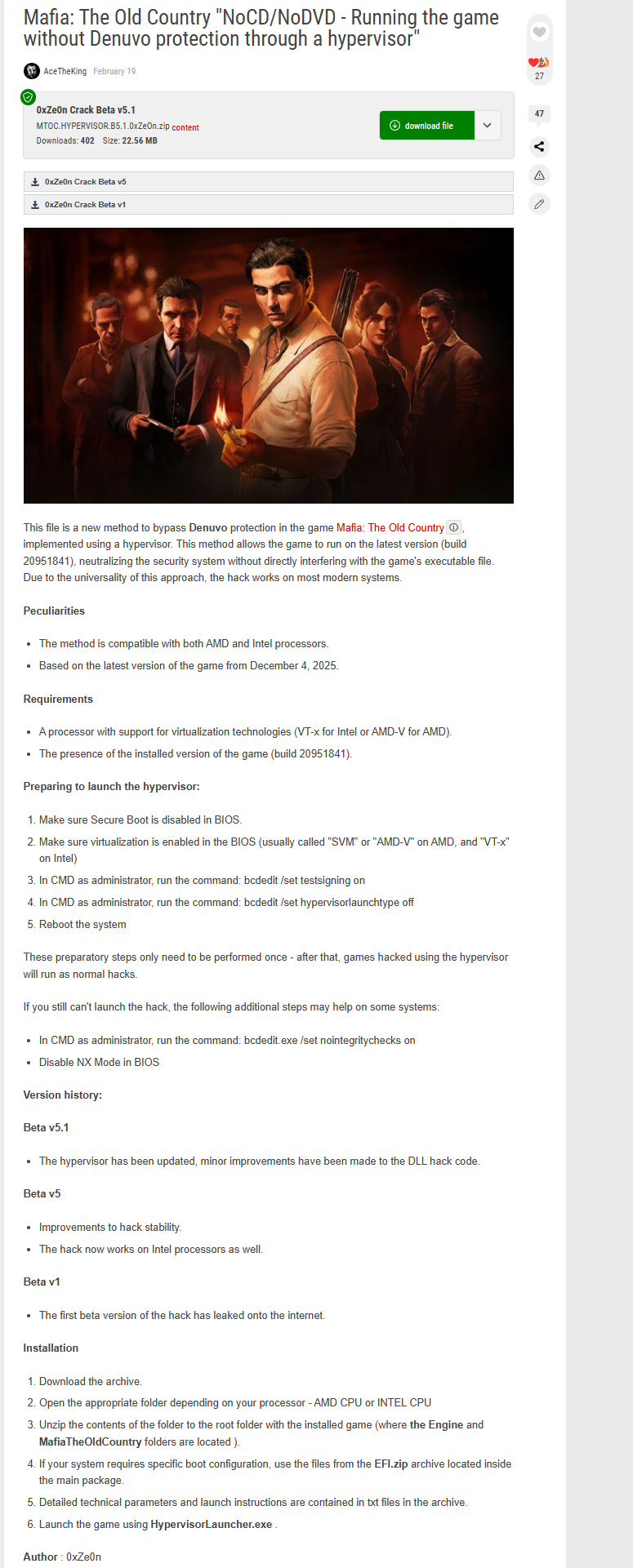
🔗 The Hypervisor Attack Surface — Why It's Different From Normal Piracy
Regular pirated games have always carried malware risks — miners, trojans, and ransomware have been found in pirated releases for years. But hypervisor cracks are a fundamentally different threat level:
| Normal Piracy Risk | Hypervisor Risk |
|---|---|
| Malware runs as a regular program | Malware runs below the operating system |
| Antivirus can detect it | Antivirus literally cannot see it — it operates on a lower level |
| Removing it = uninstall or scan | Removing it may require BIOS reflash or full hardware replacement |
| Damage limited to user-level access | Damage extends to full hardware control — CPU, memory, registers |
| Windows security is still active | Windows security is manually disabled by the user as a prerequisite |
This is what security researchers mean when they say hypervisor cracks are an “attractive attack vector.” The user does all the hard work for the attacker — disabling every protection, granting kernel-level access, running unsigned code — all voluntarily.
💰 The Math — Is a Free Game Worth It?
| What You Risk | Estimated Cost |
|---|---|
| New PC (if firmware/BIOS infected) | €800–2,000+ |
| RAM replacement (prices spiking in 2026 due to AI demand) | €100–400+ |
| Identity theft recovery (if keylogger captures banking credentials) | €500–10,000+ in damages |
| Data loss (if ransomware encrypts your files) | Priceless — photos, documents, projects |
| Time (reinstalling Windows, recovering accounts, cleaning up) | Hours to days |
| The game itself (bought legitimately) | €40–70 |
The game costs less than one component you might have to replace.
 Quick Hits
| Want | Do |
|---|---|
 Play safely Play safely |
Wait for a clean crack (voices38-style) or buy the game |
| Already used a hypervisor crack |
Re-enable Secure Boot, VBS, HVCI, Core Isolation. Disable test signing. Run full security scan. Consider clean Windows install |
 Verify a release is real Verify a release is real |
Check r/CrackWatch for confirmed releases from known names only |
 Can’t afford the game Can’t afford the game |
Wait for sales — most Denuvo-protected games drop 40–60% within 3–6 months |
A free game isn’t free if it costs you your PC, your data, or your identity. Know the risk before you click.

 !
!