currently i am pursuing bca from a tier 3 college i have no future ig i am so confused i dont know which skill i should focus on i will be in the 2nd year i only learned c++ in the 1st year , everyone is doing internship and i dont have any skill and a underrated platform to find internship , and i also need a roadmap to crack big jobs i need help to find this all which skill should i focus on , where i can find the internship faster and a roadmap to crack companies please help i am so confused, i am from india
you should mention your country too brother because every country has its own requirements and environment, that will help those who want to give you advice
An India new bieeee
Bro start to focus on programming language and became a full stack developer so as much project you can do and prepare for lite code interview questions and also make sure to learn communication well
I made this mistake u do not make thinking after degree job will be in hand
No job competition is high
yeah sorry , i edited the message
Focus on Java( it has more jobs than c++ ) and start learning Data Structures and Algorithms. Then, learn frontend and database . Finally, begin applying to companies through job portals like Wellfound and try cold emailing or sending a personal message on LinkedIn.

 BCA FROM A TIER-3 COLLEGE? YOU ARE NOT BEHIND — HERE’S YOUR ROADMAP TO INTERNSHIPS & BIG TECH JOBS


You are entering 2nd year with C++ basics, no internship, and a lot of confusion — but you are NOT finished. Your college tier does not decide your career; your skills, projects, consistency, and applications over the next 2 years do. Here is a focused roadmap for an Indian BCA student to become internship-ready and placement-ready.

 FIRST — STOP PANICKING
YOUR CURRENT SITUATION:
──────────────────────────────────────────────
✅ You are in BCA
✅ You know C++ basics already
✅ You are about to enter 2nd year
✅ You still have roughly 2 YEARS to prepare

THIS IS NOT "TOO LATE."

MOST STUDENTS MAKE THIS MISTAKE:
  → Learn C++, Python, Java, AI, web dev,
    cybersecurity, cloud, DSA — ALL at once
  → Build nothing properly
  → Get overwhelmed
  → Quit halfway

YOUR ADVANTAGE:
  → You are asking for a roadmap NOW
  → You can focus on one clear path
  → A strong portfolio can reduce the impact
    of coming from a Tier-3 college
THE BEST PATH FOR YOU
RECOMMENDED TRACK:
──────────────────────────────────────────────
DSA IN C++ + FULL-STACK WEB DEVELOPMENT

WHY THIS COMBINATION?
  → C++ is already your foundation
  → DSA is essential for coding rounds
  → Web development helps you build projects
    quickly for internships
  → Projects give you a GitHub portfolio
  → This path works for startups, service
    companies, and product-company roles

DO NOT FOCUS ON EVERYTHING YET.

YOUR FOCUS FOR THE NEXT 6 MONTHS:
  ① DSA using C++
  ② HTML + CSS + JavaScript
  ③ Git + GitHub
  ④ SQL + DBMS basics
  ⑤ 2–3 small working projects
BCA graduates can target software development, cloud, data, and related roles, but starting with programming, web development, databases, and communication skills is a practical foundation for entry-level opportunities. [1][2]
SKILLS ROADMAP
 PHASE 1 — NEXT 3 MONTHS
FOCUS: BUILD THE FOUNDATION

DSA WITH C++:
  → Arrays
  → Strings
  → Recursion
  → Linked Lists
  → Stacks and Queues
  → Sorting and Searching
  → Basic Time Complexity

PLATFORMS:
  → LeetCode
  → HackerRank
  → CodeChef

WEB BASICS:
  → HTML
  → CSS
  → JavaScript
  → Responsive design

TOOLS:
  → Git
  → GitHub
  → VS Code
  → SQL basics

DAILY ROUTINE:
  → 1–2 hours DSA
  → 1–2 hours web development
  → 30 minutes revision / GitHub upload
 PHASE 2 — MONTHS 4 TO 6
FOCUS: BUILD PROJECTS

LEARN:
  → Advanced JavaScript
  → React
  → Node.js + Express
  → MongoDB OR MySQL
  → REST APIs
  → Authentication basics

BUILD THESE PROJECTS:
  ① Student task manager
  ② Expense tracker
  ③ Notes app with login
  ④ College event management app
  ⑤ Job or internship tracker

RULE:
  → Do not copy projects blindly
  → Build, break, fix, and understand them
  → Upload source code to GitHub
  → Deploy each project using Vercel,
    Netlify, or Render
GitHub, SQL/database fundamentals, and visible practical projects are useful alongside coding practice because employers evaluate practical capability beyond a degree alone. [3][4]
 PHASE 3 — MONTHS 7 TO 12
FOCUS: INTERNSHIP-READY PROFILE

YOU SHOULD HAVE:
  ✅ 150–250 DSA problems solved
  ✅ 3 deployed projects
  ✅ Active GitHub profile
  ✅ One-page resume
  ✅ LinkedIn profile
  ✅ Basic CS subjects prepared:
     → OOPs
     → DBMS
     → OS
     → Computer Networks
     → SQL

START APPLYING NOW:
  → Don't wait to become "perfect"
  → Apply while learning
  → Rejections are part of the process
 WHAT TO LEARN — IN ORDER
YOUR EXACT LEARNING ORDER:
──────────────────────────────────────────────

MONTH 1:
  C++ revision + Arrays + HTML/CSS + Git

MONTH 2:
  Strings + Recursion + JavaScript basics

MONTH 3:
  Linked Lists + Stack/Queue + DOM projects

MONTH 4:
  Sorting + Searching + React basics

MONTH 5:
  React projects + SQL + DBMS

MONTH 6:
  Node.js + Express + MongoDB/MySQL

MONTH 7:
  Full-stack project + resume + LinkedIn

MONTH 8 ONWARD:
  Internship applications + DSA revision +
  interview preparation
 WHERE TO FIND INTERNSHIPS
MAIN PLATFORMS
 PLATFORM |
BEST FOR |
 HOW TO USE IT |
|---|---|---|
| Internshala | High-volume internships | Apply daily, filter by “work from home” and “software development” |
| LinkedIn Jobs | Startups and company posts | Follow recruiters, founders, and software companies |
| Wellfound | Startup roles | Create a complete profile and apply directly |
| Naukri / Apna | Entry-level roles | Search “software intern,” “frontend intern,” and “trainee developer” |
| Company career pages | Less crowded applications | Apply directly to company websites |
| Greenhouse / Lever boards | Startup openings | Search Google for “software intern greenhouse India” |
Internshala, LinkedIn, Wellfound, company career pages, and applicant-tracking boards such as Greenhouse, Lever, and Workday are commonly used channels for Indian internship and entry-level applications. [5][6]
 UNDERUSED METHODS THAT WORK
METHOD 1 — LINKEDIN COLD MESSAGE:
  → Find startup founders / engineering managers
  → Send a SHORT message:

  "Hi [Name], I am a BCA student building
  full-stack projects in React and Node.js.
  I liked [company/project]. I would love to
  contribute as an intern. Here is my GitHub:
  [link]. Thank you."

  → Send 5–10 personalised messages daily
  → Do NOT copy-paste a huge paragraph

METHOD 2 — APPLY TO SMALL STARTUPS:
  → Small companies care more about your skills
    than your college tier
  → Search on LinkedIn:
    "Hiring frontend intern India"
    "Hiring React intern remote"
    "Hiring software developer intern"

METHOD 3 — HACKATHONS:
  → Join college hackathons and online hackathons
  → Build projects in teams
  → Network with mentors and recruiters
  → Add real proof to your resume

METHOD 4 — OPEN SOURCE:
  → Start with documentation fixes
  → Then solve beginner issues
  → A few genuine contributions can make your
    GitHub stronger than 10 copied projects
 ROADMAP FOR BIG COMPANIES
TO CRACK PRODUCT-BASED COMPANIES:

YOU NEED 4 PILLARS:
──────────────────────────────────────────────

① DSA:
  → 300–500 quality problems over 1–2 years
  → Arrays, strings, trees, graphs, DP
  → Focus on understanding patterns, not numbers

② CORE CS:
  → OOPs
  → DBMS
  → OS
  → Computer Networks
  → SQL

③ PROJECTS:
  → 2–3 strong projects
  → One should be full-stack
  → Explain every feature confidently
  → Know your database, APIs, architecture,
    bugs, and improvements

④ COMMUNICATION:
  → Explain your approach before coding
  → Practice introductions
  → Practice project explanations
  → Do mock interviews
A BCA-to-SDE path requires both technical depth and demonstrable projects; larger companies generally evaluate coding ability, computer-science fundamentals, projects, and communication rather than degree title alone. [7][2]
 WHICH PATH TO CHOOSE?
| PATH | BEST IF YOU ENJOY | START WITH | INTERNSHIP SPEED |
|---|---|---|---|
| Full-stack web development | Building websites and apps | HTML, CSS, JavaScript, React |  |
| Backend development | Logic, APIs, databases | Java/Python, SQL, Node.js | |
| Data analytics | Numbers, dashboards, insights | Excel, SQL, Python, Power BI | |
| Cybersecurity | Networks and security testing | Linux, networking, Python | |
| AI/ML | Math, data, models | Python, statistics, ML | |
FOR YOU RIGHT NOW:
  → Pick FULL-STACK WEB DEVELOPMENT
  → Keep DSA in C++ alongside it
  → Do not jump into AI/ML just because
    everyone online is talking about it

WHY?
  → Fastest route to visible projects
  → More beginner internship opportunities
  → Your C++ remains useful for coding rounds
 YOUR WEEKLY PLAN
MONDAY–FRIDAY:
  → 2 DSA questions in C++
  → 1–2 hours web development
  → Push code to GitHub

SATURDAY:
  → Build/improve your project
  → Apply to 10–15 internships
  → Improve LinkedIn and resume

SUNDAY:
  → Revise DSA concepts
  → Learn CS fundamentals
  → Plan next week's goals
  → Rest for a few hours too ✅

MONTHLY TARGET:
  → 30–40 DSA problems
  → 1 project improvement or mini-project
  → 80–150 quality internship applications
  → 5–10 personalised LinkedIn messages
 MISTAKES TO AVOID
❌ Buying expensive “guaranteed placement” courses
❌ Learning 5 programming languages at once
❌ Collecting certificates without projects
❌ Copying YouTube projects without understanding
❌ Waiting until final year to apply for internships
❌ Comparing your beginning to someone else's
   LinkedIn highlight reel
❌ Thinking Tier-3 college means you cannot win

DO THIS INSTEAD:
  ✅ Learn one stack deeply
  ✅ Solve DSA consistently
  ✅ Build publicly on GitHub
  ✅ Apply even when you feel underprepared
  ✅ Improve after every rejection
PRO TIPS
- Your first internship does not need to be famous — a small startup, local company, NGO tech role, or open-source contribution can unlock your next opportunity.
- Use C++ for DSA and JavaScript for web development — do not force yourself to use one language for every task.
- Your GitHub profile is your proof — aim for clean READMEs, screenshots, live demo links, and steady commits.
 Keep your resume one page — skills, projects, education, achievements; avoid filling it with irrelevant certificates.
- Apply before feeling ready — internships are designed for learners, not experts.
 Find 2–3 serious classmates — study together, do mock interviews, share opportunities, and build hackathon projects.
You do not need to be the best student in your college. You need to be more consistent than the average student for the next 18–24 months. Start with DSA in C++, full-stack web development, GitHub projects, and daily internship applications — that combination can completely change your opportunities before graduation.
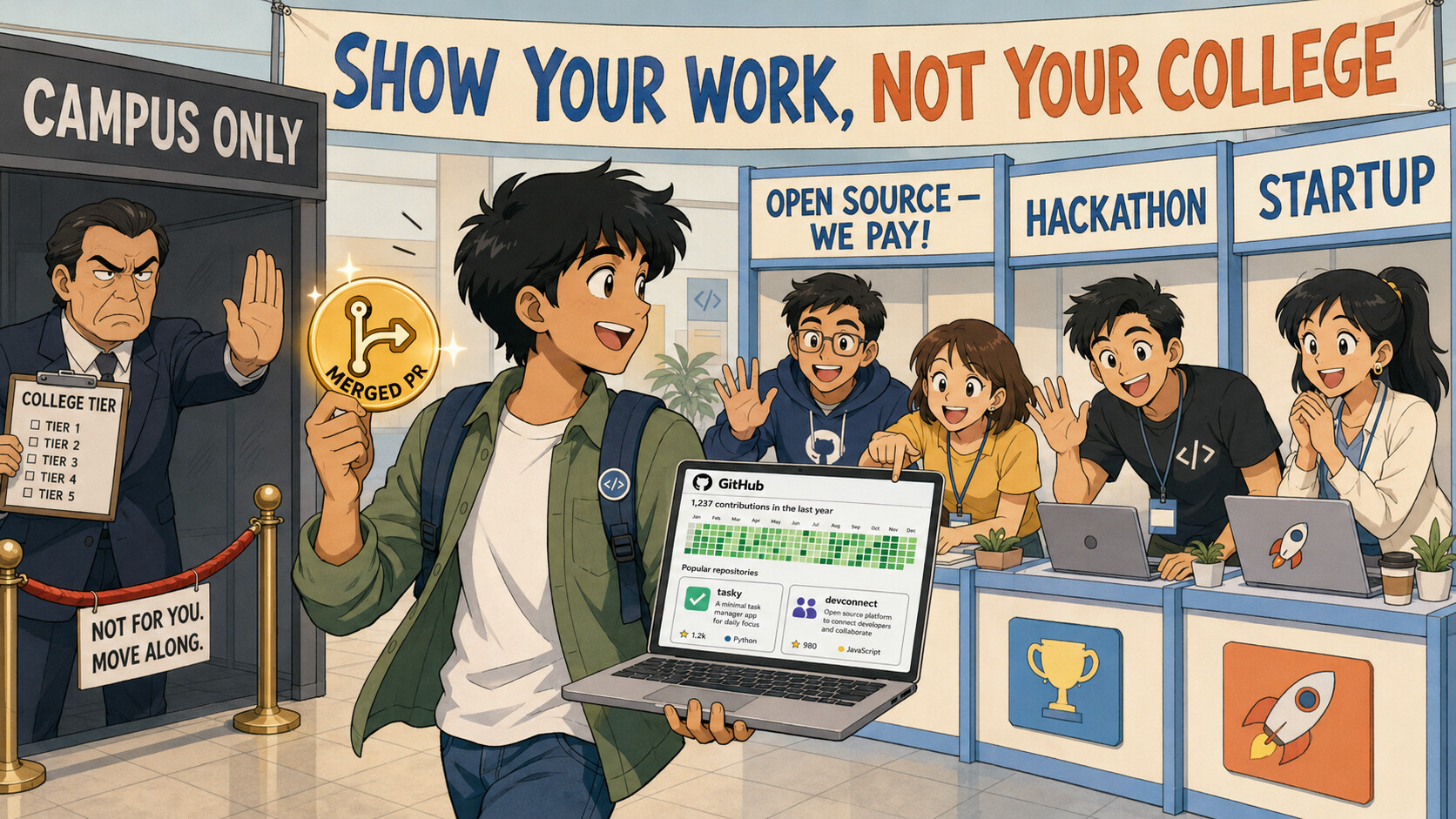
Great roadmap above  — here’s the missing half: the free tools + the doors that don’t check your college.
tier-3 ▸▸  wrong door ┊
 right door ▸▸

 A tier-3 tag only blocks ONE door: campus placement + resume-screened-by-college-name.
 Every other door judges your PROOF, not your college — and some literally pay you.
Real tier-3 kids crack GSoC & land jobs off-campus every year. It’s a route, not luck.
💰 Doors that PAY you and never ask your college (open-source stipends)
These select you on your contributions, full stop. A merged PR beats a tier-1 name tag. This is the biggest lever the roadmap above barely touched.
▸  GSoC (Google, paid) → https://summerofcode.withgoogle.com/
▸  Outreachy (paid, remote) → https://www.outreachy.org/
▸  LFX Mentorship (Linux Foundation, paid) → https://mentorship.lfx.linuxfoundation.org/
▸  MLH Fellowship → https://fellowship.mlh.io/
▸ C4GT — Code for GovTech India → https://www.codeforgovtech.in/
🧾 Proof it works — tier-3 students who cracked GSoC (read these)
Stop believing the tier caps you. These are real write-ups from tier-3 / MCA students who got in.
▸  Tier-3 college → GSoC success → https://mentorcruise.com/blog/cracking-google-summer-of-code-my-journey-from-a-tier-3-college-to-open-source-success/
▸ Tier-3 MCA student → GSoC 2026 → https://dev.to/tarunsinghofficial/how-i-got-into-google-summer-of-code-gsoc-2026-as-a-tier-3-mca-student-4017
🥇 Free structured DSA — a fixed path, not random LeetCode grinding
The roadmap said “do DSA.” Here’s the exact free sheet Indian students actually use — topic by topic, in order.
▸ Striver A2Z DSA Sheet (takeUforward) → https://takeuforward.org/strivers-a2z-dsa-course/strivers-a2z-dsa-course-sheet-2
▸  Striver SDE Sheet (interview-focused) → https://takeuforward.org/interviews/strivers-sde-sheet-top-coding-interview-problems/
▸ NeetCode roadmap + Blind 75 → https://neetcode.io/roadmap
▸  LeetCode patterns (solve by type) → https://seanprashad.com/leetcode-patterns/
🌐 Free full-stack — the real courses (skip the paid 'placement' scams)
The roadmap warned against paid “guaranteed placement” courses — good. These free ones are better than most paid ones.
▸ The Odin Project (full-stack, project-based) → https://www.theodinproject.com/
▸ Full Stack Open (Univ. of Helsinki, React/Node) → https://fullstackopen.com/en/
▸ freeCodeCamp → https://www.freecodecamp.org/learn/
▸  roadmap.sh (frontend/backend path) → https://roadmap.sh/
🏆 Hackathons + first PR — college-blind proof you can start this week
Wins and merged PRs are pure artifacts. No one asks your college on a leaderboard.
▸ Unstop (hackathons + internships) → https://unstop.com/
▸ Devfolio (build hackathon projects) → https://devfolio.co/
▸  Social/KOSS Winter of Code (India) → https://kwoc.kossiitkgp.org/
▸  good-first-issue (your first PR) → https://goodfirstissue.dev/
▸  first-contributions (practice a PR safely) → https://github.com/firstcontributions/first-contributions
📄 A resume that survives the robot filter + a portfolio that deletes the tier
Big-company forms use ATS (a robot that scans resumes). Beat it with a clean one-pager, then let a live GitHub portfolio do the talking.
▸  Free ATS resume checker → https://www.jobscan.co/
▸  Reactive Resume (free, open-source builder) → https://github.com/AmruthPillai/Reactive-Resume
▸ Free deploy your projects → https://render.com/
▸  Portfolio that gets you hired → https://github.com/RyanFitzgerald/devportfolio
✉️ The cold-DM that beats applying blind (real templates)
Small startups care about skills, not tier. One good DM with your GitHub beats 50 blind applications.
▸  Cold-DM founder templates → https://blog.peerlist.io/p/templates-for-cold-dm-to-founders-for-an-internship
▸ Wellfound (apply direct to startups) → https://wellfound.com/
▸  Remote no-whiteboard company list → https://github.com/poteto/hiring-without-whiteboards
💡 5 moves that make the tier stop mattering (do this, not just study)
- This week: merge ONE tiny PR (fix a typo in a doc) → you’re now an open-source contributor.
- Prep for GSoC/Outreachy → they pay you AND never look at your college. Biggest unlock.
 Enter one Unstop/Devfolio hackathon → a win on your resume outranks the college name.
- Deploy 2 projects on Render + pin them on GitHub → recruiters judge the proof, tier vanishes.
 DM 5 startup founders your GitHub link → skills-first shops don’t care where you studied.
The tier-3 tag guards one gate. Every gate worth walking through opens with a merged PR, not a college name.
 !