Gutted reading this — losing that much to a single tap is a gut-punch, and the panic is normal. Breathe. Here’s the truth, and every move that still matters. 
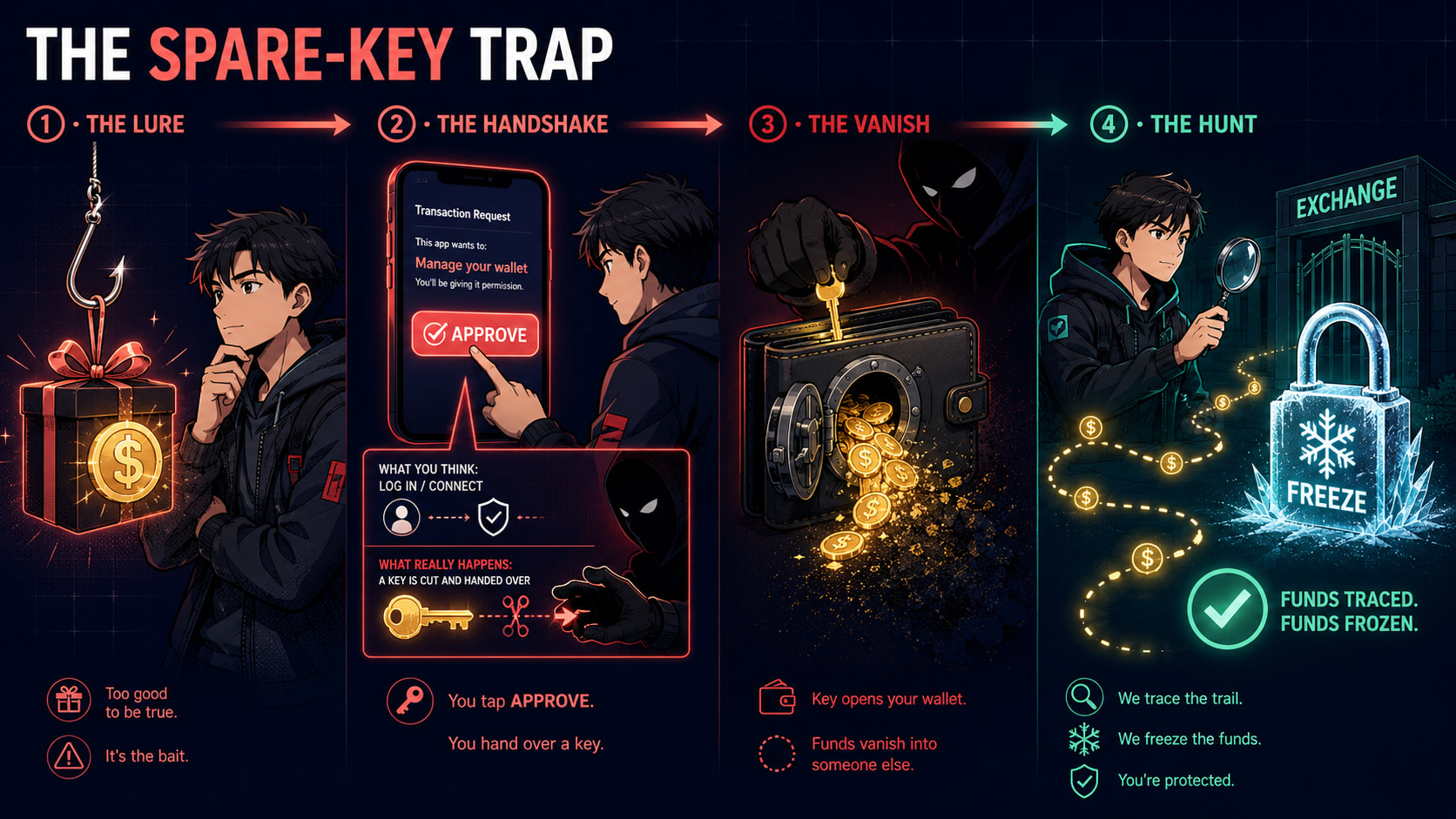
You weren’t hacked. No keylogger, no cracked password, nothing brute-forced. You signed an approval — a “let this app move my tokens” permission dressed up as a normal login popup. That one signature is the whole heist. The good news: on-chain theft leaves a permanent trail, and there are real, time-sensitive plays to trace it, freeze it, and lock down what’s left. All packed below — tap each to open.
🪤 What that 'claim' tap actually did
- Fake Binance-style page, “$500 airdrop” bait — aimed at fat wallets on purpose.
- The claim button threw a signature prompt (that “approve?” screen). Felt like a login.
- It wasn’t. It was
setApprovalForAll or a Permit — code that means “this contract can spend my tokens whenever it wants.” No password needed.
- You tapped yes → an automated drainer (an auto-sweep script) called that permission and moved everything in one block.
- Nothing was cracked. The invite was the exploit. That’s why it fools sharp people every single day.
⏱️ First hour — the moves that actually matter (do these NOW)
- Stop feeding the dead wallet. It’s compromised for good — don’t send it a cent, not even gas to “rescue” funds (a sweeper bot grabs that too).
- Move the survivors first. Anything still sitting there → push it to a brand-new wallet on a clean device before anything else.
- Emergency channel: SEAL 911 — a real whitehat first-responder hotline (run by the Security Alliance). Built for live exploits; triage is fast and free.
- Grab your evidence: open BscScan, paste your address, copy the drain transaction hash (the receipt ID for the theft) + the thief’s receiving address. That’s your entire case file.
- Log the crime (you’ll need this for any freeze): flag the thief on Chainabuse and file with your country’s cyber-police (channels two sections down).
🕵️ Hunt the money — the forensics layer nobody tells you about
Stolen crypto is traceable. This is the rare part almost every reply skips:
- MetaSleuth → SlowMist’s visual money-flow tracer. Paste the thief’s address, watch the hops light up. Free tier. Start here.
- MistTrack → same team; address risk-scoring + labels that tell you if funds already hit a known exchange.
- Arkham → on-chain intel with entity labels — often names the exact exchange deposit the thief cashed into.
- Breadcrumbs → free trail-mapper for building a shareable flow chart to hand to an exchange or the police.
- Terms you’ll hit: peel chain (thief drips funds across many hops), bridge hop (jumps chains BSC→ETH→TRON to break the trail), mixer (a scrambler — the trail often dies here), CEX off-ramp (the exchange cash-out point = your one freeze window).
- Reality check: famous public investigators exist but rarely take small individual cases for free. The tracers above are what you can run tonight, yourself.
❄️ Get it frozen — the levers that actually lock funds
- If it hit an exchange (Binance / OKX / Bybit): email their compliance/fraud team the tx hashes + thief address immediately. They can freeze proven-stolen funds — but only before it’s withdrawn. Speed is the whole game.
- If it’s now USDT or USDC: the issuer can freeze those tokens on-chain. This runs through law enforcement, so your police report + tx hashes reaching Tether (USDT) or Circle (USDC) is what triggers it. Rare-known, and frozen stablecoins have been returned to victims before.
- What any of them need: the tx hash(es), the thief’s address, a timeline, and usually an official police report or case number before they release anything.
🌍 Report it — cyber-crime channels by country
Anywhere else: search “[your country] report cyber crime.” That case number is the key that unlocks exchange and issuer freezes.
🔒 Never sign blind again — the defensive toolchain
| Tool |
What it does |
| Revoke.cash |
see + cancel every approval you’ve ever granted, any chain. Run it monthly. |
| Rabby |
wallet that simulates every tx and says “this grants unlimited spend” in plain English |
| Pocket Universe |
extension that previews any signature + flags known drainers before you tap |
| Scam Sniffer |
real-time phishing + drainer detection while you browse |
| Blockaid / Blowfish |
the security engines behind MetaMask & Phantom warnings — leave them on |
| Clear Signing (ERC-7730) |
2026 standard turning code-walls into “X is taking Y” — enable it when your wallet offers it |
Golden habit: split your stack — a small hot wallet for aping into random stuff, a cold wallet (Ledger/Trezor) that never signs a popup it didn’t start.
🚩 Recognize the trap — the exact signatures drainers abuse
| The ask |
What it really grants |
setApprovalForAll |
one sig = every NFT of a collection, gone |
approve / increaseAllowance (unlimited) |
a contract can spend your tokens with no cap |
Permit (EIP-2612) |
gasless “you may spend my tokens” — no on-chain click |
Permit2 |
batch version — many tokens grabbed in one signature |
eth_sign / blind signing |
signing raw code you can’t read — the #1 trick |
| address poisoning |
a lookalike address slipped into your history so you copy the wrong one |
See any of these on a “claim / validate / sync” prompt you didn’t fully start yourself? Reject it.
🎣 The second wolf — the 'I'll get your funds back' scam
- The moment your loss is public, DMs swarm: “certified recovery expert,” “blockchain forensics team,” “I recovered mine, msg this guy.”
- Every one is the scam’s sequel. They take an upfront fee or make you sign another approval → you lose twice.
- Rules that never break: no legit service charges upfront to recover crypto. Nobody DMs a stranger to help for free. A “sync your new wallet” request is just another
Permit grab. Block on sight.
💡 Where reading a signature quietly saves you (for everyone scrolling)
- “Claim your free airdrop
 ” popup → you spot the approval grab and close the tab, not the wallet.
- Minting a hyped NFT → Rabby’s preview flashes “this can move your whole wallet” → you bail before the sweep.
- “Validate / sync your wallet” support DM → that’s a
Permit, not a login → you don’t sign.
- Selling on a sketchy marketplace →
setApprovalForAll hands over every NFT of that type → you scope it or skip it.
- Months of DeFi clicking = forgotten approvals piling up → one monthly Revoke.cash sweep wipes the whole attack surface.
🧰 Copy-paste search seeds (dig deeper, any language)
setApprovalForAll · Permit2 phishing · eth_sign blind signing · unlimited approval revoke · wallet drainer detection · address poisoning defense · MetaSleuth trace stolen funds · MistTrack address risk · Arkham entity label · CEX freeze stolen funds request · Tether USDT freeze request · Chainabuse report · crypto recovery scam red flags · hot cold wallet split
Runs ahead in other languages — Russian отзыв разрешений кошелёк, Chinese 钱包授权 撤销 盗币. Approval-hygiene culture is often months early there.
The whole game is one habit: a signature isn’t a login, it’s a permission slip. Read it, and a drainer has nothing to grab. Trace tonight, file the report, lock the new wallet down tight.
They never steal your keys — they wait for your “yes.” The exploit was always your signature, never their code.
 US
US UK
UK India
India Canada
 Australia
 EU
EU Germany
 !
!