 How One Family Took Control of Islam — The Money, The Books, The History They Erased
How One Family Took Control of Islam — The Money, The Books, The History They ErasedThey didn’t rewrite the Quran. They rewrote who gets to explain it, who profits from it, and what happens to anyone who disagrees.

In 1744, a struggling warlord and a rejected preacher shook hands. “You handle the army, I’ll handle God.” That handshake built Saudi Arabia. 280 years later, it still controls how 2 billion people practice their faith — which version of the Quran they read, how much they pay to visit Mecca, and which thousand years of Islamic thought they’re never taught existed.
None of this requires a conspiracy theory. It’s documented in academic journals, Saudi government records, and the words of Saudi leaders themselves. The numbers are real. The history is worse — because it’s a history of what was deliberately erased.
📖 Quick Glossary — Every Term Explained (Read This First If You're Not Muslim)
This post uses Islamic terms that might be unfamiliar. Here’s everything you need — plain English, no jargon.
| Term | Plain English Meaning |
|---|---|
| Quran | Islam’s holy book — believed by Muslims to be the direct word of God, revealed to Prophet Muhammad |
| Hajj | The annual pilgrimage to Mecca (Saudi Arabia) — required once in a lifetime for Muslims who can afford it |
| Umrah | A smaller, voluntary pilgrimage to Mecca — can be done any time of year |
| Kaaba | The black cube-shaped building in Mecca — Islam’s holiest site. Muslims worldwide face it during prayer. |
| Ijtihad | Independent reasoning — using logic and scholarship to interpret Islamic law for new situations. Think of it as “thinking for yourself using the source material.” |
| Taqlid | The opposite of ijtihad — following an established authority’s interpretation instead of reasoning independently. Like following legal precedent instead of arguing from scratch. |
| Fatwa | A formal religious ruling or opinion issued by a qualified scholar — not legally binding in most contexts, but socially powerful |
| Wahhabi / Wahhabism | A strict, ultra-conservative interpretation of Islam founded by Muhammad ibn Abd al-Wahhab (1703–1792). It’s the version Saudi Arabia promotes worldwide. |
| Salafi | A broader movement (overlapping heavily with Wahhabism) that claims to follow Islam exactly as practiced by the earliest Muslims. Rejects centuries of later scholarship. |
| Shia / Sunni | Islam’s two major branches. ~85% of Muslims are Sunni, ~15% Shia. The split originated in a 7th-century disagreement over who should lead after Prophet Muhammad. |
| Madhhab | A school of Islamic law — like different legal traditions within the same religion. There are four surviving Sunni schools (Hanafi, Maliki, Shafi’i, Hanbali). |
| Ulama | Islamic scholars — the clerical class. Literally “those who know.” |
| Mujtahid | A scholar qualified to perform ijtihad (independent reasoning). The Islamic equivalent of a judge who can set new legal precedent. |
| Shirk | The sin of idolatry or associating partners with God — Wahhabism uses this accusation very broadly to condemn practices other Muslims consider normal |
| Takfir | Declaring another Muslim a non-believer (excommunication). Extremely serious — historically used to justify violence. |
| Sufi / Sufism | Islam’s mystical tradition — focused on the inner, spiritual dimensions of faith. Involves music, poetry, meditation, and direct experience of God. Wahhabism considers most Sufi practices heretical. |
| Mu’tazila | Islam’s rationalist theological school (8th–10th century) — argued that human reason could independently determine right and wrong, and that the Quran was created (not eternal). Suppressed and now labeled heretical by conservative currents. |
| DRM-free faith | Not a real term — but useful analogy. GOG games have no DRM. The Quran’s text has no “DRM” (no one altered it). But the “launcher” (the translation, footnotes, and curriculum) controls how you experience it. |
🤝 The 1744 Deal — How a Handshake Built a Country
In a town called Diriyah, a tribal leader named Muhammad ibn Saud sheltered a preacher named Muhammad ibn Abd al-Wahhab. This preacher had been expelled from multiple towns for a specific practice: takfir — declaring other Muslims rule-breakers. He was too extreme for his neighbors. But Ibn Saud saw an opportunity.
The deal: Ibn Saud handles politics and war. Ibn Abd al-Wahhab handles religion and society. Two lanes, one machine.
That arrangement hasn’t stopped since. The preacher’s descendants — the Al ash-Sheikh family — have been Saudi Arabia’s top clerics for nearly 300 years. The Sauds run everything else. Historian Madawi Al-Rasheed documented that the pact gave the Sauds “a clearly defined religious mission” — the one thing their tribal rivals couldn’t match.
Every crisis renegotiates the deal. None has killed it:
| Crisis | What Happened | How the Deal Adapted |
|---|---|---|
| 1979 — Grand Mosque seizure | Armed militants stormed Islam’s holiest site, accusing the royals of corruption | Royals crushed the rebels — then quietly implemented their demands. Religious police got massive funding. Cinemas closed for 35 years. |
| 1990 — Gulf War | Saudi-nurtured Islamist intellectuals turned against the monarchy for inviting US troops | The state arrested them, dismantled their networks, reclaimed religious authority |
| 2017 — MBS era | Crown Prince Mohammed bin Salman announced “moderate Islam” | Religious police lost arrest powers. Women could drive. But scholars who criticized Wahhabism independently were detained too |
The Baker Institute’s conclusion: “Where MBS has truncated the power of the religious establishment, it is to consolidate power into the central state.”
The most revealing move: In 2022, MBS created “Founding Day” commemorating 1727 — deliberately predating the 1744 religious pact. New textbooks don’t mention Muhammad ibn Abd al-Wahhab. The message: the Sauds came first. Religion was always the tool, never the master.
🧠 The 1,000-Year Cover-Up — Islam Had a Golden Age of Free Thinking (And It Was Deliberately Buried)
Here’s what most people — including most Muslims educated in Saudi-influenced curricula — don’t know: Islam once had one of the most intellectually diverse civilizations in human history. Before anyone claimed the “gates” of independent thinking closed, the Islamic world hosted a staggering range of competing ideas.
Think of it this way: Imagine if Christianity was taught as if only one denomination ever existed — and students were told that Catholics, Orthodox Christians, Quakers, and Lutherans were all rule-breakers. That’s roughly what happened to Islamic intellectual history.
The Rationalists (Mu’tazila) — 8th to 10th Century
Islam’s first systematic rationalist school argued something radical: good and evil are rational categories that human beings can figure out independently, without needing a sacred text to tell them. They also claimed the Quran was created (brought into being at a specific moment) rather than eternal.
Why does that matter? Because:
- If the Quran is created → it can be interpreted in context, understood relative to its time, and reinterpreted for new situations
- If the Quran is eternal and uncreated → it’s a fixed, timeless decree that resists reinterpretation
This wasn’t abstract theology — it was a fight over who gets to think. The “created” view meant trained rational thinkers and the caliphs who supported them held authority. The “uncreated” view shifted power to scholars who transmitted texts without adding rational analysis.
The rationalists lost. In 833 CE, Caliph al-Ma’mun tried to force the “created” position as orthodoxy (the Mihna — Islam’s Inquisition). The most famous resister, Ahmad ibn Hanbal, was flogged until unconscious for refusing. When the policy was reversed around 848 CE, the consequences were permanent: the text-literalist school gained the momentum that eventually carried it into Saudi state power.
The Philosophers
| Thinker | Lived | What They Did | What Happened |
|---|---|---|---|
| Al-Kindi | d. ~873 | “Philosopher of the Arabs” — built Arabic philosophical vocabulary at the House of Wisdom | Legacy marginalized |
| Al-Farabi | d. ~950 | “The Second Teacher” (after Aristotle) — argued philosophy accesses truth directly, while religion provides a “likeness” of truth | Ideas preserved in limited circles |
| Ibn Sina (Avicenna) | d. 1037 | Wrote a medical encyclopedia used in Europe until the 1600s + a philosophical system | Labeled heretical by conservative scholars |
| Ibn Rushd (Averroes) | d. 1198 | Most extensive Aristotle commentaries anywhere. His ideas on separating philosophy from religion influenced Western secularism | Found no institutional home in the Islamic world after his death. His philosophy “found a refuge with the Jews” — transmitted to Europe through Maimonides |
The Scientists
Al-Khwarizmi gave us “algebra” and “algorithm.” Ibn al-Haytham founded modern optics and the experimental method. Al-Razi distinguished smallpox from measles. Caliph al-Ma’mun funded translation work at a rate equivalent to twice the UK Medical Research Council’s annual budget. Translators at the House of Wisdom earned salaries comparable to professional athletes.
The Legal Diversity
The four surviving Sunni legal schools are survivors of a much larger population. At one point, Basra alone hosted six independent schools coexisting. The Zahiri school rejected analogy entirely. The Jariri school’s founder (al-Tabari, the great historian) refused to recognize the Hanbali school as legitimate — and Hanbalis stoned his home in response. The Awza’i, Thawri, and Laythi schools each represented independent traditions. All gone or absorbed.
In Saudi-funded curricula worldwide, Ibn Sina, Ibn Rushd, al-Farabi, and the Mu’tazila are presented not as heroes of Islamic civilization — but as rule-breakers and troublemakers.
🔓 The Gates Were Never Closed — One Scholar Proved It in 1984
One of the most important ideas in Islamic history is ijtihad — independent reasoning. The ability to look at the Quran and other sources and derive new conclusions for new situations. Think of it as a judge writing new case law instead of only following old precedents.
The popular story says: Around the 10th century, the “gates of ijtihad” were formally closed. No more independent thinking. Everyone must follow established authorities (taqlid). Case closed.
The reality: In 1984, scholar Wael Hallaq published one of the most cited papers in Islamic legal studies — “Was the Gate of Ijtihad Closed?” — and proved definitively: no. The gates were never formally closed. His evidence:
| Evidence | What It Showed |
|---|---|
| The phrase didn’t exist | No scholar before the late 11th century ever used the phrase “closing the gates of ijtihad” — the terminology was invented ~200 years after the supposed event |
| Classical law required it | The foundational legal literature treated ijtihad as a religious obligation — something scholars must do, not something they’re banned from doing |
| Anti-ijtihad groups were expelled | Groups that actually rejected ijtihad (Zahiris, Hashwiyya) were kicked out of Sunni orthodoxy — proving mainstream Sunnism required it |
| Practicing scholars in every century | Hallaq documented independent-thinking scholars in every single century — an unbroken chain |
So what actually happened? The key is a terminological trick. Classical scholars distinguished between two types of ijtihad:
- Ijtihad mutlaq = founding an entirely new legal school from scratch (everyone agreed this had stopped)
- Ijtihad fi’l-madhhab = independent reasoning within an existing school (almost nobody said this should stop)
Different scholars used the same terms differently. The “closure” narrative exploited this confusion — collapsing “we don’t need new schools” into “nobody should think independently.” As Harvard’s Frank Vogel explained, the closure was the ulama’s strategic move — it prevented random judges from issuing wild rulings (protecting the system from chaos) while keeping elite scholars’ own freedom to innovate intact.
The result: A clergy that positioned itself as the only legitimate bridge between God and ordinary Muslims. If only trained scholars can interpret divine law — and if ordinary people must simply follow (taqlid) — then the scholarly class controls access to God’s guidance itself.
🔄 The Wahhabi Paradox — 'Independent Thinking for Me, Obedience for You'
Here’s the contradiction at the heart of Saudi Islam:
Muhammad ibn Abd al-Wahhab built his entire movement on the claim to practice ijtihad — independent reasoning. His teacher explicitly encouraged him to “reject rigid imitation of medieval commentaries and develop individual research of scriptures.” He rejected established Hanbali legal manuals. He formed views “based on his direct understanding of scriptures.”
His own brother Sulayman wrote a treatise in 1754 accusing him of “undertaking independent legal reasoning without the necessary scholarly qualifications.”
And then his movement created one of the most rigid systems of religious conformity in history.
The paradox is quantifiable. A study documented 139 questions where the three most revered modern Salafi scholars — Ibn Baz, Ibn Uthaymeen, and al-Albani — reached contradicting conclusions despite all three claiming to follow “Quran and Sunnah directly.”
Example: Should you raise your index finger during a specific prayer position? Ibn Baz says no. Ibn Uthaymeen says yes. Al-Albani calls it an innovation. If the “go directly to the sources” method produces 139 disagreements among its greatest practitioners — what it really practices is following preferred authorities while refusing to admit that’s what it’s doing.
The Saudi state manages this through a perfect circle:
- Only “qualified scholars” may issue religious rulings
- The state decides who is “qualified”
- “Qualified” scholars consistently endorse state decisions
- Anyone who disagrees is declared unqualified (or arrested)
The Council of Senior Scholars — established by royal decree in 1971, members receive government salaries, no independent funding — has issued fatwas endorsing US troop deployment (1990), prohibiting public demonstrations during the Arab Spring (2011), opposing Qatar during the Saudi-led boycott, and reversing its position on women driving exactly when MBS decided to permit it.
A 2010 royal decree restricted fatwa-issuing to Council members only, with a “total ban on any topics involving strange or obsolete views.” The current Grand Mufti is a direct descendant of Muhammad ibn Abd al-Wahhab himself.
💀 The Thinkers Who Paid the Price for Thinking
The pattern of what happens to Muslim intellectuals who challenge this system is its own evidence:
| Thinker | What They Did | What Happened |
|---|---|---|
| Fazlur Rahman (1919–1988) | Developed a method for distinguishing the Quran’s specific legal provisions from its universal moral ideals | Exiled from Pakistan |
| Nasr Hamid Abu Zayd (1943–2010) | Applied literary analysis methods to the Quran | Declared an apostate by an Egyptian court, which forcibly divorced him from his wife. Spent his remaining years in exile in the Netherlands. |
| Mahmoud Muhammad Taha (executed 1985) | Proposed that earlier Meccan verses emphasizing equality should take precedence over later Medinan verses about governance | Executed by Sudan |
| Amina Wadud | Led mixed-gender Friday prayers | Received death threats and a “death watch” blog |
| Hassan Farhan al-Maliki | Saudi reformist who questioned hadith traditions | Arrested 2017. Prosecutors sought the death penalty for “casting doubt on prophetic traditions” and possessing banned books |
| Salman al-Ouda (14M Twitter followers) | Called for political reform | Faces the death penalty for “stirring public discord” |
| Raif Badawi | Ran a liberal blog | 10 years in prison + 1,000 lashes for “insulting Islam” |
The epistemological trick (how the system protects itself): Reason is celebrated when it leads someone toward Islam — dawah literature loves rational proofs for God’s existence, the Quran’s miraculousness, scientific foreknowledge. But the same reasoning is condemned when applied within Islam to established interpretations: “Who are you to interpret? Follow the scholars!”
The Quran itself uses the word for “to reason” (ya’qilun) approximately 49 times and references thinking about 68 times — often to critique non-Muslims’ blind following of ancestral tradition. Yet similar blind following within Islam receives institutional protection rather than scrutiny.
💰 The $12 Billion Hajj Machine — Who Pays, Who Profits
Hajj and Umrah generate ~$12 billion/year for Saudi Arabia — roughly 20% of non-oil GDP. Vision 2030 targets 30 million annual Umrah visitors, with projections hitting $350 billion by 2032.
Who builds it:
| Project | Cost | What It Is |
|---|---|---|
| Abraj Al-Bait complex | $15 billion | Built on the demolished site of an 18th-century Ottoman fortress. Fairmont, Raffles, Swissôtel hotels overlooking the Kaaba. 5-story mall. 4,000 shops. |
| Jabal Omar Development | $2.1 billion | 230,000 sqm. 40+ towers. 24 luxury hotels. Launched by royal decree. |
Who pays — and what it costs them:
| Country | Cost | What That Means |
|---|---|---|
 UK UK |
£6,000–15,000+ (up from £2,000–3,000 in 2005) | 25% price increase in just 5 years (2013–2018) |
 Pakistan Pakistan |
$3,700–4,200 | ~2.5 years of average income. 68% fare hike in 2023 forced Pakistan to surrender 8,000 quota places. |
 Indonesia Indonesia |
$1,925 deposit (largest quota: 221,000 places) | Exceeds 1 year’s income. Wait list: 12 to 40 years. Over 60% of pilgrims are above 60. |
 Malaysia Malaysia |
Via Tabung Haji fund ($18B from 9M depositors) | New registrants wait 30 to 40 years |
The structural pattern: The highest revenue comes from the poorest Muslim nations — Indonesia, Pakistan, Bangladesh, Nigeria. The four countries with visa-free Hajj entry? The wealthiest Gulf states. Transport fees tripled since 2022. Saudi VAT went from 5% to 15%. And Hajj costs are in riyals pegged to the US dollar — so every time the Pakistani rupee drops, the pilgrimage gets more expensive.
The Islamic law angle makes it worse. The Quran (3:97) requires Hajj only for “whoever is able to find thereto a way” — you’re explicitly exempt if you can’t afford it. All four Sunni schools agree. But cultural pressure overwhelms the legal exemption. Millions save beyond their means, depleting resources meant for education and healthcare, to fulfill an obligation their own religious law says they don’t have.
🏗️ Mecca's Transformation — The Pre-Islamic Parallel Nobody Talks About
Before Islam, the Quraysh tribe ran Mecca as a combined religious-commercial operation — custodians of a Kaaba with 360 idols, tribal pilgrimages funding their wealth. Muhammad’s message was perceived as a direct economic threat. As Brill’s Darah Journal documented, the struggle was “as much about economic control as it was against religious prosecution.”
Look at what Mecca has become under Saudi custodianship:
| Pre-Islamic Quraysh | Modern Saudi Arabia |
|---|---|
| Custodians of the Kaaba | “Custodian of the Two Holy Mosques” (official title) |
| Pilgrimage = commercial engine | $12B/year, targeting $350B by 2032 |
| Wealth concentrated among the elite | Royal-decreed luxury developments overlooking the Kaaba |
| Classism and stratification | VIP packages ($15,000+) — suites with Kaaba views. Budget pilgrims in shared rooms miles away |
| Heritage served the ruling class | 98% of historical sites destroyed since 1985 |
What’s been demolished:
- House of Khadijah (Prophet’s first wife) → reportedly replaced with a toilet block
- House of Abu Bakr (first Caliph) → replaced with a Hilton Hotel
- Mosque of Abu Bakr → razed for an ATM
- Jannat al-Baqi cemetery (tombs of Prophet’s wives/children) → leveled in 1925
- Ottoman Ajyad Fortress → demolished for the $15B Abraj Al-Bait complex
Turkey’s Culture Minister called the Ajyad destruction “a crime against humanity.” UNESCO’s response: it’s “a Saudi question.” Saudi Arabia has never submitted Mecca for World Heritage listing. Muslim governments, “mindful of the power of the Saudis to cut their quotas,” stay silent.
Land values near the Grand Mosque: $3/sqm → $22,000/sqm over 35 years. During the 2015 Mina stampede (1,000+ dead), reports indicated roads were closed for VIP movement, causing crowd columns to collide.
📖 361 Million Qurans — Same Text, Different Meaning
Critical distinction first: Nobody altered the Arabic text of the Quran. The text has been remarkably preserved since standardization under Caliph Uthman (~644–656 CE). Even the oldest manuscript fragments confirm this consistency. This is not in dispute.
What Saudi Arabia did is subtler — and arguably more powerful. They changed what the text means to readers.
The King Fahd Complex (opened 1984, Medina) has produced 361 million copies in 78 languages — mostly distributed free to pilgrims, mosques, and Islamic centers worldwide. It’s the most influential scripture publisher in human history.
The problem is in the translations and footnotes. The most distributed English translation — the Hilali-Khan translation — inserts Wahhabi theology directly into the text through parenthetical additions.
Example (Al-Fatiha 1:7):
“Not the way of those who earned Your Anger (such as the Jews), nor of those who went astray (such as the Christians).”
The bolded additions don’t exist in the Arabic original. Professor Seyyed Hossein Nasr states they have “no basis in Islamic tradition.” A scholarly analysis found 261 instances of divergence. A 2024 study found Indonesia’s translation “reflects pluralistic policies” while Hilali-Khan “adheres to Wahhabi ideology, emphasizing theological exclusivity.”
The broader propagation campaign:
| Since the 1970s | Scale |
|---|---|
| Total religious spending | $70–100 billion |
| Mosques funded worldwide | 1,500 |
| Islamic centers | 200 |
| Colleges | 200 |
| Schools | 2,000 |
Before 1973, Islam worldwide was “dominated by national or local traditions rooted in the piety of common people” — Sufi brotherhoods, local customs, diverse theological schools. After the oil embargo sent Saudi revenues from $2B to $20B/year, one interpretation drowned out centuries of diversity.
Saudi emissaries purchased influence at Al-Azhar University (Cairo) — Sunni Islam’s most prestigious institution for a millennium — by offering sabbatical salaries where scholars “in six months would earn twenty years’ salary.”
The documented result: displacement of Sufi traditions in West Africa, syncretic practices in Indonesia, Barelvi Islam in South Asia, and Ottoman-era religious culture in the Balkans.
🏛️ Religion as Government — How the Control System Worked
The Religious Police (at peak power): 3,500–4,000 officers + thousands of volunteers + 10,000 admin staff. Enforced hijab, gender segregation, shop closures during prayers, bans on music, Valentine’s gifts, and Pokémon. In the 2002 Mecca school fire, 15 students died after religious police allegedly prevented girls from evacuating without headscarves.
The Council of Senior Scholars (est. 1971) — the monarchy’s fatwa-on-demand machine:
| Year | Fatwa Issued |
|---|---|
| 1979 | Sanctioned military force to retake the Grand Mosque |
| 1990 | Legitimized US troops on Saudi soil |
| 2011 | Prohibited public demonstrations during Arab Spring |
| 2014 | Designated Muslim Brotherhood a terrorist group |
The education system was the primary pipeline. Saudi textbooks characterized Shiism as “a form of heresy worse than Christianity and Judaism” — using vocabulary later adopted by ISIS. The Islamic University of Madinah (~6,000 students from 170+ countries) has “exported Salafi-inclined theologians around the world.”
The Shia population (~10–15%, concentrated in the oil-rich Eastern Province): Ashura processions banned 1913–2005. During the 2011 Arab Spring, the government deployed $130B in economic injections + “playing the sectarian card to depict protests as an Iranian-Shia plot.” When activist Mukhlif al-Shammari visited a Shia cleric for dialogue, he was arrested for three months.
The external jihad safety valve: Saudi Arabia encouraged young radicals to fight in Afghanistan, Bosnia, and Chechnya — channeling domestic radical energy abroad. That strategy collapsed when al-Qaeda brought it home in 2003.
⚖️ The Other Side — What Saudi Arabia Gets Right
Honest analysis requires acknowledging real achievements.
| Investment | Scale |
|---|---|
| Total Hajj infrastructure | $87.4 billion |
| Grand Mosque expansion | $54 billion |
| Haramain Railway (Mecca–Medina in 2hrs) | $16 billion |
| Jamarat Bridge redesign | $1.12B — 5 floors, 300K pilgrims/hour, eliminated stampedes there after 2006 |
| 2025 Hajj: AI crowd monitoring | 900 ambulances, 60% expanded hospital capacity |
| Foreign aid since 1950 | $141 billion to 169 countries |
Managing 2–3 million pilgrims from 140+ countries in a constrained area over days is genuinely one of the world’s most complex logistics operations. These are real achievements with real humanitarian impact.
The comparative context: Israel restricts Palestinian access to Al-Aqsa. India mixes Hindu nationalism with religious infrastructure. The Vatican governs as an unelected hierarchy. The global religious tourism market is $175 billion. Saudi Arabia is not the only actor here.
The traditionalist case for structured authority also has intellectual merit. Scholar Sherman Jackson argues that taqlid (following established authority) functions like legal precedent in Western courts — providing stability while still enabling innovation within frameworks. Abdal Hakim Murad uses the medical analogy: “If one’s child is seriously ill, does one look in medical textbooks, or go to a trained practitioner?” The 139 disagreements among top Salafi scholars who all claim to reason independently illustrate why some structure may be necessary.
Collective ijtihad — scholars from different schools collaborating on new interpretations — has emerged as the most promising compromise. Modern institutions like the International Fiqh Academy practice versions of this. Philosopher Muhammad Iqbal proposed that ijtihad “should no longer rest solely with individual jurists but with representative legislative assemblies.”
But: The OIC (headquartered in Saudi-controlled Jeddah) has never challenged Saudi custodianship. The 2025 appointment of hardline cleric Saleh al-Fawzan as Grand Mufti signals centralization, not liberalization. And the scholars who attempted reform independently didn’t get debates — they got prison.
 The Numbers That Tell the Whole Story
| Fact | Number |
|---|---|
 The deal has been running since The deal has been running since |
1744 — 280+ years |
 Annual Hajj revenue Annual Hajj revenue |
~$12 billion |
 Qurans distributed worldwide Qurans distributed worldwide |
361 million copies, 78 languages |
 Religious propagation spending Religious propagation spending |
$70–100 billion since 1970s |
 Mosques funded worldwide Mosques funded worldwide |
1,500 |
 Schools funded worldwide Schools funded worldwide |
2,000 |
 Historical sites destroyed since 1985 Historical sites destroyed since 1985 |
98%+ |
 Islamic thinkers presented as rule-breakers Islamic thinkers presented as rule-breakers |
Ibn Sina, Ibn Rushd, al-Farabi, all Mu’tazila |
 Contradictions among top Salafi scholars Contradictions among top Salafi scholars |
139 documented disagreements |
 Land price near Haram (35yr change) Land price near Haram (35yr change) |
$3/sqm → $22,000/sqm |
| Indonesia Hajj wait time |
12–40 years |
| Pakistan Hajj cost vs income |
~2.5 years of wages |
 Times the Quran says “reason” Times the Quran says “reason” |
~49 times (ya’qilun) |
 Reformists facing death penalty Reformists facing death penalty |
At least 2 (al-Maliki, al-Ouda) |
One scholar proved it in 1984 — with evidence nobody has refuted.
But for millions educated in Saudi-funded institutions, the gates might as well be bricked over.
now teaches students they were rule-breakers.
became a luxury product where the ultra-rich gaze from five-star suites
while the global poor save for decades.
was wrapped in footnotes that narrow a thousand years of interpretation into one —
distributed 361 million times, for free, funded by oil money.
The system that claims to protect it punishes those who try.

 I prefer Hinduism, even if I’m not Hindu myself, because at least, it’s not Abrahamic and doesn’t involve a God choosing jews as the choosen people, lol.

 “President Trump has been anointed by Jesus to light the signal fire in Iran to cause Armageddon and mark his return to Earth.”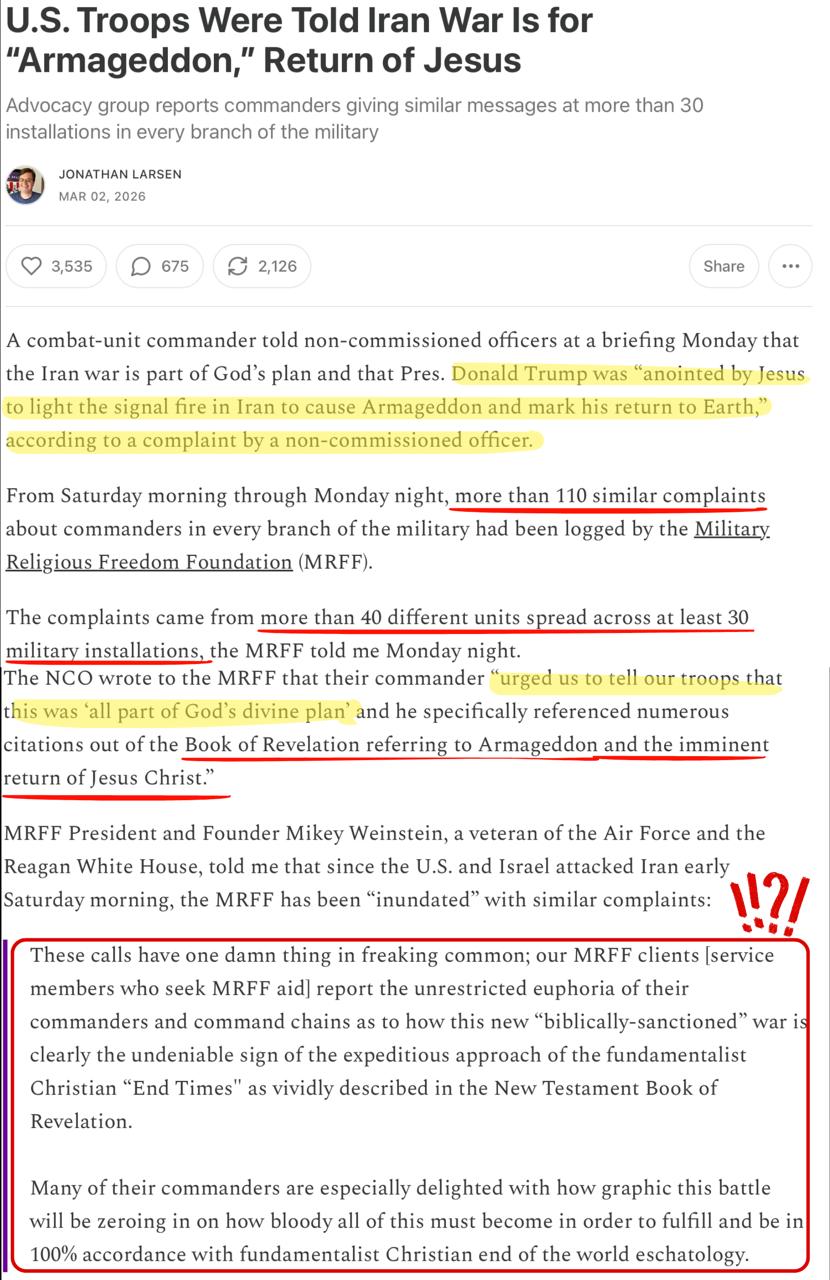
 !
!