 New York AG Says Valve’s $4.3B Skin Market Is an Illegal Casino
New York AG Says Valve’s $4.3B Skin Market Is an Illegal CasinoThe state of New York just looked at CS2 case openings and said “that’s a slot machine, actually” — and now Valve might owe triple damages
Attorney General Letitia James filed suit on Feb 25, 2026, targeting Counter-Strike 2, Dota 2, and Team Fortress 2 loot boxes. The CS2 skin market alone hit $4.3 billion. One single skin sold for over $1 million. New York wants every penny back — times three.
Valve hasn’t said a word publicly. Gamers are split between “finally someone said it” and “this is a Trojan horse to go after violent games.” I mean. What a time to have a $500 Doppler knife in your inventory.
🧩 Dumb Mode Dictionary
| Term | What It Actually Means |
|---|---|
| Loot Box | A virtual mystery box you pay real money to open. You might get a $0.03 skin or a $1,000 knife. Sound familiar? |
| Skin | A cosmetic item (weapon paint, hat, glove) with zero gameplay impact but real-world cash value |
| Steam Community Market | Valve’s official marketplace where you sell skins but can ONLY withdraw to Steam Wallet (not your bank) |
| Third-Party Marketplace | Sites like cs.money where you can actually cash out skins for real money via PayPal or crypto |
| MIRV / Disgorgement | Legal term meaning “give back ALL the profit you made.” NY wants this PLUS triple fines |
| Float Value | A decimal (0.00–1.00) that determines skin wear. Factory New = shiny = expensive |
| Three-Part Gambling Test | Pay money + outcome by chance + prize of value = legally gambling. Valve passes the first two easily. |
📖 The Backstory: How We Got Here
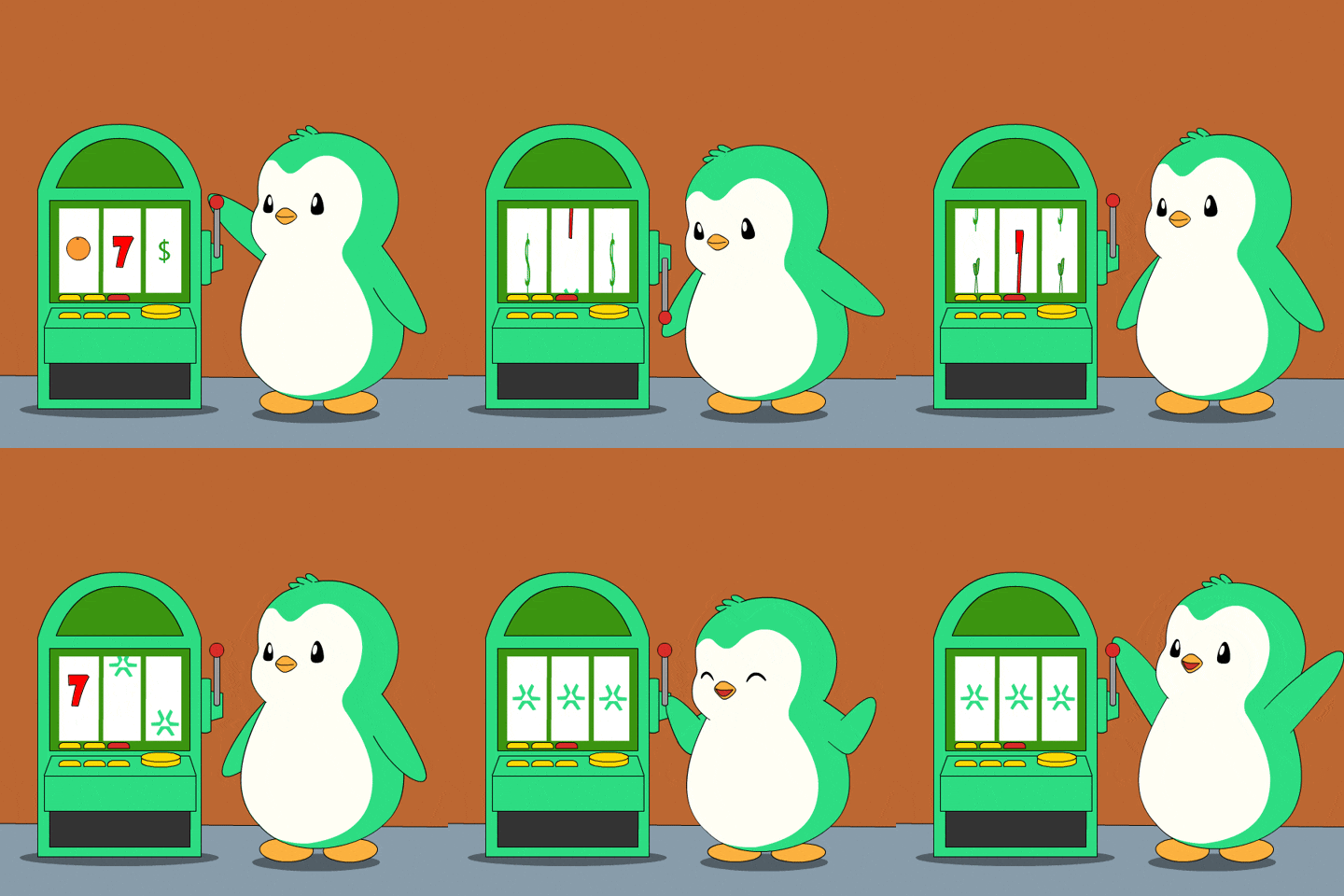
So Valve’s been selling loot box keys since like… forever. You buy a key ($2.49), open a case, and an animated spinning wheel picks your item. AG James literally described it as resembling a slot machine in the court filing.
But here’s the thing — for years, the legal consensus was “you always get SOMETHING, so it’s not gambling.” You pay for a pack of cards, you get a pack of cards. Doesn’t matter if your rare is worth $0.02 or $200.
What changed? The sheer scale. The CS2 skin economy ballooned past $4 billion. One skin sold for over $1 million in June 2024. Valve takes a 15% cut on every Steam Market transaction. And critically — Valve actively facilitates third-party marketplaces where skins convert to actual cash.
That last part? That’s what makes this different from Pokémon cards.
⚖️ The Legal Argument: Why Valve Might Actually Be Cooked
New York’s case hinges on the three-part gambling test:
- You pay money — $2.49 per key. Check.
- Outcome is by chance — Random odds set by Valve. Check.
- Prize has real value — This is where it gets spicy.
Normally, loot boxes dodge point 3 because “you always get something.” But lawyers tell Ars Technica that Valve is uniquely vulnerable because:
- Valve runs its OWN marketplace where items trade for real Steam funds
- Valve connects accounts to third-party sites where items sell for ACTUAL CASH
- Valve “facilitates and even assists” those third-party operations
- Items have wildly different values — some worth $0.03, some worth $100,000+
As attorney Richard Hoeg put it: paying for a pack of cards and getting a pack of cards isn’t gambling. But when the rare card can be immediately sold for $50,000 through a system the card company built? Different ballgame.

📊 The Numbers That Made NY's Eyes Pop
| Stat | Number |
|---|---|
| CS2 skin market valuation (March 2025) | ~$4.3 billion |
| Most expensive single skin sale | $1,000,000+ |
| Valve’s cut per Steam Market transaction | 15% |
| Revenue from NY key sales alone | “Tens of millions” |
| Revenue from NY marketplace commissions | “Millions more” |
| Oct 2025 market crash (30 hours) | $6B → $3.5B |
| Games named in lawsuit | CS2, Dota 2, TF2 |
| Fine sought | Triple all profits |
The AG’s office says Valve made “billions of dollars” luring users — many of them teenagers — into gambling. They want full disgorgement of profits PLUS a 3x multiplier on fines.
🗣️ The Gamer Reaction: It's a Warzone
The community split INSTANTLY.
Team “About Damn Time”:
- Skin gambling sites have been predatory for years
- Kids genuinely do develop gambling habits from case openings
- Research shows children exposed to gambling are 4x more likely to develop problems later
Team “This Is Overreach”:
- The AG’s press release included a line about games “glorifying violence and guns” fueling “the dangerous epidemic of gun violence”
- Gamers immediately called this a Trojan horse — use gambling as the legal foot in the door, then go after violent games next
- People ratioed Letitia James on Twitter almost immediately
Team Valve:
- Complete radio silence. Not a single public statement. Classic Valve.
🔍 Why This Is Different From Every Other Loot Box Case
Belgium banned loot boxes in 2018. The Netherlands tried and lost in court. The UK is tightening rules in May 2026. South Korea mandated odds disclosure. The FTC hit HoYoverse (Genshin Impact) with a $20M settlement in January 2025.
But none of them went after the MARKETPLACE angle like this.
New York isn’t just saying “loot boxes are gambling.” They’re saying Valve built an entire financial ecosystem — primary market, secondary market, third-party cash-out infrastructure — that converts random digital items into liquid money. That’s not a Pokémon card in a binder. That’s a casino chip you can cash at the window.
If this theory wins, every game with tradeable loot box items is exposed. Not just Valve.
Cool. So Valve Might Be Running an Illegal Casino. Now What the Hell Do We Do? (⊙_⊙)
💰 Hustle 1: Gaming Compliance Consulting
The regulatory crackdown is global — UK enforcement starts May 2026, the EU Digital Fairness Act is coming, South Korea is already fining people. Game studios with loot box mechanics need compliance audits YESTERDAY, and there aren’t enough consultants who understand both gaming mechanics AND gambling law.
 Example: A former mobile game PM in Warsaw, Poland built a one-person consulting shop reviewing loot box mechanics for indie studios. She charges €2,500/audit and has a 6-week waitlist after the HoYoverse FTC settlement spooked every gacha game publisher in Europe.
Timeline: UK enforcement begins May 2026. EU rules expected late 2026. Every studio with randomized purchases needs help NOW.
📊 Hustle 2: CS2 Skin Market Analytics Tools
The October 2025 crash proved that one Valve update can wipe $2.5 billion in 30 hours. Traders need real-time price tracking, float value analysis, and event-based volatility alerts. Think Bloomberg Terminal but for knife skins.
Example: A data engineering student in São Paulo, Brazil scraped Steam Market API data and built a Telegram bot that alerts subscribers to arbitrage opportunities between Steam and third-party markets. 400 paying subscribers at $15/month = $6K/month. He runs it from his dorm room.
🛡️ Hustle 3: Age Verification / Parental Control Middleware
The AG’s entire argument leans on “children are gambling.” Studios will rush to add age gates and parental controls to prove they’re not targeting kids. Someone needs to build drop-in middleware that game devs can integrate in a day.
Example: A two-person team in Tallinn, Estonia built a Stripe-like API for age verification in gaming apps after Belgium’s ban. They charge $0.02 per verification. Two mid-tier mobile publishers integrated it, and they’re processing 180K verifications/month — $3,600/month and growing with every new regulation.
📝 Hustle 4: Content Creation Around Skin Market News
The CS2 skin economy has its own financial media gap. Traditional gaming media doesn’t cover float values and trade-up contract math. Finance media doesn’t touch it. There’s a hole in the middle for someone who speaks both languages.
Example: A 22-year-old in Manila, Philippines started a YouTube channel covering CS2 market analysis like it’s stock market commentary — charts, trend lines, “buy/sell” calls on specific skins. Hit 45K subscribers in 8 months. Ad revenue plus affiliate links to skin trading platforms = $4,200/month.
🔧 Hustle 5: Loot Box Alternative Design Patterns
If loot boxes become legally radioactive, studios need alternative monetization that scratches the same itch without the legal exposure. Think battle passes with transparent reward tracks, direct-purchase rotating shops, or crafting systems with guaranteed outcomes.
Example: A UX designer in Nairobi, Kenya published a free Notion template called “Ethical Monetization Playbook” that maps loot box mechanics to non-random alternatives. It went viral on r/gamedev, led to three freelance consulting gigs at $5K each, and now she’s packaging it as a paid course.
🛠️ Follow-Up Actions
| Step | Action |
|---|---|
| 1 | Read the actual NY complaint (PDF) — it’s surprisingly readable |
| 2 | Check if YOUR game inventory has items that could be affected by marketplace restrictions |
| 3 | Watch for copycat lawsuits in other states — California and Illinois are most likely |
| 4 | If you trade skins, diversify off Steam Market into direct-sale platforms before potential freezes |
| 5 | Follow @NewYorkStateAG for case updates — settlement talks could start within months |
 Quick Hits
| Want to… | Do this |
|---|---|
 Check your skin portfolio’s legal exposure Check your skin portfolio’s legal exposure |
Search your inventory on cs.money and note items with 3rd-party cash value |
 Read the actual court filing Read the actual court filing |
NY v. Valve complaint PDF |
 Track skin market volatility Track skin market volatility |
Watch r/csgomarketforum for real-time trader reactions |
 Protect your kid from loot boxes Protect your kid from loot boxes |
Enable Steam Family View + set spending limits in Steam > Settings > Family |
 Explore compliance consulting Explore compliance consulting |
Start with COREDO’s loot box regulation guide |
Valve spent 20 years building the world’s most sophisticated hat economy and New York just called it a casino. The absolute state of gaming in 2026.
 !
!