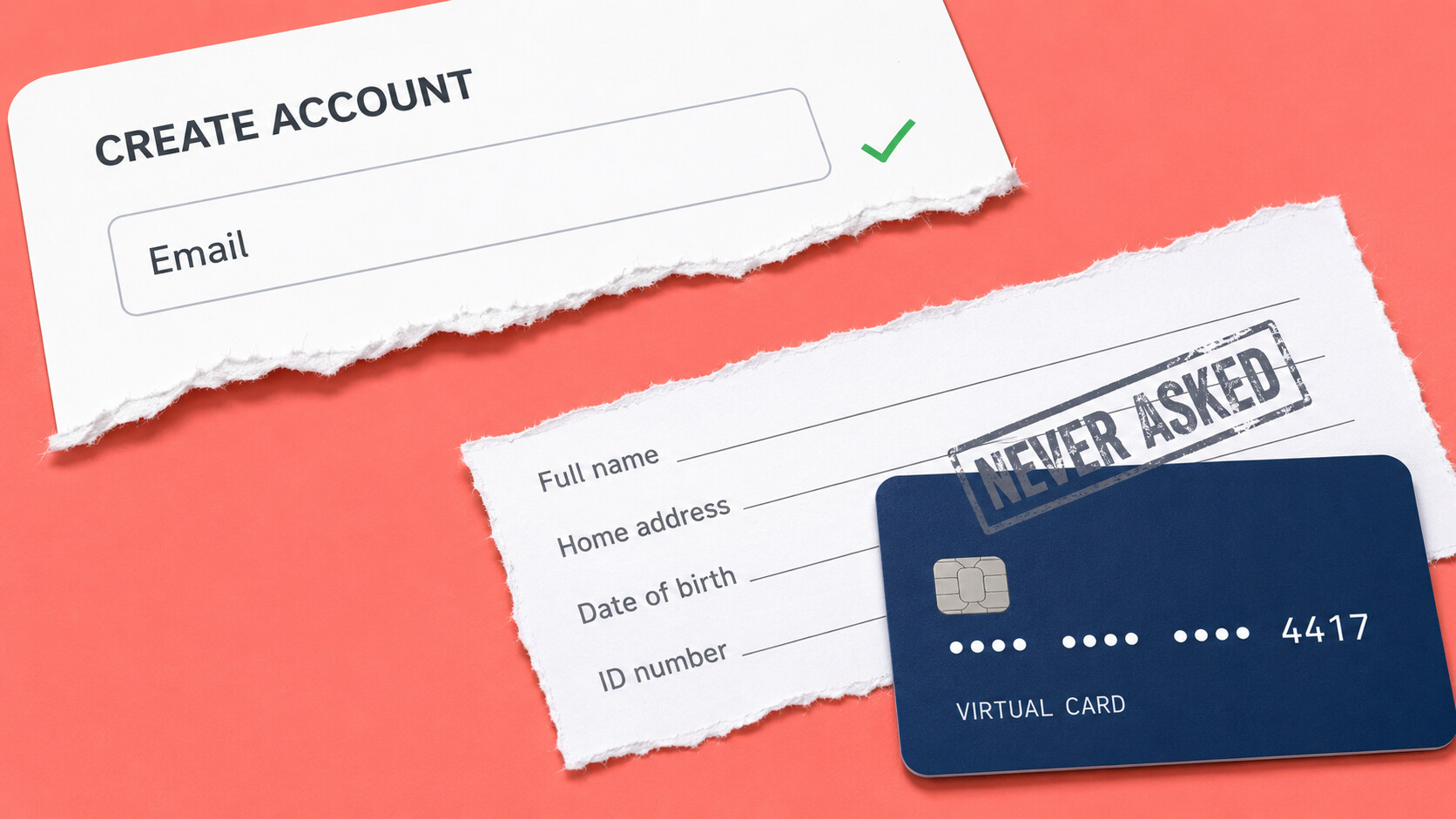
▚ DEFERRED ─ INHERITED ─ ALREADY DONE ─ NEVER SKIPPED
Straight up, before the links: a card that is free and document-free and works from any country does not exist. Every list promising one is either selling you something, or quietly means one of these three:
| What “no KYC” actually meant | Who it’s true for |
|---|---|
| Deferred — nobody checks below a number | anyone, until you cross it |
| Inherited — someone who already passed adds you | needs that someone |
| Moved upstream — the check happened at the SIM shop | you already gave ID, years ago |
The wall you keep hitting isn’t compliance. Banks and card-fintechs refuse you. Everyone else just never shows you the door — and companies whose product isn’t the card never built a refusal desk in the first place.
Two doors are genuinely open. Take the one that matches what you need.
 DOOR A — any country, starting today
Nobody sells you this card. You get handed one. Incentives companies pay people in open-loop Visa numbers — and they never had a reason to identify you, because they’re buying from you, not selling you a financial product.

signup      : email + password. no name, no address, no DOB, no phone
earn to $5  : desktop/Android app shares bandwidth, or answer surveys
cash out    : Payout → your country → Gift Cards → search "Visa"
arrives     : email, usually minutes (up to 72h)
↳ Real 16-digit Visa + expiry + CVV on a bookmarkable page. Open-loop, 212 countries. No bank, no top-up, no crypto anywhere in that path.
 The trick nobody uses: the payout rail renders its own menu based on your IP — and it’s often bigger than the platform advertised. Even when a panel only lists Amazon vouchers, open the redemption link and look for Virtual Visa before settling.
Other senders on the same rail — same card, no account with the rail itself:
├─ YouGov — email + self-declared name/DOB/postcode. Nothing uploaded. Slow (weeks of surveys) but no threshold anyone could find.
└─ BHN Rewards / Tango — the second rail; research studies and company reward programmes pay into it.
What this card will NOT do. It is not reloadable, and the prepaid BIN treats recurring billing as a cash transaction — your Netflix or Spotify line will decline. Work around it by buying that service’s gift card with the Visa, then redeeming. Also: the Visa option is region-filtered, so check your own cash-out menu before investing hours. And be clear-eyed about Pawns — you are selling residential bandwidth, so other people’s traffic exits your IP. That’s a real trade, not a footnote.
Deferred, not absent: Pawns triggers photo ID + selfie at $600 earned in 12 months — and their help centre carries a standing article about ID checks below that, so it’s discretionary too.
DOOR B — reloadable forever, cash top-up, no documents ever
Exactly one country still issues a free, document-free, open-loop virtual card to an ordinary person: Japan. Not a loophole — a statutory category. Issuers deliberately sit one yen under the verification trigger in the payment-services law.
| Card | Signup asks | Cash top-up |
|---|---|---|
| Vandle (Kanmu, an MUFG company) | nothing but an SMS number — no name, no address | 7-Eleven ATM, 24/7, fee-free |
| au PAY virtual (KDDI) | au ID — email + SMS. States 審査不要 | Lawson / Seven ATM, ¥1,000 units |
| Kyash | phone number only | Seven / Lawson ATM, fee-free |
| V-Preca (Lifecard) | the only one with a WEB signup — email + SMS | slip printed at a 7-Eleven copier |
The ceilings are the law, not the brand: ~¥100,000 balance · ¥30,000 per load · ¥120,000/month (≈ $640 / $190 / $770). au PAY is the outlier at ¥300,000/month.
The real wall here is a Japanese 070/080/090 SMS number — and it rejects VoIP. That is the whole gate.  And a dated one: Kyash closes unverified card top-up on 1 Sept 2026.
☠️ Where this question goes to die — 10 answers that look right and aren't
├─ The entire retail “no-KYC virtual card” market (uCards, PrivCards, Kripicard, CardsPro…) — these genuinely do onboard on an email with zero documents. Every single one funds only by crypto. There is no fiat twin. Ruling out crypto removes that whole lane — which is exactly why the real answer had to come from Japan and the incentives rails instead.
├─ Pyypl — the single most-recommended answer to this question, and it’s wrong. It’s a no-BANK product, not a no-KYC one; its own support docs require a government ID. Those two get conflated everywhere.
├─ Any anonymous EU prepaid card — capped by law at €150 stored and €50 per remote transaction. Legal, free, and useless for anything online.
├─ Nigeria’s “tier 1, no ID” wallets (OPay, PalmPay, Moniepoint) — closed. A CBN directive fully in force since March 2024 requires BVN/NIN on all tiers; the agent’s first move is capturing your NIN.
├─ Latin American wallets (Mercado Pago, Nequi, Ualá, Zinli…) — best-shaped finds in the region, all need a national tax number validated against a state registry. No self-declaring past it.
├─ Asian super-apps (Maya, GCash, TrueMoney, GoPay…) — every one needs a video selfie and a valid ID before the card.
├─ Free business spend tiers (Wallester’s 300 free cards, Ramp, Brex, Mercury, Payhawk…) — the free tiers are real and remarkable, and all of them need corporate documents, an EIN or a tax ID.
├─ Becoming the issuer yourself (Stripe Issuing, Marqeta, Lithic…) — registered entity + KYB with owner ID, every time.
├─ Sandbox / test-mode cards — this is where “I got a free Stripe card with no ID” stories come from. Those PANs exist only in test mode and buy nothing.
└─ Union54 — worth knowing as the ending: an African issuer that let dozens of apps mint USD cards with almost no friction. Mastercard pulled its BIN in 2022 over chargeback fraud. The network closes these lanes, not the regulator.
Not used, not recommended, not needed: inventing a name, an address, or a national ID number on a signup form. Every route above works with your real details or with no details at all.
🧬 Inherited access — real, and why it's probably not for you
The cleanest no-document cards on earth go to people added by someone who already passed. The compliance burden sits on the company at onboarding and is discharged once; everyone added afterwards joins with an email address.
├─ Extend — a business cardholder sends you a spendable virtual card; you supply an email.
├─ Amex supplementary — name + DOB + address typed by the primary member. No documents in the UK/EU flows. (US differs — it wants the additional member’s SSN.)
└─ Stripe Issuing docs — the floor, in writing: a cardholder is a self-declared name and billing address screened against sanctions lists. No upload, no tax ID.
The catch is structural: you can’t reach any of it acting alone. It needs a person or a company to bring you in.
📶 Where the check already happened — mobile money
M-PESA GlobalPay (Kenya) and Airtel Money Global Pay (Uganda/Tanzania/Zambia) issue an open-loop virtual card with nothing asked at the card step — your wallet PIN is the whole credential, and you load it by handing cash to an agent.
Said plainly: the identity check wasn’t waived, it moved. The SIM behind that wallet was registered against a national ID at a shop counter. If you already hold the line, the card costs you nothing more. If you don’t, this isn’t a door — it’s the far side of one.
Nobody skips the check. You either haven’t hit it yet, someone already passed it for you, or you passed it years ago at a phone shop.
 !
!