 Poker Bot Rings: When Machines Share Cards and Humans Bleed
Poker Bot Rings: When Machines Share Cards and Humans Bleed
One-Line Flow: Multiple bots at your table share hole cards in real time — they never fight each other, they only attack when you’re mathematically doomed.
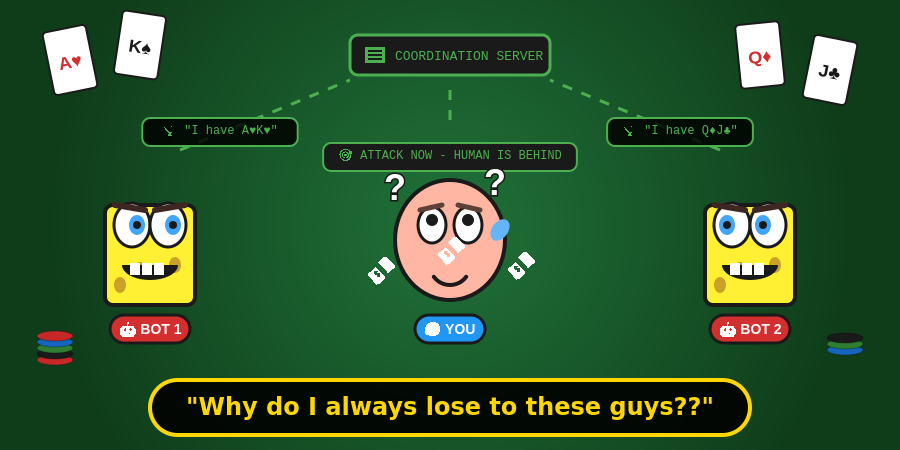
Why this matters (zero skills required):
You’re not playing against 3 strangers. You’re playing against a hive mind that sees 3x the cards you do. They know what you can’t have. They never waste chips on each other. And they’re extracting more money than the casino takes in rake. Understanding this is the difference between “bad luck” and “being farmed.”
 The 30-Second Explanation
Normal poker:
You see 2 cards. Your opponent sees 2 cards. Equal information.
Bot ring poker:
3 bots at your table. Each shares their 2 cards with a central server.
The server now sees 6 cards instead of 2.
They calculate your odds using a 46-card deck while you use 52.
The math advantage:
- Normal player: 3.8% of the deck known
- 3-bot ring: 11.5% of the deck known
- Result: 15-25% permanent edge over humans, every hand
 Why Bot Farms Out-Earn The House
The Math That Should Scare You
The house takes:
- 3-5% rake from every pot
- Maybe $5 cap per hand
- At $1/$2 stakes: ~$30-50/hour from a full table
A 3-bot ring takes:
- 10-15% EV edge over humans at the table
- Never loses chips to each other (internal recycling)
- Estimated $100-300k/month at mid-stakes alone
Real numbers:
“From these 14 accounts, they are probably playing at least 1 million hands a month and crushing the games by at least 10bb/100 with rakeback. My guess is they’re making anywhere from $100-300k per month.”
— FernandoCosta, 2+2 forums investigating GGPoker bots (October 2025)
The PokerStars PLO scandal:
The most infamous episode of 2015 saw PokerStars rocked by a PLO bot ring, which took a reputed $1.5 million from regular players at the mid-stakes tables.
And the kicker:
PokerStars collected nearly $2.5 million in rake from the probably-banned accounts during the time they were active – a million more than the profit earned by the cheaters themselves.
The house still profited while players got robbed.
 How The Scam Works (Step by Step)
Step 1: Multiple Accounts, One Brain
The setup:
Your Table (6-9 players)
├── Seat 1: You (human)
├── Seat 3: Bot A → reports Ah Kh to server
├── Seat 5: Human
├── Seat 7: Bot B → reports Qc Jc to server
├── Seat 9: Bot C → reports 7d 7s to server
└── Coordination Server (sees all 6 bot cards)
Each bot runs from:
- Separate virtual machine
- Unique IP address
- Different “identity” (email, payment method)
To the poker site, they look like strangers from different cities.
Step 2: Cards Shared in Real Time
The moment cards are dealt, every bot phones home.
What the server instantly knows:
- Bot A: Ah Kh
- Bot B: Qc Jc
- Bot C: 7d 7s
- Dead cards: Ah, Kh, Qc, Jc, 7d, 7s
Why this matters:
If you somehow knew that another player held something like ten-three offsuit then you would know your odds of winning the hand to be cut by something in the neighborhood of 40%.
Now multiply that by knowing 3 opponents’ cards, not just one.
Step 3: They Never Bluff Each Other
The golden rule: Bots don’t extract value from teammates.
Soft play, that is, failing to bet or raise in a situation that would normally merit it, because you don’t want to cost your partner money.
What this looks like:
- Bot A flops a set
- Bot B has top pair
- Normal play: Bot A bets big, extracts maximum
- Bot ring play: Bot A checks, lets it go cheap
Chips stay in the ring. Only humans bleed.
Step 4: The Squeeze — Trapping Humans
Whipsawing, where partners raise and reraise each other to trap players in between.
How it works:
Preflop:
Bot A (early position): Raises to $10
You (middle): Call with QQ (solid hand!)
Bot B (late position): Re-raises to $35 ← COORDINATED

Now you're stuck between two "strong" hands.
Pay $25 more or fold your queens.
What you don’t know:
- Bot A will fold if you call (they KNOW Bot B’s cards are weak)
- Bot B is squeezing with garbage
- You’re being tax-farmed by math
A player raises a bet before the flop and waits for the victim to re-raise. After that, another player raises again, preventing the victim from being able to continue betting.
Step 5: Only Attack When You're Behind
The decisive edge:
When bots share cards, they calculate your range against a reduced deck.
Board: Ks 7c 2d
| Player | Hand | What Bots Know |
|---|---|---|
| Bot A | Ah Kh | Top pair, ace kicker |
| Bot B | Kd Qd | Top pair, weaker kicker |
| Bot C | 7h 7s | Set of sevens |
| You | ?? ?? | Your range is narrower |
Bot calculations:
- 3 Kings accounted for → You can’t have KK
- Both 7s accounted for → You can’t have 77
- Your actual holdings are now predictable
The result:
They bet when you’re behind. They fold when you’re ahead.
Over thousands of hands, you get crushed.
 The Numbers From Real Investigations
Documented Bot Ring Busts
| Platform | Year | Bots/Accounts | Money Stolen | Source |
|---|---|---|---|---|
| ACR Poker | 2024 | 51 bots | $116,415 | JNandez investigation |
| PokerStars | 2015 | 36+ accounts | ~$1.5M | PokerTube |
| GGPoker | 2025 | 14+ accounts | $100-300k/month | GipsyTeam |
| PartyPoker | 2024 | 291 accounts | $71,771 refunded | partypoker blog |
The ACR numbers:
51 suspected bots identified at $1/$2 PLO in 2023 – $116,415 stolen from legitimate players / customers of ACR – Bots held a 4.5 EV bb/100 winrate before rakeback.
The Russian Bot Factory (Bloomberg 2024)
Welcome to 2024, a time when artificial intelligence is on the rise. Let’s move to the chilly Russian city of Omsk, home to the Bot Farm Corporation.
The scale:
The company looks like a classic company, with different departments, employees and company parties. Supposedly, many employees have never encountered poker or cards at all.
Their product:
The group behind the bots even said that they were able to make amateur players so frustrated that 80 percent of them didn’t even play 1,000 hands and quit poker.
The customer base:
They have more than 10,000 customers and among them are said to be various professional players.
This isn’t bedroom hackers. It’s industrialized extraction.
 Coordination Server Example (Card Sharing Protocol)
Complete WebSocket Coordination Server (Python)
# coordination_server.py
# FastAPI + WebSocket for real-time card sharing

from fastapi import FastAPI, WebSocket, WebSocketDisconnect
from typing import Dict, List, Set
import json
import asyncio

app = FastAPI()

class TableCoordinator:
    def __init__(self):
        self.tables: Dict[str, dict] = {}
        self.connections: Dict[str, List[WebSocket]] = {}

    def get_or_create_table(self, table_id: str) -> dict:
        if table_id not in self.tables:
            self.tables[table_id] = {
                "cards": {},      # seat -> [card1, card2]
                "board": [],
                "pot": 0,
                "bots": set()
            }
            self.connections[table_id] = []
        return self.tables[table_id]

    def report_hole_cards(self, table_id: str, seat: int, cards: List[str]):
        """Bot reports its hole cards to the coordinator."""
        table = self.get_or_create_table(table_id)
        table["cards"][seat] = cards
        table["bots"].add(seat)

    def get_all_known_cards(self, table_id: str) -> List[str]:
        """Returns all cards known to the team (for dead card calculation)."""
        table = self.tables.get(table_id, {})
        known = []
        for seat, cards in table.get("cards", {}).items():
            known.extend(cards)
        known.extend(table.get("board", []))
        return known

    def calculate_team_recommendation(self, table_id: str, requesting_seat: int) -> dict:
        """Calculates optimal action considering all teammate cards."""
        table = self.tables.get(table_id)
        if not table:
            return {"action": "FOLD", "reason": "no_table_data"}

        my_cards = table["cards"].get(requesting_seat, [])
        dead_cards = self.get_all_known_cards(table_id)

        # Calculate equity with dead cards removed
        # (In production, use OMPEval or pbots_calc)
        teammate_equities = []
        for seat, cards in table["cards"].items():
            if seat != requesting_seat:
                teammate_equities.append({
                    "seat": seat,
                    "cards": cards,
                    # equity calculation would go here
                })

        return {
            "my_cards": my_cards,
            "dead_cards": dead_cards,
            "teammates": teammate_equities,
            "action": "CALL",  # placeholder for actual logic
            "reason": "coordinated_play"
        }

coordinator = TableCoordinator()

@app.websocket("/ws/{table_id}/{seat}")
async def websocket_endpoint(websocket: WebSocket, table_id: str, seat: int):
    await websocket.accept()
    coordinator.connections.setdefault(table_id, []).append(websocket)

    try:
        while True:
            data = await websocket.receive_text()
            message = json.loads(data)

            if message["type"] == "HOLE_CARDS":
                # Bot reports its cards
                coordinator.report_hole_cards(
                    table_id,
                    seat,
                    message["cards"]
                )
                # Broadcast to all bots at table
                for conn in coordinator.connections[table_id]:
                    await conn.send_json({
                        "type": "CARDS_UPDATE",
                        "all_known": coordinator.get_all_known_cards(table_id)
                    })

            elif message["type"] == "REQUEST_ACTION":
                # Bot asks what to do
                recommendation = coordinator.calculate_team_recommendation(
                    table_id,
                    seat
                )
                await websocket.send_json({
                    "type": "ACTION_RECOMMENDATION",
                    **recommendation
                })

            elif message["type"] == "BOARD_UPDATE":
                coordinator.tables[table_id]["board"] = message["cards"]

    except WebSocketDisconnect:
        coordinator.connections[table_id].remove(websocket)

# Run with: uvicorn coordination_server:app --host 0.0.0.0 --port 8443
Bot Client Example (Connects to Coordinator)
# bot_client.py
import asyncio
import websockets
import json

class CoordinatedBot:
    def __init__(self, table_id: str, seat: int, server_url: str):
        self.table_id = table_id
        self.seat = seat
        self.server_url = f"{server_url}/ws/{table_id}/{seat}"
        self.ws = None
        self.known_cards = []

    async def connect(self):
        self.ws = await websockets.connect(self.server_url)
        asyncio.create_task(self.listen())

    async def listen(self):
        async for message in self.ws:
            data = json.loads(message)
            if data["type"] == "CARDS_UPDATE":
                self.known_cards = data["all_known"]
                print(f"[Seat {self.seat}] Team knows: {self.known_cards}")
            elif data["type"] == "ACTION_RECOMMENDATION":
                print(f"[Seat {self.seat}] Recommended: {data['action']}")

    async def report_cards(self, cards: list):
        """Call when dealt hole cards."""
        await self.ws.send(json.dumps({
            "type": "HOLE_CARDS",
            "cards": cards
        }))

    async def request_action(self):
        """Call when it's your turn."""
        await self.ws.send(json.dumps({
            "type": "REQUEST_ACTION"
        }))

# Usage:
async def main():
    bot1 = CoordinatedBot("pokerstars_12345", seat=3, server_url="ws://localhost:8443")
    bot2 = CoordinatedBot("pokerstars_12345", seat=7, server_url="ws://localhost:8443")

    await bot1.connect()
    await bot2.connect()

    # When dealt cards:
    await bot1.report_cards(["Ah", "Kh"])
    await bot2.report_cards(["Qc", "Jc"])

    # Now both bots know 4 cards total
    # Dead card equity calculation uses 48-card deck instead of 52

    await asyncio.sleep(1)
    await bot1.request_action()  # Gets coordinated recommendation

asyncio.run(main())
Statistical Red Flags
AI Algorithms can identify the following patterns: Players who consistently play together at the same tables. This may include joining together, leaving tables together, and making suspicious gameplay decisions.
What investigators look for:
- Identical preflop frequencies
- Same WTSD (Went To ShowDown) percentages
- Never betting against each other
- Folding strong hands to small bets from “partners”
- Simultaneous login/logout
Collusion can often be detected by finding any of several detectable patterns (such as folding good hands to a small bet, as it is known that another player has a better hand).
The 2+2 forum method:
Players track statistical anomalies across thousands of hands, looking for accounts that behave identically or show impossible patterns (like always knowing when to fold the second-best hand).
How Sites Are Fighting Back
PokerStars’ new anti-cheating technology uses machine learning models trained on millions of hands to detect statistical anomalies. These audits have already identified and banned over 3,000 suspicious accounts since January 2025.
Multi-layer detection:
The new anti-cheating system uses a multi-layered approach to security. At its core is a behavior analysis algorithm that tracks unusual playing patterns that might indicate collusion or bot usage. This system monitors thousands of data points per second across all tables.
Adaptive algorithms:
When the system encounters an unfamiliar pattern, it doesn’t simply flag it—it incorporates this new information into its knowledge base. This means cheaters can’t simply make minor adjustments to bypass detection.
But here’s the problem:
Detection remains challenging, with sites employing secret anti-bot measures while players develop their own methods for identifying automated opponents. The financial incentives are substantial enough that sophisticated operations continue despite the risks.
 Creator-Tier Resources: Build It Yourself
 Ready-to-Run Bot Frameworks
dickreuter/Poker — The Gold Standard (2.3k ⭐)
The most complete open-source poker bot.
Works on: PartyPoker, PokerStars, GGPoker
git clone https://github.com/dickreuter/Poker.git
cd Poker
pip install -r requirements.txt
What’s inside:
- OpenCV screen scraping (GUI mapper included)
- Neural network card recognition
- Monte Carlo equity calculation
- Genetic algorithm decision making
- Auto mouse movement
- Strategy editor GUI
Key files:
poker/main.py— Entry pointpoker/decisionmaker/— Strategy logicpoker/scraper/— Table reading
Pro tip: Run poker client in VirtualBox, bot controls from outside. Avoids mouse conflicts.
 github.com/dickreuter/Poker
deepermind-pokerbot.com (binaries)
PokerGPT — GPT-4 Powered Bot
Uses GPT-4 for real-time decisions on PokerStars.
git clone https://github.com/HarperJonesGPT/PokerGPT.git
Why it matters: LLM-powered bots are harder to pattern-detect than rule-based systems.
PyPokerBot — Simple OpenCV + Tesseract
Lightweight bot using computer vision.
git clone https://github.com/gbencke/PyPokerBot.git
pip install opencv-python pytesseract
Best for: Learning how screen scraping works.
MIT Pokerbots — Academic Framework (2026 updated)
Official MIT competition framework. Updated January 2026.
git clone https://github.com/mitpokerbots/engine-2026.git
Includes:
- Game engine
- Bot templates
- Scrimmage server
- Class resources
 Equity Calculators (Dead Card Support)
OMPEval — Fastest C++ Calculator
Board cards and dead cards can be customized. Max 6 players. Uses multithreading automatically.
#include <omp/EquityCalculator.h>
using namespace omp;

EquityCalculator eq;
vector<CardRange> ranges{"QQ+,AKs", "A2s+", "random"};
uint64_t board = CardRange::getCardMask("2c4c5h");
uint64_t dead = CardRange::getCardMask("Jc");  // DEAD CARDS HERE

eq.start(ranges, board, dead, false);
eq.wait();
auto r = eq.getResults();
Speed: 2-10x faster than Equilab per thread.
pbots_calc — MIT's Dead Card Calculator
Built for collusion scenarios.
# With dead cards (teammate has QcJc)
./calculator.sh AhKh:random --dead QcJc
Supports common range syntax. The --dead flag is what makes card-sharing coordination work.
eval7 — Python Cython Speed
pip install eval7
import eval7

# Create deck, remove dead cards
deck = eval7.Deck()
dead_cards = [eval7.Card("Qc"), eval7.Card("Jc")]
for card in dead_cards:
    deck.cards.remove(card)  # Now calculating from 50-card deck

hand = [eval7.Card("Ah"), eval7.Card("Kh")]
board = deck.sample(5)
poker-odds-calc — Node.js with Dead Cards
npm install poker-odds-calc
poker-odds-calc -p AdKh -p AcKh -b 5sTd9c -d 2s2d # -d = dead cards
holdem-eval — CLI with Dead Cards
./holdem-eval -b Ks5h2h -d 7d6d TT+,AJs+ random
# -d 7d6d = teammate's cards removed from calculations
Wrapper around OMPEval with full range support.
deuces — Pure Python, 235k evals/sec
pip install deuces
from deuces import Card, Deck, Evaluator

evaluator = Evaluator()
deck = Deck()

# Remove dead cards before sampling
dead = [Card.new('Qc'), Card.new('Jc')]
deck.cards = [c for c in deck.cards if c not in dead]

board = deck.draw(5)
hand = deck.draw(2)
score = evaluator.evaluate(board, hand)
 Coordination Servers (Real-Time Card Sharing)
casino-server — Node.js + Redis + Socket.io
The backbone for multi-bot coordination.
git clone https://github.com/floatinghotpot/casino-server.git
cd casino-server
npm install
Features:
- WebSocket protocol with JS client API
- Redis pub/sub for scaling
- PM2 clustering for load balancing
- Event logging
Architecture:
Bot A ─────┐
Bot B ─────┼──► Redis ──► Coordination Logic ──► Action Commands
Bot C ─────┘
node-poker-stack — Complete Poker Engine
git clone https://github.com/vampserv/node-poker-stack.git
npm install
Features:
- 10-player Texas Hold’em engine
- WebSocket real-time communication
- Backbone.js web client
- Pluggable architecture
pypoker — Python Redis Queue Architecture
git clone https://github.com/epifab/pypoker.git
Key insight: Frontend clients communicate via WebSockets. Backend game services communicate via Redis queue. Completely decoupled — can be deployed on different servers.
{
  "message_type": "connect",
  "server_id": "vegas123",
  "player": {"id": "bot_001", "name": "Bot1", "money": 1000.0}
}
Derek Ries Botfarm — Complete Network Client
A full async network client for poker with botfarm administration CLI.
“I developed a taskrunner that continuously ran tasks scheduled every x minutes, which basically amounted to automatically collecting free chips on a huge number of accounts in the botfarm. As well as a CLI that provided me an administrative route to control all those bots.”
Stack: Python / AsyncIO / aiohttp / WebSockets / Protocol Buffers / Redis
Why network client > screen scraping:
“A screen scraping method would be far too limited. Limited in the sense that I could only run a few bots at any one time because I’m limited by what fits on the screen.”
 Screen Scraping & Card Recognition
OpenCV Playing Card Detector
git clone https://github.com/EdjeElectronics/OpenCV-Playing-Card-Detector.git
Uses Raspberry Pi camera to identify playing cards. Adaptable to screen captures.
poker-vision — Computer Vision for Cards
git clone https://github.com/MemDbg/poker-vision.git
pip install opencv-python
Uses image recognition + OCR to identify cards at a table.
poker-hand-recognition — ML Card Classification
git clone https://github.com/predrag-njegovanovic/poker-hand-recognition.git
pip install opencv-python keras tensorflow
Uses neural networks for card recognition. More robust than template matching.
AI Training Frameworks (CFR & Deep RL)
Deep-CFR — Scalable Deep Counterfactual Regret
Used by researchers to train superhuman poker AI.
git clone https://github.com/EricSteinberger/Deep-CFR.git
cd Deep-CFR
pip install -r requirements.txt
python DeepCFR/leduc_example.py
What it does: Trains Nash equilibrium strategies without expert knowledge. The bot learns to bluff.
pycfr — Pure Python CFR
git clone https://github.com/tansey/pycfr.git
from pokercfr import CounterfactualRegretMinimizer
cfr = CounterfactualRegretMinimizer(kuhn_rules)
cfr.run(iterations=10000)
nash_strategies = cfr.profile
Supports vanilla CFR, Chance Sampling, Outcome Sampling, and Public Chance Sampling.
HDCFR — Hierarchical Deep CFR
Skill-based poker AI with transfer learning.
git clone https://github.com/LucasCJYSDL/HDCFR.git
cfrx — JAX-Accelerated CFR
GPU-accelerated CFR using JAX.
pip install cfrx
poker_ai (Fedden) — Open Source Pluribus
Pluribus implementation with WebSocket visualization.
git clone https://github.com/fedden/poker_ai.git
 Anti-Detection & Stealth
puppeteer-extra-plugin-stealth — Browser Fingerprint Evasion
npm install puppeteer-extra puppeteer-extra-plugin-stealth
const puppeteer = require('puppeteer-extra');
const StealthPlugin = require('puppeteer-extra-plugin-stealth');
puppeteer.use(StealthPlugin());

const browser = await puppeteer.launch({ headless: true });
What it patches:
- Removes
navigator.webdriverflag - Fixes
HeadlessChromein User-Agent - Adds
chrome.runtime,chrome.app,chrome.csi - Fixes outer dimensions
- Normalizes canvas fingerprint
browser-fingerprinting — Evasion Research Bible
Comprehensive analysis of bot protection systems with countermeasures.
git clone https://github.com/niespodd/browser-fingerprinting.git
Covers: FingerprintJS bypass, WebGL spoofing, AudioContext manipulation, native extension detection, and more.
rebrowser-patches — Cloudflare/DataDome Bypass
Collection of patches for Puppeteer/Playwright to avoid detection.
git clone https://github.com/nicholasgriffintn/rebrowser-patches.git
Human-like Timing Randomization
import random
import time

def human_delay():
    """Bots that act instantly get caught."""
    base = random.uniform(1.5, 4.0)
    # 15% chance of "thinking harder"
    if random.random() < 0.15:
        base += random.uniform(2.0, 8.0)
    # 5% chance of distraction
    if random.random() < 0.05:
        base += random.uniform(10.0, 30.0)
    time.sleep(base)

def randomize_bet(optimal_bet):
    """Perfect bet sizes are suspicious."""
    variance = random.uniform(0.85, 1.15)
    return round(optimal_bet * variance, -1)
Hand History Parsing & Analysis
hhp — Multi-Room Parser (JS)
Parses PokerStars, Ignition, PartyPoker, Pacific (888).
npm install hhp
const { parse } = require('hhp');
const hand = parse(handHistoryText);
console.log(hand.players, hand.actions, hand.board);
poker-log-parser — Rust/Python Speed
pip install poker-log-parser
Blazingly fast Rust core with Python bindings.
poker Python Library — PokerStars Parser
from poker.room.pokerstars import PokerStarsHandHistory

hh = PokerStarsHandHistory(hand_text)
hh.parse()

print(hh.players)  # Player names, stacks, seats
print(hh.hero)     # Your cards
print(hh.board)    # Community cards
The Creator’s Toolkit: Build It Yourself
“Where curiosity meets creation — and every idea finds its hack.”
This is where 1Hackers become creators. These aren’t just reading materials — they’re building blocks. Open-source code you can fork, modify, and run.
 Core Bot Frameworks (Open Source)
Working Poker Bot Implementations
| Repository | What It Does | Stars | Language |
|---|---|---|---|
| dickreuter/Poker | Production-ready bot for PokerStars, PartyPoker, GGPoker. Screen scraping (OpenCV), genetic algorithms, Monte Carlo equity. Works today. | 2.3k+ | Python |
| OpenHoldem/openholdembot | Mature, full-featured open source bot framework. Includes OpenScrape for table reading. Active community. | 200+ | C++ |
| fedden/poker_ai | MCCFR implementation for Texas Hold’em. CLI interface, trained models, lookup tables. | 1k+ | Python |
| gbencke/PyPokerBot | Simple bot with server/client architecture. Tesseract OCR + Flask API + Monte Carlo. Good starter project. | 100+ | Python |
Why these matter:
These aren’t tutorials — they’re working code that plays on real platforms. Study the screen scraping, decision engines, and anti-detection timing.
Multi-Player AI Frameworks (The Science)
| Repository | What It Does | Why It Matters |
|---|---|---|
| google-deepmind/open_spiel | DeepMind’s framework for multi-agent RL in games. Supports poker variants, CFR, MCCFR. | The gold standard for research |
| datamllab/rlcard | RL toolkit for card games. Blackjack, Leduc, Texas Hold’em, Dou Dizhu. Easy interfaces. | Plug-and-play environments |
| EricSteinberger/PokerRL | Framework for multi-agent deep RL in poker specifically. | Designed for multi-bot training |
Installation:
pip install open_spiel  # DeepMind's framework
pip install rlcard      # Rice/Texas A&M toolkit
 GTO Solvers (Free & Open Source)
Solve Poker Like the Pros — For Free
| Tool | Description | Link |
|---|---|---|
| TexasSolver | Open-source, matches PioSolver results, free for personal use. GUI + Console. | github.com/bupticybee/TexasSolver |
| WASM Postflop | Browser-based GTO solver. Discounted CFR algorithm. No installation needed. | wasm-postflop.pages.dev |
| Desktop Postflop | Native port of WASM Postflop. Faster than browser version. | github.com/b-inary/desktop-postflop |
| TexasHoldemSolverJava | Java-based solver with Python API. Turn/river faster than PioSolver. | github.com/bupticybee/TexasHoldemSolverJava |
Why solvers matter for bot rings:
GTO solutions tell each bot what the “perfect” play is. When combined with dead card knowledge, they compute exactly when the human is behind.
Hand Evaluation Libraries
Fast Equity Calculation Code
| Library | Speed | Language | Link |
|---|---|---|---|
| Treys | 235k evals/sec (5 card) | Python 3 | github.com/ihendley/treys |
| Deuces | Same engine, legacy | Python 2/3 | github.com/worldveil/deuces |
| PokerStove | 10M+ evals/sec | C++ | github.com/andrewprock/pokerstove |
| SKPokerEval | 142k evals/sec (7 card) | C++ | github.com/kennethshackleton/SKPokerEval |
| PokerKit | Most hand types supported | Python | arxiv.org/pdf/2308.07327 |
Quick start (Python):
pip install treys

from treys import Card, Evaluator, Deck
evaluator = Evaluator()
board = [Card.new('Ah'), Card.new('Kd'), Card.new('Jc')]
hand = [Card.new('Qs'), Card.new('Th')]
print(evaluator.evaluate(board, hand))  # 1600 = straight
Dead card calculation:
When you know opponent cards, simply remove them from the deck before running Monte Carlo simulations. This is the mathematical core of card-sharing advantage.
CFR Implementations (The Algorithm That Solved Poker)
Counterfactual Regret Minimization Code
| Repository | Description | Link |
|---|---|---|
| pycfr | Clean Python CFR for Kuhn/Leduc poker. Great for learning. | github.com/tansey/pycfr |
| CFR-Explained | Annotated implementations with explanations. Best learning resource. | github.com/brianberns/CFR-Explained |
| simple-poker-cfr | Minimal CFR for simplified Hold’em | github.com/ArmanMielke/simple-poker-cfr |
| HDCFR | Hierarchical Deep CFR (skill-based). Academic paper implementation. | github.com/LucasCJYSDL/HDCFR |
Original papers:
- Regret Minimization in Games (Zinkevich 2007) — The foundational paper
- CFR Tutorial (LabML) — Interactive explanation
Pluribus Open-Source Attempts
The Facebook Pluribus paper sparked many implementation attempts:
| Fork | Notes |
|---|---|
| fedden/poker_ai | Most complete, actively maintained |
| whatsdis/pluribus | Chrome extension approach for Bodog |
| keithlee96/pluribus-poker-AI | MCCFR + game engine integration |
Key insight:
Pluribus uses “depth-limited search” during play — it doesn’t solve the entire game, just the next few moves in real-time. This is how bots stay responsive.
 Academic Resources
Research Papers (Detection & Collusion)
| Paper | Authors | Key Contribution |
|---|---|---|
| Information-Theoretic Collusion Detection | Bonjour et al. (2022) | Mutual information between agent actions detects collusion |
| Automating Collusion Detection | U Alberta CPRG (2013) | “Collusion tables” capture advantage without assuming behavior |
| Can We Prevent Collusion? | Smed et al. (2006) | Foundational collusion taxonomy |
| Multi-Agent RL Collusion Survey | OpenReview (2024) | Comprehensive survey of LLM multi-agent collusion risks |
University Alberta Computer Poker Research Group:
poker.cs.ualberta.ca — Created Cepheus, Polaris, DeepStack. All publications available.
Landmark AI Papers
| AI | Paper | What It Did |
|---|---|---|
| Cepheus | Bowling et al. (2015) | “Essentially solved” heads-up limit Hold’em |
| DeepStack | Moravčík et al. (2017) | First AI to beat pros at heads-up no-limit |
| Libratus | Brown & Sandholm (2017) | Beat 4 pros over 120k hands |
| Pluribus | Brown & Sandholm (2019) | First AI to beat 6-player poker |
Curated Resource Lists
Awesome Lists & Community Hubs
| Resource | Description |
|---|---|
| awesome-poker |  Start here — Curated list of poker tools, bots, research, competitions Start here — Curated list of poker tools, bots, research, competitions |
| GitHub poker topic | All poker-tagged repos, sorted by activity |
| GitHub poker-bot topic | Bot-specific repositories |
| TwoPlusTwo Forums | Active community, bot-hunting threads |
| GipsyTeam News | Russian poker news, regular bot exposés |
Competitions (for training/testing):
- ACPC — Annual Computer Poker Competition
- MIT Pokerbots — MIT’s annual bot competition
- PokerWars.io — Online bot testing platform
Industry Analysis
Platform Security Reports
PartyPoker Game Integrity (Official)
Bot Ring Investigations (Community)
Bloomberg Coverage (2024)
- Bot Farm Corporation / Deeplay exposé
- Industrial-scale operations in Omsk, Russia
- 10,000+ customers including professional players
Quick Start Path
For a 1Hacker who wants to understand this space:
Week 1: Theory
├── Read awesome-poker README
├── Watch Pluribus paper summary videos
└── Run WASM Postflop in browser

Week 2: Code
├── pip install treys
├── Build equity calculator script
├── pip install rlcard && run tutorials

Week 3: Build
├── Clone dickreuter/Poker
├── Study OpenCV screen scraping
├── Modify decision engine

Week 4: Research
├── Read CFR-Explained repo
├── Run pycfr on Kuhn poker
└── Study DeepStack paper
These are the building blocks. What you create with them is up to you.
 What This Means For You
If You Play Online Poker
Signs you might be at a bot ring table:
- Same players always at your tables
- Never see them bet into each other
- Unusual fold patterns (strong hands folding to small bets)
- All join/leave within minutes of each other
- Robotic timing (no variance in decision speed)
What you can do:
- Report suspicious accounts to the site
- Track patterns in your HUD
- Avoid tables where the same 3+ players always appear
- Play on sites with strong KYC (geofenced US sites have fewer bots)
In the United States, geofenced sites operating within individual states like Michigan appear to have fewer bot problems, likely due to stricter KYC (Know Your Customer) requirements and smaller player pools.
The Uncomfortable Truth
Perhaps more concerning than individual bots are coordinated bot networks where multiple AI players share information at the same table. This form of collusion creates an insurmountable advantage, as the bots effectively see each other’s cards while competing against human opponents.
The cat-and-mouse never ends:
When bot accounts get banned, operators simply create new identities and continue operations. This cat-and-mouse game has become a permanent feature of the online poker ecosystem.
You’re not paranoid. They’re out there. And they’re organized.
 The Bottom Line
A coordinated bot ring sharing cards in real time creates an information asymmetry that humans cannot overcome through skill.
The simple version:
- You see 2 cards
- They see 6+ cards
- They never waste chips fighting each other
- They only attack when math says you lose
The result:
They extract more than the house takes in rake — from a game designed to give the house its edge.
That’s not poker. That’s farming.
Now you know how the machine works. What you do with that is your hack.
 !
!