 Regeneron Made a Gene Therapy That Cures Deafness — And They’re Giving It Away Free
Regeneron Made a Gene Therapy That Cures Deafness — And They’re Giving It Away FreeA single injection behind the ear. 80% of deaf children started hearing. And somehow, the drug costs $0.
On April 23, the FDA approved the first gene therapy in history that restores hearing — and in a move nobody saw coming, Regeneron said it’ll be free in the US.
The treatment is called Otarmeni. It targets a rare genetic mutation called OTOF that causes about 50 babies per year to be born completely deaf. In a trial of 20 kids, 16 started hearing within months — and 42% ended up with normal hearing, including whispers. This is the kind of thing that makes you close your laptop and stare at the wall for a minute.
🧩 Dumb Mode Dictionary
| Term | What It Actually Means |
|---|---|
| Gene therapy | Doctors put a corrected version of a broken gene into your body using a harmless virus as a delivery truck |
| OTOF gene | A specific gene that tells your inner ear how to send sound signals to your brain. If it’s broken, you’re born deaf |
| Otoferlin | The protein the OTOF gene makes. Without it, the tiny hair cells in your ear can “feel” sound but can’t tell your brain about it |
| Adeno-associated virus (AAV) | A tiny, harmless virus that scientists hollow out and stuff with the correct gene — basically a FedEx package for DNA |
| Sensorineural hearing loss | Deafness caused by damage or defects in the inner ear or nerve pathways, not just a blocked ear canal |
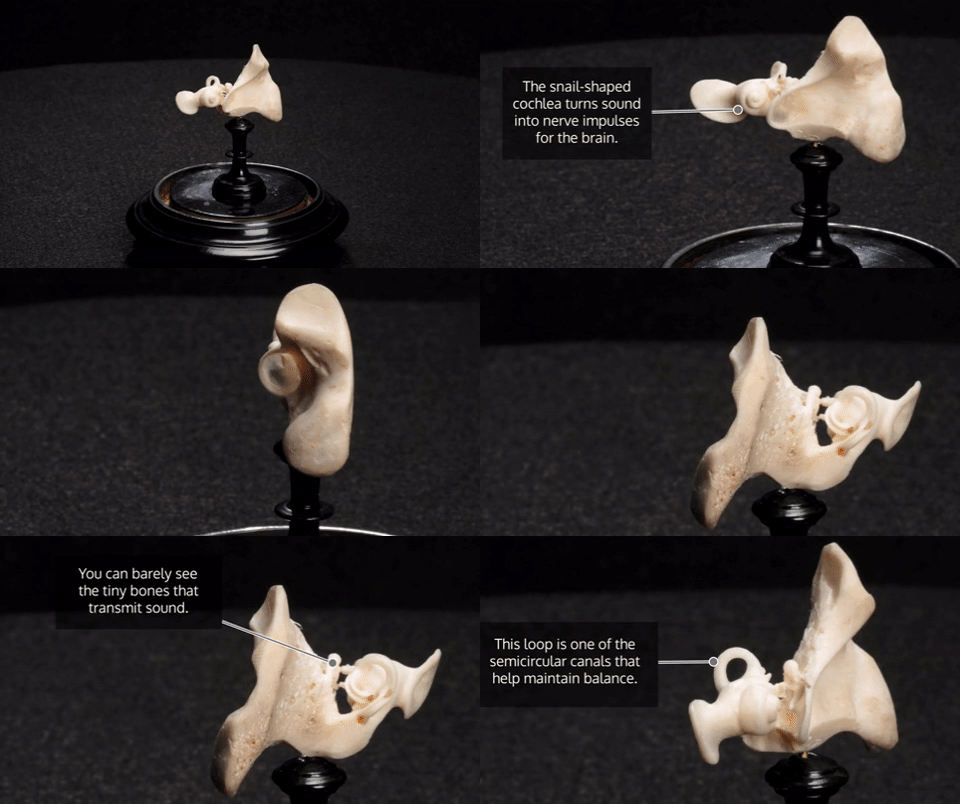
| Cochlea | The snail-shaped part deep inside your ear where sound gets converted into electrical signals for your brain |
| Accelerated approval | The FDA saying “the early data is so good we’re not going to make everyone wait 5 more years” |
📖 How Did We Get Here?
For decades, the only option for kids born deaf from OTOF mutations was cochlear implants — electronic devices surgically placed in the ear that bypass broken parts and stimulate the hearing nerve directly. They work, but they’re not natural hearing. The sound is often described as robotic.
Researchers figured out the problem years ago: if the OTOF gene is broken, you don’t make a protein called otoferlin. Without otoferlin, the hair cells in your ear can pick up vibrations but can’t pass the signal to your brain. It’s like having a perfectly good phone with a dead charging port.
The fix sounds almost too simple: stuff a working copy of the gene into a harmless virus, inject it behind the ear, and let it do its thing. But the OTOF gene is huge — too big to fit inside a single virus. So Regeneron’s team split the gene in half, loaded each half into separate viruses, and trusted that the pieces would reassemble correctly inside the cell. Wild.
📊 The Numbers That Matter
| Stat | Value |
|---|---|
| Babies born deaf from OTOF mutations (US/year) | ~50 |
| Patients in the clinical trial | 20 |
| Patients who gained significant hearing | 80% (16 of 20) |
| Patients who reached normal hearing | 42% (including whispers) |
| How fast results showed up | Weeks to months |
| How long hearing lasted so far | 2.5+ years and counting |
| Price in the US | $0 (the drug itself) |
| Price outside US | Not yet set |
| Typical gene therapy price tag | $1M+ per treatment |
| Hearing loss gene therapy market (2026) | $1.33 billion |
| Projected market by 2035 | $6.32 billion |
🔬 How the Procedure Actually Works
- The patient goes under general anesthesia (they’re asleep)
- A surgeon makes a small cut behind the ear
- Billions of modified AAV viruses — carrying the two halves of the working OTOF gene — get infused directly into the cochlea (the spiral-shaped inner ear chamber)
- The viruses enter the hair cells and deliver the gene
- The two halves reassemble, and the cell starts making otoferlin protein
- Hair cells can now transmit sound to the brain
- Hearing develops over weeks to months, improving over time
The whole surgical part takes a few hours. Then you wait. One mother, Sierra Smith, described the moment her son Travis reacted to sound for the first time: “We were driving in the car and he was sleeping. And I laughed really loud, and he startled for the first time.”
💰 Why Is It Free? (The Real Reason)
Honestly, this is the part that made me do a double-take. Gene therapies routinely cost $1 million to $3.5 million per patient. Regeneron’s CEO Leonard Schleifer said the drug will be free in the US — but also dropped this quote about other countries: “They should pay their fair share outside the United States.”
So what’s the play? A few things:
- OTOF deafness affects only ~50 US babies per year. The total addressable market is tiny. Charging $2M per patient gets you $100M max, minus the PR nightmare
- The FDA’s National Priority Voucher Program gave Regeneron a special voucher for treating a rare disease — that voucher alone can be sold to other pharma companies for hundreds of millions
- The real money is in what comes next: gene therapies for GJB2 mutations (way more common) and eventually age-related hearing loss — a market projected to hit $6.32 billion by 2035
Okay but seriously — whatever the business logic, deaf kids are getting their hearing back for free. That’s not nothing.
🗣️ What People Are Saying
Researchers: “It’s the first time in history there’s a new drug for hearing loss” — calling it a landmark for the entire field of audiology
Families: Sierra Smith, whose son was treated at Columbia University, described months of waiting before the breakthrough moment in the car. The hearing keeps improving over time.
Deaf community (pushback): Historian Jaipreet Virdi raised concerns that therapies like this treat deafness as “a problem in need of eradication” rather than respecting deaf culture and identity. This is a real tension — not everyone in the deaf community wants a “cure.”
Biotech analysts: Regeneron stock didn’t spike dramatically because the OTOF market is small. The real investor excitement is about what this proves: gene therapy for sensory organs works. That opens doors to treating millions with other forms of hearing loss.
🌍 The Bigger Picture
This isn’t just about 50 babies a year. It’s a proof of concept (a first test that shows the idea works) for an entire category of medicine:
- 23 clinical programs targeting genetic hearing loss are currently running worldwide, up from just 7 in 2021
- Eli Lilly paid $1.12 billion to partner with Seamless Therapeutics on gene editing for hereditary deafness
- Novartis invested $75M in OtoMedicine for a different deafness gene (GJB2)
- Chinese companies like Otovia Therapeutics and Fudan University Hospital are running parallel trials
- The eventual target: age-related hearing loss and noise-induced hearing loss, which affect ~1.5 billion people globally
We’re watching the first domino fall.
Cool. Deaf Kids Can Hear Whispers Now… Now What the Hell Do We Do? (⊙_⊙)
🧬 Build a Genetic Testing Interpretation Layer for Families
Most parents who get told “your baby has a biallelic OTOF variant” have absolutely zero idea what that means or what to do next. Right now there’s a gap between the genetic test result and the family understanding their options.
Build a simple tool (even a Notion-based guide or a WhatsApp bot) that takes a genetic test result code, translates it into plain language, and maps it to available treatments, clinical trials, and support groups — like a Carfax report but for your kid’s genes.
 Example: A genetic counselor in Bangalore built a WhatsApp flow using Typebot that walks parents through their newborn’s hearing screen results in Hindi and English. Pediatric clinics in 3 states started embedding her link in discharge papers. She charges clinics $200/month per location for the white-labeled version.
Timeline: 2-4 weeks to build a basic version. Revenue starts when you pitch it to ENT clinics and genetic counselors who are drowning in confused parents.
📝 Create Accessible Content Explaining Gene Therapy to Non-English-Speaking Families
Here’s the thing nobody’s talking about: OTOF mutations aren’t more common in English-speaking countries. Families in Latin America, South Asia, and the Middle East will hear about this therapy and have zero resources in their language explaining how it works, whether they qualify, or how to access it.
Build a YouTube channel or TikTok series that breaks down gene therapy approvals in Spanish, Arabic, Urdu, or Tagalog — specifically targeting parents of deaf children. Be the trusted translator between Big Pharma press releases and real families.
Example: A medical student in Cairo started a TikTok account explaining clinical trials in Arabic. After Regeneron’s announcement, her video explaining OTOF gene therapy got 2.3M views. She now runs a paid community ($5/month) where she posts trial updates and connects families with participating hospitals. 4,700 subscribers in 3 months.
💼 Become a Gene Therapy Medical Tourism Coordinator
Regeneron is giving Otarmeni away for free… in the US. Outside the US? They haven’t even set a price yet. That means families in countries without FDA-equivalent approvals are going to start looking at medical tourism options — flying to the US for the free treatment.
Except navigating US hospital systems, insurance paperwork (even for “free” drugs), visa requirements, and finding housing near treatment centers is a nightmare if you don’t speak English or know the system.
Example: A former travel agent in Manila pivoted to coordinating medical trips for Filipino families seeking cochlear implants at US hospitals. When the Otarmeni approval dropped, she added gene therapy packages — handling visa letters from the hospital, temporary housing near Columbia University Medical Center (one of the trial sites), and interpreter services. She charges $1,500 per family for the full coordination package.
📊 Track and Map Every Gene Therapy Clinical Trial for Hearing Loss
There are 23 active clinical programs targeting genetic hearing loss worldwide right now. Nobody has a clean, searchable, plain-English database that shows: which gene, which company, which countries are recruiting, what phase, and whether your specific mutation qualifies.
Build this database. Keep it updated. Monetize it with premium alerts (think: “a new trial just opened for GJB2 mutations in your country”) or by licensing the data to genetic counseling practices.
Example: A data analyst in São Paulo scraped ClinicalTrials.gov for all hearing-loss gene therapy studies, cleaned the data, and built a free Airtable with a paid tier ($10/month) that sends personalized match alerts when a new trial opens for your child’s specific genetic mutation. After posting it to parent forums in Brazil and India, she hit 800 paying subscribers in 2 months.
🛠️ Follow-Up Actions
| Want | Do |
|---|---|
| Understand OTOF mutations | Read the GeneReviews entry on genetic hearing loss — free, written for clinicians but readable |
| See the actual trial data | The results are published in the New England Journal of Medicine |
| Check if a child qualifies | Contact an audiologist or genetic counselor — OTOF testing is part of standard gene panels |
| Find active hearing gene therapy trials | Search ClinicalTrials.gov for “OTOF” or “hearing loss gene therapy” |
| Track the biotech companies in this space | Genemod’s list of top gene therapy companies is a solid starting point |
| Follow the money side | Motley Fool’s Regeneron analysis post-approval breaks down the investment angle |
 Quick Hits
| Want | Do |
|---|---|
| Understand the science |
Read NPR’s explainer — best plain-language breakdown out there |
 See why Regeneron gave it away free See why Regeneron gave it away free |
Check CNBC’s pricing analysis — the voucher math is wild |
 Watch the field grow Watch the field grow |
Bookmark Nature Biotech’s coverage — they track every new hearing gene therapy |
 Help families who need this Help families who need this |
Share the Regeneron patient eligibility page with anyone who has a deaf child |
 Invest in the trend Invest in the trend |
The hearing gene therapy market is projected to hit $6.32B by 2035 — 18.9% growth per year |
Honestly, we just watched a virus — the thing we usually panic about — deliver a gene that let a kid hear his mother laugh for the first time. Maybe science isn’t all bad.
 !
!