 Russia Tried to Block 65 Million VPN Users — And Accidentally Killed Its Own Banks
Russia Tried to Block 65 Million VPN Users — And Accidentally Killed Its Own BanksThe government swung at Telegram. It hit Sberbank instead. Cash was the only option for an entire day.
65 million daily Telegram users in Russia. One overloaded filter system. An entire country’s banking infrastructure down. Moscow metro turnstiles thrown open for free.
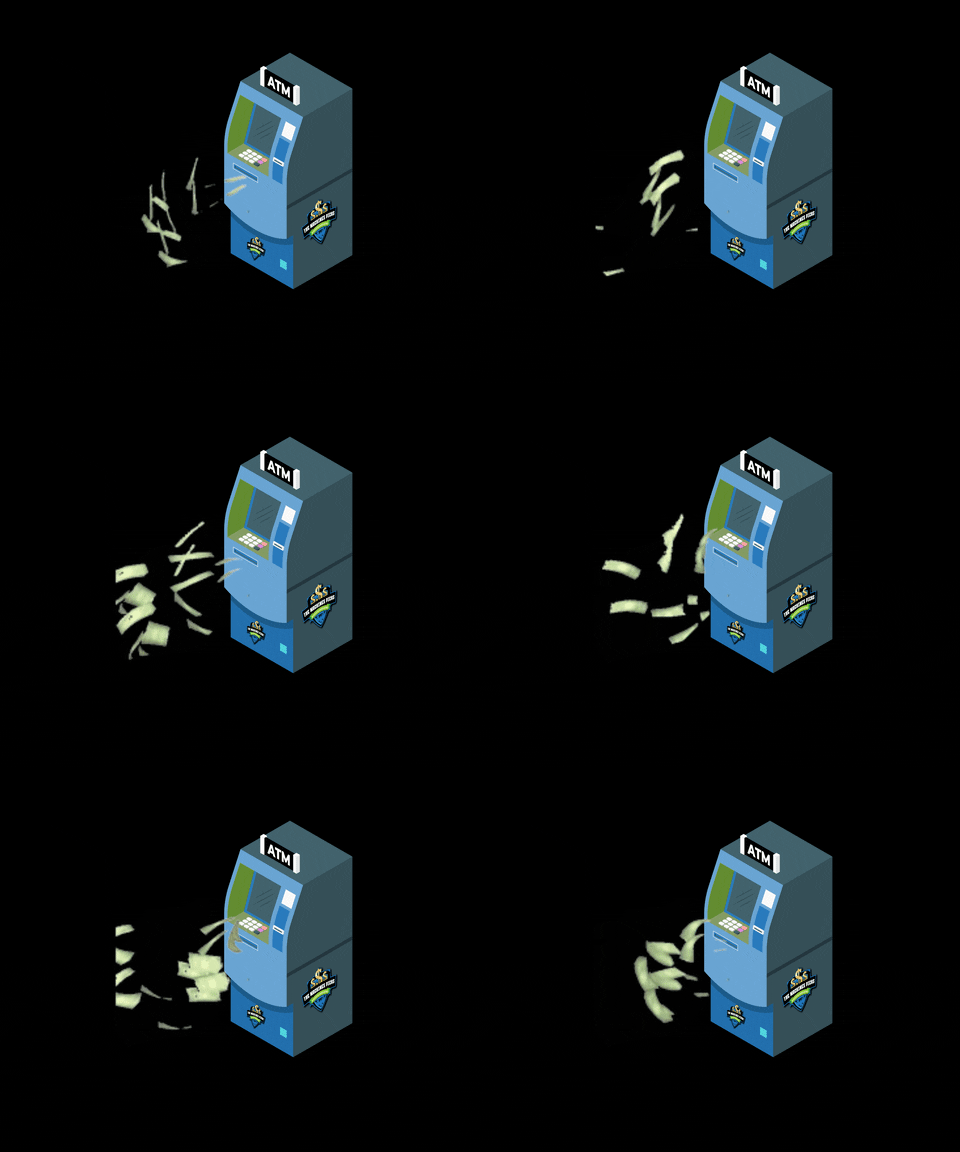
Russia’s internet watchdog tried to block VPNs on Friday, April 3rd. The filtering hardware couldn’t handle the traffic. It didn’t just fail — it took down mobile banking, ATM withdrawals, QR payments, and retail transactions across the country’s biggest banks. For hours, 144 million people were stuck with whatever cash they had in their pockets.
🧩 Dumb Mode Dictionary
| Term | What It Actually Means |
|---|---|
| VPN | A tool that hides your internet traffic so your government (or anyone else) can’t see what you’re doing online |
| Deep Packet Inspection (DPI) | A filter that reads every piece of internet data passing through it — like a border guard opening every letter |
| Roskomnadzor | Russia’s internet police. They decide what gets blocked |
| TSPU | Special filtering boxes installed at Russian internet providers. The things that overloaded |
| NSPK | Russia’s national payment card system — the pipes that make bank transfers work |
| Digital Resistance | Durov’s name for the 65M Russians still using Telegram through VPNs despite the ban |
📊 What Actually Went Down — The Timeline
- Late March 2026: Russia’s digital minister Maksut Shadayev announces plan to “reduce VPN usage”
- February 2026: Russia already deleted WhatsApp and Telegram from its internet
- April 1: Apple’s App Store payments stop working in Russia
- April 3 (Friday): VPN-blocking filters overload. Banking goes dark.
- Same day: Moscow metro opens turnstiles for free — payment systems are bricked
- Same day: Sberbank, T-Bank, and VTB users report total failures in mobile banking, ATMs, and QR payments
- April 4-5: Pavel Durov posts on Telegram: “Welcome back to the Digital Resistance”
- Official response: Russia’s NSPK blames “a technical failure at one of the banks.” Sure.
🔍 But Here's the Thing Nobody Mentions
The data shows this isn’t new. Russia tried the exact same thing in 2018 when they first banned Telegram. Back then, the blocking attempt knocked out online payments, smart home devices, and gaming services. Telegram lost about 3% of its Russian audience. 3%. That’s it.
Eight years later, Telegram is bigger than ever in Russia. 65 million daily users, up from 50 million a year ago. Every time the government blocks something, more people learn what a VPN is.
But here’s the real number that matters: Russia’s entire modern economy — ride hailing, food delivery, metro, banking — runs through internet-connected payment systems. You can’t block VPN traffic without also blocking the traffic that looks like VPN traffic. And it turns out, a lot of legitimate bank traffic looks exactly like VPN traffic to a filter that’s trying too hard.
The filtering boxes (called TSPUs) are installed at every Russian internet provider. When they get overloaded, they don’t just fail gracefully — they take down everything running through them. It’s like putting a bouncer at every door in a building, then the bouncers all pass out and nobody can get in or out.
🗣️ What Durov Actually Said
Pavel Durov — who holds passports from Russia, UAE, France, and Saint Kitts and Nevis — posted directly on Telegram:
“Telegram was banned in Russia, yet 65 million Russians still use it daily via VPNs. The government has spent years trying to ban VPNs too. Their blocking attempts just triggered a massive banking failure; cash briefly became the only payment method nationwide.”
He also announced Telegram would keep adapting to make its traffic harder to detect and block.
Meanwhile, Russia’s “Max” app — the state-approved platform designed to replace everything — sat there doing nothing useful while the whole country was scrambling for rubles.
📰 The Bigger Pattern
This is happening everywhere, not just Russia:
- Iran: Shut down internet during protests. Caused $1.5B in economic damage to its own businesses
- India: Kashmir internet shutdowns cost the local economy an estimated $2.4B over 5 years
- Myanmar: Military junta blocks internet. Crypto and mesh networks fill the gap
The pattern is always the same: government blocks the internet → economy takes the hit → people find workarounds → government blocks harder → economy takes a bigger hit. Nobody has ever won this game. The internet always routes around censorship. But the collateral damage keeps getting worse because every year, more critical stuff depends on the internet working.
⚙️ Why Filtering Systems Break Everything
Here’s the technical version in plain English:
- Russia installs special hardware (TSPUs) at every internet provider
- These boxes inspect every single packet of data — billions per second
- VPN traffic gets encrypted in a specific way. The boxes look for that pattern
- Problem: banking apps, streaming, cloud services, and payment terminals also use encryption that looks similar
- When the boxes try to block “all suspicious encrypted traffic,” they end up blocking legitimate traffic too
- When too many users connect at once (which happens when you’re blocking 65 million people’s VPNs), the hardware overloads
- Overloaded hardware = nothing gets through = no banking, no payments, no metro
Russian media outlet The Bell and other sources confirmed the overload theory. Experts warned that “major restrictions risk undermining network stability.” They were right.
Cool. So governments keep breaking their own internet trying to censor it. Now What the Hell Do We Do? ( ͡ಠ ʖ̯ ͡ಠ)
🛡️ Build 'Censorship Insurance' Kits for Businesses in Restricted Countries
Companies in Russia, Iran, and other censorship-heavy countries just watched their payment systems die because the government sneezed. There’s a real market for pre-configured “internet outage survival kits” — offline-capable POS systems, mesh network hardware, satellite internet failovers, and local backup payment rails bundled together.
You don’t sell “anti-censorship.” You sell “business continuity.” Very different marketing. Very legal.
 Example: A 26-year-old developer in Tbilisi, Georgia set up a Shopify-like store selling pre-flashed GoTenna mesh networking devices bundled with offline payment terminals to Russian small businesses through Telegram channels. Made $14K in the first month after the banking outage, shipping through Kazakhstan.
Timeline: 2-3 weeks to source hardware and set up a Telegram storefront. Revenue spikes every time a country has an internet crackdown.
💰 Arbitrage the VPN Panic Cycle
Every time a country announces VPN restrictions, VPN company stocks and subscriptions spike. This happens on a predictable cycle — announcement, crackdown attempt, failure, quiet period, repeat. Mullvad, Proton VPN, and NordVPN all see traffic surges from restricted countries.
The move: watch government announcements from Russia, Iran, Pakistan, and Turkey. When they announce VPN crackdowns, VPN-adjacent stocks move. Proton AG isn’t publicly traded, but companies like ZScaler and Cloudflare (which offers WARP VPN) are.
Example: A trader in Dubai noticed Russian Digital Ministry announcements consistently preceded VPN company revenue bumps. Built a simple RSS alert system tracking Roskomnadzor press releases, then took positions in Cloudflare stock 24-48 hours before each crackdown. Averaged 4-7% returns per cycle, 3-4 cycles per year.
🔧 Sell 'Dual-Stack' Payment Solutions to Russian Merchants
Russian merchants just learned the hard way that digital-only payments are a single point of failure. There’s a gap right now for payment consultants who help brick-and-mortar shops set up hybrid systems — digital payments that automatically fall back to offline/cash processing when the internet goes down.
The technical term is “store and forward” — the terminal records the transaction offline and processes it when connectivity returns. Most modern POS systems support this but nobody configures it.
Example: A payments consultant in Istanbul started offering remote setup services to Russian café and restaurant chains through Telegram. Charges $200 per location to configure SumUp and iZettle terminals for offline fallback mode. Landed 40 locations in two weeks through word-of-mouth after the April outage.
📱 Create Telegram Mini-App Tools for 'Outage-Proofing'
65 million Russians are already on Telegram daily. Telegram has a Mini Apps platform that lets you build apps inside Telegram itself. Build tools that help users prepare for the next outage: offline maps cached locally, emergency contact directories, local cash-exchange matchmaking (connect people who have cash with people who need it, and vice versa).
This isn’t a VPN tool — it’s disaster preparedness. That framing matters.
Example: A two-person team in Yerevan, Armenia built a Telegram Mini App called “CashMap” that lets users flag local businesses still accepting cash during outages, like a Waze for working payment methods. Hit 180K users within 72 hours of the April banking outage. Monetized through promoted business listings at $5/month.
🧠 Consult on 'Sanctions-Proof Infrastructure' for Crypto Exchanges
Here’s the sideways play nobody’s talking about. Crypto exchanges operating in or near Russia just watched the traditional banking system fail. Every one of them is now asking: “What happens to our fiat on-ramps when this happens again?” There’s consulting money in helping exchanges build redundant payment infrastructure that doesn’t depend on a single country’s banking system.
You’re not helping people evade sanctions. You’re helping licensed, compliant exchanges maintain operations during infrastructure failures. Big difference.
Example: A fintech consultant in Dubai who previously worked at a Turkish payment processor started advising mid-size crypto exchanges in the UAE and Georgia on multi-country payment rail redundancy. Three clients in the first month at $8K/month retainer each, specifically because they watched the Russian banking system go dark.
🛠️ Follow-Up Actions
| Step | Action | Link |
|---|---|---|
| 1 | Monitor Russian internet censorship announcements in real-time | OONI Explorer — free, open-source censorship tracker |
| 2 | Learn Telegram Mini App development (free) | Telegram Mini Apps Docs |
| 3 | Track VPN usage spikes by country | Top10VPN’s VPN Demand Index |
| 4 | Understand mesh networking basics | Briar Messenger — works without internet |
| 5 | Follow internet shutdown economics research | Access Now’s KeepItOn campaign |
 Quick Hits
| Want To… | Do This |
|---|---|
| Protect yourself from payment outages |
Keep 2-3 days of cash on hand. Seriously. Read why |
 Use a VPN that actually works in restricted countries Use a VPN that actually works in restricted countries |
Try Mullvad or Proton VPN — both work on obfuscated protocols |
 Trade on censorship cycles Trade on censorship cycles |
Set up Google Alerts for “Roskomnadzor VPN” and “internet shutdown” |
 Build for the 65M Russian Telegram users Build for the 65M Russian Telegram users |
Start with the Telegram Bot API — zero barrier to entry |
 Track internet censorship globally Track internet censorship globally |
Bookmark OONI Explorer — real-time, free, open-source |
Russia spent billions building internet filters to control its people. Then the filters crashed and the people couldn’t buy groceries. Somewhere, a 2018 Telegram engineer is laughing.
 !
!