 Silence Any Bluetooth Speaker in Range — Bluetooth Pentesting With Gretel
Silence Any Bluetooth Speaker in Range — Bluetooth Pentesting With GretelYour neighbor’s speaker is blasting music at 2 AM. You’re within Bluetooth range. One command and it goes quiet.
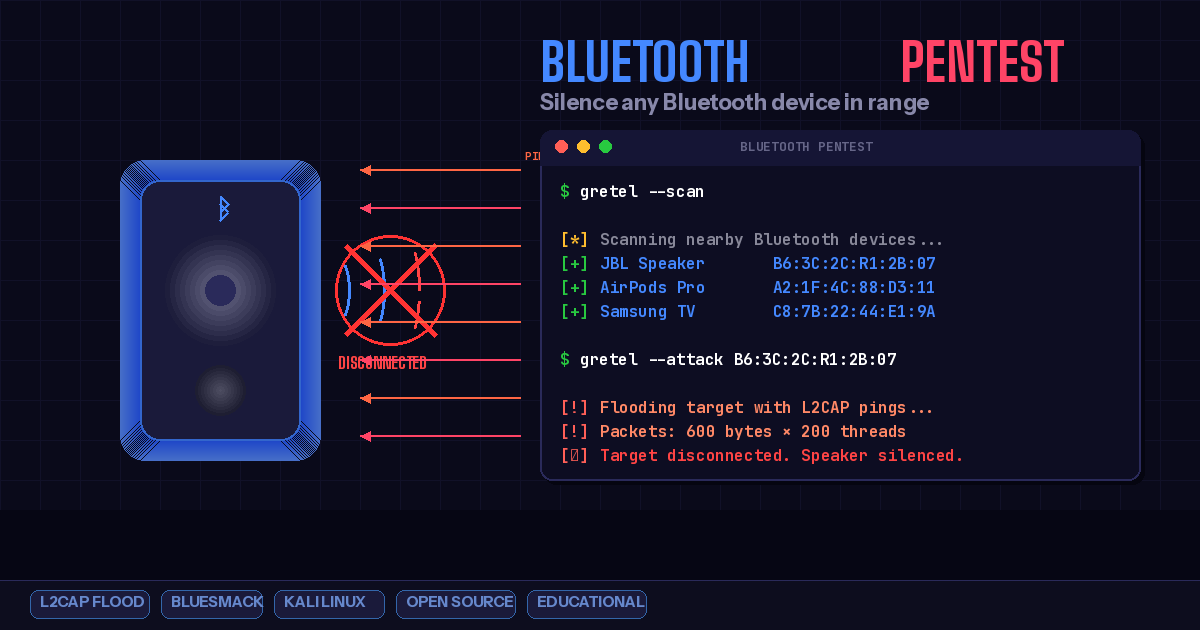
This is a real penetration testing technique used by security researchers. It works on speakers, headphones, and any Bluetooth device in range. Now you know it exists.
Gretel is a Bluetooth attack tool that floods a device with so many ping requests it can’t do anything else — including play music. The device’s tiny processor gets overwhelmed, existing connections drop, and nobody can reconnect until the attack stops. Educational purposes. 100% working.
🧠 What Is This? — The Simple Explanation
Every Bluetooth device — speakers, headphones, keyboards, game controllers — has a small computer chip inside that manages connections. That chip can only handle so much at once.
Bluetooth flooding (also called “BlueSmack”) works like this: you send hundreds or thousands of “ping” requests to a Bluetooth device at the same time. The device’s tiny processor gets so busy trying to respond to all those pings that it can’t do anything else — it drops its music connection, rejects new pairing attempts, and basically freezes.
Think of it like calling someone’s phone 500 times per second. They can’t make or receive any other calls because the line is always busy.
Gretel is a custom pentesting tool that automates this entire process — scanning for nearby Bluetooth devices, selecting a target by its MAC address, and flooding it until it disconnects.
When the attack stops, the device goes back to normal. No permanent damage. The speaker works fine again — connections resume immediately.
⚡ How It Works — Step by Step
The Attack Flow
| Step | What Happens |
|---|---|
| 1. Scan | Gretel scans for nearby Bluetooth devices and shows you what’s in range |
| 2. Select | You pick the target device by its MAC address (like B6:3C:2C:R1:2B:07) |
| 3. Flood | The script sends a massive number of L2CAP ping requests to the target |
| 4. Disconnect | The device’s processor gets overwhelmed → drops all active connections |
| 5. Stop | You stop the attack → device recovers immediately → connections work again |
Proof of Concept (Tested)
The creator tested this on a C10 Bluetooth speaker:
- Attack was running → phone tried to connect to speaker → connection failed
- Attack stopped → phone tried again → connected successfully
The device isn’t broken — it’s just too busy to handle connections while being flooded. The moment the flood stops, everything goes back to normal.
🔧 The Technical Side — What's Actually Happening
For anyone who wants to understand the mechanics:
L2CAP (Logical Link Control and Adaptation Protocol) is the layer of Bluetooth that handles data connections. Every Bluetooth device supports it.
l2ping is a standard Linux tool (part of the BlueZ Bluetooth stack) that sends echo requests to a Bluetooth device — basically “are you there?” pings.
The exploit: Most Bluetooth device processors (especially cheap speakers and headphones) have very limited processing power. When you flood them with l2ping requests at maximum speed and maximum packet size (~600 bytes), the chip can’t keep up. It drops existing audio streams, rejects new connections, and becomes unresponsive.
Why it works: Bluetooth was designed for low-power, short-range communication — not for handling hundreds of simultaneous requests. There’s no built-in rate limiting on most consumer devices. This is a known design weakness that security researchers have documented for years.
What Gretel adds: Instead of manually running l2ping commands, Gretel wraps the entire workflow — device scanning, target selection, multi-threaded flooding, and clean disconnect — into a single automated tool.
Requirements
- Linux (Kali Linux recommended — has everything pre-installed)
- Bluetooth adapter (built-in or USB dongle)
- BlueZ tools (
l2pingandhcitool— installed by default on Kali) - Python 3
🎯 Real Use Cases — Why Security Researchers Care About This
This isn’t just about annoying speakers. Bluetooth flooding is a serious security research area:
| Use Case | Why It Matters |
|---|---|
| IoT security testing | Smart locks, medical devices, and industrial sensors use Bluetooth. If they can be jammed, that’s a vulnerability. |
| Corporate security audits | Companies need to know if their Bluetooth-enabled conference rooms, keyboards, and access points are vulnerable to jamming. |
| Physical penetration testing | Red teams test if they can disrupt Bluetooth-based security systems (badge readers, alarm sensors). |
| Research & CVEs | Discovering which devices are vulnerable helps manufacturers fix their firmware. |
| Personal awareness | Understanding that any Bluetooth device near you can be disrupted by anyone with a laptop and a $10 USB dongle. |
Career path: Bluetooth/wireless security testing is a specialized niche within penetration testing. Wireless pentest roles pay $80K–$150K+. Bug bounties for Bluetooth vulnerabilities in IoT devices can pay $5K–$50K+.
🧰 Related Open-Source Bluetooth Pentest Tools
Gretel is a custom-developed tool. Here are similar open-source tools in the same space:
| Tool | What It Does | Link |
|---|---|---|
| l2flood | Multithreaded l2ping flood — the core technique behind most BT DoS tools | GitHub |
| BLUETOOTH-DOS-ATTACK-SCRIPT | Python-based BT DoS with scanning + auto-targeting | GitHub |
| BTSTORM | Scans nearby devices, auto-disconnects paired connections, multi-target flood | GitHub |
| BlueToolkit | Full Bluetooth Classic vulnerability testing framework — 43 exploits | GitHub |
| Bluing | Bluetooth intelligence gathering — device fingerprinting, service discovery, sniffing | GitHub |
| awesome-bluetooth-security | Curated list of Bluetooth security resources, talks, papers, and tools | GitHub |
All of these run on Linux. Most work best on Kali Linux which has Bluetooth tools pre-installed.
⚠️ Legal & Ethical Reality Check
This is for educational purposes and authorized testing only.
Jamming or disrupting Bluetooth devices you don’t own is illegal in most countries. In the US, the FCC prohibits intentional interference with wireless communications. Similar laws exist in the EU, UK, and most other jurisdictions.
When it’s legal:
- Testing your own devices
- Authorized penetration testing (written permission from the device owner)
- Security research in controlled lab environments
- Academic research with proper ethical review
When it’s not legal:
- Your neighbor’s speaker (even if it’s annoying)
- Random devices in public
- Anything you don’t have explicit written permission to test
The “noisy neighbor” scenario in the OP is a relatable example of what the tool can do — not a recommendation of what you should do. Understanding the capability is the point. Using it responsibly is your responsibility.
📚 Learn More — Bluetooth Security Deep Dives
| Resource | What It Covers | Link |
|---|---|---|
| Bluetooth Pentest Framework | The original comprehensive Bluetooth attack reference | bluetooth-pentest.narod.ru |
| BlueSmack Attack Writeup | Step-by-step walkthrough of L2CAP DoS attacks | Embedded Lab Vienna |
| HackMag — DDoS on Bluetooth | Practical guide to disabling portable speakers | HackMag |
| BlueDoS Research Paper | Academic analysis of Bluetooth DoS attack methods (SECRYPT 2024) | SCITEPRESS |
| DEF CON Bluetooth Talks | Years of Bluetooth security presentations from DEF CON and Black Hat | awesome-bluetooth-security |
| Kali Linux | The standard OS for wireless pentesting — BT tools pre-installed | kali.org |
 Quick Hits
| Want | Do |
|---|---|
| Understand BT flooding |
→ L2CAP ping flood overwhelms the device’s processor |
 Try open-source BT DoS tools Try open-source BT DoS tools |
→ l2flood or BTSTORM |
 Full BT vulnerability framework Full BT vulnerability framework |
→ BlueToolkit — 43 exploits |
 Learn BT security research Learn BT security research |
→ awesome-bluetooth-security |
 Best OS for wireless pentesting Best OS for wireless pentesting |
→ Kali Linux |
Every Bluetooth device in range is a target. The only question is whether someone’s tested it yet. Now you know how.
 !
!