 A SpaceX Satellite Just Blew Itself Up in Orbit — And Nobody Can Explain Why
A SpaceX Satellite Just Blew Itself Up in Orbit — And Nobody Can Explain WhyStarlink 34343 scattered “tens of objects” across low-Earth orbit on March 29. It was less than a year old. And it’s the second one to do this in three months.
10,000+ Starlinks in orbit. 3,532 of this exact model. Two unexplained breakups since December. SpaceX says “no risk.” Astrophysicists disagree.
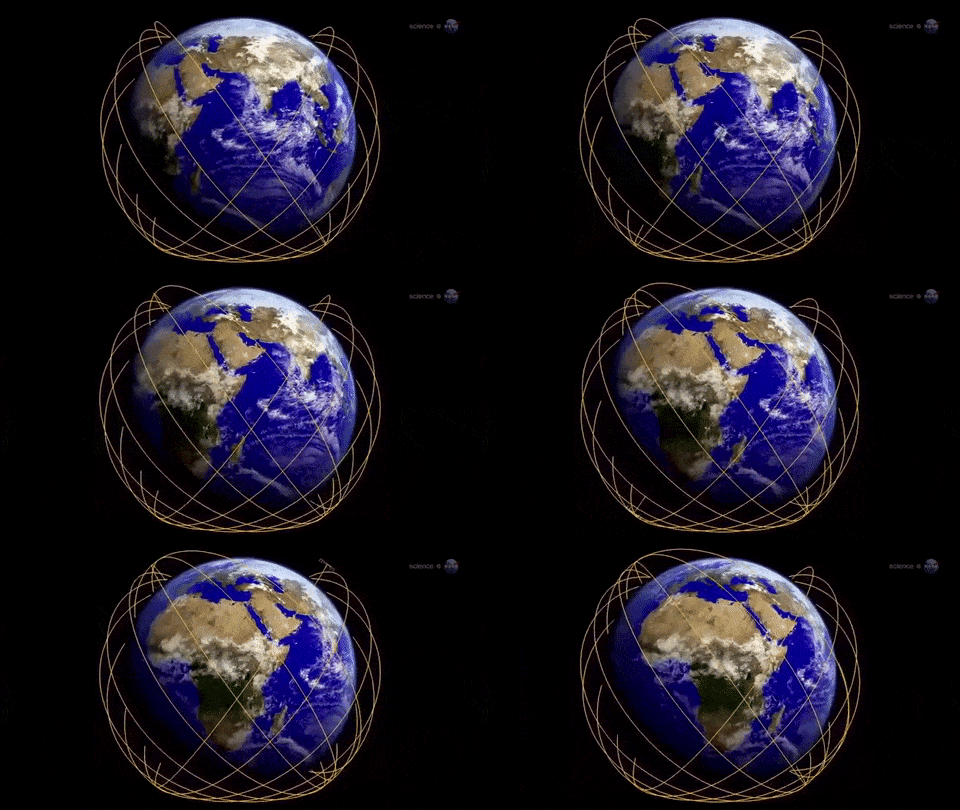
So you’ve got a satellite constellation the size of a small country’s population just… vibing up there at 560 kilometers. And sometimes one of them apparently decides to pop like a balloon at a kid’s birthday party. Cool cool cool.
🧩 Dumb Mode Dictionary
| Term | Translation |
|---|---|
| Anomaly | SpaceX’s word for “our satellite blew up and we don’t know why” |
| Internal energetic source | Something inside the satellite went boom — probably batteries or propulsion |
| V2 Mini Optimized | The specific Starlink model that keeps having this problem. 3,532 of them are up there |
| LeoLabs | Private company with radar stations that tracks everything in orbit. They spotted the debris |
| Kessler Syndrome | The nightmare scenario where debris hits more satellites, creating more debris, creating more hits, until orbit becomes a pinball machine |
| Deorbit | When debris falls back toward Earth and (hopefully) burns up in the atmosphere |
📡 What Actually Happened
- On March 29, 2026, Starlink satellite 34343 broke apart while orbiting at ~560 km altitude
- LeoLabs’ Global Radar Network in the Azores, Portugal detected “tens of objects” scattered around the satellite immediately after
- The satellite had been in orbit for less than a year — launched May 27, 2025 from Vandenberg Space Force Base in California
- LeoLabs says the cause was an “internal energetic source” — NOT a collision with space junk
- Translation: something inside the satellite — batteries, propulsion, who knows — went sideways
🔁 Wait, This Happened Before?
Yeah. That’s the part that should make your eyebrows climb.
- December 17, 2025: Starlink satellite 35956 experienced a nearly identical anomaly
- That one dropped 2.5 miles in altitude and generated hundreds of pieces of debris (though the satellite stayed mostly intact)
- LeoLabs explicitly connected the two events, stating they are “similar”
- Both satellites are the V2 Mini Optimized model
- There are 3,532 of this exact model currently orbiting Earth
So either this is incredibly bad luck, or there’s a design flaw sitting inside thousands of satellites. I mean.
📊 The Numbers That Matter
| Stat | Value |
|---|---|
| Total Starlinks in orbit | ~10,000+ |
| V2 Mini Optimized in orbit | 3,532 |
| Anomalies in 3 months | 2 |
| Debris from latest event | Tens of objects (more analysis ongoing) |
| Satellite age at failure | < 1 year |
| Altitude | ~560 km |
| Expected debris deorbit time | Weeks (smaller pieces), years (larger) |
🗣️ SpaceX Says 'No Risk' — Scientists Say 'Hold On'
SpaceX released a statement saying the event “poses no new risk to the ISS, its crew, or to the upcoming launch of NASA’s Artemis II mission.”
Astrophysicist Jonathan McDowell, who independently tracks every object in orbit, had a different take:
“I don’t see how the risks can be nil. They are low because all the debris is expected to reenter quickly. But I’d like to hear more about why they assess the risk to be zero.”
And here’s the real quote that should keep you up at night:
“If the fragmentation event arose from a design flaw, that could affect hundreds of Starlinks, and then the risks go up, a lot.”
McDowell estimated the debris represents roughly a 10% increase in orbital collision risk for several months. Not catastrophic. But not zero.
⚠️ Why This Is Actually a Big Deal
Here’s the thing most coverage glosses over. SpaceX isn’t launching a few dozen satellites. They have 10,000+ up there. They want 42,000. If even a small percentage of one model has a flaw that makes them spontaneously fragment? You’re looking at:
- Hundreds of potential breakup events
- Thousands of debris pieces in heavily-used orbital lanes
- Increased collision risk for the ISS, Artemis missions, and every other satellite operator
- A potential acceleration toward Kessler Syndrome — the chain-reaction scenario that could make parts of orbit unusable
McDowell’s recommendation: SpaceX should “identify the root cause and proactively retire any particular subset of satellites” found to be at risk. Whether they will? That’s a different question.
Cool. Two satellites spontaneously exploded and 3,530 identical ones are still up there. Now What the Hell Do We Do? ( ͡ಠ ʖ̯ ͡ಠ)
📡 Build a Satellite Tracking Dashboard and Sell Alerts
Track orbital anomalies and debris events in real time using public TLE data from CelesTrak and LeoLabs’ public feeds. Package the data into a clean dashboard for satellite operators, insurance underwriters, or space journalists who need to know immediately when something breaks apart up there.
 Example: A developer in Estonia built a Telegram bot that alerts amateur astronomers to Starlink re-entry events using public tracking data. Within 6 months he had 4,200 subscribers and signed a monitoring contract with a European space insurance firm worth €2,800/month.
Timeline: CelesTrak data is free. Python + Skyfield library to compute passes. MVP dashboard in a weekend. Monetize through tiered alerts for professional users.
🔭 Start a Space Debris Photography Channel
Those “tens of objects” from satellite breakups create visible re-entry events — bright streaks across the night sky. With a DSLR, a star tracker mount, and public orbital data, you can predict exactly when and where debris will burn up. The footage is genuinely stunning and deeply shareable.
Example: A photographer in New Zealand filmed a Starlink de-orbit train in late 2025 and posted it to YouTube. The video hit 2.1M views. He now sells prints of satellite trail long-exposures for $45-120 each through his own site, pulling ~$3,400/month.
📰 Launch a 'Space Situational Awareness' Newsletter
The space debris problem is only getting worse, and there’s a massive information gap between specialized orbital tracking data and what the public (and investors) understand. A weekly newsletter translating events like this Starlink anomaly into plain English has a real audience — journalists, defense analysts, satellite startup founders, and space-curious investors.
Example: A former aerospace engineer in the UK launched a Substack called “Orbital Watch” covering satellite conjunction warnings and breakup events. Grew to 11,000 free subscribers and 800 paid ($8/month) within 8 months — $6,400/month from pure writing.
🛡️ Offer Space Debris Risk Assessment for Satellite Insurers
Space insurance is a real and growing market. Insurers need to understand collision probability, and most of them don’t have in-house orbital mechanics expertise. If you can model debris field propagation and conjunction probability using open-source tools (GMAT, Orekit), you can consult for underwriters pricing satellite policies.
Example: A grad student in Brazil built a conjunction risk model for a thesis project using NASA’s open-source GMAT toolkit. A Lloyd’s of London syndicate hired her as a part-time consultant at $150/hour to run debris risk scenarios before renewing a $40M satellite constellation policy.
🛠️ Follow-Up Actions
| Step | Action |
|---|---|
 Track debris in real time Track debris in real time |
LeoLabs Dashboard — free tier available |
 Get orbital data Get orbital data |
CelesTrak for TLE files, updated multiple times daily |
 Predict visible passes Predict visible passes |
Heavens-Above or N2YO |
 Follow McDowell’s tracking Follow McDowell’s tracking |
@planet4589 on X — he catalogs every object in orbit |
| Learn orbital mechanics |
NASA GMAT (free), ESA Orekit (free), or start with Skyfield for Python |
 Quick Hits
| Want to… | Do this |
|---|---|
| See debris in real time |
Check LeoLabs and CelesTrak |
| Track Starlink anomalies |
Follow Jonathan McDowell on X and Space-Track.org |
| Photograph re-entries |
Use Heavens-Above to predict when fragments burn up over your location |
 Understand the risk Understand the risk |
Read LeoLabs’ public event reports — they connect the dots between incidents |
| Stay informed |
SpaceNews and Ars Technica space desk cover every anomaly within hours |
10,000 satellites. Two unexplained explosions. Zero public root cause analysis. Sleep tight.
 !
!