 Strait of Hormuz Shuts Down — Asia Puts 2 Billion Workers on 4-Day Weeks
Strait of Hormuz Shuts Down — Asia Puts 2 Billion Workers on 4-Day WeeksThe Iran conflict just closed the world’s most important oil chokepoint. Half of Asia is rationing fuel, mandating remote work, and telling people to take the stairs.
21% of global oil supply transits the Strait of Hormuz. Japan sources 90% of its oil from the Middle East. Thailand has 95 days of reserves left. The IEA just released 400 million barrels from emergency stockpiles.
This isn’t a drill. Multiple Asian governments are now ordering four-day workweeks, banning non-essential travel, and cranking the AC thermostat to 27°C. Bangladesh moved a national holiday forward just to close universities early and save fuel.

🧩 Dumb Mode Dictionary
| Term | Translation |
|---|---|
| Strait of Hormuz | A 33-mile-wide bottleneck between Iran and Oman where ~21% of the world’s oil passes through on tankers every day |
| Strategic petroleum reserves | Emergency fuel stashes governments keep for exactly this kind of situation — like a national gas can in the garage |
| IEA | International Energy Agency — the club of oil-consuming countries that coordinates “oh crap” fuel releases |
| LPG | Liquefied petroleum gas — the stuff that powers cooking stoves, commercial kitchens, and industrial heating across South Asia |
| 4-day workweek (involuntary) | Not the fun European kind where you get Fridays off. The “we literally cannot fuel a 5-day economy” kind |
📰 What Happened
The Iran conflict escalated into a full Strait of Hormuz closure. This is the nightmare scenario that energy analysts have been war-gaming for decades, and now it’s here.
- The Strait handles ~21% of global oil supply — roughly 20 million barrels per day
- Japan gets 90% of its oil from the Middle East. South Korea gets 70%
- Thailand calculated it has 95 days of energy reserves remaining
- The IEA unanimously agreed to release 400 million barrels from strategic reserves
🏢 Who's Doing What
| Country | Measure | Details |
|---|---|---|
| Thailand | WFH + dress code change | Stairs only (no elevators), AC at 27°C, short-sleeve shirts, remote work for civil servants |
| Philippines | 4-day workweek | Government officials limited to “essential travel only” |
| Vietnam | WFH mandate | Businesses told to enable remote work to “reduce travel and transportation” |
| Bangladesh | Early Eid holiday | Universities closed ahead of schedule to conserve fuel |
| Pakistan | 4-day week + school closures | Government offices on reduced schedule, schools shut |
| India | LPG rationing | Commercial LPG suspended — households prioritized over hotels and restaurants |
📊 The Numbers That Keep Me Up at Night
| Metric | Number |
|---|---|
| Global oil through Hormuz (daily) | ~20 million barrels |
| Japan’s Middle East oil dependency | 90% |
| South Korea’s Middle East oil dependency | 70% |
| Thailand’s remaining reserves | ~95 days |
| IEA emergency release | 400 million barrels |
| Crude oil price spike since closure | $130+/barrel (and climbing) |
Right, so here’s what’s actually happening. The last time we had a serious Hormuz scare was 2019, and that was just a couple of tanker incidents. This is a full closure. The strategic reserves buy time — months, not years. And those 400 million barrels the IEA is releasing? That’s roughly 20 days of Hormuz throughput.
🗣️ Reactions
- Thai PM: Ordered civil servants to “lead by example” by taking stairs and wearing casual clothing to reduce AC load
- Indian restaurant owners: Warning they may be forced to close entirely without commercial LPG — hotels and industrial kitchens are scrambling for alternatives
- Energy analysts: Pointing out that even with IEA reserves, this is a band-aid on an arterial bleed if the strait stays closed for more than 60-90 days
- Remote work advocates: Noting (somewhat uncomfortably) that this is the strongest argument for distributed work since COVID, just for very different reasons
🔍 The Deeper Problem
This isn’t just about oil. It’s about a structural dependency that nobody fixed after the last three decades of warnings.
- Japan has been talking about energy diversification since the 1973 oil crisis. It’s 2026 and they’re still at 90% Middle East dependency for oil.
- South and Southeast Asian countries built their entire industrial and transportation infrastructure on cheap imported fuel with zero redundancy.
- India’s LPG rationing means millions of households could face cooking fuel shortages if this drags on — restaurants closing is bad, but people not being able to cook is a different kind of emergency.
- The “take the stairs” mandates in Thailand sound almost comical, but they represent a government that is genuinely running the math on how many days they have left.
Cool. The world’s biggest oil chokepoint just closed and half of Asia is rationing electricity… Now What the Hell Do We Do? ( ͡ಠ ʖ̯ ͡ಠ)
⚡ Sell Remote Work Infrastructure to Asian SMBs
Right, so millions of businesses across Southeast Asia just got told “figure out remote work or shut down.” Most of them don’t have VPNs, cloud desktops, or even decent video conferencing setups. The companies that already have remote-work-in-a-box solutions — Slack alternatives, lightweight VDI, async collaboration tools — just got handed the biggest demand spike since March 2020. If you build or resell these tools, Asia is your market right now.
 Example: A SaaS founder in Estonia packaged a $49/month “remote office kit” (Jitsi + Nextcloud + Tailscale VPN preconfigured) after COVID. He’s now seeing 3x signups from Philippine and Vietnamese businesses this week — $18K MRR to $54K MRR in 5 days.
Timeline: Demand is spiking NOW. The window is 30-90 days depending on how long the strait stays closed. Move this week.
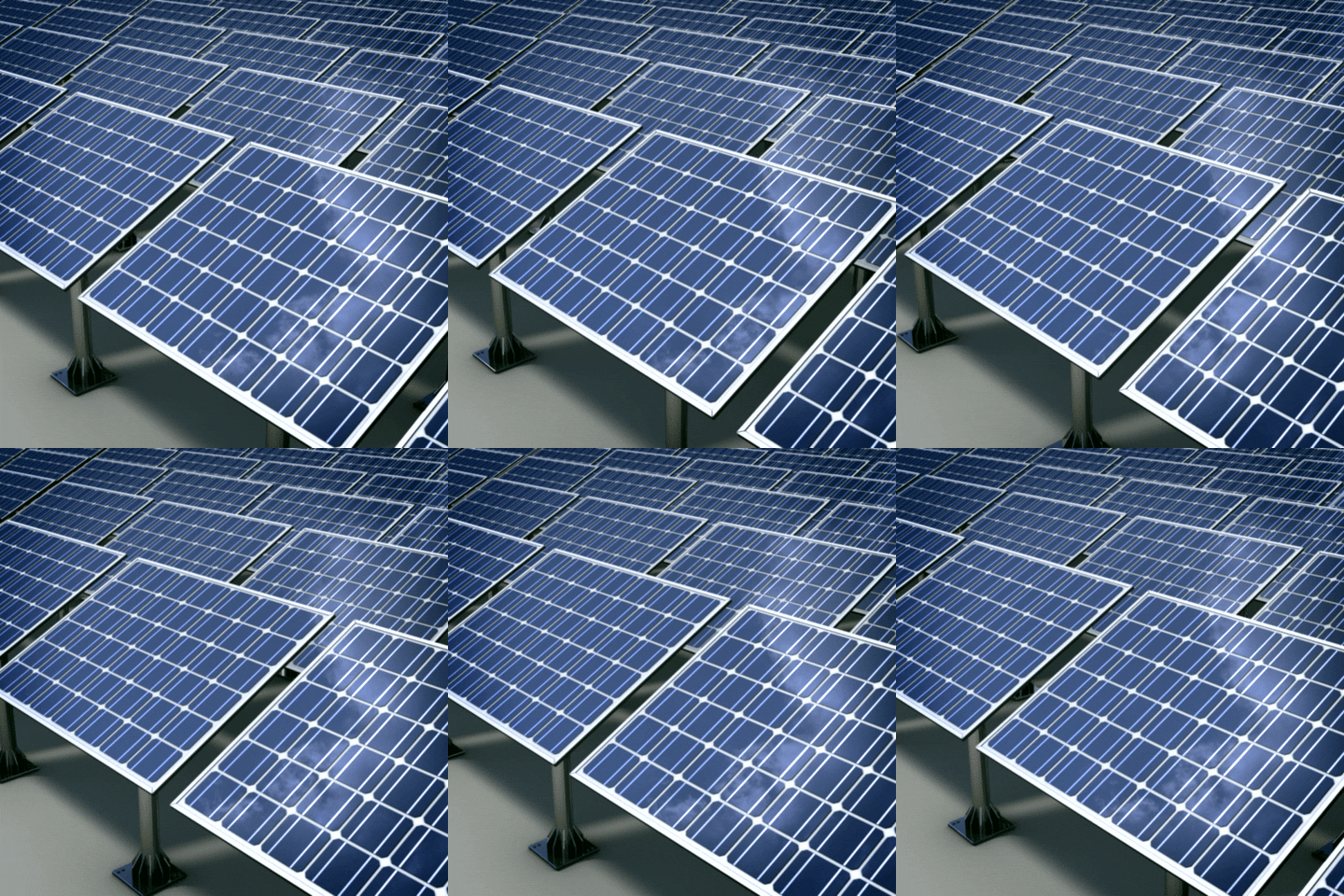
🔧 Deploy Solar + Battery Microgrids for Fuel-Independent Buildings
Thailand has 95 days of reserves. Pakistan is on a 4-day week. But buildings with rooftop solar and battery storage? They don’t care. The economics of solar-plus-storage just went from “nice to have” to “keeps the lights on when diesel runs out.” If you’re an installer, integrator, or even a consultant who can spec these systems, every commercial building owner in Southeast Asia is suddenly very interested in your phone number.
Example: A solar installer in Cebu, Philippines previously struggled to close deals with mall operators. This week he signed 3 contracts totaling $420K because building managers realized their backup diesel generators have maybe 2 months of fuel — and nobody’s sure when resupply comes.
💰 Build Energy Monitoring Dashboards for Rationing Compliance
Governments are mandating AC temperatures, elevator shutdowns, and reduced operating hours. Somebody has to verify compliance. IoT energy monitoring — smart meters, building management dashboards, real-time power consumption alerts — just became a regulatory requirement overnight. If you can build or deploy these systems, you’ve got government contracts waiting.
Example: A two-person IoT startup in Bangkok built a $12/month smart plug dashboard for restaurants tracking electricity use. After the Thai government’s energy mandates, the municipal government contracted them to monitor 200 government buildings for AC compliance — $86K contract, signed in 48 hours.
📱 Create Fuel Price & Availability Tracker Apps
When India suspended commercial LPG, restaurant owners had zero visibility into when supply would resume or where to find alternatives. Same story across the region for gasoline, diesel, and cooking fuel. A real-time fuel availability tracker — crowdsourced station data, price alerts, alternative fuel locations — is the GasBuddy moment for Southeast Asia. This is a straightforward mobile app with an API layer and crowdsourced data.
Example: A developer in Karachi built a WhatsApp bot that scrapes Pakistani government fuel allocation announcements and sends alerts to subscribed restaurant owners. 8,000 subscribers in 3 days, now monetizing with a $2/month premium tier for priority alerts. $16K MRR from a weekend project.
🛠️ Follow-Up Actions
| Step | Action | Tool/Resource |
|---|---|---|
| 1 | Track Hormuz closure status daily | IEA.org situation reports, Reuters energy desk |
| 2 | Monitor country-specific energy mandates | Government gazette feeds for TH, PH, VN, PK, IN, BD |
| 3 | Identify local partners in Southeast Asia | LinkedIn Sales Navigator, regional tech Slack groups |
| 4 | Price out solar + storage for commercial buildings | Aurora Solar (design), EnergySage (pricing benchmarks) |
| 5 | Set up remote work consulting packages | Bundle existing tools (Jitsi, Nextcloud, WireGuard) with setup services |
| 6 | Build or fork a fuel tracker MVP | Flutter/React Native + Firebase + crowdsourced data |
 Quick Hits
| Want to… | Do this |
|---|---|
 Understand the geopolitics Understand the geopolitics |
Read the IEA’s emergency oil release framework — it explains exactly how reserves get deployed and when they run out |
 Sell remote work tools in Asia Sell remote work tools in Asia |
Target Philippine BPOs and Vietnamese factories first — they have budget and immediate need |
 Go solar-independent Go solar-independent |
Check NREL’s PVWatts calculator for your region — commercial rooftop solar pays back in 3-5 years even without a crisis |
 Track the crisis Track the crisis |
Reuters Energy, S&P Global Platts, and the IEA weekly oil market reports — ignore Twitter speculation |
 Help with rationing compliance Help with rationing compliance |
Open-source building energy monitoring: OpenEnergyMonitor.org has everything you need |
Turns out the best argument for renewable energy wasn’t climate change — it was someone parking a warship in front of the gas station.
 !
!