 Test Cards + Tokens + 3DS + DIDs — One Desktop Tool Does It All Update 29.03.2026
Test Cards + Tokens + 3DS + DIDs — One Desktop Tool Does It All Update 29.03.2026 Generate Luhn-valid test cards with tokens, 3DS codes, biometrics, and DIDs — all from a desktop app you can run offline.
If you’ve ever tested a payment form, you’ve probably hit Namso Gen. It works. But it’s online-only, limited in features, and you’re trusting someone else’s server with your workflow. This tool runs locally, generates more data types, and gives you a proper GUI.
🧠 What Even Is a Test Card Generator?
Payment forms need testing. Real cards = real charges = real problems. Test cards = fake numbers that look valid to the form but can’t actually charge anyone.
How it works:
- Every card number follows the Luhn algorithm (a.k.a. Mod 10) — a checksum that catches typos
- The first 6-8 digits are the BIN/IIN — they identify the card network (Visa, Mastercard, etc.) and issuing bank
- Generators create numbers that pass Luhn validation but aren’t linked to real accounts
What you use them for:
- Testing checkout flows without risking real money
- Validating that your payment form rejects bad numbers
- Stress-testing payment systems with bulk data
- Learning how card validation actually works
What they DON’T do:
- Generate real card numbers with real balances
- Work for actual purchases (they’ll fail at the bank level)
- Give you anything illegal — these are test numbers, not stolen data
⚡ The Tool — Test Card Generator 2030
This is a Python + PyQt6 desktop app. You run it locally. No servers, no tracking, no rate limits.
What It Does
| Feature | What You Get |
|---|---|
| BIN input | Enter any 6-8 digit IIN, generates matching card type |
| Auto-detection | Visa, Mastercard, Amex, Discover, UnionPay, Crypto — detected from BIN |
| Correct lengths | Visa: 16 or 19, Amex: 15, Mastercard: 16 — handled automatically |
| CVV generation | 3 digits (most cards) or 4 digits (Amex) — auto-selected |
| Expiry dates | 2026+ with 1-10 year validity |
| Cardholder names | Random English names for realistic test data |
| Batch generation | Up to 200 cards at once |
| Save to file | Export everything to .txt |
Advanced Features (Checkboxes)
| Checkbox | What It Adds |
|---|---|
| Add tokens | Simulates Apple Pay / Google Pay / stablecoin tokenization |
| Add 3DS codes | 6-digit codes for 3D Secure authentication testing |
| Add biometric tokens | SHA-256 hash mimicking fingerprint/face ID tokens |
| Add dynamic CVV | Changes hourly (shows seed + explanation) |
| Add DID | Decentralized identifiers (did:ethr:..., did:key:..., did:web:...) |
Screenshots
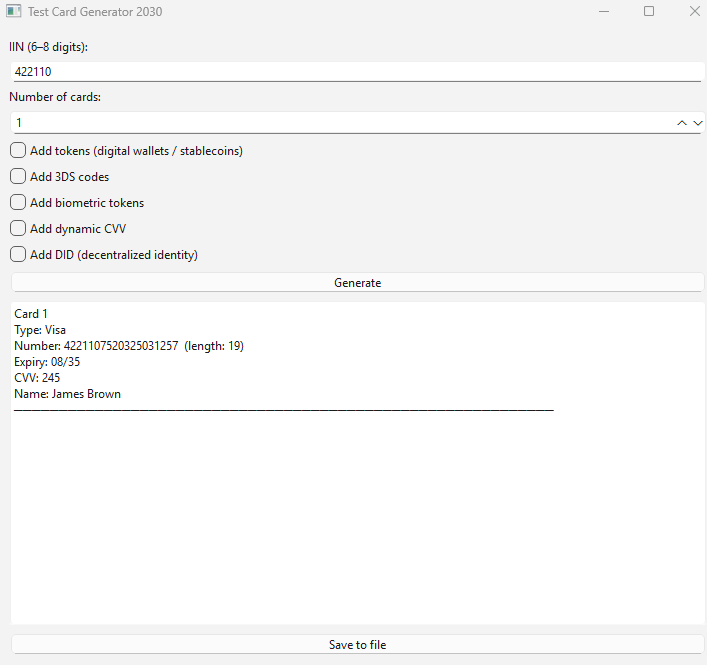
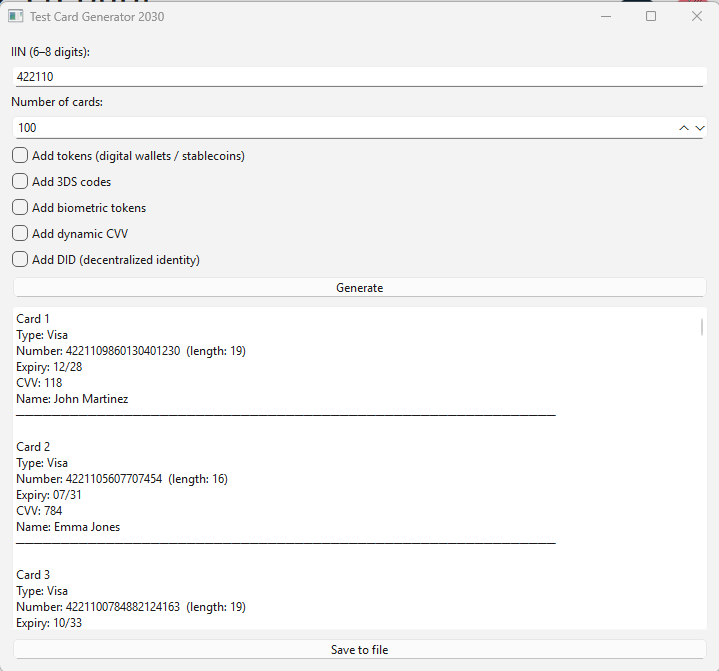

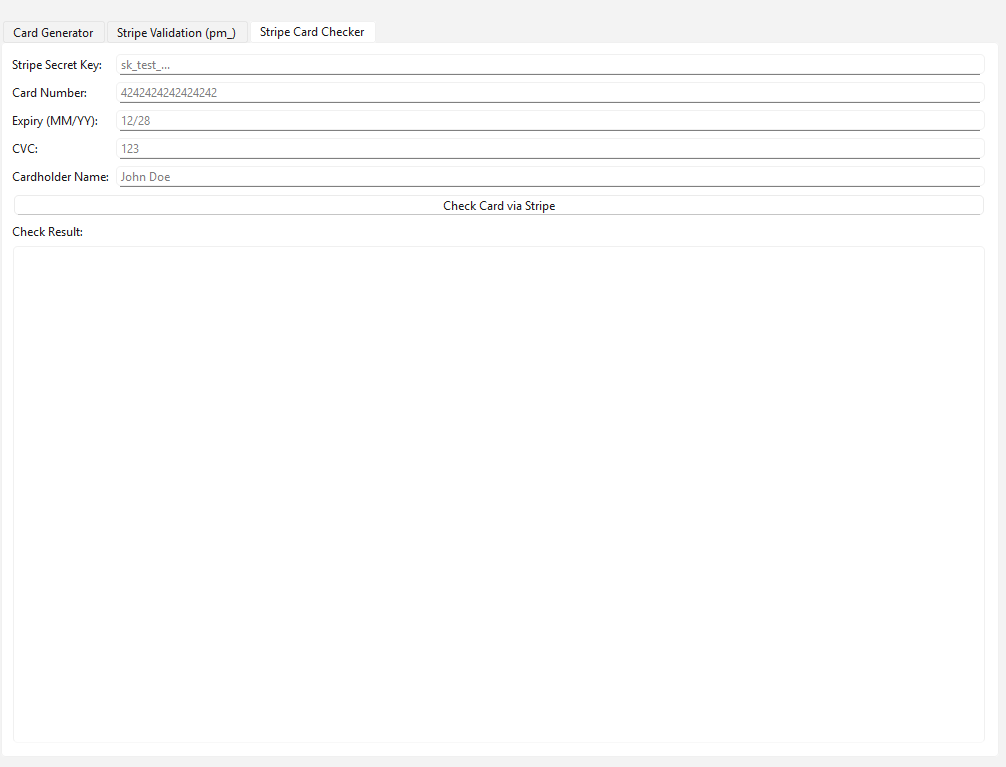
📋 The Full Script (Copy-Paste Ready)
Requirements: Python 3.9+ and pip install PyQt6 stripe
Save this as card_generator.py and double-click to run:
#!/usr/bin/env python3
import sys
import random
import hashlib
import os
from datetime import datetime
from typing import Optional

import stripe
from PyQt6.QtWidgets import (
    QApplication, QWidget, QVBoxLayout, QLabel, QLineEdit,
    QPushButton, QTextEdit, QSpinBox, QFileDialog,
    QMessageBox, QCheckBox, QTabWidget, QFormLayout, QHBoxLayout
)

# ====================== CARD GENERATOR FUNCTIONS ======================
def luhn_checksum(number_str):
    digits = [int(d) for d in number_str]
    for i in range(len(digits) - 2, -1, -2):
        digits[i] = sum(divmod(digits[i] * 2, 10))
    total = sum(digits)
    return (10 - (total % 10)) % 10


def determine_card_type(iin_prefix):
    iin_str = str(iin_prefix)
    if iin_str.startswith('4'):
        return 'Visa', [16, 19], 3
    elif iin_str.startswith('5') or iin_str.startswith('2'):
        return 'Mastercard', 16, 3
    elif iin_str.startswith('34') or iin_str.startswith('37'):
        return 'American Express', 15, 4
    elif iin_str.startswith('6'):
        return 'Discover', [16, 19], 3
    elif iin_str.startswith('62') or iin_str.startswith('81'):
        return 'UnionPay', [16, 19], 3
    elif iin_str.startswith('7'):
        return 'Crypto/Stablecoin', [16, 19], 3
    else:
        return 'Unknown', 16, 3


def generate_card_number(iin_prefix):
    iin_str = str(iin_prefix)
    if len(iin_str) < 6 or len(iin_str) > 8:
        raise ValueError("IIN must be 6-8 digits")

    card_type, length_range, _ = determine_card_type(iin_prefix)

    if isinstance(length_range, int):
        length = length_range
    else:
        length = random.choice(length_range)

    remaining_length = length - len(iin_str) - 1
    random_digits = ''.join(str(random.randint(0, 9)) for _ in range(remaining_length))
    partial_number = iin_str + random_digits
    checksum = luhn_checksum(partial_number + '0')
    return partial_number + str(checksum), length


def generate_expiry_date():
    base_year = 2026
    current_year = datetime.now().year
    start_year = max(current_year, base_year)
    expiry_year = start_year + random.randint(1, 10)
    expiry_month = random.randint(1, 12)
    return f"{expiry_month:02d}/{expiry_year % 100:02d}"


def generate_static_cvv(length=3):
    return ''.join(str(random.randint(0, 9)) for _ in range(length))


def generate_dynamic_cvv(seed, length=3):
    current_time = datetime.now().strftime("%Y%m%d%H")
    hash_input = f"{seed}{current_time}"
    hashed = hashlib.sha256(hash_input.encode()).hexdigest()
    return hashed[:length].upper()


def generate_biometric_token():
    bio_data = ''.join(random.choices('0123456789ABCDEF', k=32))
    return hashlib.sha256(bio_data.encode()).hexdigest()


def generate_did():
    method = random.choice(['ethr', 'key', 'web'])
    identifier = ''.join(random.choices('0123456789abcdef', k=40))
    return f"did:{method}:{identifier}"


def generate_cardholder_name():
    first_names = ["John", "Jane", "Alex", "Emily", "Michael", "Sophia", "David", "Olivia", "James", "Emma"]
    last_names = ["Doe", "Smith", "Johnson", "Williams", "Brown", "Jones", "Garcia", "Miller", "Davis", "Martinez"]
    return f"{random.choice(first_names)} {random.choice(last_names)}"


def generate_token(card_number):
    token_length = random.randint(16, 19)
    token_prefix = random.choice(['9', '8'])
    remaining = token_length - 1 - 4
    random_part = ''.join(str(random.randint(0, 9)) for _ in range(remaining))
    return token_prefix + random_part + card_number[-4:]


def generate_3ds_code():
    return ''.join(str(random.randint(0, 9)) for _ in range(6))


def generate_cards(iin_prefix, count, include_token=False, include_3ds=False,
                  include_biometric=False, include_dynamic_cvv=False, include_did=False):
    card_type, length_range, default_cvv = determine_card_type(iin_prefix)
    cards = []
    for _ in range(count):
        card_number, actual_length = generate_card_number(iin_prefix)
        expiry = generate_expiry_date()
        cvv_seed = random.randint(100000, 999999)
        cvv_length = default_cvv
        cvv = generate_dynamic_cvv(cvv_seed, cvv_length) if include_dynamic_cvv else generate_static_cvv(cvv_length)
        name = generate_cardholder_name()

        card = {
            'type': card_type,
            'number': card_number,
            'length': actual_length,
            'expiry': expiry,
            'cvv': cvv,
            'name': name
        }
        if include_dynamic_cvv:
            card['cvv_note'] = f"Dynamic (seed: {cvv_seed}, changes hourly)"
        if include_token:
            card['token'] = generate_token(card_number)
        if include_3ds:
            card['3ds_code'] = generate_3ds_code()
        if include_biometric:
            card['biometric_token'] = generate_biometric_token()
        if include_did:
            card['did'] = generate_did()
        cards.append(card)
    return cards


# ====================== CARD GENERATOR GUI ======================
class CardGeneratorGUI(QWidget):
    def __init__(self):
        super().__init__()
        self.setWindowTitle("Test Card Generator 2030")
        self.resize(720, 640)
        layout = QVBoxLayout(self)

        self.iin_label = QLabel("IIN (6–8 digits):")
        self.iin_input = QLineEdit()
        self.iin_input.setPlaceholderText("Example: 411111")

        self.count_label = QLabel("Number of cards:")
        self.count_input = QSpinBox()
        self.count_input.setMinimum(1)
        self.count_input.setMaximum(200)
        self.count_input.setValue(10)

        self.token_cb = QCheckBox("Add tokens (digital wallets / stablecoins)")
        self.threeds_cb = QCheckBox("Add 3DS codes")
        self.bio_cb = QCheckBox("Add biometric tokens")
        self.dyn_cvv_cb = QCheckBox("Add dynamic CVV")
        self.did_cb = QCheckBox("Add DID (decentralized identity)")

        self.generate_btn = QPushButton("Generate Cards")
        self.generate_btn.clicked.connect(self.generate)

        self.output = QTextEdit()
        self.output.setReadOnly(True)

        self.save_btn = QPushButton("Save to File")
        self.save_btn.clicked.connect(self.save_result)

        layout.addWidget(self.iin_label)
        layout.addWidget(self.iin_input)
        layout.addWidget(self.count_label)
        layout.addWidget(self.count_input)

        for cb in [self.token_cb, self.threeds_cb, self.bio_cb, self.dyn_cvv_cb, self.did_cb]:
            layout.addWidget(cb)

        layout.addWidget(self.generate_btn)
        layout.addWidget(self.output)
        layout.addWidget(self.save_btn)

    def generate(self):
        try:
            iin_text = self.iin_input.text().strip()
            if not iin_text:
                QMessageBox.warning(self, "Error", "Please enter IIN")
                return
            if not iin_text.isdigit():
                QMessageBox.warning(self, "Error", "IIN must contain only digits")
                return
            iin = int(iin_text)
            if len(str(iin)) < 6 or len(str(iin)) > 8:
                QMessageBox.warning(self, "Error", "IIN must be between 6 and 8 digits")
                return

            count = self.count_input.value()
            cards = generate_cards(
                iin, count,
                include_token=self.token_cb.isChecked(),
                include_3ds=self.threeds_cb.isChecked(),
                include_biometric=self.bio_cb.isChecked(),
                include_dynamic_cvv=self.dyn_cvv_cb.isChecked(),
                include_did=self.did_cb.isChecked()
            )

            out = ""
            for idx, card in enumerate(cards, 1):
                out += f"Card {idx}\n"
                out += f"Type: {card['type']}\n"
                out += f"Number: {card['number']} (length: {card['length']})\n"
                out += f"Expiry: {card['expiry']}\n"
                out += f"CVV: {card['cvv']}"
                if 'cvv_note' in card:
                    out += f" ({card['cvv_note']})"
                out += "\n"
                out += f"Name: {card['name']}\n"
                if 'token' in card:
                    out += f"Token: {card['token']}\n"
                if '3ds_code' in card:
                    out += f"3DS Code: {card['3ds_code']}\n"
                if 'biometric_token' in card:
                    out += f"Biometric Token: {card['biometric_token']}\n"
                if 'did' in card:
                    out += f"DID: {card['did']}\n"
                out += "─" * 60 + "\n\n"

            self.output.setPlainText(out)

        except ValueError as ve:
            QMessageBox.warning(self, "Input Error", str(ve))
        except Exception as e:
            QMessageBox.critical(self, "Error", f"{type(e).__name__}\n{str(e)}")

    def save_result(self):
        text = self.output.toPlainText().strip()
        if not text:
            QMessageBox.information(self, "Nothing to save", "Generate some cards first")
            return
        path, _ = QFileDialog.getSaveFileName(self, "Save As", "", "Text Files (*.txt);;All Files (*.*)")
        if path:
            try:
                with open(path, "w", encoding="utf-8") as f:
                    f.write(text)
                QMessageBox.information(self, "Success", "File saved successfully")
            except Exception as e:
                QMessageBox.critical(self, "Save Error", str(e))


# ====================== STRIPE VALIDATION TAB ======================
class StripeValidationTab(QWidget):
    def __init__(self) -> None:
        super().__init__()
        self.secret_input = QLineEdit()
        self.secret_input.setEchoMode(QLineEdit.EchoMode.Password)
        self.secret_input.setPlaceholderText("sk_test_... (or use STRIPE_SECRET_KEY env)")

        self.pm_input = QLineEdit()
        self.pm_input.setPlaceholderText("pm_... (PaymentMethod ID)")

        self.customer_input = QLineEdit()
        self.customer_input.setPlaceholderText("cus_... (optional)")

        self.output = QTextEdit()
        self.output.setReadOnly(True)

        run_button = QPushButton("Validate in Stripe")
        run_button.clicked.connect(self.validate_payment_method)

        form = QFormLayout()
        form.addRow("Stripe Secret Key:", self.secret_input)
        form.addRow("PaymentMethod ID:", self.pm_input)
        form.addRow("Customer ID:", self.customer_input)

        top = QHBoxLayout()
        top.addLayout(form)
        top.addWidget(run_button)

        layout = QVBoxLayout(self)
        layout.addLayout(top)
        layout.addWidget(self.output)

    def validate_payment_method(self) -> None:
        key = self.secret_input.text().strip() or os.getenv("STRIPE_SECRET_KEY", "").strip()
        pm_id = self.pm_input.text().strip()
        customer_id: Optional[str] = self.customer_input.text().strip() or None

        if not key:
            QMessageBox.warning(self, "Stripe", "Please enter Stripe test secret key.")
            return
        if not pm_id.startswith("pm_"):
            QMessageBox.warning(self, "Stripe", "PaymentMethod ID must start with 'pm_'")
            return

        try:
            stripe.api_key = key
            if customer_id:
                stripe.PaymentMethod.attach(pm_id, customer=customer_id)

            si = stripe.SetupIntent.create(
                payment_method=pm_id,
                customer=customer_id,
                confirm=True,
                payment_method_types=["card"],
                usage="off_session",
            )
            self.output.setPlainText(
                f"SetupIntent: {si.id}\n"
                f"Status: {si.status}\n"
                f"Customer: {si.customer or '-'}\n"
                f"PaymentMethod: {si.payment_method or '-'}"
            )
        except Exception as exc:
            QMessageBox.critical(self, "Stripe Error", str(exc))


# ====================== STRIPE CARD CHECKER TAB ======================
class StripeCardCheckerTab(QWidget):
    def __init__(self) -> None:
        super().__init__()

        self.secret_input = QLineEdit()
        self.secret_input.setEchoMode(QLineEdit.EchoMode.Password)
        self.secret_input.setPlaceholderText("sk_test_...")

        self.card_number = QLineEdit()
        self.card_number.setPlaceholderText("4242424242424242")

        self.expiry_input = QLineEdit()
        self.expiry_input.setPlaceholderText("12/28")

        self.cvc_input = QLineEdit()
        self.cvc_input.setPlaceholderText("123")
        self.cvc_input.setMaxLength(4)

        self.cardholder_input = QLineEdit()
        self.cardholder_input.setPlaceholderText("John Doe")

        self.output = QTextEdit()
        self.output.setReadOnly(True)

        check_button = QPushButton("Check Card via Stripe")
        check_button.clicked.connect(self.check_card)

        form = QFormLayout()
        form.addRow("Stripe Secret Key:", self.secret_input)
        form.addRow("Card Number:", self.card_number)
        form.addRow("Expiry (MM/YY):", self.expiry_input)
        form.addRow("CVC:", self.cvc_input)
        form.addRow("Cardholder Name:", self.cardholder_input)

        layout = QVBoxLayout(self)
        layout.addLayout(form)
        layout.addWidget(check_button)
        layout.addWidget(QLabel("Check Result:"))
        layout.addWidget(self.output)

    def check_card(self):
        key = self.secret_input.text().strip() or os.getenv("STRIPE_SECRET_KEY", "").strip()
        number = self.card_number.text().strip().replace(" ", "").replace("-", "")
        expiry = self.expiry_input.text().strip()
        cvc = self.cvc_input.text().strip()
        name = self.cardholder_input.text().strip()

        if not key:
            QMessageBox.warning(self, "Error", "Please enter Stripe Secret Key")
            return
        if not number or len(number) < 13:
            QMessageBox.warning(self, "Error", "Please enter a valid card number")
            return
        if not expiry or "/" not in expiry:
            QMessageBox.warning(self, "Error", "Expiry must be in MM/YY format")
            return

        try:
            mm, yy = map(int, expiry.split("/"))
            if yy < 100:
                yy += 2000
        except ValueError:
            QMessageBox.warning(self, "Error", "Invalid expiry date format")
            return

        try:
            stripe.api_key = key

            pm = stripe.PaymentMethod.create(
                type="card",
                card={
                    "number": number,
                    "exp_month": mm,
                    "exp_year": yy,
                    "cvc": cvc,
                },
                billing_details={"name": name} if name else None,
            )

            si = stripe.SetupIntent.create(
                payment_method=pm.id,
                confirm=True,
                payment_method_types=["card"],
                usage="off_session",
            )

            result = "✅ Card check passed!\n\n"
            result += f"PaymentMethod: {pm.id}\n"
            result += f"SetupIntent: {si.id}\n"
            result += f"Status: {si.status}\n"

            if hasattr(pm, 'card'):
                result += f"Brand: {pm.card.brand}\n"
                result += f"Last 4: {pm.card.last4}\n"
                result += f"CVC Check: {getattr(pm.card.checks, 'cvc_check', 'N/A')}\n"

            if si.status == "succeeded":
                result += "\nCard successfully verified"
            elif si.status == "requires_action":
                result += "\nAdditional action required (e.g. 3DS)"

            self.output.setPlainText(result)

        except stripe.error.CardError as e:
            self.output.setPlainText(f"❌ Card Error:\n{e.user_message}\nCode: {e.code}")
        except stripe.error.StripeError as e:
            self.output.setPlainText(f"❌ Stripe Error:\n{str(e)}")
        except Exception as e:
            QMessageBox.critical(self, "Unknown Error", str(e))
            self.output.setPlainText(f"Error: {str(e)}")


# ====================== MAIN UNIFIED WINDOW ======================
class UnifiedWindow(QWidget):
    def __init__(self) -> None:
        super().__init__()
        self.setWindowTitle("Unified App — Card Generator + Stripe Tools")
        self.resize(1020, 760)

        tabs = QTabWidget()
        tabs.addTab(CardGeneratorGUI(), "Card Generator")
        tabs.addTab(StripeValidationTab(), "Stripe Validation (pm_)")
        tabs.addTab(StripeCardCheckerTab(), "Stripe Card Checker")

        layout = QVBoxLayout(self)
        layout.addWidget(tabs)


def main() -> None:
    app = QApplication(sys.argv)
    window = UnifiedWindow()
    window.show()
    sys.exit(app.exec())


if __name__ == "__main__":
    main()
To run:
- Install Python 3.9+ from python.org
- Open terminal/cmd →
pip install pyqt6 - Save the script → double-click to run
🌐 Alternatives — Online Generators
If you don’t want to run Python locally, these web tools do similar things:
| Tool | What It Does | Link |
|---|---|---|
| Namso Gen | The OG. BIN-based generation, Luhn-valid, bulk export | namso.net |
| Multi-CC Gen | Multiple BINs at once, simpler interface | multi-cc-gen.web.app |
| BinCodes Generator | Generator + validator + BIN lookup combined | bincodes.com |
| TheNamsoGen | Bulk generation, CSV/JSON export, region-specific data | thenamsogen.com |
Why the desktop tool is still better:
- Works offline (no internet required after install)
- No rate limits or captchas
- Advanced features (tokens, 3DS, biometrics, DIDs) not available elsewhere
- Your data stays on your machine
🔧 GitHub Repos — Build Your Own
Want to modify or integrate this into your workflow? Here are open-source alternatives:
| Repo | Language | Stars | What It Does |
|---|---|---|---|
| python-cc-num-gen | Python | — | Simple class-based generator, Visa/MC/Amex/Discover |
| CreditCardGenerator | Swift | — | CLI tool with batch generation + file export |
| credit-card-generator (Node) | Node.js | — | npm package, Triple-DES CVV generation |
| CCGenerator | Python | — | Interactive CLI with performance modes |
| reNamso | HTML/JS | 31★ | Modern rewrite of Namso, no jQuery, clean code |
🔍 BIN Lookup APIs — Know Your Numbers
Before generating, you might want to look up what a BIN actually represents:
| API | Free Tier | What It Returns |
|---|---|---|
| binlist.net | 5/hour | Card brand, type, bank, country |
| HandyAPI BIN | Free with key | Updated weekly, 6-8 digit support |
| BinCodes API | Limited | XML/JSON, card validation |
| BINTable | 100/month | REST API, detailed issuer data |
| API-Ninjas BIN | Free tier | Brand, type, country, validity check |
❓ Common Questions
Q: Will these cards work for real purchases?
No. They pass Luhn validation (the checksum check) but fail at the bank level. There’s no account behind them.
Q: Is this legal?
Generating test numbers = yes. Using them for fraud = no. These are for testing payment forms, not stealing.
Q: What’s a BIN/IIN?
The first 6-8 digits of a card number. They identify the card network (Visa starts with 4, Mastercard with 5, etc.) and the issuing bank.
Q: Why do some Visa cards have 19 digits?
Visa supports both 16 and 19-digit numbers. The generator handles this automatically.
Q: What’s a dynamic CVV?
Some modern cards change their CVV periodically (often hourly) for security. The generator simulates this with a seed-based hash.
Q: What’s a DID?
Decentralized Identifier — a Web3/blockchain identity format. Useful for testing systems that use verifiable credentials.
New to BINs and how they actually work? This breaks it down from zero:
 Working BIN Masterclass
One script. Offline. More features than Namso. No excuses.


 thank you
 !
!