 The EU Just Set Aside €2 Billion for Open Source — and Wrote 29 Pages Telling You How to Grab It
The EU Just Set Aside €2 Billion for Open Source — and Wrote 29 Pages Telling You How to Grab ItBrussels looked at America’s tech stack, said “yeah no thanks,” and decided to fund the free-software nerds instead. Honestly, didn’t see that one coming.
€2 billion over 7 years. 29 of 29 pages soaked in open source. Public money becomes the #1 customer. Real laws hit Parliament autumn 2026.
The Open Source Initiative (the folks who literally define what “open source” legally means) read the EU’s new Tech Sovereignty package and said over a third of it is about free, shareable software. That’s not a footnote. That’s a plan.

🧩 Dumb Mode Dictionary
| Term they use | What it actually means |
|---|---|
| Open source | Software where anyone can see the recipe and use it free (think Linux, the thing running most of the internet you never see) |
| Tech sovereignty | EU wanting to not depend on US companies (Microsoft, Google, Amazon) for everything |
| Software steward | A person/group who keeps a free project alive and patched. New EU rules give them duties — and now, money |
| OSPO | “Open Source Program Office” — a government desk whose whole job is using and funding free software (code.europa.eu is the EU’s own GitHub) |
| Public money, public code | If taxpayers pay for software, the code should be open for taxpayers. Wild concept, I know |
| Anchor consumer | The big reliable customer everyone wants. EU just volunteered to BE that for open source |
| Erasmus+ | The EU program that pays students to travel and study abroad — now it covers open-source learners too |
📜 What Brussels actually announced
Honestly, governments “supporting open source” usually means a press release and a free pizza at one conference. This is different (I know, I always say that). The receipts:
- €2 billion mobilized over seven years for an Open Source Maintenance Instrument + the European Competitiveness Fund
- The public sector pledges to become the anchor consumer — meaning city halls, schools, and ministries get pushed to buy/use open source first
- Open Source Business Accelerators — free mentorship, legal/licensing help, and marketing support for FOSS startups
- Erasmus+ cash to cover travel for people learning open-source dev and attending community meetups
- Master’s degree programs in open-source collaboration and community governance
- Laws expected at the European Parliament by autumn 2026 — full strategy doc here
🗺️ How we got here
Okay but seriously — this didn’t fall from the sky. For a decade the EU has watched its hospitals, courts, and schools run on software owned by a handful of American giants. One pricing change in Seattle and a whole country’s budget moves.
Then the Cyber Resilience Act (a security law) scared open-source maintainers — suddenly unpaid volunteers worried they’d get legally liable for the free code millions depend on. The community screamed. The EU, instead of ignoring them, actually… listened? And wrote a “stewardship toolkit” plus real funding to back it. The OSI’s breakdown calls it most of their wishlist granted.
🧮 The receipts (numbers that matter)
| Thing | Number |
|---|---|
| Pages in the doc | 29 |
| Share about open source | Over 1/3 |
| Money on the table | €2 billion |
| Over how many years | 7 |
| Laws reach Parliament | Autumn 2026 |
| EU’s own code platform | code.europa.eu |
| Travel funding source | Erasmus+ |
🗣️ What the timeline's saying
- The maintainers: cautiously hyped — “they finally get that one guy in Nebraska holds up the whole internet” (the famous xkcd 2347 energy)
- The skeptics: “€2B over 7 years across 27 countries is… €10M a year per country. Cute, not Microsoft money.”
- The critics at TechPolicy.Press: the real test is execution, not the PDF
- The gaps OSI flagged: no formal open-source expert group yet, no tax-deduction guidance for donors. Half a win, not a clean sweep.
Cool. Brussels Is Handing Out Free-Software Money… Now What the Hell Do We Do? (•̀ᴗ•́)و
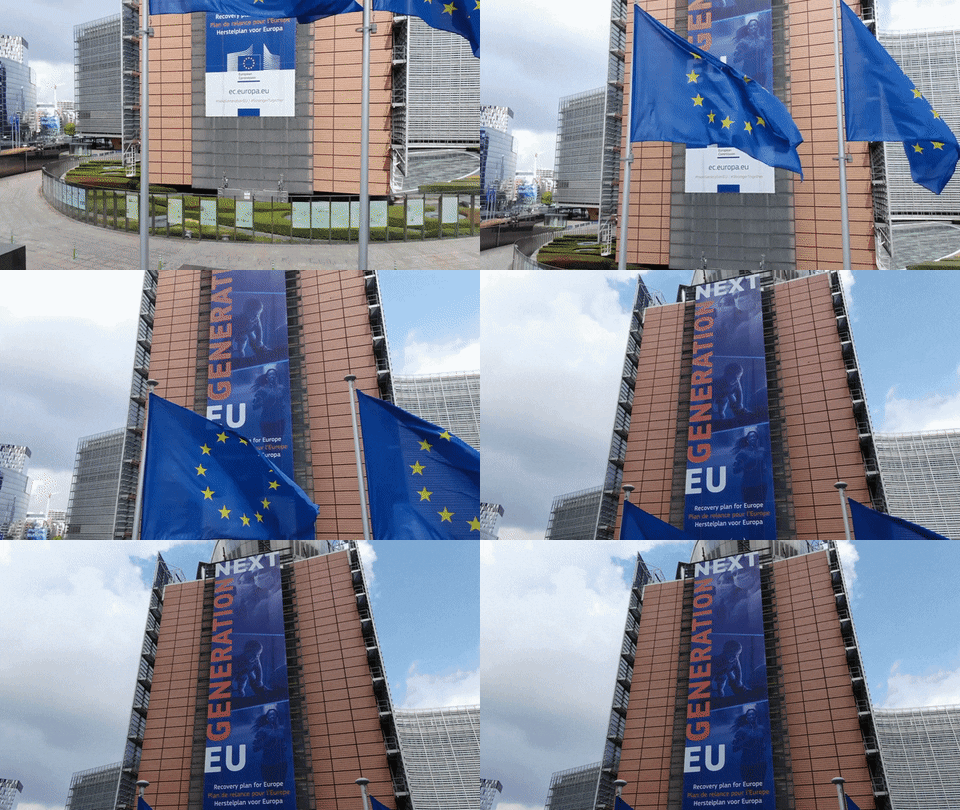
Here’s the thing nobody tells you: when a government writes a 29-page plan with €2 billion attached, the money doesn’t go to whoever “deserves” it. It goes to whoever shows up prepared the day the window opens. Most people will read the headline, nod, and do nothing. You’re not most people. Five ways to actually catch some of this — legal, real, and time-sensitive.
🪟 The Grant Window Sprint
The €2B fund and the “software steward” rules go live around autumn 2026. There’s a gap right now where almost nobody has positioned their project to qualify. First movers who already have a tidy, documented open-source repo on code.europa.eu or GitHub — with a clear maintainer and a license — are first in line when the Open Source Maintenance Instrument opens applications.
 Example: A 29-year-old dev in Kraków, Poland maintains a small but genuinely-used logistics library. Instead of waiting, he writes a clean README, adds a security policy, registers it on the EU platform, and drafts a one-page steward proposal NOW — so when the fund opens he submits day one instead of scrambling. Early maintenance grants in similar EU pilots have run €5K–€30K per project.
Timeline: Prep work pays off the week the fund opens (target autumn 2026). The easy-money window slams shut within ~6 months once every maintainer in Europe figures it out.
🎓 The Erasmus Free-Ride Loophole
Everyone thinks Erasmus+ is for 19-year-olds drinking in Barcelona. The new strategy quietly extends it to open-source learners — covering travel and stay for traineeships and community meetups. Translation: the EU will literally pay your way to go contribute to a project in another country and call it education.
Example: A 22-year-old comp-sci student in Cluj, Romania applies for Erasmus+ mobility funding to attend a FOSDEM-style open-source gathering and do a 2-month traineeship with a German FOSS org. Flights, housing, and a stipend covered — she walks out with contributions on her GitHub, a network, and zero debt.
🏛️ Bait the Suits (Public Money, Public Code)
The EU just made every government office an “anchor consumer” for open source. That means thousands of city halls, schools, and clinics are about to be told to switch off expensive US software — and most of them have no clue how. The bridge: take a mature free tool (Nextcloud, LibreOffice, Matrix) and sell the boring part — setup, migration, training, support — to a town that can’t do it themselves.
Example: A 34-year-old sysadmin in Porto, Portugal packages Nextcloud migration-as-a-service for small municipalities. The software’s free; the hand-holding isn’t. He charges a flat setup fee + monthly support per office. Public procurement loves a local vendor with the “sovereignty” buzzword on the invoice.
🧩 Be the Dictionary for 'Software Steward' Compliance
New rules = new confusion = new vocabulary nobody understands yet. The CRA’s “software steward” duties and the EU’s “stewardship toolkit” are about to make thousands of maintainers panic about whether they’re legally compliant. First person to publish the clear, plain-English cheatsheet owns the search results for years.
Example: A 27-year-old in Tallinn, Estonia builds a free, dead-simple “Am I a software steward? What do I owe?” guide + checklist, links every official EU doc, and ranks #1 on Google for the term. Monetize with a paid compliance-review template, consulting upsell, or sponsorship from a hosting company wanting eyeballs. Being the SEO anchor for a new term is criminally underrated.
🛠️ Sell Picks and Shovels to the Accelerators
Everyone’s gonna chase the €2B directly. Boring move. The smart play: the EU is funding Open Source Business Accelerators that need mentors, legal/licensing reviewers, and marketing help. Be the supplier to the gold rush, not another panner. License auditing especially — half of FOSS startups have no idea if their dependencies are even legally clean.
Example: A 31-year-old in Berlin offers a fixed-price “open-source license & dependency audit” (using free tools like FOSSA or ScanCode) aimed at startups entering EU accelerator programs. Each accelerator cohort = a batch of clients who all need the same thing at the same time. Productized service, repeatable, no chasing one giant grant.
🛠️ Follow-Up Actions
| If you want to… | Do this |
|---|---|
| Track the actual law | Bookmark the EU Open Source Strategy page |
| Read the OSI’s full take | OSI’s welcome post |
| Park a project where the EU sees it | Push code to code.europa.eu |
| Find a community meetup to fund | Check FOSDEM + local Linux user groups |
| Understand the scary security law | Skim the Cyber Resilience Act page |
 Quick Hits
| You want | You do |
|---|---|
 First crack at the €2B fund First crack at the €2B fund |
Clean up your repo + draft a steward proposal before autumn 2026 |
 Free EU-funded travel Free EU-funded travel |
Apply for Erasmus+ open-source mobility |
 Government clients Government clients |
Package a free tool’s setup + support for local councils |
 SEO ownership SEO ownership |
Publish the first plain-English steward compliance guide |
 Steady income, no grant chase Steady income, no grant chase |
Sell audits/services to EU accelerator cohorts |
Brussels printed 29 pages and €2 billion. Most people will read zero of them. Be the weirdo who reads page 14 and shows up early.
 !
!