 50 Free Tools That Replaced Software Worth Thousands — And the Insane Stories Behind Them
50 Free Tools That Replaced Software Worth Thousands — And the Insane Stories Behind ThemEvery tool on this list was built by someone too stubborn, too broke, or too angry to pay.
Most “free alternatives” lists give you a name and move on. This one tells you why each tool exists, who built it, the trick that makes it better than the paid version — and what nobody mentions in the feature comparison.
Some of these tools were born from crashed homework. Others from billion-dollar corporate spite. A few were built by a single person in a small apartment who now earns millions. The paid software industry doesn’t want you to know how good the free side has gotten — because in at least five categories, the free tool has already won.
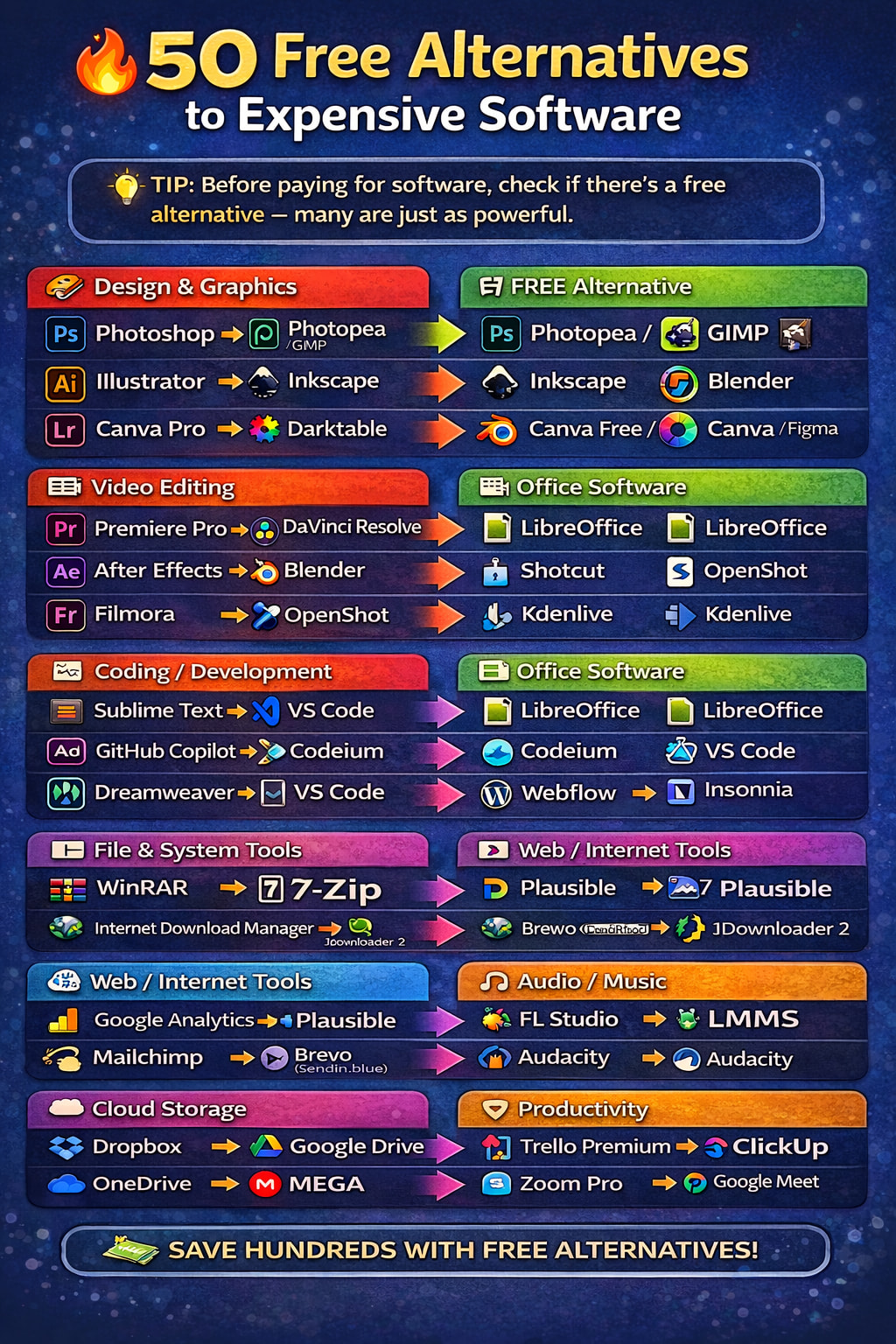
🎨 Design & Graphics — Where Crashed Homework Beats $600/Year Subscriptions
1. Photoshop → Photopea / GIMP
Photopea — Built entirely by one Ukrainian developer (Ivan Kutskir) living in Prague. Zero employees. Hosting cost: $700/year. Revenue: $3M+/year from ads alone. Opens actual .PSD files in your browser — no install, no account. He rejected every acquisition offer, saying: don’t sell even if they offer 1000x your earnings.
Trick: Photopea runs 100% client-side. Your files never touch a server. Open a private browser tab → your edits are invisible. Also reads .sketch, .xd, and .fig files — formats the paid tools can’t even open from each other.
GIMP — Exists because a college homework assignment crashed. Two UC Berkeley students in 1995 had their LISP compiler fail so badly they rage-built an image editor in C instead. They accidentally created GTK (GIMP ToolKit) in the process — the toolkit that runs the entire GNOME Linux desktop. The name came from watching Pulp Fiction.
Filters → Script-Fu → Console) lets you batch-process hundreds of images with one command. Resize 500 product photos in 30 seconds — something Photoshop charges $264/year to do manually.
2. Illustrator → Inkscape
Forked in 2003 from a dead project called Sodipodi because the original developer wouldn’t accept patches. The version numbers used to reflect SVG compliance percentage (0.91 = 82% compliant). NASA and the Open Clip Art Library use it for technical illustrations.
Extensions → Generate from Path → Voronoi Diagramcreates organic, professional patterns that look like you paid a designer. Export as SVG → scales to billboard size with zero quality loss.
3. Lightroom → Darktable
Created by Johannes Hanika — a researcher at Weta Digital (the VFX studio behind Avatar and Lord of the Rings). He couldn’t find a RAW photo editor for Linux that didn’t suck, so he made one. Name = “darkroom” + “lighttable.” His day job was rendering CGI for Hollywood; his side project was giving away pro photography tools for free.
filmic rgbmodule handles dynamic range recovery better than Lightroom’s highlight slider in most test comparisons. Shoot RAW → import →filmic rgbwith auto-tune → you’ll recover shadow detail Lightroom clips.
4. Canva Pro → Canva Free / Figma
Figma almost became a meme generator. Founder Dylan Field (child actor, booked Windows XP commercials at age 5) dropped out of Brown on a Thiel Fellowship. On the application, his controversial opinion was: “Chocolate is repulsive.” His co-founder was nicknamed “Computer Jesus.” Product took 4 years to build. Adobe tried to buy it for $20B — regulators blocked it, Adobe paid a $1B breakup fee. Figma IPO’d at $68B.
5. CorelDRAW → Inkscape — Same tool as #2. Handles .CDR import via UniConvertor plugin.
6. Sketch → Figma — Same tool as #4. Figma killed Sketch’s market share so thoroughly that Sketch dropped its subscription model in desperation.
7. Affinity Designer → Inkscape / 8. Affinity Photo → GIMP + Krita
Krita deserves its own story. It was renamed twice because a German trademark troll sued them. The final name mixes Swedish (krita = crayon), the word rita (to draw), and Sanskrit kṛta (made). Its maintainer has stewarded it for 20+ years. French artist David Revoy creates an entire open-source webcomic (Pepper & Carrot) using only Krita — when a publisher offered a traditional deal, he insisted on Creative Commons. The publisher’s legal team was so confused they eventually agreed and became Krita’s top financial patron.
View → Wrap Around Mode) lets you paint seamless textures — game developers use this daily. It’s a $0 tool doing what $50/month tools charge for.
🎬 Video Editing — The $800,000 Software That Became Free
9. Premiere Pro → DaVinci Resolve
This is the single most absurd price drop in software history. DaVinci Resolve cost $200,000–$800,000 in the 2000s — it was physical hardware bolted to color correction rooms in Hollywood. Films colored on it: Avatar, Star Wars, La La Land, Game of Thrones. In 2009, Blackmagic Design (founded by Australian telecine engineer Grant Petty) bought the dying company and released it for free. No watermarks. No time limits. Full-quality export. The paid Studio version is a one-time $295. Premiere Pro costs $264/year, every year, forever. Petty, now a billionaire, still personally writes SQL code for his company’s internal systems.
10. After Effects → Blender
In 2025, a film rendered entirely in Blender won the Oscar for Best Animated Feature, beating Pixar and Disney. But here’s the real story: when Blender’s parent company went bankrupt in 2002, investors held the source code hostage. Creator Ton Roosendaal ran one of the world’s first crowdfunding campaigns (7 years before Kickstarter existed) and raised €100,000 in seven weeks. The community literally bought the code’s freedom. Name came from a song by Swiss electronic band Yello. The monkey head in every Blender tutorial? Named Suzanne — after the orangutan in Jay and Silent Bob Strike Back. It was an Easter egg snuck in during the bankruptcy chaos.
11. Final Cut Pro → Shotcut — Built on the MLT multimedia framework. Cross-platform (Mac, Windows, Linux). No account required, no trial period. Just works.
12. Filmora → OpenShot — Created by Jonathan Thomas as a Linux-first editor. Intentionally simple.
13. Vegas Pro → Kdenlive — Part of the KDE project. Its proxy editing workflow handles 4K on hardware that would make Premiere Pro cry.
Project → Project Settings → Proxy). Edit in low-res, render in full-res. This is how Netflix editors handle 8K footage — and you get it free.
14. Camtasia → OBS Studio
Started as a StarCraft cheat. Hugh “Jim” Bailey wanted to see more of the minimap by capturing part of his screen. He was, in his own words, “a complete bum living with his dad” — self-taught since age 8, no degree, no job history. Posted it to the StarCraft subreddit in 2012. Now ~60% of all live streamers use it. He turned down seven-figure acquisition offers because it wouldn’t be good for users. He bombed a Twitch interview so badly he describes it as a joke.
Settings → Output → Recording → MKV format(never MP4 — if OBS crashes during MP4 recording, the file corrupts). Remux to MP4 after:File → Remux Recordings.
🧑💻 Coding & Development — The Gang of Four Defector
15. Sublime Text → VS Code
Built by Erich Gamma — one of the legendary “Gang of Four” who wrote the most influential programming book in history. The irony: Gamma previously led Eclipse at IBM, which was literally named to “eclipse” Visual Studio. Then he joined Microsoft. VS Code started as a failed browser editor with 3,000 users. Now it has 75.9% market share among developers. It killed GitHub’s Atom editor so thoroughly that Microsoft (who bought GitHub) archived Atom entirely.
16. GitHub Copilot → Codeium / Windsurf
Co-founders Varun Mohan and Douglas Chen met in middle school. Built GPU infrastructure (Exafunction), raised $28M, then killed the entire company over a single weekend when they realized AI would eat their market. Pivoted to an AI coding assistant. Hit 300,000 users within a year. OpenAI acquired them (now renamed Windsurf) for $3 billion in 2025 — a middle-school friendship turned into one of OpenAI’s largest deals.
17. Webflow → WordPress
Matt Mullenweg started WordPress at 18, forking an abandoned blog tool after its developer literally vanished. A friend suggested the name. Every release is named after a jazz musician — Mullenweg studied saxophone and once paid for server costs by playing gigs. WordPress now powers 43% of all websites. Plot twist: in 2024, Mullenweg called his biggest customer “a cancer,” blocked 200,000+ websites from updates, and seized a plugin without consent. 159 employees quit. Jury trial: February 2027.
18. Dreamweaver → VS Code — Same as #15. With Live Server extension, you get hot-reload that makes Dreamweaver feel prehistoric.
19. Postman → Insomnia (or Bruno)
Cautionary tale: creator Gregory Schier built Insomnia solo, grew it to $20K/month, sold to Kong Inc. after burning out. Kong then required mandatory cloud accounts overnight — users who auto-updated got locked out of their own saved data. The GitHub issue was titled “enshittification / needing an account.” Community forked it into Insomnium (named after a Finnish death metal band). The migration chain developers now describe: Postman → Insomnia → Bruno.
20. TablePlus → DBeaver
The name was a mystery for 14 years. In 2024, they finally explained: DB (database) + Beaver — because beavers build dams (like DBAs), work with trees (relational databases have tree structures), and “eager beaver” means hardworking. Creator Serge Rider started it as a 2010 hobby project. Now has 8 million users. When they launched the commercial version, their first license sold the next day — a community member just wanted to say thanks.
right-click database → View Diagram) visualizes your entire database schema instantly. This alone replaces paid database modeling tools.
🧾 Office Software — The Corporate Spite Fork
21. Microsoft Office → LibreOffice
Born from pure rage at Oracle. When Oracle bought Sun Microsystems in 2010, they’d already killed OpenSolaris and sued Google over Java. The OpenOffice community saw the writing on the wall. On September 28, 2010, The Document Foundation announced LibreOffice. They raised the €50,000 incorporation fee in eight days. 95% of the original OpenOffice community defected. Oracle, out of apparent spite, dumped the codebase on the Apache Foundation rather than give it to the people who actually built it. LibreOffice now has 200+ million users.
Tools → AutoCorrect Options → Localized Options → uncheck everythingremoves LibreOffice’s annoying auto-formatting. Also: save as.docxby default (Tools → Options → Load/Save → General → Always save as: Microsoft Word 2007-365).
22. Notion AI → Obsidian
Founded by Shida Li and Erica Xu, who left Dynalist because they wanted local-first, offline-capable note-taking that you actually own. All your notes are plain markdown files on your hard drive — no server, no lock-in. If Obsidian disappears tomorrow, your notes still work in any text editor.
[[backlinks]]+ daily notes + the Dataview plugin. Treat it like a personal search engine for your brain.
23. Evernote → Joplin
Named after ragtime pianist Scott Joplin because creator Laurent Cozic was obsessed with ragtime music while building it. He uses Joplin to store sheet music on his tablet for piano practice. The project partnered with carbon.eco to reforest four hectares of French forest. All notes encrypted end-to-end if you want. Sync via Dropbox, OneDrive, or your own server.
24. Grammarly Premium → LanguageTool
Started as a 2003 German university thesis by Daniel Naber, who also built the German thesaurus inside LibreOffice. He maintained it for 22 years in his spare time. Ironic detail: nobody on the development team is a native English speaker. Despite this (or because of it), LanguageTool checks 30+ languages — Grammarly only does English.
25. PowerPoint → LibreOffice Impress — Same as #21. Impress handles .pptx files. For serious presentations, pair with Slidev (markdown-powered slides for developers).
📂 File & System Tools — The One-Man Army and the Political Scandal
26. WinRAR → 7-Zip
Igor Pavlov has maintained this alone for 25+ years. He created both the tool and the LZMA compression algorithm. Doesn’t use Git — distributes through SourceForge, which is basically a digital fossil. When asked what his “official work” is, he replied: “I work only for 7-Zip. So it’s my official work.” He placed the LZMA SDK into the public domain — one of the most generous licensing decisions in compression history. Due to sanctions, PayPal won’t process Russian accounts, making even donations logistically painful.
Add to archive → 7z format → LZMA2 → Ultra → Solid archive. Files compress 10-30% smaller than .rar.
27. CCleaner → BleachBit
Built in 2008 because a backup annoyed its creator. Stayed obscure until 2016, when a congressman declared on national TV that Hillary Clinton’s team used BleachBit to wipe emails “where even God can’t read them.” Creator Andrew Ziem responded by selling microfiber cloths printed with Clinton’s face — called “Cloth or Something.” They sold out repeatedly. BleachBit was never subpoenaed.
--shredflag overwrites deleted files, making forensic recovery extremely difficult. CCleaner was acquired by Avast and started bundling adware — BleachBit has zero bundleware.bleachbit --previewshows what it’ll delete before it deletes anything.
28. Internet Download Manager → JDownloader 2 — Community-driven, open-source, handles mega.nz, mediafire, and premium link generators automatically. Solves CAPTCHAs itself.
Settings → Reconnect → LiveHeaderlets JDownloader cycle your IP to reset download limits on file hosts — legally questionable, technically effective.
29. Total Commander → Double Commander — Near-identical dual-pane file manager. Cross-platform. Same keyboard shortcuts.
30. Daemon Tools → WinCDEmu — Mounts ISO/IMG/BIN with one click. No toolbars, no ads, no nonsense. The installer is 2 MB.
🌐 Web & Internet Tools — The Anti-Google and the Breach Survivor
31. Google Analytics → Plausible
Estonian developer Uku Täht was asked to set up Google Analytics and simply asked “Can we use something else?” Found nothing. Built Plausible. Cold-emailed Croatian marketer Marko Saric after reading his “De-Google Your Life” blog post. They’ve never met in person. Saric’s first blog post about Plausible hit #1 on Hacker News and doubled their revenue in one day. They hit $1M ARR with zero investors and zero paid ads.
32. Mailchimp → Brevo (formerly Sendinblue) — Free tier: 300 emails/day. Enough for most small businesses. The rebrand from Sendinblue was a 2023 identity reset.
33. LastPass → Bitwarden / 34. 1Password → Bitwarden
Kyle Spearrin had never built a mobile app or browser extension when he started Bitwarden as a side project in 2015. Then LastPass got breached in 2022 — attackers stole encrypted vaults, unencrypted user info, and even website URLs. LastPass also had trackers in its Android app and admits to selling data in its privacy policy. Bitwarden: zero breaches ever, fully open-source, $10/year for premium vs. LastPass’s $36/year. 10 million+ users across 180 countries.
35. Hootsuite → Buffer — Free tier handles 3 social channels. For more: Mixpost (self-hosted, unlimited channels).
🎧 Audio & Music — The PhD Dropout, the Spy Scandal, and the Floppy Disk DAW
36. FL Studio → LMMS
Includes synthesizer emulations of the Commodore 64 SID chip, Nintendo NES, and Game Boy sound hardware. You can make chiptune music in a free DAW. Cross-platform, no sign-up, and surprisingly deep once you learn the piano roll.
.sf2SoundFont files. Download free orchestral SoundFonts → load into LMMS → you have a full orchestra. No $200 sample library needed.
37. Adobe Audition → Audacity
Created in 1999 by Carnegie Mellon grad student Dominic Mazzoni — who originally wanted software that transcribes recordings into sheet music. He never finished his PhD (too busy building the editor). Went on to work at NASA’s Jet Propulsion Lab and Google. Hobbies: ballroom dancing and riding a unicycle. Downloaded 114 million+ times. When Muse Group acquired it in 2021 and tried adding telemetry (with a privacy policy mentioning “our main office in Russia”), the community exploded. A fork called Tenacity appeared overnight.
Effect → Noise Reductionis Audacity’s hidden superpower. Step 1: select a silent section (just background noise) →Get Noise Profile. Step 2: select entire track → apply. This removes fan hum, AC buzz, and room noise — studio-quality cleanup for $0.
38. Ableton Live → Tracktion Waveform Free
Julian Storer built a DAW so small it fit on a floppy disk in 2002. Mackie bought the rights — then abandoned it, going silent after 2008. Storer reacquired control in 2013 and resurrected it. But here’s the bigger story: the C++ audio code he wrote for Tracktion became JUCE — the industry-standard framework for building audio plugins. One person created both a free DAW and the underlying framework the entire pro audio industry uses. His escape from tech? Playing classical music.
39. Sound Forge → Ocenaudio — Built at the Federal University of Santa Catarina in Brazil — a coastal island city, hence “ocean” in the name. Lightning-fast waveform editing with real-time preview of every effect.
📁 Cloud Storage — The Most Cinematic Arrest in Tech History
40. Dropbox → Google Drive — 15 GB free. You already have a Google account.
41. OneDrive → MEGA
Born from the most cinematic law enforcement raid in tech history. January 20, 2012 — the day before Kim Dotcom’s 38th birthday — 76 armed officers and two helicopters hit his $30M rented mansion in New Zealand. Dotcom (6’7", ~300 lbs) locked himself in a safe room; officers cut through. Seized: 18 luxury cars (vanity plates: “HACKER,” “GUILTY,” “MAFIA,” “GOD”), $175M in cash, 64 frozen bank accounts. For perspective, the bin Laden raid used ~24 Navy SEALs. One year later — timed to the anniversary — Dotcom launched MEGA with end-to-end encryption by default. The domain was supposed to be me.ga, but Gabon’s government canceled the registration. He was the #1 ranked Call of Duty: Modern Warfare 3 player in the world at the time of his arrest. 20 GB free.
mega-sync /local/folder /remote/folderruns on a cron job = free encrypted cloud backup.
42. iCloud Storage → pCloud — Swiss-based. Ran a $100,000 hacking challenge: 2,860 hackers tried, none succeeded. Offers a lifetime plan (one payment, storage forever) — the only major cloud storage that does.
🧠 Productivity — The Failed Game, the $12B Rejection, and the Gun-to-Head Pivot
43. Trello Premium → ClickUp / 44. Monday.com → ClickUp
Founder Zeb Evans cites three near-death experiences as pivotal — including a jet-ski accident at 10 and a home invasion where a gun was pointed at his forehead. He dropped out of Virginia Tech the next day. ClickUp was supposed to be a safer Craigslist — but everyone was more interested in their internal project management tool. They pivoted. Bootstrapped to $10M ARR before raising money. $4B valuation by 2021.
45. Slack → Discord / Mattermost
Discord exists because a mobile game flopped. Jason Citron sold his previous company for $104M, then built Fates Forever (iPad MOBA) — gorgeous game, almost no players. Co-founder Stan Vishnevskiy assembled the world’s #1 ranked Final Fantasy XI team as a teenager. Discord launched with 10–20 daily users. Growth hack: a friend posted in a Final Fantasy subreddit, redditors joined, talked to the founders live, then told everyone “the devs are in there.” Now: 259M monthly active users, 78% non-gaming. They rejected Microsoft’s $12B acquisition offer.
Mattermost was the internal chat tool for a video game company. When they pivoted, the chat tool was more interesting than the games. Now used by the European Parliament, NASA, and the U.S. Air Force. Context: the U.S. Army previously used mIRC (a decades-old IRC client) to coordinate military operations.
46. Zoom Pro → Google Meet — Was enterprise-only until April 2020. COVID made Google open it up — scaling 30x in three months, adding 3 million users per day. Free tier: 60-minute meetings, 100 participants.
47. Calendly → Cal.com
Peer Richelsen was broke, sleeping on his friend’s couch in Germany, when he googled “Calendly open source” and found nothing. So he built it. His first business? Selling plastic sleeves for Magic: The Gathering cards that went viral on Reddit. He paid co-founder Bailey Pumfleet $5,000 for two weeks of work. They bought the three-letter domain Cal.com — noting it saves “62.5% of typing.”
🖼 Media & Utilities — The Steam Screenshot Tool and the Sheep Shepherd
48. HandBrake Alternative → Shutter Encoder — French-made. Goes beyond HandBrake: converts audio, creates image sequences, burns subtitles, extracts audio from video. One tool replaces three.
49. Adobe Acrobat → PDF24 Creator
Created by Berlin engineer Stefan Ziegler, who started coding at 17. The team’s about page calls him “the keeper of the many, many sheep” — the project’s mascot symbolizes growth from a “small lamb.” No premium tier. No ads in the software. Downloaded 10.5M+ times on Chip.de alone. User rating: 4.88/5. Over 25 PDF tools in one free package.
50. Snagit → ShareX
In continuous development for 19 years by Turkish developer Jaex. One of the only productivity tools available on Steam (“Free to Play,” 94% positive rating). Does screenshots, screen recording, GIFs, scrolling capture, OCR text recognition, auto-upload, color picker, QR code scanner, and file sharing — all free, all in one tool.
Capture region → Add watermark → Upload to Imgur → Copy link to clipboard— all triggered by one hotkey. Automates what takes 5 manual steps in paid tools.
 Quick Hits — Your Situation → What to Use
| Want This | Use This | Why This One Wins |
|---|---|---|
 Edit photos for free Edit photos for free |
→ Photopea | Opens in browser, reads .PSD files, no install |
 Edit video like Hollywood Edit video like Hollywood |
→ DaVinci Resolve | Was $800K, now free, used on actual films |
 Code editor Code editor |
→ VS Code | 76% of devs use it — or VSCodium for no telemetry |
 Password manager Password manager |
→ Bitwarden | Zero breaches vs. LastPass’s catastrophic hack |
 Office suite Office suite |
→ LibreOffice | 200M users, born from corporate spite |
 Record/edit audio Record/edit audio |
→ Audacity | 25 years old, 114M downloads, still the standard |
 Stream/record screen Stream/record screen |
→ OBS Studio | 60% of all streamers, built by one person |
 File compression File compression |
→ 7-Zip | Better compression ratio than WinRAR, 25 years running |
 Encrypted cloud storage Encrypted cloud storage |
→ MEGA | Zero-knowledge encryption, 20 GB free |
 Screenshots + recording Screenshots + recording |
→ ShareX | Does everything Snagit does, plus OCR, GIFs, and workflows |
Behind every free tool is someone who chose obsession over a paycheck. The least you can do is stop paying Adobe.
 !
!