 The Hidden Guide Inside You — How Your Body Already Does the “Impossible” (And How to Actually Use It)
The Hidden Guide Inside You — How Your Body Already Does the “Impossible” (And How to Actually Use It)Your cells can regenerate. Your gut already predicts the future. Your brain builds a survival companion when you need one most. Here’s how to recognize these abilities — and stop ignoring them.
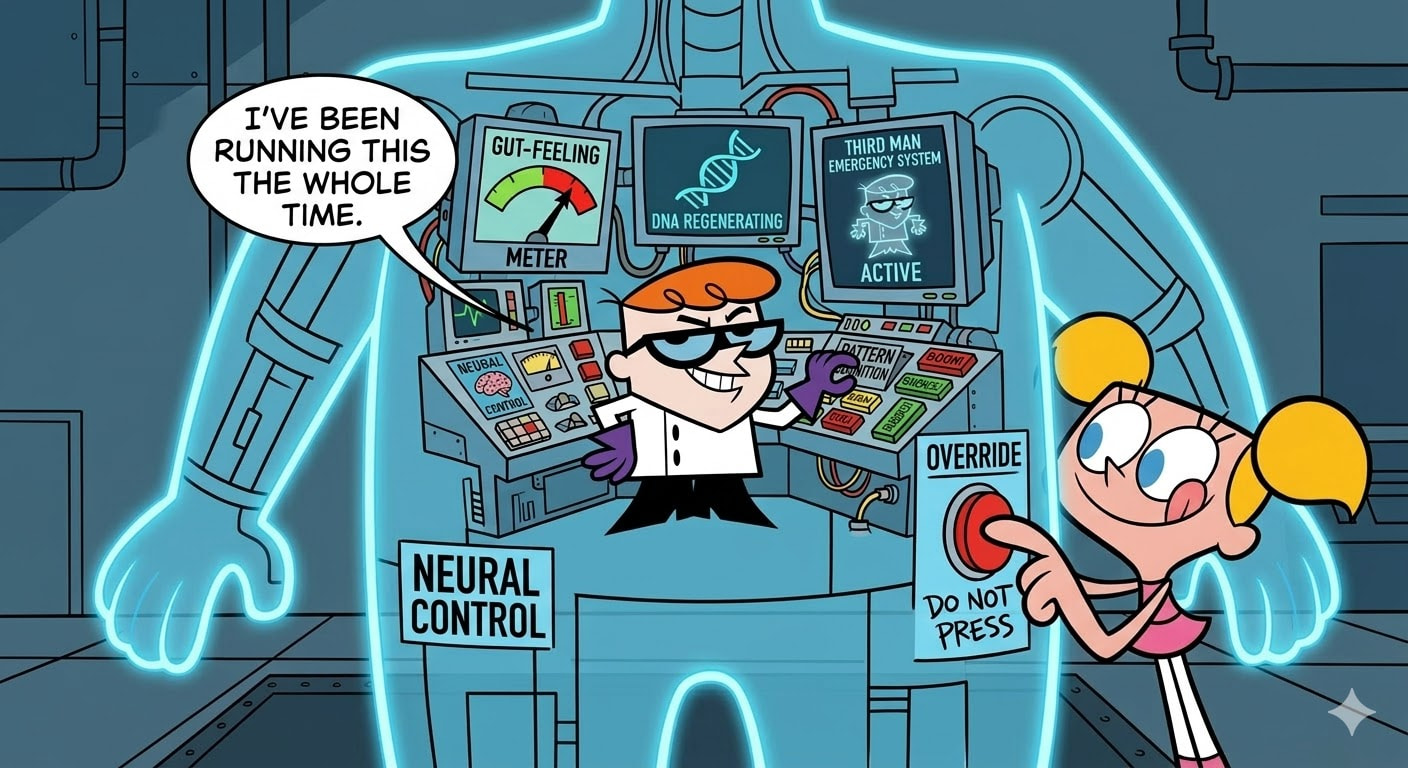
You’ve already experienced most of this. That gut feeling that saved you from a bad decision. That moment where your body reacted before your brain caught up. That eerie sense of someone “with you” during the worst night of your life.
These aren’t glitches. They’re features. Documented, studied, and increasingly understood — and most people go their entire lives without realizing their body is doing extraordinary things right now. This isn’t a list of cool science facts. This is a field guide to recognizing what’s already happening inside you, understanding why it works, and learning how to stop getting in its own way.
🔄 Your Cells Already Know How to Regenerate — You Just Keep Interrupting Them
What this looks like in your life: You heal slower than you used to. A cut takes weeks instead of days. You feel “older” in ways you can’t quite describe. Your body seems to be running down.
What’s actually happening: Your cells have the same regeneration toolkit as organisms that literally cannot age — you just have it turned down. Way down.
A jellyfish called Turritopsis dohrnii does something your cells technically can do but don’t: when damaged or stressed, it hits full factory reset. Adult cells revert to juvenile cells. Old becomes young. The molecular switches it uses? Yamanaka factors — the exact same transcription factors scientists are now using to reprogram human cells in labs.
Your body has these factors. Right now. They’re just silenced.
Hydra — a tiny freshwater organism — uses a transcription factor called FoxO to maintain indefinite self-renewal. The human version, FoxO3a, is one of the strongest genetic markers of people who live past 100. A 2026 finding flipped expectations: the immortal Hydra species lacks the anti-aging genes its mortal cousin has — suggesting longevity isn’t about adding special genes, but about organizing the ones you already have.
What this means for you: Your cells aren’t missing the regeneration hardware. They’re running software that actively suppresses it — mostly as cancer protection. The cutting-edge research isn’t about adding something new to your body. It’s about carefully turning back on what’s already there.
The naked mole-rat — the first mammal to break the mathematical law that says death probability increases with age — lives 10× longer than its body size predicts. It has seven separate cancer-defense systems. Its cells can detect the loss of a single tumor suppressor and self-destruct.
Your cells have most of these same defense pathways. They’re just less organized.
What you can actually do with this right now:
The research points in one direction: your body prioritizes repair when you stop flooding it with damage signals.
| What the Science Shows | What That Means for You |
|---|---|
| The immortal jellyfish upregulates DNA repair while suppressing cell division during regeneration | Repair happens when growth pressure stops — fasting and caloric restriction research mirrors this exact pattern |
| FoxO3a (the human version of Hydra’s immortality gene) is activated by metabolic stress | Intermittent fasting, exercise, and caloric restriction all activate FoxO3a pathways |
| Naked mole-rats have ultra-stable epigenomes that resist corruption | Sleep, stress reduction, and avoiding chronic inflammation protect epigenomic stability — this isn’t wellness fluff, it’s the same mechanism |
| The PEARL trial (2025) showed low-dose rapamycin is safe and improves lean tissue in women | mTOR inhibition — the pathway rapamycin targets — is also triggered naturally by fasting and exercise. You’re already doing it. You could be doing it more deliberately |
The single biggest lesson from immortal organisms: They don’t add magic ingredients. They remove accumulated damage and let repair systems work. The Conboy lab at UC Berkeley proved this in mammals — replacing 50% of old mouse blood plasma with saline (literally salt water) produced better muscle repair, less liver damage, improved brain function, and reversed biological age markers. Not young blood. Not a drug. Dilution of the bad stuff.
What’s overhyped vs what actually works:
| Substance | The Claim | What the Data Actually Says |
|---|---|---|
| NMN supplements | Reverses aging | Reliably raises NAD+ levels, but a 2024 meta-analysis of 12 trials found most real outcomes no different from placebo |
| Resveratrol | Activates longevity genes | Debunked. GSK shut down a $720M acquisition after 5 years. Save your money |
| Rapamycin | Slows aging via mTOR | Most robust clinical evidence in the longevity space — PEARL trial confirms safety, lean tissue gains. But it’s a prescription drug, not a supplement |
| Fasting / caloric restriction | Activates repair pathways | Activates FoxO, triggers autophagy, reduces mTOR signaling — the same pathways the expensive drugs target. Free. Available now |
Evidence quality: Cellular regeneration mechanisms = mainstream molecular biology. Conboy plasma dilution = peer-reviewed, clean methodology. FoxO3a centenarian association = robust genetics. Supplement claims = mostly overhyped, check the table above.
🎭 You Are Not One Person — And That's a Superpower, Not a Disorder
What this looks like in your life: You act differently around different people. You’ve surprised yourself with a skill you didn’t know you had. You’ve felt like “a different person” after a major life event. Your handwriting changes with your mood.
What’s actually happening: Your brain doesn’t have a fixed identity. It constructs one — from scratch, every moment. And that construction is way more flexible than you think.
The most dramatic proof: people with Dissociative Identity Disorder don’t just act differently across identities. Their bodies physically change:
| What Changes Between Identities | Documented Evidence |
|---|---|
| Vision | Different eyeglass prescriptions — measurable changes in refraction, pupil size, and eye pressure |
| Allergies | One identity drinks orange juice fine, another breaks out in hives — switching identities makes hives vanish instantly |
| Blood pressure | 150/110 in one personality, 90/60 in another |
| Handedness | Switches between identities |
| Brain activity | Distinct neural patterns on fMRI |
Same body. Radically different physiological states. Triggered by which identity is “driving.”
This isn’t a disorder lesson — it’s a capability demonstration. Your brain already controls your blood pressure, your immune response, your allergies, your pain threshold. DID proves these systems are more controllable than medicine traditionally assumed. The identity that’s “in charge” literally changes the body’s physical state.
How to use identity flexibility deliberately:
Your brain naturally shifts identity states depending on context — you’re a different “you” at work vs home vs emergencies. Most people do this unconsciously. The research suggests doing it deliberately produces measurable physical changes:
-
Ellen Langer’s “Counterclockwise” study (1979): Elderly men who lived as their younger selves for a week showed improved memory, flexibility, hearing, and vision. Their bodies physically responded to the identity shift.
-
Placebo research is fundamentally identity research: when you believe you’re someone who received medicine (vs someone who didn’t), your body produces measurable chemical responses. That’s not the pill working — that’s your identity state changing your physiology.
-
Performance psychologists have known this for decades: elite athletes use identity anchoring — shifting into a specific mental persona before competition. The persona isn’t acting. It triggers different physiological states: lower cortisol, sharper reaction times, higher pain thresholds.
The darker side — why this matters for protection:
The same flexibility that makes you adaptable also makes you vulnerable. Deepfake volume grew from 500K in 2023 to ~8 million in 2025. Human detection accuracy for high-quality video deepfakes: 24.5% — worse than coin flip. A Hong Kong employee transferred $25M to scammers using a deepfake of the company’s CFO. Voice cloning now needs only seconds of audio.
Your identity flexibility is a feature. Others’ ability to exploit it is the threat. The research-backed defense: verify through a separate channel. Never trust voice or video alone for high-stakes decisions. The technology to fake identity has surpassed the human ability to detect fakes.
Evidence quality: DID physiological changes = documented, peer-reviewed. Langer’s counterclockwise study = replicated with variations. Placebo physiology = gold-standard medical science. Deepfake detection failure = industry-verified.
🧠 Your Gut Already Predicts the Future — Here's How to Stop Ignoring It
What this looks like in your life: A bad feeling about a person that turns out to be right. Pulling your hand back from a hot stove before you consciously feel the heat. Knowing the answer to something without knowing how you know it. A “hunch” about a decision that you can’t explain but that turns out to be correct.
What’s actually happening: Your body processes information faster than your conscious mind — and it communicates through physical sensations you’ve been trained to dismiss.
The uncontroversial science (this is gold-standard cognitive research):
Antonio Damasio’s Iowa Gambling Task proved it in a lab: participants’ skin conductance spiked before they chose from “bad” card decks — before they could consciously articulate which decks were dangerous. The body knew. The mind hadn’t caught up yet.
Gary Klein studied 134 firefighter decisions: 87% were made through pattern recognition — not analytical comparison. Experienced firefighters don’t weigh options. Their bodies register “this feels wrong” and they move. The conscious explanation comes after.
Gerd Gigerenzer’s research at Max Planck: simple gut-based decision rules regularly outperform complex statistical models. German students outperformed Americans at predicting U.S. city sizes — because knowing less forced them to rely on recognition-based intuition, which was more accurate than analysis.
They’re not irrational. They’re pre-rational. They arrive before your conscious mind can put them into words.
How to use this deliberately:
| The Signal | What It Probably Means | What to Do |
|---|---|---|
| Stomach tightens around a person or decision | Your body recognized a pattern associated with past negative outcomes | Don’t dismiss it. Ask yourself: “What does this person/situation remind me of?” Often the connection surfaces |
| Sudden urge to leave a place | Unconscious threat detection — your peripheral vision and hearing caught something your conscious mind didn’t | Trust it first, analyze later. Klein’s firefighter research shows this impulse saves lives |
| “I just knew” the right answer | Pattern recognition from accumulated experience — the same system that makes expert chess players see the right move instantly | This gets stronger with deliberate practice in any domain. The “10,000 hours” research is about building this exact system |
| Physical discomfort when someone is lying | Micro-expression detection — your brain registers facial incongruencies at speeds below conscious awareness | You’re already a lie detector. You just need to stop talking yourself out of what you noticed |
The knowledge that’s already IN you (and how to access it):
Acquired savant syndrome proves something unsettling: extraordinary abilities can emerge instantly when the brain’s filtering systems are disrupted. Jason Padgett — a college dropout — was mugged in 2002 and immediately began seeing mathematical fractals everywhere, developing abilities usually associated with years of training. Derek Amato hit his head in a pool and four days later played complex piano for five hours. Never played before.
Allan Snyder used transcranial magnetic stimulation to temporarily suppress the left temporal lobe — the brain’s “editor.” None of 28 volunteers could solve a classic puzzle. After stimulation, >40% solved it. The knowledge was already there. The brain was actively hiding it.
Your ancestors left you molecular notes:
The Dias and Ressler experiment (2013, Nature Neuroscience): mice conditioned to fear a cherry-blossom smell produced grandchildren with the same fear response and enlarged scent-detecting neurons — despite never encountering the smell. IVF ruled out learning. The information was written in molecular ink on their DNA through altered methylation patterns.
What this means: Some of your fears, attractions, and aversions may not be “yours” — they may be inherited survival data from ancestors who learned something the hard way. That inexplicable fear of a specific thing? It might be useful information from someone who didn’t survive it.
A 2019 follow-up showed extinction training could reverse the inherited fear in offspring — meaning these inherited patterns aren’t permanent. They can be overwritten with new experience.
The contested frontier (be honest about what’s unproven):
Presentiment research (Radin, Mossbridge) shows the body reacting to future emotional stimuli before they’re presented — skin conductance, heart rate, and pupil dilation all spike. Meta-analysis across 26 studies from 20 labs: effect size 0.21, p < 2.7 × 10⁻¹². Statistically robust. Theoretically implausible. Artifact explanations not fully eliminated. This is the frontier — fascinating, not yet reliable enough to act on.
Evidence quality: Damasio gut-feeling science = gold standard. Klein’s firefighter pattern recognition = gold standard. Acquired savant syndrome = documented, ~90 cases. Transgenerational epigenetic inheritance = peer-reviewed, replicated. Presentiment = statistically interesting, contested.
👻 The Guide That Appears When You Need It Most — It's You, Protecting Yourself
What this looks like in your life: A voice in your head that says “get up” when you want to quit. A sense of someone “with you” during the worst moment. An inner calm that appears from nowhere during a crisis and disappears when it’s over. The feeling that something is guiding you through a situation you shouldn’t be able to handle.
What’s actually happening: Your brain has an emergency system that, under extreme stress, generates a separate “companion” presence to guide you through survival situations. It has a name: the Third Man Factor. It’s been documented hundreds of times. And it might be the most practically useful thing your brain does.
The strongest cases:
- Shackleton’s 1916 Antarctic crossing. Three men independently sensed a fourth companion during a 36-hour traverse of unmapped mountains. Shackleton said nothing — then Worsley volunteered the same perception, then Crean. Three-way corroboration from experienced, unsentimental explorers.
- Ron DiFrancesco — last person out of the South Tower on 9/11. Collapsed on the 84th floor. An unseen voice said “Get up!” He felt a physical presence leading him to the stairs. It vanished at the 76th floor.
- Frank Smythe — 1,000 feet from Everest’s summit, 1933. Sensed a companion so vividly he broke off a piece of mint cake to offer to his invisible partner.
The pattern is remarkably consistent: the presence is almost always benevolent. It stands behind or beside you. It gives practical guidance. It vanishes when the crisis passes.
How it works (Olaf Blanke cracked it in 2014):
His team built a robot that pokes your back with a 500-millisecond delay from your own finger movement. Within three minutes, participants felt a “presence” behind them. Some counted up to four ghosts. Some asked to stop.
The mechanism: when sensorimotor signals conflict — you’re exhausted, oxygen-deprived, seeing nothing but white, putting one foot in front of another — your brain generates a second body representation. You perceive it as “someone else.” But it’s your own survival processing, externalized into a character you can take orders from.
How to recognize it and work with it:
| What You Experience | What’s Happening | What to Do |
|---|---|---|
| A “voice” telling you to keep going during physical/emotional extremity | Your brain externalized its survival calculations as an audible instruction | Listen to it. This is your deepest processing making itself heard because your conscious mind is too overwhelmed to receive it normally |
| A calm “presence” during a crisis that vanishes afterward | Sensorimotor mismatch under stress generated a companion — your own processing wearing a mask | Don’t question it during the crisis. It’s doing exactly what it’s designed to do. Process it afterward |
| An inexplicable sense that “someone is watching over you” during hardship | Could be the same mechanism at lower intensity — subclinical Third Man activation | The research says 10% of all people report vivid sensory experiences of absent beings (SPR Census, confirmed in modern surveys). This is common enough to be normal |
| Inner dialogue that feels like “advice from someone wiser” | Could be right-hemisphere survival processing perceived as a separate entity (Jaynes’ bicameral hypothesis) | The content of the advice is what matters — is it practical? Is it calming? Is it pushing you toward survival? Then it’s working |
The cross-cultural universality confirms it’s biological, not cultural:
Greek daimon. Hindu ishta-devata. Buddhist bodhisattva. Indigenous vision-quest spirits. Aboriginal dreamtime guides. Every human culture independently developed a concept of an inner/emergency guide — because every human brain has the same hardware. Culture names it. The brain generates it.
Evidence quality: Third Man documentation = extensive, multi-case, cross-corroborated. Blanke’s mechanism = experimentally demonstrated, published in Nature. Cross-cultural universality = consistent with neuroscience. Jaynes’ bicameral hypothesis = theoretical framework, not confirmed.
🌊 The Spaces Between Things Are Where Everything Happens — And Your Life Works the Same Way
What this looks like in your life: The biggest changes happen during transitions — between jobs, between relationships, between who you were and who you’re becoming. You’re most creative at the boundaries of disciplines, not in the center of one. Your best ideas come when you’re between activities, not during them.
What’s actually happening in nature: Wherever two different things meet without fully merging, extraordinary things happen. This isn’t metaphor. It’s documented physics and biology — and the pattern scales from rivers to your own life.
The Meeting of Waters near Manaus, Brazil — the Rio Negro (black, acidic, warm, slow) meets the Rio Solimões (brown, neutral, cool, fast). They run side by side for 6 km without mixing. Combined, they carry 20% of Earth’s freshwater.
Why they don’t mix: density differences, temperature gaps, flow rate mismatches. Each water body maintains its identity while being transformed by proximity to the other.
But here’s the part that matters: the boundary — the exact line where two different things touch — is where all the interesting stuff happens.
| Boundary | What Happens There |
|---|---|
| River confluences | Fish diversity significantly exceeds mainstream communities (2025 eDNA study). The boundary is richer than either river alone |
| Hydrothermal vents (400°C meets near-freezing) | Organism densities 10,000–100,000× greater than surrounding ocean. Some of the oldest life on Earth (4.28 billion years) started here |
| Brine pool shorelines (deep-sea “underwater lakes”) | The pool itself is instant death. But at the precise chemical gradient of its edge? Unique ecosystems thrive — organisms found nowhere else on Earth |
| Cenote haloclines (freshwater over saltwater) | The boundary creates a shimmering mirror-like layer where unique chemistry enables unique biology |
How to apply the confluence principle deliberately:
Victor Turner’s observation about liminal spaces: they share “the suspension of normal rules, a sense of ambiguity, and the potential for transformation.” This maps directly to:
- Career transitions — the period between jobs isn’t dead time. It’s a confluence. Two professional identities meeting. The research on creativity shows ideas most often come at the intersection of disciplines, not within them
- Discomfort zones — the feeling of being “between things” — not expert and not beginner, not the old you and not yet the new you — is the exact condition that produces growth. The boundary is where the biodiversity is
- Relationship transitions — the space between who you were with someone and who you are without them isn’t emptiness. It’s a liminal zone. The work happens there, not before or after
- Learning boundaries — the most powerful learning happens at the edges of what you know. Two knowledge domains meeting. This is why cross-disciplinary thinkers consistently outperform specialists at novel problem-solving
The WWII lesson: 62 German U-boats exploited the density boundary in the Strait of Gibraltar to drift into the Mediterranean with engines off — invisible to sonar because the density interface between water layers blocks detection. The boundary protects what’s moving through it.
Evidence quality: Pycnocline physics = textbook. Biodiversity at confluences = 2025 peer-reviewed eDNA studies. Liminality as a concept = well-established anthropology. Application to personal transitions = pattern-based, not experimentally tested on humans.
⚛️ You Can't Be in Two Places at Once — But You Can Hold Two Truths at Once
What this looks like in your life: Holding contradictory beliefs simultaneously. Being genuinely two different people in two different contexts. The tension of being “between” decisions where both options feel equally real.
What physics actually says: At the quantum level, particles genuinely exist in superposition — in two states simultaneously. But not the way pop science sells it. A particle in superposition doesn’t have two definite positions. It exists as a probability distribution — undefined until measured.
Think of it this way: the particle hasn’t decided which room it’s in until you open the door. Not knowing isn’t a limitation. It’s the actual state.
The 2025 record: University of Vienna achieved superposition of >7,000 sodium atoms at positions 133 nanometers apart. The team is working toward small viruses next. But for a human body? Decoherence at room temperature kills quantum superposition in 10⁻²⁰ seconds. Physics won’t let us bilocate.
But here’s what IS useful:
The cognitive version of superposition — holding two contradictory ideas simultaneously without collapsing into one — is one of the strongest predictors of creative and intellectual capacity.
| Cognitive Superposition Skill | What It Does for You |
|---|---|
| Integrative complexity (Suedfeld & Tetlock) | People who evaluate issues from multiple perspectives simultaneously make better predictions and decisions than those who collapse to one view |
| Dialectical thinking (Peng & Nisbett) | The ability to accept apparent contradictions without forcing resolution is associated with better interpersonal outcomes and more adaptive worldviews |
| Negative capability (Keats → Bion → modern psychology) | Tolerance for uncertainty without “irritable reaching after fact and reason” is a trainable skill associated with creativity and reduced anxiety |
Evidence quality: Quantum superposition = Nobel-winning physics. Cognitive integrative complexity = robust political/cognitive psychology. Dialectical thinking research = cross-cultural, replicated. Physical bilocation for humans = impossible at room temperature.
 The Field Guide — Quick Reference
| When You Experience… | What’s Actually Happening | Trust It? | How to Use It |
|---|---|---|---|
 Gut feeling about a person or decision Gut feeling about a person or decision |
Unconscious pattern recognition — your body processed thousands of micro-signals | Yes. 87% of expert decisions use this system | Stop overriding it with “logic.” Investigate what it’s telling you |
 A calm presence or voice during a crisis A calm presence or voice during a crisis |
Third Man Factor — your brain externalized survival processing as a companion | Yes. It’s your deepest intelligence talking | Listen to it during the crisis. Analyze it after |
 Feeling like a “different person” in different contexts Feeling like a “different person” in different contexts |
Identity flexibility — your brain constructs identity moment to moment | Normal. DID proves the range is wider than you think | Map your “modes.” Learn to activate the useful ones deliberately |
 Discomfort during a life transition Discomfort during a life transition |
You’re in a confluence zone — where two things meet, the most growth happens | Productive. Don’t rush through it | Use the boundary. Nature’s richest ecosystems are at edges, not centers |
| Sudden unexpected ability or insight |
Suppressed capability surfaced because your mental “editor” relaxed | Yes. Allan Snyder’s TMS research confirms it | Structure time for flow states, tired-brain creativity, and inner-critic shutdowns |
 A fear that doesn’t match your experience A fear that doesn’t match your experience |
Possibly transgenerational epigenetic inheritance — molecular notes from ancestors | Worth examining. But context may no longer apply | Acknowledge it, evaluate whether it’s still relevant, and update if needed |
 Tension from holding two contradictory truths Tension from holding two contradictory truths |
Cognitive superposition — the undefined state before collapse | Valuable. Don’t rush to resolve it | Sit in the tension. Better answers come from holding both than choosing prematurely |
Everything you need is already inside you. The regeneration hardware. The pattern-matching instincts. The emergency companion. The identity flexibility. The only thing missing is the manual — and now you have it.
 !
!