 90+ Amateur Cameras Are Tracking Every Fireball in Europe’s Sky — You Can Build One for $150
90+ Amateur Cameras Are Tracking Every Fireball in Europe’s Sky — You Can Build One for $150a bunch of nerds with PoE cables and Sony sensors are doing NASA’s job for free and honestly? they’re kinda better at it
90+ stations across Europe. 5,000 meteors per station per year. 30 cameras catching a single fireball simultaneously. Total budget per unit: less than a PS5.
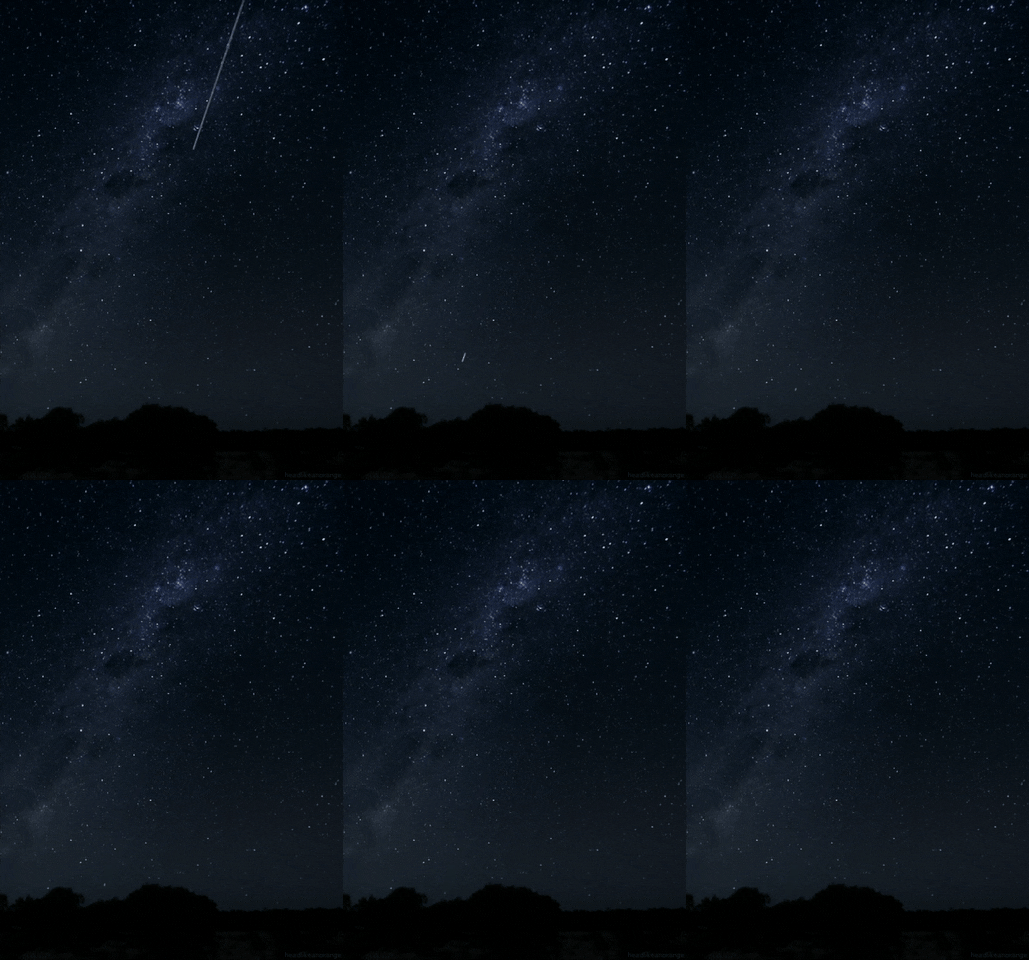
the AllSky7 Fireball Network is a volunteer-run, non-commercial constellation of all-sky cameras that records meteors 24/7/365 — calculating trajectories, orbits, and predicted landing zones. it started with one dude named Mike Hankey in 2018 and now it’s the densest fireball detection grid on the planet. no government funding. no billion-dollar satellite. just vibes and ethernet cables.
🧩 Dumb Mode Dictionary
| Term | Translation |
|---|---|
| Fireball | A meteor brighter than Venus — the ones that make you stop your car |
| Astrometry | Measuring exactly where something is in the sky using math and reference stars |
| Photometry | Measuring how bright something is (so you can figure out how big/fast it was) |
| PoE (Power over Ethernet) | One cable sends both power AND data. chef’s kiss of cable management |
| Limiting magnitude | The faintest thing a camera can see. Mag 4 = you can see ~700 stars |
| Sony STARVIS | Sony’s low-light sensor tech. Originally for security cameras. Now catching meteors |
| Triangulation | Two cameras + geometry = exact 3D position. More cameras = better accuracy |
| Citizen science | Regular people doing real science. No PhD required, just obsession |
📖 The Backstory — One Nerd, Seven Cameras, and a Dome
Mike Hankey built the first AllSky7 system and published a paper at the Meteoroids 2020 conference. The idea was dead simple: stuff seven security cameras into a weatherproof dome, point them at different parts of the sky, and let software figure out the rest.
Each dome runs on a single CAT-6 ethernet cable (PoE), powered by a mini PC running Ubuntu. The software handles everything — meteor detection, false-positive filtering, star calibration, trajectory calculation. It’s basically a self-contained space surveillance station that fits on your roof.
By 2022, the European network alone had ~90 stations. Germany, Hungary, and the Benelux countries hit full coverage density (one station every 100-150 km). Now there are stations in New Zealand, Iowa, and New York too.
⚙️ Hardware Specs — What's Actually in the Dome
| Component | Spec |
|---|---|
| Cameras | 8 total (7 horizon + 1 fisheye on top) |
| Sensor | Sony IMX307 (upgraded from IMX291 in 2024) |
| Lens | 4mm f/1.0 (main) + 1.13mm fisheye (8th cam) |
| FoV per camera | 45° × 80° |
| Frame rate | 25 fps |
| Resolution | SD (704×576) + HD (1920×1080) dual stream |
| Limiting magnitude | ~4 mag |
| Angular resolution | 25 pixels/degree |
| Power | PoE — one CAT-6 cable for everything |
| Computer | Mini PC, Ubuntu, AllSky7 software |
| 2025 upgrade | AS7 Sensor Board: GPS timing, humidity, temp sensors |
| Meteors/year | ~5,000 per station (central Europe) |
📊 The Numbers That Hit Different
| Stat | Value |
|---|---|
| European stations (2022) | ~90+ |
| Max simultaneous detections per fireball | 30 cameras |
| Ideal station spacing | 100-150 km |
| Meteors recorded per station/year | ~5,000 |
| Recording hours per day | 24 (analysis: nighttime only… for now) |
| Camera upgrade generations | 4 (original → AllSky7+ → HS → HS SB) |
| Cost of commercial equivalent | ~$10,000+ |
| Cost of DIY Raspberry Pi version | $30-$150 |
Almost every meteor in the network is a multi-station detection. That means triangulation. That means real orbital calculations. That means when a rock falls out of the sky, these folks can tell you where it came from AND where it landed.
🗣️ What the HN Crowd Said
- One commenter studied planetary science in Berlin where a professor used these cameras to predict meteorite landing zones — then sent students out to actually find the rocks on the ground
- Another pointed out the fireball footage is so dramatic “you can understand why people claim to have seen UFOs”
- A developer plugged an open-source alternative that runs on Raspberry Pi and can “automatically create star trails and timelapses”
- Physics nerds debated atmospheric deflection angles and whether pre-entry trajectory prediction is even physically possible (spoiler: it depends on the entry angle)
the vibe was basically “this is the coolest citizen science project i’ve ever seen and i want one on my roof immediately”
🔍 Why This Matters Beyond Cool Factor
This isn’t just space nerd LARP. The AllSky7 network produces actual peer-reviewed science. They presented at an EU-ESA workshop on Near-Earth Object impact warning. That’s right — the system that tracks asteroids heading toward Earth partially runs on volunteer cameras connected to mini PCs in people’s attics.
NASA has their own All Sky Fireball Network, but it’s US-only and government-run. AllSky7 is grassroots, global, and growing faster. The software is free for all network members (community license). And because every station is independently operated, there’s no single point of failure.
The network also catches non-meteor events: auroras, noctilucent clouds, satellites, and yes — unidentified aerial phenomena that make for excellent content.
Cool. Space rocks are falling and volunteers are tracking them with security cameras. Now What the Hell Do We Do? ᕕ( ᐛ )ᕗ
📡 1. Build a $150 Meteor Camera and Join a Global Network
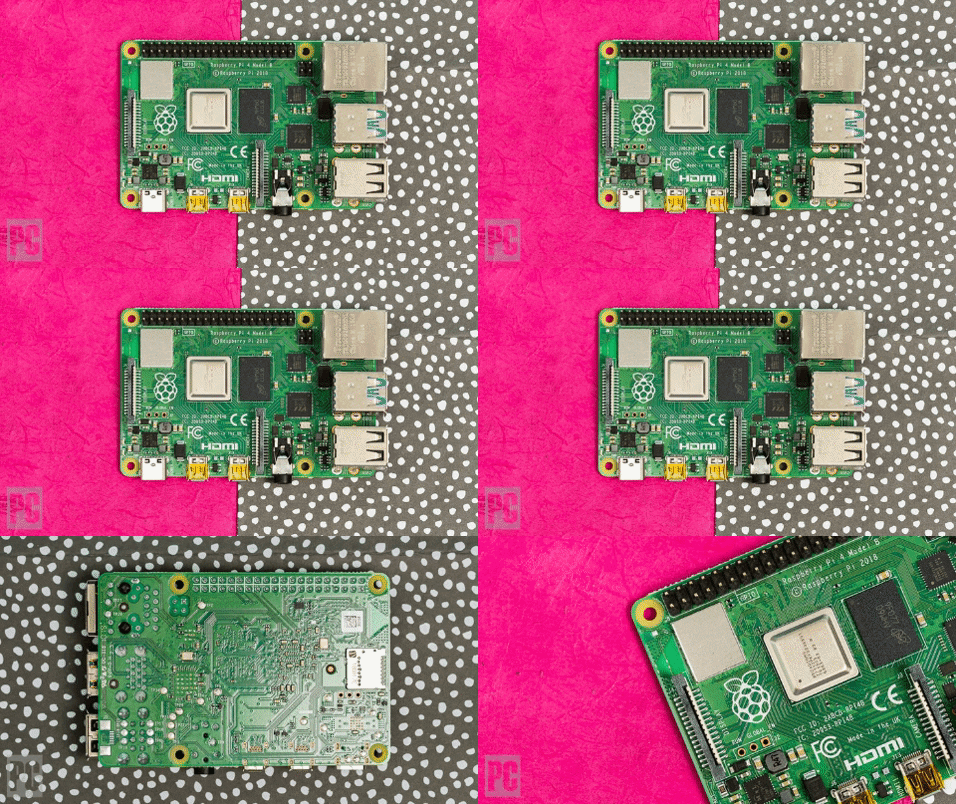
The Global Meteor Network and AllSky7 both accept new stations from anyone willing to set one up. A Raspberry Pi 4 + HQ Camera + 180° fisheye lens + acrylic dome = working meteor station for under $150. The ultra-budget “travel model” using a Pi Zero W costs literally $30.
Software options: INDI-AllSky (open source, GitHub), Meteotux Pi, or the AllSky7 software itself (free with network membership). Point it at the sky, connect ethernet, let it run.
 Example: A maker in rural Germany built a Pi-based allsky station for €120, joined the AllSky7 network, and within 3 months had captured a fireball that was used to calculate the orbit of a meteorite fragment — which was subsequently found on the ground by a university team.
Timeline: Weekend build → operational in 1-2 days → first meteor detection within a week
💰 2. Sell Pre-Built Allsky Camera Kits on Etsy/Tindie
The commercial equivalent of these cameras costs $10,000+. A pre-assembled, tested, weatherproof allsky kit with a Raspberry Pi, pre-configured SD card, dome, and mounting hardware could sell for $300-500 with healthy margins. The astronomy hobbyist market is massive and underserved in the DIY tier.
Example: A hardware tinkerer in Shenzhen, China started selling pre-assembled Pi-based weather station kits on Tindie for $89. Pivoted to allsky camera kits after seeing the meteor community’s demand. Now does $4,200/month from 3 SKUs, shipping worldwide with AliExpress fulfillment.
🎓 3. Create a 'Build Your Own Meteor Tracker' Course
YouTube + Udemy + a parts list affiliate link = passive income machine. The overlap between space enthusiasts, Raspberry Pi hobbyists, and STEM educators is enormous. A well-produced 2-hour course covering hardware assembly, software config, and network registration would have zero competition in this niche.
Example: An astrophotography YouTuber in Melbourne, Australia created a 90-minute course on building a Pi-based aurora camera. Charged $29 on Gumroad, included Amazon affiliate links for parts. Course made $8,400 in 6 months. The allsky/meteor angle is even more niche = less competition.
📱 4. Build a Fireball Alert App Using Open Network Data
The AllSky7 and NASA fireball networks publish detection data. An app that sends push notifications when a fireball is detected in your region — with trajectory visualization, estimated landing zone, and links to footage — would be genuinely useful AND cool. Monetize with a $2.99 premium tier for real-time alerts.
Example: A solo dev in São Paulo, Brazil built an earthquake alert app using USGS open data. Charges $1.99/month for real-time push notifications. Hit 12,000 subscribers in one year. Fireball detection is the same playbook — open data, push notifications, niche audience willing to pay.
🛠️ Follow-Up Actions
| Step | Action | Link/Tool |
|---|---|---|
| 1 | Browse the live AllSky7 station map | allsky7.net |
| 2 | Read the DIY Pi meteor camera guide | Hackster.io $150 build |
| 3 | Clone the INDI-AllSky open source software | GitHub - indi-allsky |
| 4 | Join the Global Meteor Network | globalmeteornetwork.org |
| 5 | Contact AllSky7 to host a station (EU: [email protected]) | allsky7.net/contact |
| 6 | Browse NASA’s fireball data API | NASA Fireball API |
 Quick Hits
| Want to… | Do this |
|---|---|
 Track meteors tonight Track meteors tonight |
Build a $30 Pi Zero allsky cam with Meteotux Pi |
 Sell to space nerds Sell to space nerds |
Pre-build and sell allsky kits for $300-500 on Tindie |
 Teach STEM skills Teach STEM skills |
Create a “build a meteor tracker” course on YouTube/Udemy |
 Build an app Build an app |
Use NASA/AllSky7 open fireball data for push alert notifications |
 Do actual science Do actual science |
Join AllSky7 network — your footage could track a near-Earth object |
90 nerds with ethernet cables and $150 cameras are doing more asteroid tracking than most space agencies. the universe doesn’t care about your budget — it just cares if you looked up.
 !
!