 AES Built a Robot That Installs Solar Panels 2x Faster — 100 MW Down, 1 GW to Go
AES Built a Robot That Installs Solar Panels 2x Faster — 100 MW Down, 1 GW to Goa trillion-watt industry can’t find enough humans, so they built a metal one that doesn’t need water breaks
Four robots. 100 MW installed. Half the time, half the cost. And a 53,000-worker gap they’re racing to fill before 2030.
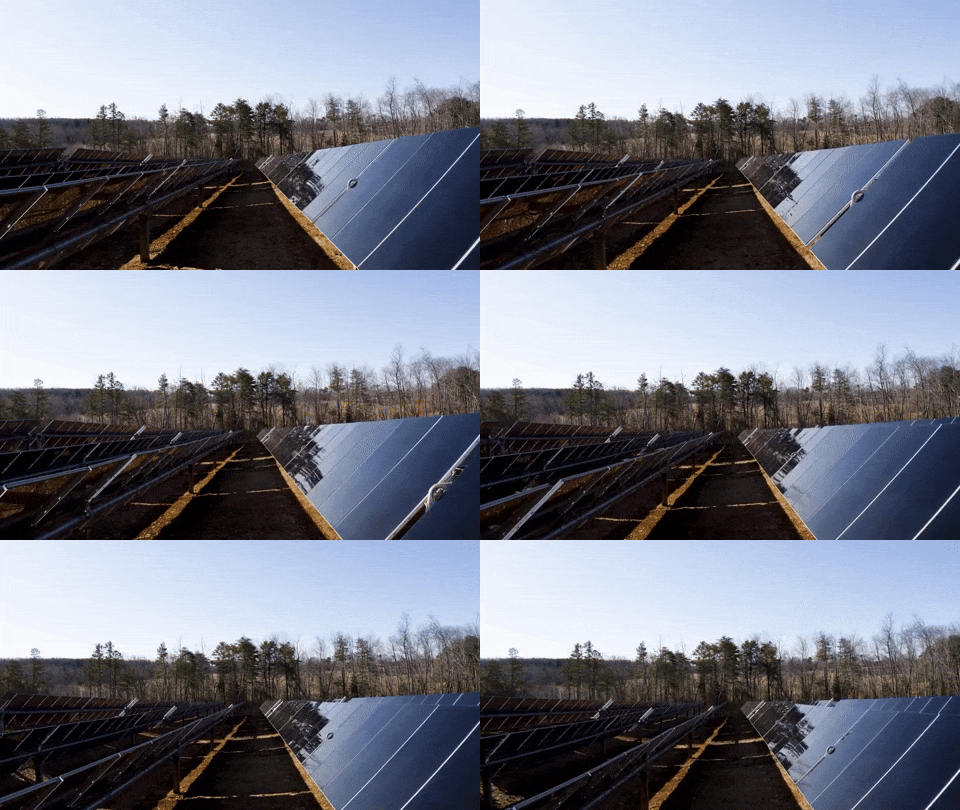
AES just hit the biggest milestone in solar construction robotics — ever. Their “Maximo” robot fleet installed 100 megawatts of utility-scale solar at the Bellefield complex in Kern County, California. And they’re not stopping. The target is 1 GW of solar + 1 GW of battery storage. This robot is about to become the most important construction worker in America and it doesn’t even have a union card.
🧩 Dumb Mode Dictionary
| Term | What It Actually Means |
|---|---|
| Maximo | AES’s solar-installing robot — not a Marvel character, sadly |
| 100 MW | Enough electricity to power ~20,000 homes per year |
| 1 GW | One gigawatt — Doc Brown’s magic number, but real this time |
| Utility-scale solar | Massive solar farms that feed power directly to the grid, not rooftop stuff |
| Module per minute | The speed at which robots slap solar panels onto racks — humans do roughly half that |
| Nvidia Omniverse | The simulation platform where they trained the robot in a digital twin before letting it loose IRL |
📖 Backstory — Why Robots Are Building Solar Farms Now
The solar industry needs 355,000 workers by 2026 to hit its installation targets. It’s projected to fall short by 53,000. Meanwhile, 89% of solar firms can’t find enough qualified applicants.
You can’t build 30 GW of solar capacity per year if nobody shows up to bolt the panels down. Enter Maximo — a robot that doesn’t get heat exhaustion in the Mojave Desert and installs panels at 24 modules per hour per person (nearly double the human-only rate).
AES originally pitched this thing in 2024 as “half the time, half the cost.” Two years later, they delivered the receipts.
⚙️ The Robot — What Maximo 3.0 Actually Does
- Fleet size: 4 Maximo v3.0 robots deployed at Bellefield
- Speed: Consistently surpassing 1 module per minute
- Output: 24 solar panel modules per hour, per person — nearly 2x traditional methods
- AI stack: Nvidia Isaac Sim for physics-based simulation, AWS for real-time construction analytics
- What it does: Picks up solar panels, positions them on tracker structures, secures them. Repeat. All day. No complaints.
Maximo spun off from AES as its own robotics company. Chris Shelton runs it. Version 4.0 is already in development. the glow-up is real.
📊 The Numbers That Matter
| Stat | Number |
|---|---|
| Solar installed by Maximo | 100 MW |
| Target at Bellefield | 1 GW solar + 1 GW battery |
| Robot installation speed | 2x human crews |
| Cost reduction (claimed) | 50% |
| US solar worker shortage by 2026 | 53,000 workers |
| Solar installer job growth through 2034 | 42% (BLS) |
| Local economic injection at Bellefield | $150 million |
| Transmission line to grid | 14 miles to SCE Windhub Substation |
🗣️ What People Are Saying
Chris Shelton, Maximo President:
“Reaching 100 MW demonstrates that field robotics can move beyond experimentation and deliver consistent results at utility scale.”
Kara Hurst, Amazon Chief Sustainability Officer:
“Technologies like Maximo demonstrate how we can accelerate the transition to carbon-free energy while improving safety and efficiency.”
Traditional solar installers are… conflicted. The industry projects 42% job growth through 2034, but the jobs are shifting from “carry heavy panels in 110°F heat” to “operate and maintain the robots that carry heavy panels in 110°F heat.” the vibes are mixed but the math is clear.
🔍 The Bigger Picture — Who Else Is in This Race
Maximo isn’t alone. The solar robotics space is heating up fast:
- Terabase Energy (Berkeley) just finished field testing their “Terafab” automated construction system — now shipping commercially
- Cosmic Robotics raised $4M in seed funding in 2025 for AI-powered solar farm construction bots
- Charge Robotics (MIT spinoff) is building “portable factories” that roll onto solar sites
- Terabase has $130M in total funding for their automated solar platform
The industry target? 50,000 solar modules installed per hour industry-wide by 2035. That’s not happening with humans alone. lowkey this is the most important construction arms race nobody’s talking about.
Cool. Robots Are Installing Solar Panels Now. Now What the Hell Do We Do? ᕕ( ᐛ )ᕗ
🔧 Hustle #1: Become a Solar Robot Technician
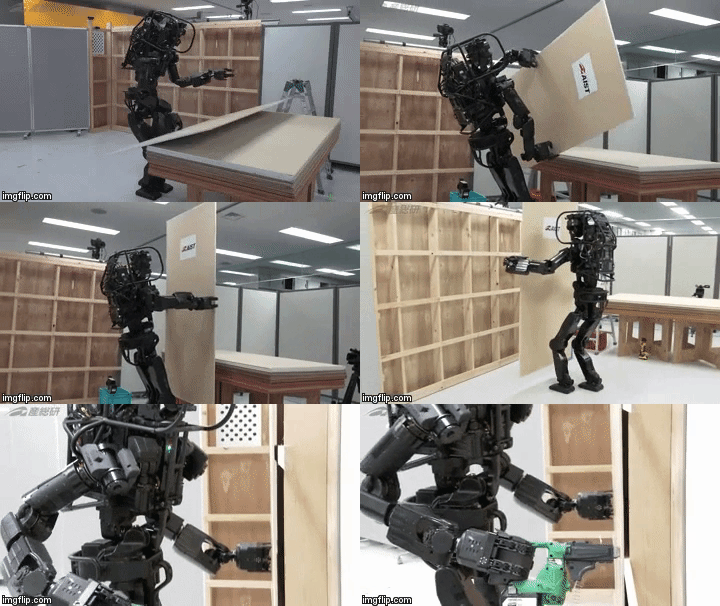
The robots don’t maintain themselves. Every Maximo unit needs operators, calibration techs, and field engineers who understand both robotics AND solar. This is the highest-demand role in the transition — half mechanic, half programmer.
Solar companies are literally begging for these people. The BLS says solar installer roles are growing 42% through 2034, but the real gold is in the robotics maintenance niche.
 Example: A former auto mechanic in Bakersfield, CA retrained through a 6-month robotics certificate at Bakersfield College. Got hired at a Kern County solar site maintaining autonomous installation equipment. Starting salary: $78K, up from $48K turning wrenches on Hondas.
Timeline: 3-6 months for robotics cert → apply to AES, Terabase, or solar EPC contractors → $65K-$90K starting
💰 Hustle #2: Solar Site Drone Inspection Service
Every utility-scale solar farm needs pre-construction terrain mapping, progress tracking during build, and post-installation thermal inspections. Drones do this 10x faster than walking crews. And with robotic installation accelerating project timelines, demand for fast aerial data is spiking.
You need a Part 107 license, a thermal camera drone (~$2K-$5K), and some GIS software skills.
Example: A freelance photographer in Lagos, Nigeria pivoted to drone-based solar farm inspection after seeing West Africa’s solar boom. Got contracts with two utility companies for $3,500/site quarterly inspections across 4 sites. Grossing $56K/year from what started as a side gig with one DJI Mavic.
📱 Hustle #3: Build Solar Workforce Training Content
There’s a massive skills gap and almost no standardized training. The industry desperately needs accessible courses for the new wave of solar-robotics technicians — and most of the existing content is terrible corporate PowerPoint energy.
YouTube channels, Udemy courses, or niche platforms teaching solar installation + robotics basics could print money.
Example: An electrical engineering grad in Hyderabad, India created a 12-hour Udemy course on “Solar PV Systems + Automation Basics” priced at $19.99. After 6 months of marketing on LinkedIn and r/solar, it had 4,200 students and was generating ~$6,800/month in passive revenue. Launched a second course on drone inspection techniques.
💼 Hustle #4: Solar Construction Analytics Dashboard
Maximo uses AWS for real-time construction intelligence. But most solar EPC (engineering, procurement, construction) companies are smaller firms without fancy AI dashboards. They’re tracking projects with spreadsheets and WhatsApp groups.
Build a simple SaaS tool that tracks module installation progress, crew productivity, weather delays, and equipment uptime for solar construction sites.
Example: Two software devs in Nairobi, Kenya built “SolarTrack” — a React Native app that lets site managers log daily installation counts, flag equipment issues, and generate progress reports. Signed 8 solar contractors across East Africa at $200/month each within 4 months. Now at $19K ARR and growing after adding drone footage integration.
🛠️ Follow-Up Actions
| Action | Where to Start |
|---|---|
| Get robotics certified | Coursera robotics specialization, local community college programs |
| Get Part 107 drone license | FAA CATS portal, ~$175 exam fee |
| Find solar construction companies hiring | AES careers page, Indeed “solar robotics technician” |
| Study solar PV fundamentals | NABCEP certification pathway, free MIT OpenCourseWare |
| Build solar SaaS MVP | Start with n8n or Retool for rapid prototyping, validate with local contractors |
| Follow the industry | r/solar, r/robotics, Solar Power World magazine, Electrek |
Quick Hits
| Want to… | Do this |
|---|---|
 Work with solar robots Work with solar robots |
Get a robotics maintenance cert, apply to AES/Terabase |
 Start a solar drone biz Start a solar drone biz |
Part 107 + thermal drone + call every solar contractor within 100 miles |
 Teach the skills gap Teach the skills gap |
Create solar+robotics courses on Udemy/YouTube — the market is starving |
 Build solar SaaS Build solar SaaS |
Simple project tracking dashboard for solar EPC firms — they’re drowning in spreadsheets |
 Just stay informed Just stay informed |
Follow Maximo’s progress — v4.0 drops soon and the 1 GW target is the real test |
the robots aren’t taking solar jobs — there literally aren’t enough humans to do them. the machine showed up because you didn’t. and honestly? it brought snacks.
 !
!