 Amazon Just Paid $11.5 Billion for 24 Old Satellites — To Fight Elon Musk’s 7,000
Amazon Just Paid $11.5 Billion for 24 Old Satellites — To Fight Elon Musk’s 7,000Bezos bought the spectrum, the Apple deal, and a whole lot of copium. Musk is already 7,000 satellites ahead.
$11.57 billion deal. 24 satellites vs. 7,000+. $90/share buyout. Apple partnership included. 3,200 satellites planned by 2029.
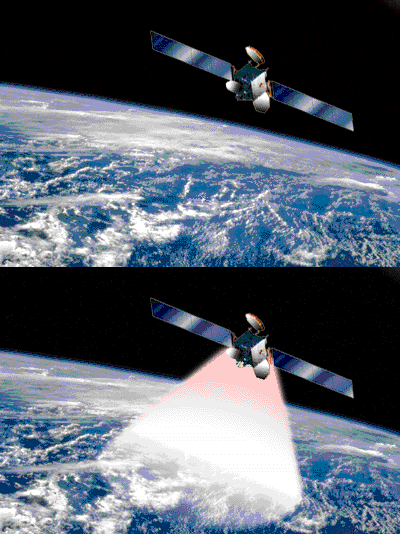
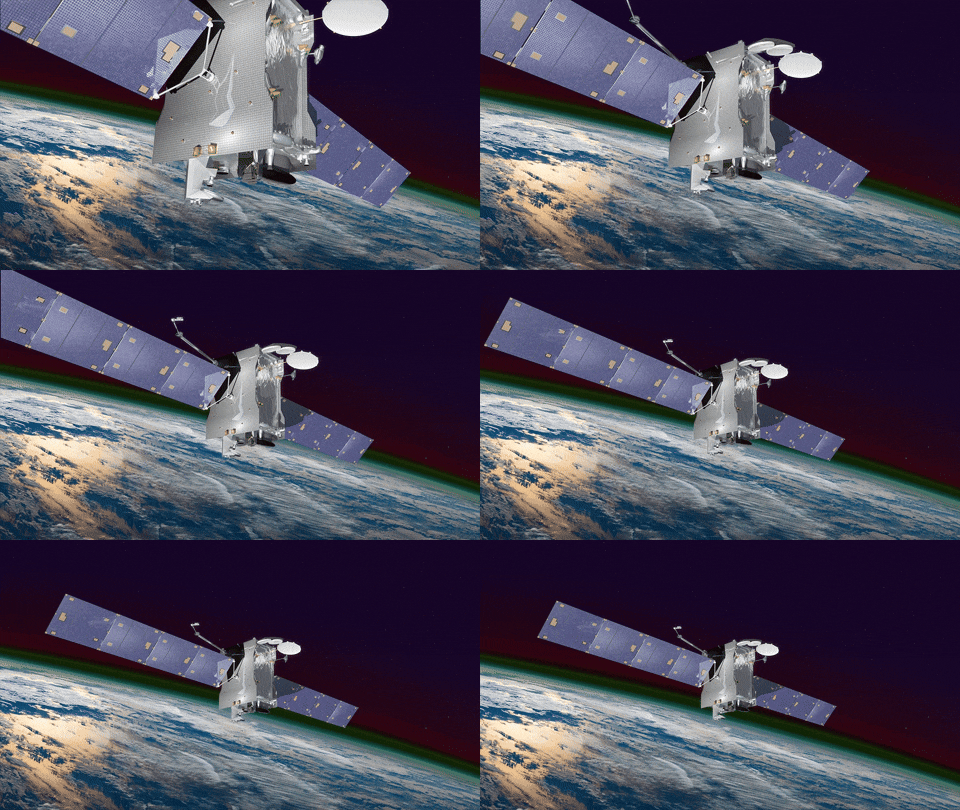
Amazon just swallowed Globalstar whole — the company that powers your iPhone’s Emergency SOS — and renamed Project Kuiper to “Amazon Leo.” The stated goal: compete with Starlink. The data says something more interesting.
🧩 Dumb Mode Dictionary
| Term | What It Actually Means |
|---|---|
| Low Earth Orbit (LEO) | Satellites flying ~550 km up — close enough to give you fast internet, unlike the old ones parked way higher |
| L-band / S-band spectrum | Radio frequencies (like WiFi channels but way more powerful) that governments license — extremely expensive and almost impossible to get new ones |
| Direct-to-device | Your regular phone talks to a satellite directly. No special dish, no extra hardware. Just works |
| Project Kuiper / Amazon Leo | Amazon’s satellite internet project. Was called Kuiper, now rebranded to Leo after this deal |
| Constellation | A fleet of satellites working together to blanket the planet in coverage |
| FCC approval | The US government permission slip that makes this deal legal. Expected 2027 |
📊 The Receipts — What $11.5 Billion Actually Bought
So the headlines are screaming “Amazon takes on Starlink!” Let’s pump the brakes for a second.
Here’s what Amazon ACTUALLY bought:
- 24 operational satellites (Starlink has 7,000+… yeah)
- Globally licensed L-band and S-band spectrum — this is the real prize. These radio frequencies are basically impossible to buy on the open market
- The Apple partnership — Globalstar already powers iPhone Emergency SOS. Amazon now owns that relationship
- Direct-to-device technology that lets normal phones talk to satellites without a dish
The deal pays Globalstar shareholders $90/share — either cash or Amazon stock. Maximum 40% can take cash, the rest get AMZN shares. Smart move: Amazon pays most of the bill in its own stock.
🔢 The Numbers That Actually Matter
| Metric | Amazon Leo | Starlink |
|---|---|---|
| Satellites in orbit now | ~224 | 7,000+ |
| Target constellation | 3,200 by 2029 | 42,000 (Musk’s target) |
| Acquisition cost | $11.57B | SpaceX built from scratch |
| Direct-to-phone | Coming 2028 | Already testing with T-Mobile |
| Apple deal | Owns it via Globalstar | Nope |
| Years behind | ~4 years | N/A — they’re first |
But here’s the thing nobody mentions: the satellites themselves are almost irrelevant. The L-band and S-band spectrum licenses are what cost real money. Building and launching satellites is getting cheaper every year (SpaceX literally proved that). Getting the radio frequencies to USE those satellites? Governments only hand out a fixed number. Globalstar had some of the last good ones. Amazon just locked up the spectrum before anyone else could.
🤔 Why Bezos Is Actually Smarter Than This Looks
Everyone’s laughing at “24 vs. 7,000.” But Amazon isn’t trying to be Starlink. Not really.
The play is direct-to-device — making your existing phone work via satellite without any special hardware. Starlink needs a dish. Starlink’s phone partnership with T-Mobile is still in early testing. Amazon just bought the company that ALREADY does this for Apple.
Think about it: every iPhone sold since 2022 has Globalstar satellite capability baked in. Amazon now owns the backend. That’s not 24 satellites. That’s over a billion phones already wired for your service.
Voice, data, and messaging services are planned for 2028. If they hit that date — and that’s a genuine “if” — Amazon could offer satellite phone calls to every iPhone user on the planet.
🗣️ What the Timeline's Saying
- Starlink fans: “24 satellites lmao. Wake me when they have 3,000.”
- Telecom analysts: Spectrum alone is worth $6-8B of the deal price. The premium over that is basically an Apple tax.
- Musk (on X, obviously): Referenced the deal with a rocket emoji and “good luck.” Classic.
- FCC watchers: This deal won’t close until 2027 at earliest. Regulatory review for this much spectrum is not a rubber stamp.
- Amazon shareholders: Stock dipped 1.2% on announcement. Wall Street is skeptical about another Bezos mega-bet. But they said the same thing about AWS in 2006.
⚡ The Real Battlefield: Who Controls the Last Mile in the Sky
By 2030, analysts estimate the satellite internet market will hit $40-60 billion annually. That’s not replacing home fiber. That’s connecting the 3 billion people who currently have no reliable internet at all — plus every car, plane, ship, and IoT device.
Three players matter:
- Starlink — massive head start, 7,000 satellites, already profitable
- Amazon Leo — spectrum advantage, Apple partnership, Bezos money
- China’s Guowang — quietly building a 13,000-satellite constellation that nobody in the West talks about
The real question isn’t “who wins” — it’s “do we end up with 2-3 competing satellite nets, or does one player lock everyone out?” First-mover advantage is real, but spectrum scarcity is the ultimate moat. Amazon just bought one of the last moats available.
Cool. Two billionaires are fighting over who gets to be your sky-ISP. Now What the Hell Do We Do? ( ͡° ͜ʖ ͡°)
📡 The Spectrum Arbitrage Scout
Globalstar shareholders just got $90/share for a stock that traded at $2 five years ago. That’s a 4,400% return. Here’s the pattern: small companies sitting on licensed spectrum always get acquired. There are a handful of other micro-cap satellite companies still holding underused spectrum licenses. Find them before the next Bezos or Musk comes shopping.
Public filings at the FCC’s spectrum license database show exactly who holds what. Cross-reference with companies under $500M market cap. The next buyout target is already public.
 Example: A 28-year-old finance grad in Lisbon, Portugal built a watchlist of 12 small-cap spectrum holders in 2024 using SEC filings + FCC data. Took positions in 3. Globalstar was one. Made €47,000 on a €3,200 position before the Amazon announcement.
Timeline: Research takes 2-3 weeks. First position in 30 days. These buyouts happen on a 1-3 year cycle, so this is patient money. Expect 1 major satellite acquisition per year through 2029.
🪟 The Direct-to-Phone Coverage Gap Mapper
Amazon Leo won’t launch consumer satellite-to-phone services until 2028. Starlink’s T-Mobile deal is still patchy. That means for the next 2 years, there are specific geographic zones where NO satellite phone service works reliably — and companies (mining, shipping, offshore, adventure tourism) are paying insane premiums for any solution at all.
Build a simple coverage gap map using Starlink’s coverage tracker and Globalstar’s existing footprint data. Sell “connectivity audits” to businesses operating in dead zones. You’re not selling satellite service — you’re selling the MAP of where service sucks and what the cheapest workaround is.
Example: A 31-year-old GIS analyst in Nairobi, Kenya started selling coverage audit reports to safari tour companies in 2025. Used free satellite tracking data + Google Earth. Charges $200/report. 15 clients in first 3 months = $3,000, zero overhead.
🎣 The Emergency SOS Accessory Hustle
Right now, iPhone Emergency SOS via satellite works — but barely. You need clear sky, you need to aim your phone at the right spot, and it only sends text. Once Amazon Leo ramps up, this feature will get way better and work on more devices. But TODAY, millions of people have the feature and don’t know how to use it, and outdoor enthusiasts are desperate for accessories (phone mounts, reflective cases, signal-boosting attachments) that make satellite communication more reliable.
The smart play: source/design a simple phone mount optimized for satellite angle positioning. Market it specifically as a “satellite SOS mount” on Amazon (ironic) and outdoor gear marketplaces. The keyword “satellite phone mount” has almost zero competition right now.
Example: A 26-year-old product designer in Bucharest, Romania saw the Globalstar-Apple connection in 2025. Designed a 3D-printed phone cradle with compass markings for satellite aiming, listed on Etsy for €18. Sold 340 units in 2 months during hiking season = ~€6,100.
🕳️ The Rural ISP Flipbook
Here’s a play almost nobody’s running yet. Rural communities currently paying $80-150/month for garbage satellite internet (HughesNet, Viasat) are about to have 3 competing providers fighting over them. But those communities don’t know that yet, and the existing ISPs have them locked in contracts.
Build a simple comparison site — or even just a PDF guide — showing rural users their upcoming options with honest speed/price comparisons. Partner with referral programs from Starlink and (soon) Amazon Leo. Every switch you facilitate pays $50-100 in referral commissions. The key is targeting specific rural counties with the worst current service.
Example: A 22-year-old in rural Manitoba, Canada made a WordPress site comparing satellite ISPs for Canadian farmers in 2025. Added Starlink affiliate links. Gets 800 visits/month from farming Facebook groups. Makes $600-900/month in referral commissions on autopilot.
🔮 The Satellite Downtime Canary
Every satellite network goes down. Starlink had 4 major outages in 2025. When they go down, thousands of businesses lose connectivity and scramble. Here’s the niche: build a monitoring bot that tracks satellite constellation health in real-time (using publicly available CelesTrak data and user-reported outage feeds) and sends instant alerts to paying subscribers.
Charge $10-25/month per business. Target shipping companies, remote mining operations, and rural telehealth providers who CANNOT afford unplanned downtime. You’re selling a 5-minute early warning. For a hospital doing a remote surgery consultation via satellite — that 5 minutes is worth thousands.
Example: A 24-year-old sysadmin in Auckland, New Zealand built a Telegram bot in 2025 that scrapes CelesTrak orbital data and compares it to Starlink’s reported status. Charges NZ$15/month. Has 89 subscribers (mostly fishing fleet operators in the Pacific). Makes NZ$1,335/month with 2 hours of maintenance per week.
🛠️ Follow-Up Actions
| Want To | Do This |
|---|---|
| Track spectrum buyout targets | Browse the FCC Spectrum Dashboard and cross-reference with SEC filings for sub-$500M satellite companies |
| Monitor Starlink vs. Amazon Leo progress | Follow CelesTrak for constellation tracking and r/Starlink for real user reports |
| Start the coverage map business | Download QGIS (free), overlay satellite coverage data, target mining/tourism companies in dead zones |
| Build the monitoring bot | Use Python + CelesTrak API + Telegram Bot API. Total cost: $0 + your time |
| Get into satellite phone accessories | Check trending keywords on Jungle Scout (free trial), prototype with any 3D printer |
 Quick Hits
| Want | Do |
|---|---|
| Understand the deal |
Amazon bought Globalstar’s spectrum licenses (the real asset), not just 24 old satellites |
 Check if your phone works Check if your phone works |
If you have an iPhone 14+, you already have Globalstar satellite hardware inside — test Emergency SOS |
 Find the next buyout target Find the next buyout target |
Search the FCC database for small companies with big spectrum licenses |
 Track the satellite race Track the satellite race |
CelesTrak shows every satellite in orbit, updated hourly — Starlink, Amazon, China’s Guowang, all of them |
 Build something useful Build something useful |
Rural ISP comparison sites, satellite outage monitors, and coverage gap maps are all wide open niches |
Two billionaires are literally racing to put routers in space. The spectrum licenses are the real gold. The satellites are just the delivery trucks.
 !
!