 Amazon Just Dropped $11.6 Billion on 24 Satellites to Fight Starlink — And Got Apple’s iPhone Deal Too
Amazon Just Dropped $11.6 Billion on 24 Satellites to Fight Starlink — And Got Apple’s iPhone Deal Toobezos really said “if i can’t be first to space, i’ll just buy the space”
$11.6 billion. 24 satellites. One globally-licensed radio frequency that money literally cannot buy anywhere else. And oh yeah — every future iPhone’s emergency satellite connection now runs through Amazon.
While everyone was watching Elon tweet, Jeff just bought the radio spectrum equivalent of oceanfront property. SpaceX has 7,000+ satellites. Amazon just bought 24. But those 24 came with something Starlink doesn’t have — the one frequency band that works in every country on Earth and plays nice with every phone chip already manufactured. lowkey the most expensive spectrum flex in telecom history.
🧩 Dumb Mode Dictionary
| Term | Translation |
|---|---|
| LEO (Low Earth Orbit) | Satellites that fly close to Earth (~550km up) so your internet doesn’t lag like it’s 1999 |
| Spectrum / Band 53 | A specific radio frequency that lets devices talk to satellites — owning it is like owning a private highway in the sky |
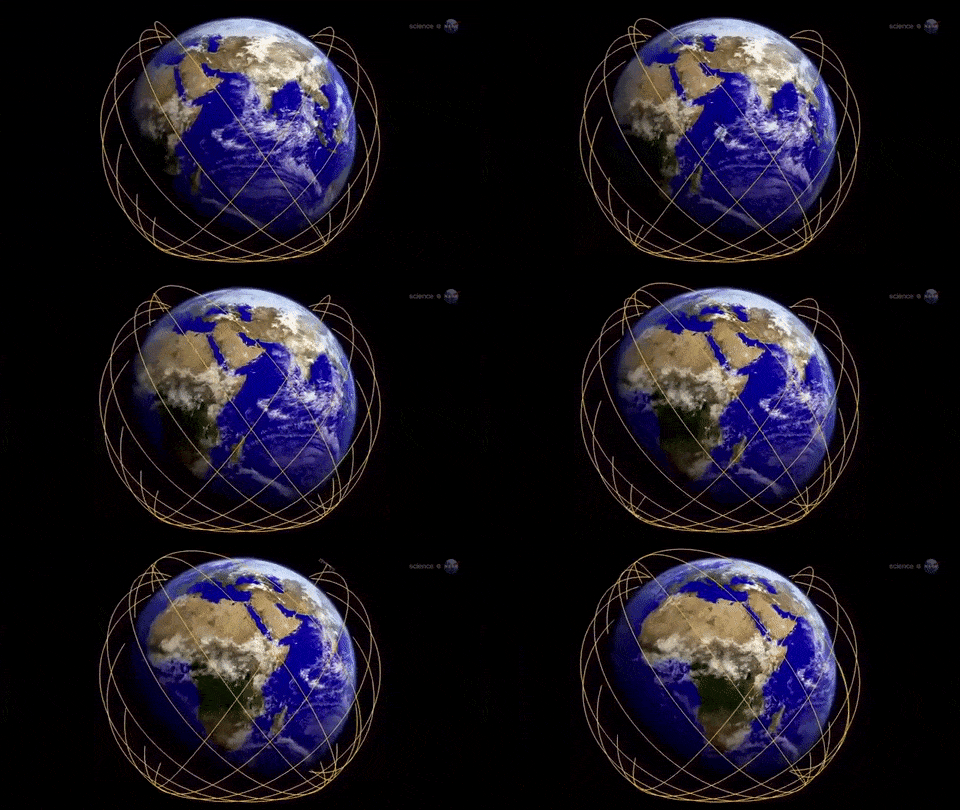
| Constellation | A big group of satellites working together — not the astrology kind |
| Globalstar | Old-school satellite company founded in 1991 that Amazon just swallowed whole |
| Amazon Leo | Amazon’s satellite internet project (used to be called “Project Kuiper”) — their answer to Starlink |
| Ka-band | The main radio frequency Amazon Leo satellites use to beam internet down to you |
| Phased-array antenna | A flat panel that can steer its signal electronically without physically moving — the satellite dish of the future |
📖 The Backstory: How We Got Here
Amazon has been quietly building a satellite army since 2020. The FCC gave them permission to put 3,236 satellites in orbit. They rebranded from “Project Kuiper” to “Amazon Leo” in November 2025. They’ve already launched 300+ satellites. They have beta customers including Verizon, AT&T, Vodafone, JetBlue, and even NASA.
But Starlink already had 7,000+ satellites and millions of paying customers. Amazon was playing catch-up with better rockets but fewer birds in the sky.
Then in April 2026 — the Globalstar deal. And suddenly the math changed completely.
💰 The Deal: What Amazon Actually Bought
- Price tag: $11.6 billion ($90 per share, cash or stock)
- 24 operational satellites already in orbit
- A global ground station network (the buildings on Earth that talk to satellites)
- Band 53/n53 spectrum — licensed in 12+ countries covering 870 million people. This frequency (2483.5–2495 MHz) sits right next to your Wi-Fi band and is already built into phone chips worldwide
- Apple’s satellite contract — every iPhone and Apple Watch emergency satellite feature (Emergency SOS, Find My, roadside assistance) now runs through Amazon
- Patents, bandwidth licenses, and engineering talent
Apple previously owned 20% of Globalstar and invested $1.5 billion into it. Now Amazon controls that whole relationship.
📊 The Numbers That Hit Different
| Stat | Details |
|---|---|
| Deal value | $11.6 billion |
| Globalstar share price | $90/share (18-year high) |
| Amazon stock reaction | +5% on announcement day |
| Satellites Amazon Leo has now | 300+ (plus Globalstar’s 24) |
| Total satellites authorized by FCC | 7,727 (Gen 1 + Gen 2) |
| FCC deadline | Half the constellation must fly by July 30, 2026 |
| Commercial launch target | Mid-2026 |
| Starlink comparison | 7,000+ satellites, millions of customers |
| Amazon’s cost per customer terminal | Under $1,000 vs fiber’s $10,000-$50,000 |
| AST SpaceMobile stock after news | Down 25% in one day |
🗣️ Why Spectrum Is the Real Prize
here’s the thing nobody’s talking about enough. Amazon didn’t pay $11.6 billion for 24 old satellites. they paid for a radio license that is literally impossible to get any other way.
Globalstar’s Band 53/n53 operates at 2.4 GHz — right next to regular Wi-Fi. That means it doesn’t interfere with existing networks AND it’s already supported by phone chipsets that are already manufactured and shipping. You don’t need a new phone. You don’t need a special antenna. The hardware is already in your pocket.
This spectrum is “globally harmonized” — meaning it’s licensed the same way in dozens of countries. SpaceX spent years fighting regulators country by country. Amazon just bought a skeleton key.
And the Apple deal means Amazon now powers satellite features on the most popular phone on Earth. That’s not just internet service — that’s distribution.
⚔️ The SpaceX Angle
Here’s the spicy part: SpaceX tried to buy Globalstar first. Back in November 2025, Musk’s company explored an acquisition. Amazon outbid them.
imagine getting outbid by the guy whose rocket company is six years behind yours. that’s gotta sting.
But Musk still has the numbers advantage — 7,000+ satellites vs Amazon’s 300+. Starlink already has millions of paying customers. Amazon Leo hasn’t even commercially launched yet. The question is whether spectrum + Apple + AWS integration beats pure satellite count.
Industry analysts are calling this the birth of a “Big Tech duopoly” in satellite internet. Everyone else — AST SpaceMobile, Telesat, OneWeb — just got squeezed.
🔮 What Happens Next
- Mid-2026: Amazon Leo commercial launch for consumers, businesses, and governments
- 2027: Globalstar acquisition closes (pending regulators)
- By July 2026: Amazon must have half its authorized constellation (1,618 satellites) in orbit or lose the FCC license
- 2028: Amazon plans to offer voice, data, and messaging services through Globalstar’s network
- Through 2035: Full 7,727-satellite constellation deployment
Amazon CEO Andy Jassy said Leo will “integrate seamlessly with AWS” — which means businesses already on Amazon’s cloud can add satellite internet with minimal work. That’s the real competitive moat.
Cool. Two Billionaires Are Fighting Over Space Internet. Now What the Hell Do We Do? ᕕ( ᐛ )ᕗ

📡 Become a Satellite Internet Field Installer Before the Gold Rush
Amazon Leo launches commercially mid-2026. They need thousands of people to install terminals on roofs, configure networks, and hand-hold rural customers who’ve never had fast internet. Starlink already created a cottage industry of $150-$300/install gigs. Amazon will need the same — but with their enterprise clients (hotels, farms, ships, oil rigs), the ticket sizes are way bigger.
Get certified in basic networking (CompTIA Network+ or even just YouTube university), buy a drill and a ladder, and position yourself in a rural area before the launch date.
 Example: Carlos, a 28-year-old handyman in rural Oaxaca, Mexico, started installing Starlink terminals for American expats in 2024. He charges $200 USD per install and does 3-4 per week. When Amazon Leo launches in Latin America through their Vrio partnership, he’ll be one of the few locals who already knows satellite terminal installation. He’s already getting pre-orders.
Timeline: Start learning now → Amazon Leo commercial launch mid-2026 → enterprise rollout through 2027
🌍 Build 'Last-Mile Connectivity' Packages for Off-Grid Tourism
Here’s a gap nobody’s filling: eco-lodges, safari camps, surf hostels, and mountain retreats in places with zero traditional internet. These businesses NEED connectivity for booking systems, guest Wi-Fi, and card payments — but they’re too remote for cell towers and too small for enterprise satellite contracts.
You become the middleman. Get a Starlink business plan ($250/month through the T-Mobile SuperBroadband tier), bundle it with a basic mesh Wi-Fi setup, and offer it as a “connected retreat package” to tourism businesses for $500-800/month including hardware rental and support. When Amazon Leo launches with potentially lower pricing, you play them against each other.
Example: Priya, a digital nomad from Bangalore, set up satellite internet packages for 6 off-grid yoga retreats in Bali. She charges each retreat $600/month for managed satellite internet + guest Wi-Fi portal (with the retreat’s branding). Her cost: $120/month for Starlink residential + $40 for mesh hardware amortized. She manages everything remotely from her laptop.
📱 Flip the Apple Emergency SOS Angle Into a Safety Product
Amazon now controls the satellite backbone for Apple’s Emergency SOS. That means every iPhone user is unknowingly an Amazon satellite customer. But most people don’t even know Emergency SOS via satellite exists, let alone how to use it.
Create a short course, a TikTok series, or a printed quick-reference card targeting hikers, overlanders, sailors, and solo travelers. Sell the card as a physical product on Etsy/Amazon ($7.99, laminated waterproof). Upsell to a digital “Emergency Satellite Kit” with templates for emergency contacts, GPS coordinates cheat sheets, and offline maps — $19.99 on Gumroad.
Example: Jake, a former park ranger in New Zealand, made a Gumroad guide called “Satellite SOS: The 5-Minute Setup That Could Save Your Life” after Apple’s Emergency SOS launched. He’s sold 4,200 copies at $12 each to international hikers and expedition companies who buy in bulk for their clients.
📊 Trade the Satellite Internet Supply Chain
When two trillion-dollar companies go to war over space internet, every supplier wins. The Globalstar deal sent AST SpaceMobile stock down 25% in one day. That’s panic selling — and panic creates opportunity.
Map the satellite internet supply chain: antenna manufacturers, ground station builders, spectrum analytics companies, rocket launch providers. Amazon has 100+ launches secured. SpaceX is doing weekly launches. Both need components — reaction wheels, solar arrays, phased-array chips. Companies like Rocket Lab, L3Harris, and smaller component makers will ride this wave.
You don’t need to pick the winner between Amazon and SpaceX. You invest in the companies selling shovels during the gold rush.
Example: Dmitri, a retail investor in Estonia, bought AST SpaceMobile stock after the 25% crash and bought calls on Rocket Lab before Amazon’s launch schedule announcement. His thesis: regardless of who wins the satellite war, both sides need rockets and ground infrastructure. He’s up 40% on the Rocket Lab position in 3 months.
🛠️ Follow-Up Actions
| Action | Where |
|---|---|
| Track Amazon Leo launch timeline | Amazon Leo official updates |
| Learn satellite terminal installation basics | YouTube + CompTIA Network+ study guides |
| Monitor FCC spectrum decisions (April 30 vote) | FCC.gov proceedings |
| Check Starlink business pricing for your area | starlink.com/business |
| Follow satellite internet competition | r/Starlink, r/AmazonLeo, r/SatelliteInternet |
| Research satellite supply chain stocks | Rocket Lab (RKLB), L3Harris (LHX), AST SpaceMobile (ASTS) |
 Quick Hits
| Want to… | Do this |
|---|---|
| Understand the deal |
Amazon bought Globalstar for $11.6B — mostly for the spectrum, not the satellites |
 Know why Apple matters Know why Apple matters |
Every iPhone’s emergency satellite feature now runs on Amazon’s network |
 See who’s winning See who’s winning |
Starlink has 7,000 satellites and millions of users. Amazon has 300+ satellites but better spectrum and Apple |
 Find the opportunity Find the opportunity |
Rural satellite installation, off-grid tourism connectivity, supply chain investing |
 Watch what’s next Watch what’s next |
Amazon Leo commercial launch mid-2026. FCC spectrum vote April 30. Full constellation by 2035 |
two billionaires fighting over who gets to give you wifi from space and honestly? i’m just glad the competition exists because my rural internet still loads like it’s dial-up and at this point i’d let either of them beam data directly into my skull if it meant i could stream without buffering
 !
!