BCBC PAIG — The AI Gateway That Remembers Your Entire Project
Open Source RFC (Request for Comments)
What is PAIG?
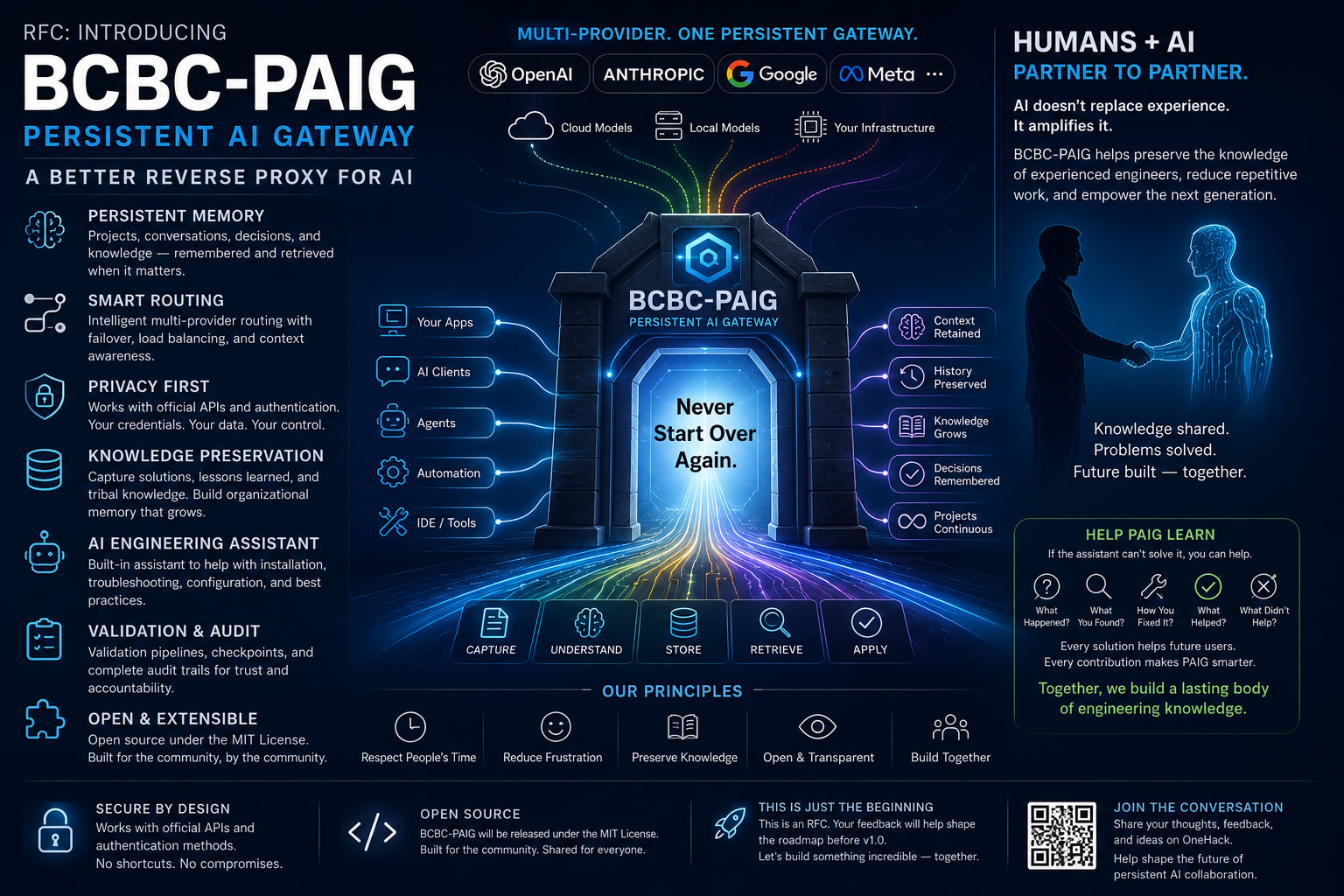
PAIG (Project AI Gateway) is an open-source gateway that sits between users, applications, AI providers, models, and AI agents.
Instead of every application maintaining its own isolated AI integration, PAIG provides a single intelligent gateway that can:
- Route requests between AI providers
- Preserve project context
- Manage credentials securely
- Coordinate multiple models
- Integrate AI agents
- Build engineering memory over time
The long-term goal is to make AI infrastructure modular, portable, vendor-neutral, and easier to maintain.
Why Does PAIG Exist?
Today’s AI workflows are becoming increasingly fragmented.
Projects frequently depend on:
- Multiple AI providers
- Multiple models
- Multiple APIs
- Multiple authentication methods
- Multiple AI agents
- Multiple disconnected conversations
Engineering context becomes scattered.
Knowledge gets lost.
Developers repeatedly solve the same problems because previous decisions disappear into chat history, documentation, or someone’s memory.
PAIG is intended to become the operational layer that keeps those pieces working together while preserving the engineering knowledge behind them.
Current Development Goals
- Unified AI Gateway
- Multi-provider routing
- Project-aware context management
- Secure credential management
- AI agent integration
- Modular architecture
- Open-source development
- Vendor-neutral design
Long-Term Vision
PAIG is intended to evolve well beyond an API gateway.
Future capabilities include:
- Engineering Memory
- AI Agent Orchestration
- Operational Documentation
- Deployment Automation
- Administrative Control
- Modular Knowledge Libraries
- Self-documenting Systems
The objective is not simply to preserve project files.
The objective is to preserve the engineering experience that created the project.
BCBC Engineering Standard (BES)
While building PAIG, another project began taking shape almost naturally.
I’m calling it the BCBC Engineering Standard (BES).
Its central idea is simple:
Experience Should Become Infrastructure.
Most software preserves source code.
Very little software preserves engineering experience.
There is a difference.
- Knowledge tells us what to do.
- Experience teaches us how to do it.
- Wisdom explains why we do it that way.
If important lessons must be learned twice, the system failed to preserve them.
Engineering experience should become part of the system itself.
Why I’m Posting This on OneHack
I’m intentionally introducing PAIG here before promoting it anywhere else.
I’ve always respected the quality of discussion within the OneHack community.
In my experience, this community is full of engineers, builders, researchers, and practitioners who have actually deployed infrastructure, solved difficult problems, and are willing to explain what worked—and what didn’t.
That’s exactly the kind of feedback this project needs.
I’m not looking for validation.
I’m looking for experienced people who are willing to challenge assumptions, point out weaknesses, suggest improvements, and share lessons they’ve learned.
If you’ve built reverse proxy environments, AI gateways, model routing systems, agent frameworks, automation platforms, or anything similar, your experience could directly influence where PAIG goes next.
Feedback Requested
I’d especially appreciate input on:
- Reverse proxy architecture
- AI gateway design
- Multi-provider routing
- Agent orchestration
- Credential management
- Security
- Operational workflows
- Engineering documentation
- Scalability
- Anything I’ve overlooked
Constructive criticism is far more valuable than agreement.
Final Thoughts
PAIG is an open-source project, but more importantly, it’s an engineering experiment.
The goal isn’t simply to build another AI gateway.
The goal is to build systems that preserve the experience required to build the next generation of systems.
If that idea resonates with you—or if you think parts of it are flawed—I would genuinely appreciate your feedback.
Thanks for taking the time to read this.


 The full map — each goal → who already owns it
 Study before writing more code →
  The one square nobody owns — aim here
 !
!