Bug Bounty for Government Backdoors
Hi everyone,
This is my first post here, so I wanted to start with something that has been on my mind for a while.
In my opinion, credibility is often used to influence or manipulate public opinion and even the law.
Today, in many countries, we can watch live debates, parliamentary sessions, and voting on important national issues. Since politicians make decisions that affect all of us, I started wondering:
Can we automatically verify whether public statements made by politicians are true or misleading?
My Project
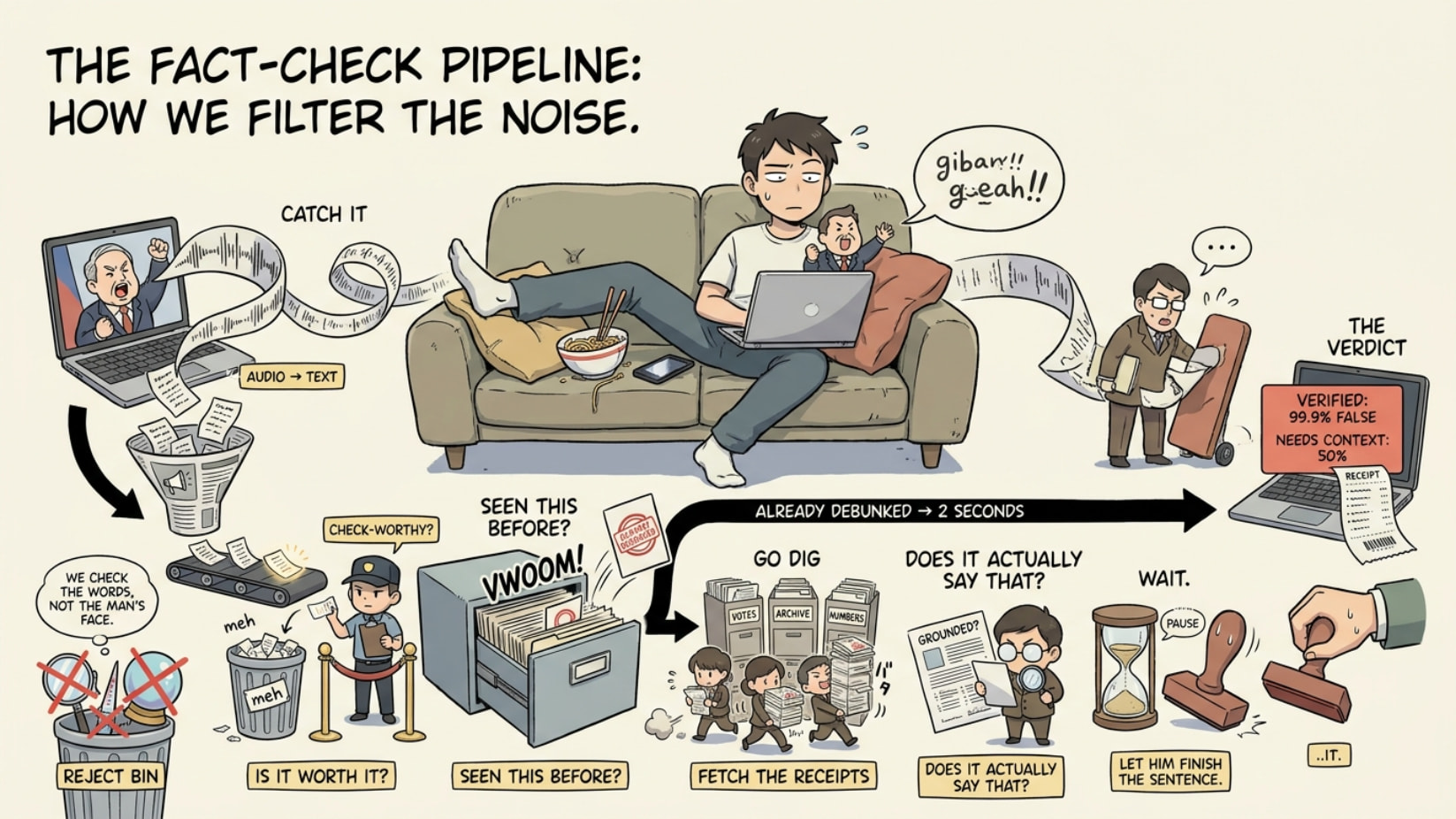
I built a simple Chrome extension.
The idea is straightforward:
- While watching a live debate, if the system detects that a politician is making a false or misleading statement, a red box appears on the screen.
- The box shows the type of misinformation or logical fallacy, along with a short explanation of why it was flagged.
The project originally started with a very simple approach.
I used a locally hosted Ollama 3.0 model that only monitored subtitle changes in the webpage’s DOM. As subtitles appeared, the model analyzed them using scientific methodologies designed to reduce bias and emotional reasoning when evaluating claims.
The goal was never to attack political opinions. It was simply to encourage evidence-based thinking.
Naturally, many additional features came to mind after that.
The Legal Problem
Then the EU introduced regulations stating that employers generally cannot use AI systems to monitor employees in the workplace.
I think that makes sense for private companies.
However, politicians are different.
If I vote for someone, that person represents me and my interests while acting as a public official during working hours.
Shouldn’t citizens be allowed to verify whether those public statements are accurate?
Unfortunately, depending on where you live and how such software is used, trying to build or distribute tools that automatically evaluate politicians’ statements may raise legal concerns.
Because of that, I will not publish the repository.
I’m not interested in creating legal problems for myself.
Instead, I’ll simply share observations and research.
Possible Technical Directions
There are many interesting research areas related to this idea.
For example:
- Psychological, neurocognitive, and medical research discussing whether deception can be detected from behavior or body language.
- Historical archives and knowledge bases that can verify whether someone is misquoting another person or putting words into someone else’s mouth.
- Replacing fragile DOM monitoring with speech transcription using Whisper.
- Using multiple LLMs instead of a single model to reduce false positives.
- Allowing the AI to delay judgment until additional context is spoken, assigning a confidence percentage before showing a warning instead of immediately displaying a false red flag.
The objective is not to declare someone a liar instantly.
The objective is to estimate the probability that a claim is misleading while minimizing false accusations through additional context and verification.
I still believe a simple sentence says it best:
“Friends don’t lie.”
P34C3

 !
!