 Fusion, Fission, and Gas Are Tied for 2035 Grid Power — And Solar Might Beat Them All
Fusion, Fission, and Gas Are Tied for 2035 Grid Power — And Solar Might Beat Them AllAI ate the power grid’s lunch. Now three energy sources are racing to feed a planet that can’t build turbines fast enough.
GE Vernova’s gas turbine backlog: 80 GW deep, sold out through 2030. Commonwealth Fusion Systems’ first commercial reactor: 400 MW in Virginia, early 2030s. Solar + battery cost per MWh: $50–$130 — already overlapping all three.
For the first time in decades, nobody knows what’s going to keep the lights on in 2035. Not the utilities. Not the regulators. Not the folks at 3 AM staring at capacity forecasts and wondering if they chose the wrong career. The old answer was always gas. Now? It’s a genuine three-horse race — and a dark horse with solar panels is gaining on the outside.
🧩 Dumb Mode Dictionary
| Term | Translation |
|---|---|
| LCOE | Levelized Cost of Energy — what each megawatt-hour actually costs over a plant’s lifetime, including building, fuel, and maintenance. The one number that matters. |
| SMR | Small Modular Reactor — a nuclear fission reactor that’s factory-built in pieces and assembled on-site, instead of constructing a cathedral-sized facility from scratch. |
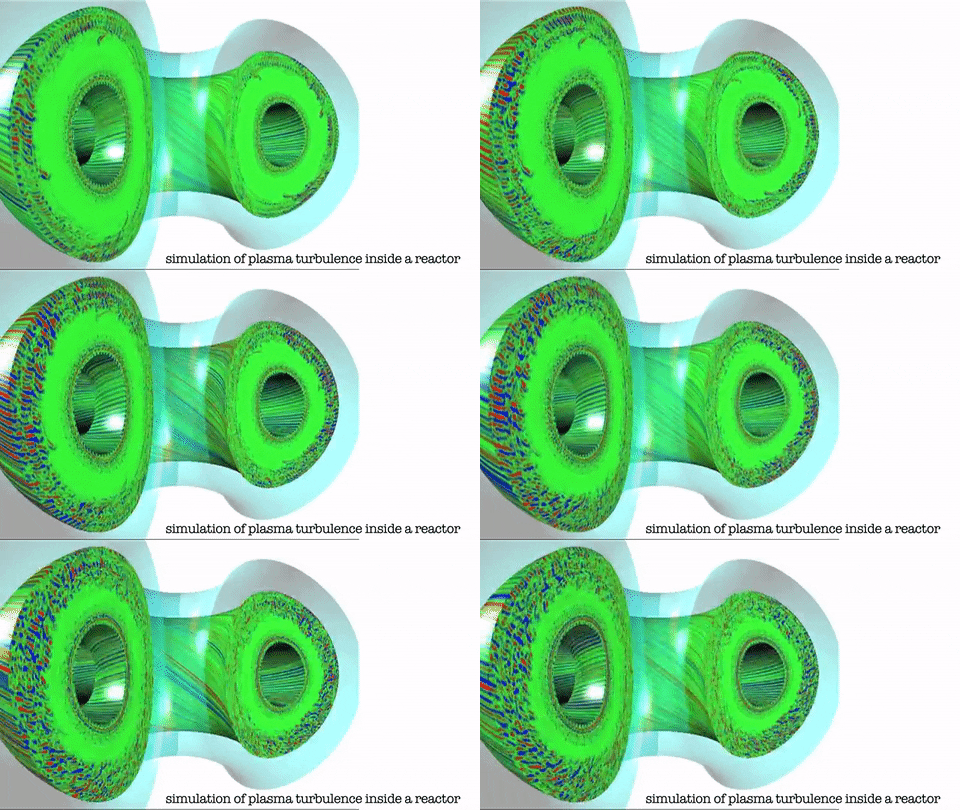
| Tokamak | A donut-shaped chamber that uses magnetic fields to contain plasma hot enough to fuse atoms. The design behind most serious fusion bets. |
| Baseload | The minimum amount of electricity a grid needs 24/7. Solar and wind can’t do this alone because the sun sets and wind stops. |
| CCGT | Combined-Cycle Gas Turbine — the current workhorse of grid power. Burns gas, captures waste heat for a second turbine. Efficient. Also: backordered until the 2030s. |
| HTS Magnets | High-Temperature Superconducting magnets — the breakthrough that let CFS shrink their tokamak from “building-sized” to “large-room-sized.” |
📖 How We Got Here
Right, so here’s what’s actually happening. AI data centers are devouring electricity like nothing we’ve seen. Gartner says 40% of AI data centers will be power-constrained by 2027. Total data center demand could hit 6.7–12% of all U.S. electricity by 2028.
The obvious move was natural gas. Proven tech, relatively cheap, runs 24/7. But then two things happened:
- Iranian drone strikes hit Qatar’s gas infrastructure, exposing just how fragile the supply chain is
- Everybody tried to order turbines at the same time
Now GE Vernova is sitting on an 80 GW backlog stretching to 2029. Mitsubishi says turbines ordered today won’t arrive until 2028–2030. If you want a new gas plant, you’re looking at a 5–7 year wait. Which is… about how long it takes to build a fusion reactor.
Funny how that works.
🔬 The Three Contenders
Natural Gas (The Incumbent)
Still the easiest path to 24/7 power. Lazard pegs new CCGT at ~$76/MWh (up from $60 in 2021). But good luck getting a turbine. The backlog is real and getting worse.
Nuclear Fission / SMRs (The Reliable Cousin)
The physics is proven — we’ve been splitting atoms for 70 years. Kairos Power has a deal with Google to bring its first SMR online by 2030. NuScale has NRC approval. TerraPower is building in Wyoming. The challenge: NuScale already doubled its cost estimates once. Trust is earned, not granted.
Nuclear Fusion (The Moonshot)
Commonwealth Fusion Systems plans to fire up its SPARC demonstration reactor by 2027. If that works, the 400 MW ARC commercial plant in Virginia follows in the early 2030s. That’s enough to power 150,000 homes. They’ve got Dominion Energy partnering and $3B+ raised. But fusion has been “10 years away” for 50 years. We’ll believe it when the meter spins.
📊 The Numbers That Matter
| Source | LCOE ($/MWh) | Timeline to Grid | Key Constraint |
|---|---|---|---|
| Natural Gas (CCGT) | ~$76–$107 | 5–7 years (backlog) | Turbine shortage, supply chain risk |
| Nuclear Fission (SMR) | ~$80–$110 | 2028–2035 | Cost overruns, regulatory process |
| Nuclear Fusion | ~$150–$200 (first plants) | Early 2030s (if SPARC works) | Unproven at commercial scale |
| Solar + Battery (4hr) | $50–$130 | Now–2 years | Intermittent, needs storage |
Solar paired with batteries is already cost-competitive with everything on this list. Without subsidies. The ITC brings storage costs down to $83/MWh in energy communities. That’s cheaper than new gas and new fission.
But — and this is the part renewables fans don’t love hearing — solar doesn’t run at 3 AM in January. Baseload still matters. You need something that runs when the sun doesn’t.
🗣️ What The Industry Is Saying
The fusion camp is bullish. Type One Energy’s CEO went on record at Utility Dive claiming fusion will beat advanced fission to the grid. CFS has the biggest war chest ($3B+), the MIT pedigree, and a site in Virginia with Dominion Energy’s blessing.
The fission camp is quieter but arguably more credible. Google didn’t sign a multi-reactor deal with Kairos Power because they enjoy paperwork. TerraPower’s Wyoming project promises 250+ jobs at six-figure salaries. The NRC has approved NuScale’s designs. The regulatory path exists.
And the gas guys? They’re watching their order books fill up through 2030 and shrugging. Demand is demand.
Meanwhile, the grid operators are the ones who actually have to keep things running. And they’re the most worried. Because none of these timelines are guaranteed, and data center demand isn’t waiting for anyone.
🌍 Why This Affects You Specifically
You might be thinking: “I’m not a utility executive, why should I care?”
Because your electricity bill went up 20% in two years. Because the AI tools you use daily are burning through power at a rate that makes Bitcoin mining look quaint. Because wherever you live, your grid is getting squeezed — and what replaces the retiring coal and gas plants determines whether your power stays cheap and reliable or becomes expensive and spotty.
Also because there’s money in this. Serious money. The companies that win this race will be worth hundreds of billions. The workers who skill up now will be unfireable for decades.
Cool. The Grid Needs a Miracle by 2035. Now What the Hell Do We Do? ಠ_ಠ
⚡ Hustle 1: Become an Energy Storage Installer Before the Rush
Battery storage installations are growing 127% year-over-year and there aren’t enough people who know how to wire them up. Get certified in BESS (Battery Energy Storage Systems) installation through programs from NABCEP or your local community college. Commercial properties and multifamily buildings are installing storage at $0 upfront through companies like Vista — and they need boots on the ground.
 Example: A licensed electrician in Brisbane, Australia pivoted to BESS installation after a 6-week certification course. He now subcontracts for three solar companies across Queensland and charges AUD $2,200/day for commercial installs. His old hourly rate was $45.
Timeline: 2–3 months for certification, 6 months to build a client pipeline. Demand is already outstripping supply in most markets.
🔧 Hustle 2: Build Energy Monitoring Dashboards for SMEs
Small and medium businesses are getting hammered by rising electricity costs but have zero visibility into their usage. Build real-time energy monitoring dashboards using open-source tools (Grafana + InfluxDB + cheap IoT sensors). Sell it as a monthly SaaS or a one-time install with maintenance contract.
Example: A freelance developer in Lagos, Nigeria built a simple energy monitoring system using ESP32 sensors and a Grafana dashboard. He pitched it to three restaurant chains and now manages 40+ locations at ₦150,000/month ($95 USD) per site. Total monthly recurring revenue: ~$3,800 USD.
📊 Hustle 3: Nuclear/Energy Workforce Recruiting and Consulting
Every SMR project needs 150–250 permanent employees. TerraPower’s Wyoming plant alone is hiring 250+ at six-figure salaries. There’s a massive talent gap in nuclear operations, radiation protection, and modular manufacturing. Start a specialized recruiting firm or career placement service targeting this niche.
Example: A former HR manager in Manchester, UK started a LinkedIn-based recruiting consultancy focused on nuclear decommissioning roles. Within 8 months she had placed 35 candidates at Sellafield and EDF, earning £4,000–£8,000 per placement. Annual revenue hit £180,000 in year one.
💡 Hustle 4: EV Battery Second-Life Reselling
Companies like Moment Energy are already repurposing retired EV batteries into grid storage. But there’s a supply chain gap: someone needs to source, test, and grade those batteries. Set up a testing and resale operation for second-life EV batteries, selling to off-grid communities, small businesses, and DIY solar installers.
Example: A mechanic in São Paulo, Brazil started pulling batteries from wrecked Nissan Leafs at salvage yards, testing cells with a $300 battery analyzer, and reselling graded packs to rural solar installers. He moves 15–20 packs/month at R$3,500 ($650 USD) profit per pack. Monthly take: ~$10,000 USD.
🛠️ Follow-Up Actions
| Step | Action |
|---|---|
| 1 | Read Lazard’s LCOE+ 2025 report (free PDF) to understand real energy costs |
| 2 | Check NABCEP.org for battery storage installer certification programs |
| 3 | Search ZipRecruiter for “Small Modular Reactor” — 160+ open roles right now at $68K–$160K |
| 4 | Look into Grafana + InfluxDB + ESP32 for DIY energy monitoring builds |
| 5 | Follow Commonwealth Fusion Systems, Kairos Power, and TerraPower for career/investment signals |
Quick Hits
| Want to… | Do this |
|---|---|
 Understand the real costs Understand the real costs |
Read Lazard’s free LCOE+ report — it’s the industry bible |
 Get into energy careers Get into energy careers |
Nuclear/SMR jobs: 150–250 per reactor, six-figure salaries, 30-year career runway |
 Build something now Build something now |
ESP32 + Grafana energy dashboards — $50 hardware, sell for $95/mo/site |
 Follow the money Follow the money |
Watch CFS ($3B raised), Kairos (Google deal), TerraPower (Bill Gates, Wyoming) |
| Bet on the dark horse |
Solar + 4hr battery: $50–$130/MWh unsubsidized. Already cheaper than new gas. |
The grid doesn’t care about your favorite energy source. It cares about what shows up on time, under budget, and doesn’t blow up. Right now, that’s nobody — and everybody.
 !
!