Lost After Graduation ---- Looking for Genuine Career Guidance

Lost After Graduation — Looking for Genuine Career Guidance

My college is over, and I Btech CSE without a single internship or job offer. I somehow managed to 7 CGPA.

During college, I did get a few job opportunities, but honestly, they were very limited. And yes, I admit that part of the problem was me too. I never focused on problem-solving, DSA, or aptitude. I even failed the hiring rounds of mass recruitment companies.

Technically, I know I’m good. I genuinely love technology and enjoy building and experimenting with things that many people around me can’t. But I eventually realized that companies don’t just hire based on technical curiosity. They expect strong fundamentals, problem-solving skills, and aptitude—areas where I was lacking.

Towards the end of my final semester, reality hit me. I realized I was in trouble if I didn’t start preparing seriously. So, even though it was late, I started learning frontend and backend development. I learned React, Node.js, Express.js, and AWS basics through YouTube tutorials and AWS skillbuilder labs.

Right now, I’m applying everywhere, but I’m barely getting any opportunities. To be honest, I sometimes hesitate to apply because I don’t have enough confidence that I can crack the interviews.

Currently, I’m trying to improve myself every day. I started learning DSA about a month ago and can now solve arrays and other basic problems. Alongside that, I’m preparing for my AWS Cloud Practitioner certification. The biggest challenge is balancing everything. If I focus on DSA, I feel like I’m neglecting development. If I go back to development, I worry that my DSA progress will slow down. Sometimes I just feel completely lost.

Mentally, I’m not a weak person. Ironically, I’m usually the one motivating my friends who are struggling to get jobs, telling them that things will eventually work out. But like everyone else, I have my own fears and doubts too.

What I Need

I’m looking for guidance.

Given my current situation, what would you do if you were in my place?

I’m considering CDAC feb batch because of its placement opportunities, but I’m not fixated on it. If there’s a better path—whether it’s improving my current skills, preparing differently, pursuing a reputed master’s program, or something else entirely—I’m open to hearing it.

I don’t want to waste another year making the wrong decision. I want to invest my time in something that genuinely improves my chances of building a career in tech.

If you’ve been through a similar phase or have experience in the industry, I’d really appreciate your advice.

Thank you for reading.

Many people insist on aiming only for core tech roles, but in today’s market that approach can be limiting. A smarter path is to enter the corporate world through tech‑adjacent roles and then transition internally. Here’s how:

:white_check_mark: Step 1: Consider Tech Support Roles

  • Companies like Wipro and Tech Mahindra hire thousands of people every month for tech support positions.
  • These roles often pay ₹5–6 LPA, which is a solid entry point.
  • Tech support is a closed‑to‑tech role, meaning it’s closely connected to technical work and gives you exposure to corporate systems, processes, and culture.

:white_check_mark: Step 2: Internal Switch to Tech

  • Once inside a company, you’ll gain visibility into internal openings.
  • Many professionals successfully switch internally to developer, analyst, or engineering roles after proving themselves.
  • This path avoids the struggle of breaking directly into core tech from outside.

:white_check_mark: Step 3: Build Skills in Parallel

  • While working, pursue internships at AI startups to strengthen your technical profile.
  • This keeps your resume active and shows initiative.
  • Avoid long gaps… waiting for CDAC or similar programs can add unnecessary resume gap.

:warning: Why Not Wait for CDAC?

  • CDAC offers packages around ₹3–4 LPA for the top 20–30% of students.
  • Waiting a year for the next batch risks a career gap without significantly better outcomes. You should have joined Batch July 2026.
  • Instead, start working now and build experience while learning.

:rocket: Key Takeaway

Don’t get stuck chasing only “pure tech” roles from the outside.
Enter through tech support → gain corporate exposure → switch internally → grow with internships and projects.
This strategy avoids gaps, builds credibility, and positions you for stronger opportunities in the long run.

@R_Dead first — breathe. You are not lost. You taught yourself MERN + AWS basics and started DSA, in the hardest stretch, while doubting yourself the whole way. That’s not a zero — that’s a real starting position most freshers don’t have. The problem isn’t your skill; it’s a timing decision and one wrong question you keep asking yourself.

Honest plan below — open the boxes. :backhand_index_pointing_down:

⏱️ First — the CDAC timing (and why you probably don't need it)

Quick reality check on the batch: the February 2026 PG-DAC batch already started back in February — the next real intake is the August cycle, so don’t plan around a batch that’s already running. (Confirm exact dates yourself on C-DAC ACTS rather than any forum.)

My honest take: CDAC isn’t the right move for you right now. It’s built for someone starting from zero direction — no stack, no cert, no momentum. You’re past that:

  • You already have React / Node / Express / AWS.
  • You already started DSA a month ago.
  • A 6-month program means resetting momentum you’ve already built, and skills often rust during its exam-focused grind.

Its placements are decent but land service/mid-tier — the same tier you can reach in 2–3 focused months on your own clock. Keep CDAC as a backup, not the plan.

🧠 The real trap — 'DSA vs web dev' is the wrong question

This framing is what’s actually keeping you stuck:

“If I focus on DSA I neglect dev… if I go back to dev, DSA slows down.”

Nobody gets hired for a perfect balance between two tracks. They get hired for problem-solving depth and staying consistent in one direction long enough to build real capability. The good news: these two aren’t a tug-of-war — you run a daily DSA habit alongside one deep build. The worry about “neglecting” one is the exact loop that keeps people stuck for years. Kill the loop, run both on autopilot.

🚀 Your next 90 days (the actual plan)

Weeks 1–4 — build ONE real proof-of-work project
Take your MERN + AWS and ship one complete, deployed, non-tutorial app — not a to-do list. Something with auth, a database, a real use case. This becomes your interview anchor: the thing you can explain in depth for 20 minutes. Put it on GitHub with a clean README and deploy it live free on Render or Vercel.

Weeks 1–12 — DSA, daily, non-negotiable (in parallel)
1 problem/day minimum. Order: Arrays → Strings → Recursion → Linked Lists → Trees. Chase understanding the pattern, not “5 solved today.” Free structured paths: NeetCode and Striver’s A2Z sheet.

Weeks 5–12 — apply relentlessly while you build
Target service companies + startups at the same time, 15–20 roles/week. Freshers face a brutal rejection ratio regardless of skill — it’s a numbers game and a skill game. Resume anchors: your deployed project + finish the AWS Cloud Practitioner cert (fast, credible, fills the gap).

📊 CDAC vs doing it yourself
Factor CDAC (Aug 2026) Your 90-day plan
Starting point assumes zero you already have a stack
Time to job-ready 6+ months 90 days, momentum kept
Cost program fees free (self-directed)
Placement tier service/mid-tier same tier, on your own
Skill regression high (exam grind) none — you keep building
Momentum reset to zero compounds what you started

Verdict: CDAC is for someone starting from nothing. You’d be paying to reset. Compound what you’ve already got instead.

💬 Your real fear, flipped

You said you hesitate to apply because you’re not confident you’ll crack interviews. Flip it:

Applying IS the practice.

Every rejected interview hands you exact data on what you’re weak in — worth more than another month of solo prep. Your 7 CGPA and no-internship stop being the story the second you can talk about one strong project + clear DSA fundamentals instead. You’ve spent this whole time being the one who tells your friends “it’ll work out.” Point that same belief at yourself — as a plan, not just a pep talk. :flexed_biceps:

✅ Do this week
  1. Don’t wait for the August CDAC batch — commit to the 90 days first, reassess only if truly stuck after real effort.
  2. Pick ONE non-tutorial project idea (indecision on what to build is usually fear of starting in disguise).
  3. Start a 1-problem-a-day DSA streak on NeetCode/Striver — today.
  4. Track applications in a simple spreadsheet (company · date · status) so the volume game feels visible, not demoralizing.
  5. Finish AWS Cloud Practitioner in 2–3 weeks — quick credibility.

Bottom line: you already did the hardest part — spotting the gap and starting to close it. Don’t reset into CDAC. Ship one strong project, keep DSA daily, apply relentlessly — that combo hires you faster than restarting from scratch.

You were never behind — you were building quietly. Now point the belief you hand your friends back at yourself, and let the work speak. :graduation_cap:

@R_Dead the plan you already got here is solid — ship one project, DSA daily, apply. So I won’t repeat it. I want to fix the part that’s actually hurting: “applying everywhere but barely getting opportunities.”

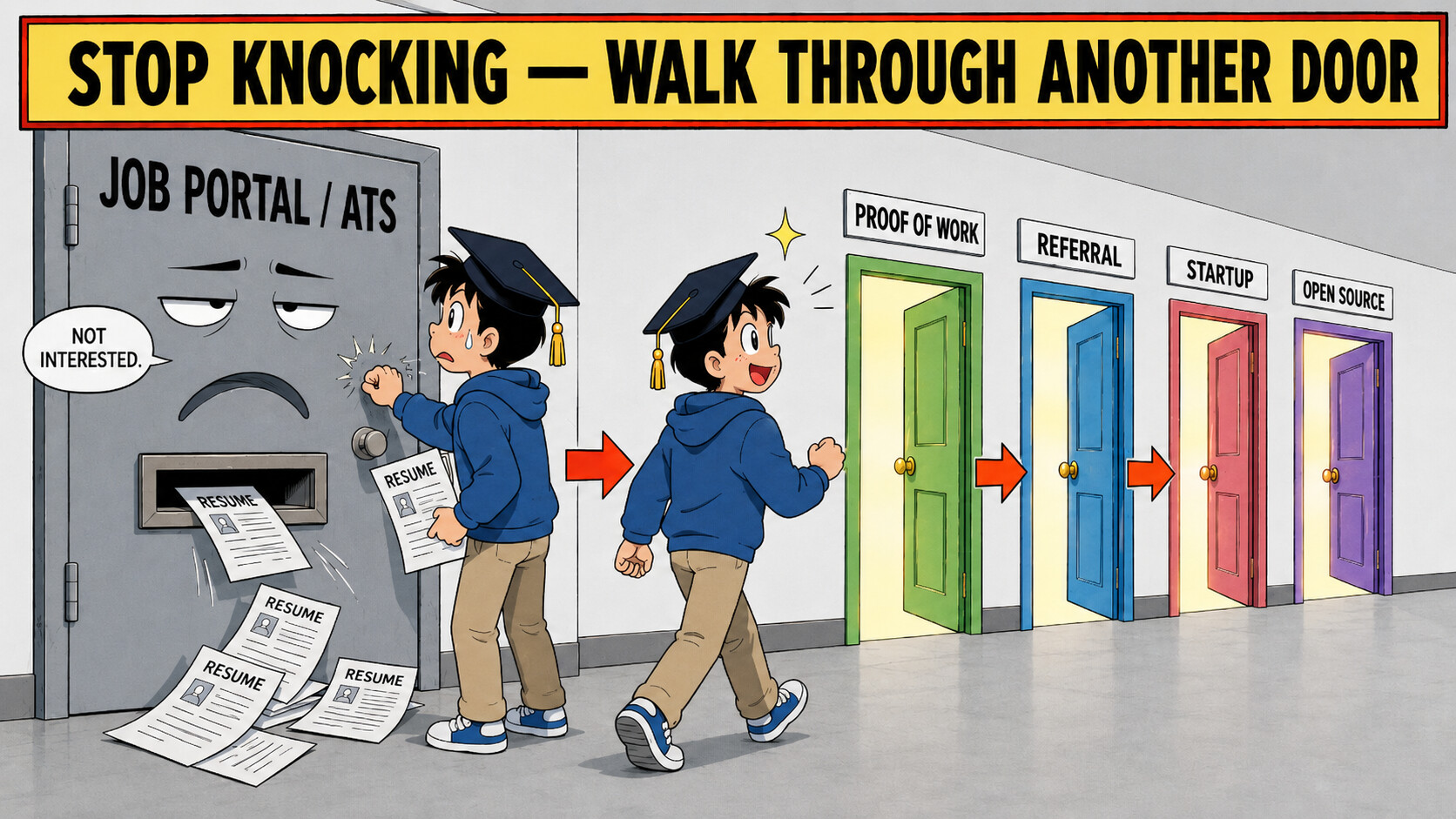
That’s not a skill problem and it’s not a CDAC problem. It’s a visibility one. You’re firing a no-referral, no-brand-college resume into the same funnel — mass-recruiter portals + generic job boards — that already rejected you. An ATS (the software that auto-scans resumes before a human sees them) filters you out on keywords + college in seconds. More applications into that door = more silence.

So use the doors where they judge what you built, not where you studied. Same effort, pointed somewhere it converts. Open the ones that fit you :backhand_index_pointing_down:

🇮🇳 Start here — the India off-campus ENGINE most freshers never realize they can enter directly

Almost every service company hires off-campus through a few central portals + one test. Register once, become visible to dozens of companies:

🎯 Programs that PAY you AND out-rank a campus tier (proof-first, college-blind)

Getting into any of these is itself a resume line that beats a placement cell — they pick you on contributions, not CGPA:

💼 Job platforms where startups hire on a build, not a CGPA

Founders here read your project and talk to you in 20 minutes — no aptitude gauntlet:

🤝 Referrals from strangers (skip the ATS completely)

A referred resume gets read; a portal resume gets counted. You don’t need to know anyone:

🧩 Turn your open-source into the interview (back-channel hiring)

Fixing a company’s bug is a live audition maintainers remember at hiring time:

📄 When you DO apply the front way — don't let the ATS eat your resume
🗺️ Sharpen the fundamentals (free paths + real interview practice)

You don’t have a skill gap — you already build things most freshers can’t. You have a door gap. Pick the India engine + one proof-door, and put this week’s applications through them instead of the black hole.

The front door counts resumes and forgets them. Every other door reads what you made — so stop knocking louder and walk through a different one.