 Meta’s $300 Spy Glasses Can Now Identify Every Stranger You Look At
Meta’s $300 Spy Glasses Can Now Identify Every Stranger You Look At70+ organizations just told Zuckerberg his “Name Tag” glasses will arm stalkers, predators, and federal agents with silent ID powers. Meta’s response? “We’ll be thoughtful about it.”
7 million Ray-Ban smart glasses sold in 2025 alone. Meta owns 72% of the smart glasses market. And now they want to add a feature that lets any wearer scan your face and pull up your name, your Instagram, your info — without you ever knowing.
A leaked internal memo shows Meta planned to drop this feature during political chaos on purpose — betting that privacy groups would be too busy fighting other fires to notice. 70+ civil rights organizations noticed anyway.
🧩 Dumb Mode Dictionary
| Term | What It Actually Means |
|---|---|
| Name Tag | Meta’s secret project name for “scan someone’s face with your sunglasses and find out who they are” |
| Biometric data | Body measurements used to identify you — fingerprints, face shape, voice patterns |
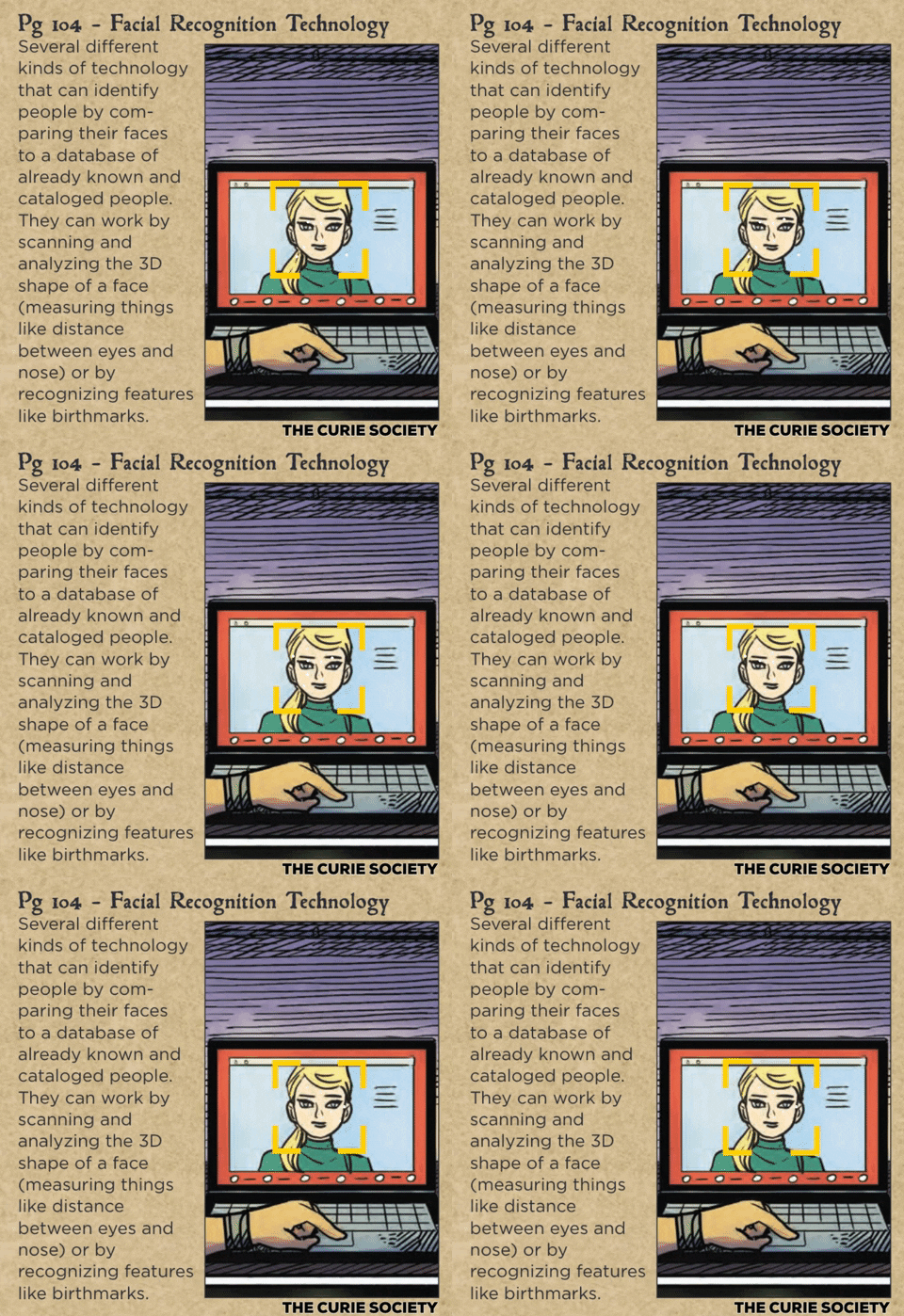
| Facial recognition | Software that matches a photo of your face to your identity in a database |
| Smart glasses | Regular-looking sunglasses with hidden cameras, microphones, and AI built in |
| Opt-out | A setting that supposedly lets you say “don’t track me” — but companies keep doing it anyway |
| COPPA | A U.S. law that protects kids’ data online — updated in 2025 to cover face scans |
| Civil society | Organizations that fight for regular people’s rights (like the ACLU) |
📰 What Happened
- Meta built a feature called “Name Tag” into its Ray-Ban smart glasses that uses AI to identify strangers just by looking at them
- Two versions exist: one that only identifies your Facebook/Instagram connections, and a broader version that scans anyone with a public Meta account
- The New York Times broke the story in February 2026 after internal documents leaked
- A coalition of 70+ organizations — including the ACLU, Fight for the Future, and the Electronic Privacy Information Center — sent a formal letter to Zuckerberg demanding he kill the feature entirely
- U.S. Senators Ron Wyden and Jeff Merkley separately demanded answers from Meta with an April deadline
📊 Meta's Smart Glasses Empire — By the Numbers
| Stat | Number |
|---|---|
| Ray-Ban smart glasses sold in 2025 | 7 million units |
| Meta’s share of the smart glasses market | 72.2% |
| Smart glasses market growth (2025) | +211.2% year-over-year |
| Organizations demanding Meta stop | 70+ |
| Meta’s past privacy fines (FTC, 2019) | $5 billion |
| Texas biometric lawsuit settlement | $1.4 billion |
| Countries getting new rollout (2026) | Canada, France, Italy, UK |
The data shows Meta isn’t some scrappy startup testing a feature. They’re the dominant player in a market that grew 211% in one year — and they want to bolt face-scanning onto 7 million pairs of sunglasses already on people’s faces.
🗣️ The Leaked Memo That Changed Everything
Here’s the part that makes your skin crawl. An internal memo from Meta’s Reality Labs division — the team building these glasses — described the current U.S. political environment as “favorable for launch.”
The exact reasoning: civil society groups would have “their resources focused on other concerns” during political turmoil, so Meta could slip the feature through with less pushback.
The coalition called this out directly. They accused Meta of “taking advantage of rising authoritarianism and this federal administration’s disregard for the rule of law to roll out a product that will harm vulnerable people.”
But here’s the thing nobody mentions: Meta actually tried this before. In 2021, they considered adding facial recognition to the first version of these glasses and backed off because of technical problems AND ethical concerns. What changed between then and now? The tech got better. And Meta decided the political cover was good enough.
🛡️ Why 70+ Groups Say This Can't Be Fixed
The coalition’s position is unusually absolute. They didn’t ask for better privacy settings. They didn’t ask for an opt-out button. They said — word for word — that face recognition in everyday glasses “cannot be resolved through product design changes, opt-out mechanisms, or incremental safeguards.”
Why so extreme? Because the threat model is different from your phone:
- You can see someone holding up a phone camera. You can’t tell if someone’s sunglasses are scanning you.
- A phone takes a photo. These glasses run AI continuously, keeping a rolling record of the wearer’s entire day.
- Stalkers currently need effort. Name Tag would let an abuser walk past their victim in a crowd and get an instant identity match — silently.
The EFF wrote separately: “Adding facial recognition technology to smartglasses would obliterate the privacy of everyone.”
😤 Who's Actually at Risk
This isn’t a theoretical problem. The coalition specifically listed the people who face the most danger:
- Domestic violence survivors who escaped abusers and rely on anonymity in public
- Immigrants who could be identified by federal agents at churches, schools, or hospitals
- LGBTQ+ people in areas where being identified could lead to harassment or worse
- Kids — COPPA law now explicitly covers biometric data, and these glasses could scan a child’s face without their parents knowing
- Literally anyone with an Instagram account — which is the broader version of Name Tag’s target pool
Fight for the Future is now pushing family-friendly businesses — restaurants, parks, malls — to post signs banning these glasses from their premises.
⚖️ Meta's Track Record With Your Face
Let’s check the receipts on how Meta handles biometric data:
- 2019: Paid $5 billion to the FTC for privacy violations including unauthorized facial data collection
- 2021: Shut down Facebook’s photo-tagging facial recognition after years of backlash
- 2024: Paid $1.4 billion to settle Texas biometric privacy lawsuit
- 2026: Internal memo reveals strategy to exploit political chaos for feature launch
Meta’s official response to the coalition letter: “Our competitors offer this type of facial recognition product, we do not. If we were to release such a feature, we would take a very thoughtful approach before rolling anything out.”
The counter-argument: Meta has spent $6.4 billion in fines and settlements on privacy violations. “Thoughtful” has a different meaning when your track record looks like that.
Cool. So Sunglasses Can Dox You Now… Now What the Hell Do We Do? ( ͡ಠ ʖ̯ ͡ಠ)
🛡️ Build a 'Glass-Free Zone' Certification for Local Businesses
There’s a gap forming right now. Fight for the Future is pushing businesses to ban facial recognition glasses, but there’s no standardized system for it. First person to build a simple certification program — logo, decal, directory — for “Glass-Free Zones” can own this space. Think of it like the “Wi-Fi Available Here” stickers, but for privacy. Sell the decals, charge businesses for directory listings, upsell to “privacy-certified venue” marketing packages.
 Example: A 24-year-old designer in Lisbon, Portugal created a “Privacy Safe” badge system for local cafes worried about smart glasses. She charges €15/month per venue for a listing in her directory app. Within 3 months, 340 venues signed up across Portugal and Spain — mostly restaurants, yoga studios, and domestic violence shelters. Revenue: €5,100/month.
Timeline: Design + launch in 2-3 weeks. Revenue starts from first batch of sign-ups. Scale city by city.
🔍 Sell 'Am I Findable?' Audits to Regular People
Most people have no idea how much of their face is already in databases. With Name Tag reportedly pulling from public Meta accounts (Instagram, Facebook), anyone with a public profile is scannable. Build a simple service: for $20-50, you check someone’s public exposure across Meta platforms, face search engines like PimEyes, and public records — then give them a step-by-step guide to reduce their “face footprint.” Target: parents, domestic violence orgs, therapists, influencers who separate their real identity from their brand.
Example: A cybersecurity student in Manila, Philippines started offering “Digital Face Audits” on Twitter/X after the Meta news broke. He charges ₱1,500 (~$27) per audit using PimEyes + manual Instagram/Facebook checks. He runs 8-10 per day, mostly for women worried about stalkers. Monthly take: ~$6,500.
📱 Create Anti-Recognition Accessories (IR Glasses, Face Patches)
This is physical product territory. Infrared LEDs embedded in glasses frames or hat brims can blind camera-based facial recognition without being visible to the human eye. The research is already public — Carnegie Mellon published papers on adversarial face patterns years ago. Nobody has made a sleek, consumer-ready version yet. First person to make IR-blocking glasses that look like normal fashion accessories (not cyberpunk cosplay) wins. Sell on Etsy, TikTok Shop, or direct.
Example: A hardware tinkerer in Shenzhen, China prototyped IR-emitting eyeglass frames using $3 worth of components from Taobao. He posted a demo video on TikTok showing them defeating iPhone Face ID — it got 2.1 million views. Pre-orders hit 4,000 units at $45 each within a week. Revenue: $180,000 before shipping a single unit.
💼 Become the 'Smart Glasses Policy' Person for Schools and Libraries
Schools, libraries, museums, and government buildings are about to need policies on facial recognition wearables — and most of them have zero clue where to start. The Library Freedom Project (one of the 70+ groups that signed the letter) is already pushing this, but individual institutions still need someone to actually write their policy, train staff, and handle signage. Position yourself as a consultant who specializes in exactly this. One template policy, customized per institution. Charge $500-2,000 per engagement.
Example: A law student in Toronto, Canada wrote a free template “Smart Glasses Policy” for public libraries, posted it on LinkedIn, and tagged 50 library directors. Three hired her within a week at CAD $1,200 each to customize it. She now has a waitlist of 22 institutions including two school boards. Projected quarterly revenue: CAD $26,400.
🧠 Build a 'Face Exposure Score' Browser Extension
Nobody has built a simple tool that tells you: “Based on your public Instagram photos, Facebook profile, and tagged images — here’s how easy it would be for Name Tag to identify you, on a scale of 1-100.” Build a browser extension or web app that scans someone’s public social profiles (with their permission) and calculates a “Face Exposure Score.” Free version gives the score. Paid version ($5/month) gives specific instructions to lower it — which photos to delete, which settings to change, which tags to remove.
Example: Two comp-sci students in Berlin, Germany built a “Privacy Score” Chrome extension that checks Instagram and Facebook exposure. Free tier got 12,000 installs in 10 days after a Reddit post in r/privacy went viral. Conversion to the €4.99/month premium tier (with fix-it guides) hit 6.2%. Monthly recurring revenue: €3,700 and climbing.
🛠️ Follow-Up Actions
| Step | Action |
|---|---|
| 1 | Check your Instagram/Facebook privacy settings RIGHT NOW — switch to private if you don’t need public reach |
| 2 | Search your face on PimEyes to see what’s already out there |
| 3 | Read the EFF’s full breakdown on why these glasses are a problem |
| 4 | If you run a business, check Fight for the Future’s ban toolkit for free signage |
| 5 | Remove tagged photos of yourself on Facebook/Instagram that you didn’t post |
| 6 | Follow the ACLU’s privacy page for updates on legal challenges |
 Quick Hits
| Want to… | Do this |
|---|---|
 Disappear from Name Tag Disappear from Name Tag |
Set Instagram + Facebook to private, remove face from tagged photos |
| See if your face is already searchable |
Run your photo through PimEyes (free tier available) |
 Ban spy glasses from your business Ban spy glasses from your business |
Grab free signage from Fight for the Future |
 Understand the full legal picture Understand the full legal picture |
Read the EFF deep dive |
 Turn this into income Turn this into income |
Pick one of the hustles above — the privacy panic market is wide open |
Meta spent $6.4 billion learning that people hate facial recognition. Now they’re putting it in sunglasses. Some lessons you just refuse to learn.
 !
!