 NASA’s $4.1B Moon Rocket Broke a Seal and Missed March — April 1 Is the New Launch Date
NASA’s $4.1B Moon Rocket Broke a Seal and Missed March — April 1 Is the New Launch DateA dislodged helium seal. That’s what’s standing between humanity and its first crewed trip around the Moon in over 50 years. A seal.
Artemis II — 4 astronauts, 10-day mission, $4.1 billion per launch, delayed by a rubber gasket smaller than your fist.
NASA just confirmed: the SLS rocket and Orion spacecraft won’t roll back to the pad until later this month, targeting April 1 for launch. No, really. April Fools’ Day. You can’t make this up.
🧩 Dumb Mode Dictionary
| Term | What It Actually Means |
|---|---|
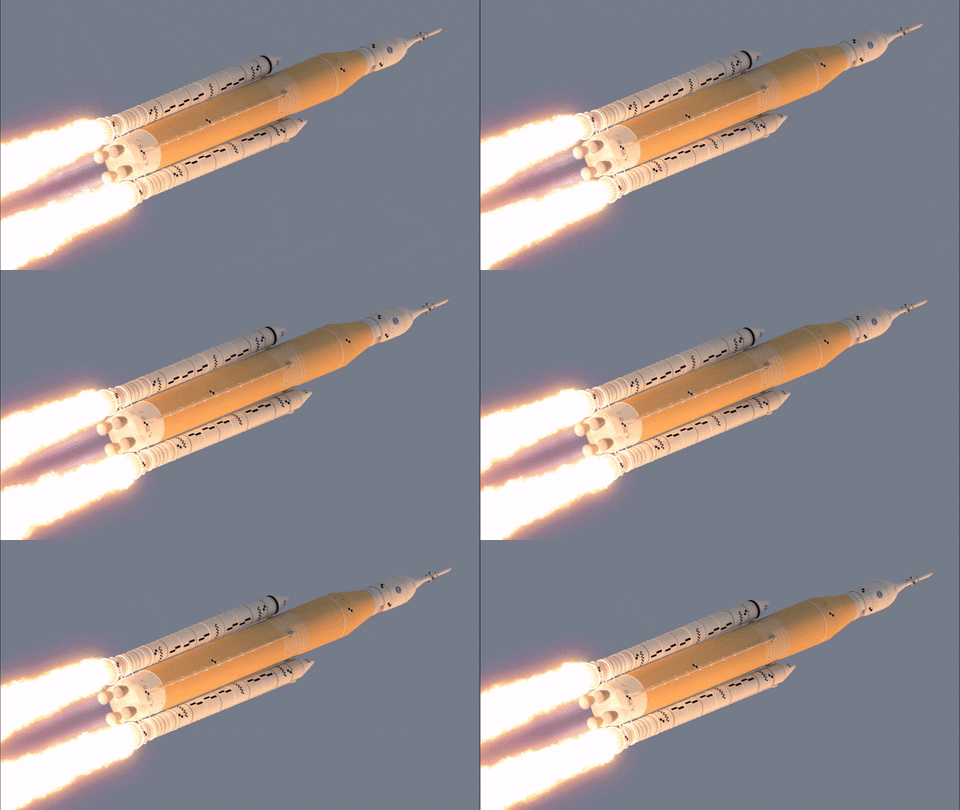
| SLS | Space Launch System. NASA’s 322-foot rocket. Costs more per launch than some countries’ GDP |
| Orion | The crew capsule that sits on top of SLS. Named “Integrity” by the crew, which is ironic given the schedule |
| Free-return trajectory | A path around the Moon that uses gravity to slingshot back to Earth. No braking required. Apollo 13 did this when things went sideways |
| Quick disconnect | A coupling that lets ground systems plug into the rocket. Think USB-C but for helium and it costs millions |
| VAB | Vehicle Assembly Building. The giant barn at Kennedy Space Center where they fix the rocket when the pad won’t do |
| Wet dress rehearsal | Loading the rocket with actual propellant to test everything without launching. Like a fire drill but with liquid hydrogen |
| Flight termination system | The self-destruct button. If the rocket goes off course, range safety blows it up. Batteries for this expire, apparently |
📖 The Backstory — Why We're Going Back to the Moon
Artemis II is NASA’s first crewed lunar mission since Apollo 17 in 1972. Four astronauts will ride the SLS rocket and Orion spacecraft on a 10-day trip around the Moon — no landing, just a flyby to prove the hardware works with humans aboard.
The crew:
- Reid Wiseman (Commander) — ISS veteran, two spacewalks
- Victor Glover (Pilot) — will be the first Black person to travel to the Moon
- Christina Koch (Mission Specialist) — will be the first woman on a lunar trajectory
- Jeremy Hansen (Mission Specialist, Canadian Space Agency) — first Canadian, first spaceflight
They named their spacecraft “Integrity.” The universe is testing that name.
🔧 What Actually Broke — The Helium Seal Saga
Right, so here’s what’s actually happening. The rocket passed a critical fueling test on February 21 — they loaded cryogenic propellants without the hydrogen leak that scrubbed the February launch attempt. That was the good news.
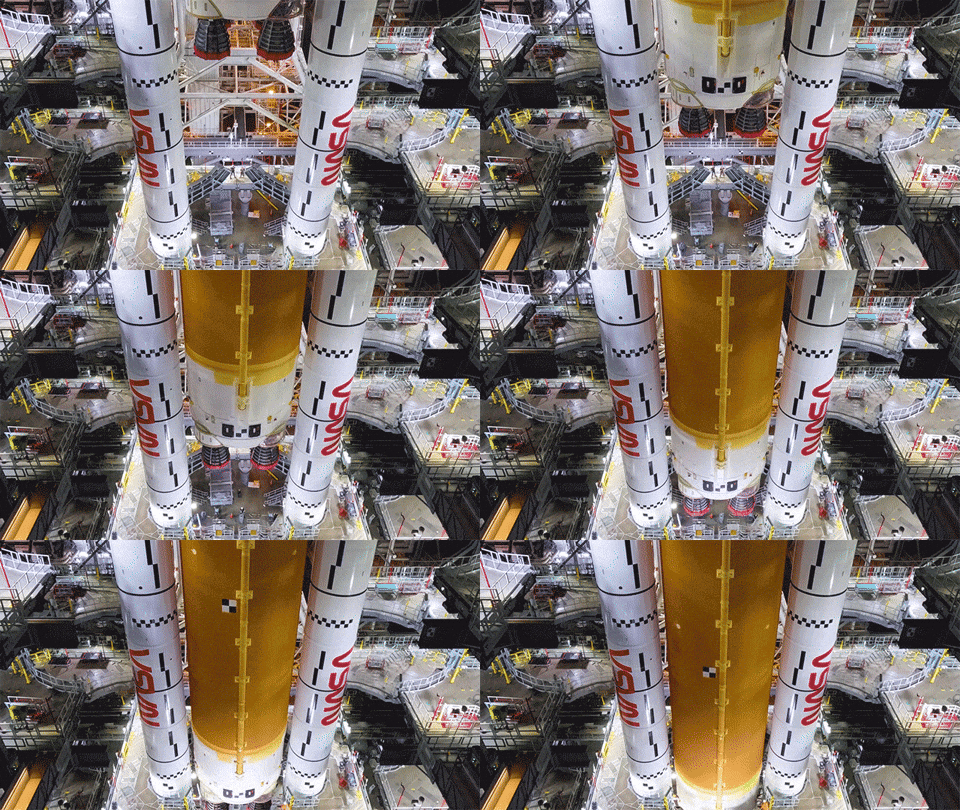
One day later, ground teams couldn’t flow helium into the upper stage. The helium lines to the upper stage are only accessible inside the VAB — not at the pad. So the entire 322-foot rocket had to be rolled back on February 25.
Within a week, engineers found it: a seal in the quick disconnect was obstructing the helium pathway. They removed it, reassembled the system, and ran reduced-flow helium tests to validate the fix.
Now they’re doing a root cause analysis on why the seal dislodged in the first place. Because if it happened once at the pad, it can happen again at the worst possible moment.
📊 The Numbers That Matter
| Metric | Value |
|---|---|
| Cost per SLS launch | $4.1 billion |
| Total SLS development (2011-2024) | $29 billion |
| Orion development (2006-2022) | $20.4 billion |
| Rocket height | 322 ft (98 m) |
| Mission duration | ~10 days |
| Crew size | 4 astronauts |
| Budget overrun | 140% over original estimates |
| Trump FY2026 proposed NASA cut | $6 billion (24%) |
| Congressional override for Artemis IV-V | $4.1 billion secured |
NASA’s own inspector general called the per-launch cost “unsustainable.” Congress funded two more missions anyway. And NASA Administrator Jared Isaacman just cancelled the SLS Block 1B and Block 2 upgrades entirely — they’re standardizing on Block 1 and that’s it.
🗣️ What People Are Saying
NASA (official update, March 3): “Engineers are assessing what allowed the seal to become dislodged to prevent the issue from recurring.”
NASA Inspector General Paul Martin (congressional testimony): “A price tag that strikes us as unsustainable.”
The Ars Technica comment section (87+ comments and counting) is roughly split between “this is an embarrassment” and “this is how spaceflight works, every program has delays.” Both are correct.
Meanwhile, SpaceX got $1 billion earmarked in the same budget that tried to kill SLS after Artemis III. The writing is on the wall — or rather, on the line items.
⚙️ What Happens Before April 1
Before rolling back to the pad, technicians need to:
- Replace flight termination system batteries — the range safety destruct system needs fresh ones (they expire)
- Swap flight batteries on the SLS core stage, upper stage, and solid rocket boosters
- Recharge Orion batteries on the crew capsule
- Complete the helium seal root cause analysis — make sure the fix is permanent
- Roll the whole stack back to Pad 39B — this is a multi-day process on a giant crawler
All of this has to happen in March. The April 1 date is the start of a launch window, not a guarantee.
🔍 The Bigger Picture — SLS Is Already Dead Walking
Here’s the part nobody at NASA wants to say out loud. The SLS program has been effectively capped. Administrator Isaacman cancelled the Block 1B and Block 2 upgrades in late February. Congress funded exactly two more flights (Artemis IV and V) at $1.025 billion per year through 2029.
After that? The budget explicitly says NASA will transition to “more cost-effective commercial systems.” Translation: SpaceX Starship, which costs a fraction per launch even if you include the part where they occasionally blow up in the Gulf of Mexico.
Artemis II might be the last time we see this particular rocket fly with humans aboard before the whole architecture changes. That makes it historically significant — and historically expensive.
Cool. A $4.1 Billion Rocket Got Grounded by a Seal. Now What the Hell Do We Do? ( ͡ಠ ʖ̯ ͡ಠ)

📱 1. Build an Artemis Launch Tracker App
Space launch tracking apps are a proven niche. With Artemis II generating massive public interest (first crewed Moon mission in 53 years), a dedicated tracker with countdown, live telemetry links, and push notifications has a real audience.
 Example: A solo dev in Bratislava, Slovakia built a minimal launch tracker for Artemis using Flutter, pulled live data from NASA’s public APIs, and monetized with a $1.99 pro tier for widget support. The app hit 14,000 downloads in the two weeks surrounding the February fueling test, generating ~$3,800 in revenue from a weekend project.
Timeline: NASA’s public APIs are free and well-documented. An MVP takes a weekend with Flutter or React Native.
🎓 2. Create Space Engineering Explainer Content
Every delay generates a news cycle, and every news cycle generates a wave of people Googling “what is a quick disconnect” and “why does NASA use helium.” Educational content that translates aerospace engineering into plain English performs well on YouTube and TikTok.
Example: A mechanical engineering student in Melbourne, Australia started a TikTok series called “Why Rockets Break” using whiteboard animations. The Artemis hydrogen leak video in February pulled 2.1M views and landed her a sponsored deal with Brilliant.org worth $4,200 for a single integration.
💰 3. Sell Space Mission Merchandise Around Launch Windows
Print-on-demand shops see massive spikes around crewed launches. Artemis II will be the first crewed Moon mission for Gen Z — the meme potential alone is worth a Shopify store.
Example: A graphic designer in Guadalajara, Mexico created an “April Fools Moon Mission” shirt line on Printful after the date was announced. Pre-orders hit 620 units at $24.99 within 72 hours of the March 3 announcement, netting roughly $5,500 profit after platform fees.
🔧 4. Build a NASA Delay Dashboard / Historical Tracker
There’s a surprising lack of good public dashboards tracking NASA mission delays, cost overruns, and schedule slips. A well-designed data visualization project gets shared on HN, Reddit r/space, and aerospace Twitter. Monetize with ads or a Patreon.
Example: A data analyst in São Paulo, Brazil scraped NASA’s public budget documents and GAO audit PDFs to build an interactive D3.js dashboard showing SLS cost per launch over time vs. SpaceX Falcon Heavy. The site hit HN front page, pulled 48,000 unique visitors in a week, and now earns ~$400/month from a mix of Ko-fi tips and a small display ad.
📝 5. Write the 'Is SLS Worth It?' Deep Dive
Long-form analysis comparing SLS cost-per-kg to orbit vs. Falcon Heavy vs. Starship is the kind of content that ranks for years. Substack, Medium, or your own blog — aerospace policy content has a small but dedicated (and high-income) readership.
Example: A freelance tech writer in Nairobi, Kenya published a 4,000-word Substack breakdown titled “The $29 Billion Rocket That Might Fly Five Times” with GAO source data and per-mission cost comparisons. It was picked up by Ars Technica’s comment section and r/space, pulling 12,000 subscribers to a free Substack and converting ~340 to paid ($7/month) within the first month — roughly $2,380/month recurring.
🛠️ Follow-Up Actions
| Step | Action |
|---|---|
| 1 | Bookmark NASA Artemis II page for official updates |
| 2 | Monitor NASA public APIs for live data feeds |
| 3 | Follow @NASAArtemis for real-time schedule changes |
| 4 | Read the GAO SLS audit report for cost data |
| 5 | Check The Planetary Society’s SLS cost tracker for updated figures |
| 6 | Set a calendar reminder for late March — the rocket roll-out to Pad 39B will be the next milestone |
 Quick Hits
| Want to… | Do this |
|---|---|
| Watch the launch live |
NASA TV streams free — bookmark nasa.gov/live for April 1 |
 Track SLS costs Track SLS costs |
Planetary Society has the best public breakdown — updated quarterly |
 Get launch alerts Get launch alerts |
NextSpaceflight app (free) or Space Launch Now sends push notifications |
 Understand the engineering Understand the engineering |
Everyday Astronaut’s SLS series on YouTube is the gold standard |
 Trade the launch hype Trade the launch hype |
Watch $LMT, $BA, $AJRD — defense/aerospace stocks move on Artemis milestones |
Fifty-three years to go back to the Moon, and we’re being held up by a gasket. Some things never change — including the part where the fix costs more than your house.
 !
!