
 HOW TO GET YOUR RESEARCH PAPER PUBLISHED FAST IN 2026 — BEGINNER’S COMPLETE BLUEPRINT

 Most beginners fail not because their research is bad — but because they don’t know the system. The publication game has rules, shortcuts, and landmines. This blueprint covers every single one. Follow this and your first DOI is a matter of months, not years.
 UNDERSTAND THE PUBLISHING ECOSYSTEM FIRST
TWO WORLDS EXIST IN ACADEMIC PUBLISHING:
──────────────────────────────────────────────
🌍 WORLD 1 — CONFERENCES
   → Submit → Get reviewed in weeks
   → Present your work (virtual OK)
   → Paper goes LIVE on IEEE Xplore with DOI
   → BEST entry point for beginners ✅

🌍 WORLD 2 — JOURNALS
   → Submit → Wait months to years
   → No presentation required
   → Higher academic prestige
   → BEST after you have 1–2 papers already

YOUR FASTEST PATH IN 2026:
  Conference first → Journal second
  Total time conference → DOI = 3–6 months
  Total time journal → DOI = 12–24 months
 PHASE 1 — BUILDING A PUBLISHABLE PAPER
The 8 Sections Every Reviewer Wants to See
① TITLE
   → Specific + keyword-rich
   ❌ "A Study on Machine Learning"
   ✅ "ResNet-50 Based Diabetic Retinopathy
      Detection with 97.3% Accuracy on
      APTOS 2019 Benchmark"

② ABSTRACT (150–250 words)
   → Problem → Your method → Results → Impact
   → Reviewer reads this FIRST to decide
     if they'll read further — make it count

③ INTRODUCTION
   → What problem exists?
   → Why does it matter?
   → What specifically did YOU contribute?

④ LITERATURE REVIEW
   → What have others done?
   → What GAP does your work fill?
   → Cite papers from 2021–2026 ONLY
     (older = signals you didn't research well)

⑤ METHODOLOGY
   → Your most important section
   → Be SPECIFIC: which model, which dataset,
     which hyperparameters, which evaluation metrics
   ❌ "We used deep learning for classification"
   ✅ "We fine-tuned EfficientNet-B4 on 3,662
      training images using Adam optimizer
      (lr=0.001) for 50 epochs with batch size 32"

⑥ RESULTS & DISCUSSION
   → Always compare against a BASELINE
   → Tables + graphs = stronger than words alone
   → Explain WHY your results are better

⑦ CONCLUSION
   → What did you prove?
   → What are the limitations? (be honest)
   → What is the future work?

⑧ REFERENCES
   → IEEE format: [1] Author, "Title," Journal,
     vol., no., pp., year.
   → Minimum 20–30 references for conferences
   → Minimum 40–50 for journals
 PHASE 2 — FORMATTING (WHERE MANY BEGINNERS FAIL)
DOWNLOAD OFFICIAL IEEE TEMPLATE:
  → ieee.org/conferences/publishing/templates
  → Available: MS Word + LaTeX
  → LaTeX = preferred by reviewers
  → Word = perfectly acceptable for beginners

NON-NEGOTIABLE FORMATTING RULES:
  ✅ Two-column layout (IEEE standard)
  ✅ Times New Roman 10pt (body)
  ✅ Figures: 300 DPI minimum
  ✅ All text READABLE (no tiny axis labels)
  ✅ Paper length: 4–6 pages for conferences
  ✅ References section NOT counted in page limit

PLAGIARISM — THE SILENT KILLER:
  → IEEE uses iThenticate to check every paper
  → Threshold: BELOW 15% similarity ✅
  → Self-plagiarism counts — even your own
    previous work needs citation
  → AI-generated text is now detectable in 2026
    → Write your paper yourself
    → Use AI for grammar help only

FREE PLAGIARISM CHECKERS BEFORE SUBMITTING:
  → Quetext.com (free tier)
  → Plagiarismdetector.net
  → SmallSEOTools plagiarism checker
 PHASE 3 — FINDING YOUR TARGET VENUE
Step 1 — Match Your Topic to a Specific Field
EXAMPLES OF TOPIC → RIGHT CONFERENCE MAPPING:
──────────────────────────────────────────────
AI / Computer Vision    → ICIP, CVPR, IEEE Access
Biomedical Engineering  → EMBC, IEEE JBHI
Power / Energy Systems  → IPRECON, PESGM
Communication / 5G      → IEEE GLOBECOM, ICC
Robotics                → ICRA, IROS
General CS / India      → INDISCON, CONECCT

⚠️ SCOPE MISMATCH = INSTANT DESK REJECTION
   Submitting AI paper to hardware conference
   = rejected without being read
   ALWAYS match your topic to the venue's CFP
Step 2 — Search for Active Conferences
BEST SEARCH TOOLS:
──────────────────────────────────────────────
① IEEE Official Search:
   conferences.ieee.org/conferences_events/
   conferences/search
   → Filter: Field of Interest = your topic
   → Filter: Country = India (lower fees)
   → Filter: Format = Virtual/Hybrid

② WikiCFP.com
   → wikicfp.com/cfp
   → Best site to find open Call for Papers
   → Search by keyword + deadline

③ Conference Ranks:
   → core.edu.au/conference-portal
   → Check ranking: A* > A > B > C
   → Aim for B or above as a beginner ✅

④ ResearchGate
   → Browse what researchers in your field
     are publishing and WHERE they publish
Step 3 — Verify the Conference is Legitimate
THE 3-STEP LEGITIMACY CHECK:
──────────────────────────────────────────────
✅ CHECK 1: Search name on IEEE Xplore
   ieeexplore.ieee.org
   → Previous year proceedings exist?
   → Papers inside match your topic?

✅ CHECK 2: Time from conference to DOI
   → Find last year's conference date
   → Find when papers appeared on Xplore
   → 6–12 weeks gap = well-managed ✅
   → 6+ months gap = disorganized ⚠️

✅ CHECK 3: Predatory check
   → beallslist.net
   → If listed → NEVER submit there
   → Predatory publications can
     DAMAGE your academic reputation

INSTANT RED FLAGS — WALK AWAY IF YOU SEE:
  ❌ "Accept within 24 hours"
  ❌ Fee required before review begins
  ❌ No Program Committee listed
  ❌ Copy-paste CFP covering "all topics"
  ❌ Zero IEEE Xplore publication history
 PHASE 4 — COSTS & HOW TO PUBLISH FREE
Conference Registration Fees
INDIA-HOSTED IEEE CONFERENCES:
──────────────────────────────────────────────
Student author rate:  ₹6,000–₹10,000
Regular author rate:  ₹10,000–₹15,000
IEEE member discount: 10–20% off ✅

COST-REDUCTION STRATEGIES:
  ① IEEE Student Membership = ~₹1,500/year
     → Pays back on first conference fee
  ② Be second author initially
     → First author pays, you still get published
  ③ Target regional NIT/IIT conferences
     → Same IEEE Xplore indexing, lower fees
  ④ Apply for student travel grants
     → Many IEEE chapters offer them
Completely Free Reputable Options
FREE OPTION 1 — SUBSCRIPTION JOURNALS
  → IEEE Transactions, Springer, Elsevier
  → Submit WITHOUT enabling "Open Access"
  → You pay zero ✅
  → Readers access via library subscriptions
  → Most rigorous but completely free to publish

FREE OPTION 2 — DOAJ WAIVER JOURNALS
  → doaj.org → Filter "Without APCs"
  → Peer-reviewed, open access, free to publish
  → Scopus-indexed options available
  → Thousands of legitimate options

FREE OPTION 3 — GEOGRAPHIC FEE WAIVERS
  → India qualifies for waivers at:
     → Springer Nature ✅
     → Wiley Open Research ✅
     → Cambridge University Press ✅
  → Apply during submission process
  → Look for "APC Waiver" in Author Guidelines

FREE OPTION 4 — PREPRINT SERVERS
  → arXiv.org (best for STEM — globally respected)
  → Zenodo.org (all disciplines, CERN-backed)
  → Not peer-reviewed BUT:
     → Establishes your publication DATE
     → Gets your work cited before formal review
     → Free DOI via Zenodo
     → Many papers gain citations at preprint stage
 PHASE 5 — SUBMISSION DAY
MAIN PLATFORMS (CREATE ACCOUNTS BEFORE DEADLINE):
──────────────────────────────────────────────
→ Microsoft CMT: cmt3.research.microsoft.com
  (most IEEE conferences use this)
→ EDAS: edas.info
  (second most common)
→ ScholarOne: mc.manuscriptcentral.com
  (IEEE Transactions journals)

YOUR PRE-SUBMISSION FINAL CHECKLIST:
  ✅ IEEE template used correctly
  ✅ Similarity score verified below 15%
  ✅ All figures clear, 300+ DPI
  ✅ References complete + correct format
  ✅ Author info removed for blind review
  ✅ Paper length within stated limit
  ✅ Spell-check + grammar check done
  ✅ A senior mentor has reviewed it ← #1 priority
  ✅ Scope match confirmed against CFP
 PHASE 6 — SURVIVING PEER REVIEW
THE 4 POSSIBLE DECISIONS:
──────────────────────────────────────────────
✅ ACCEPT AS IS
   → Rare for first submissions
   → Proceed to camera-ready immediately

📝 MINOR REVISION (most common positive outcome)
   → Small changes: add comparison, fix figure,
     clarify explanation
   → Respond within given deadline
   → Write a polite response letter:
     "Thank you for your valuable feedback.
      We have addressed your comments as follows:
      Comment 1: [what you changed + where]"

📋 MAJOR REVISION
   → Significant work needed
   → Still worth doing — means they see potential
   → Typical turnaround: 2–3 months

❌ REJECT
   → NOT the end — most published researchers
     faced multiple rejections
   → Read reviewer comments carefully
   → Improve the paper based on feedback
   → Submit to next venue on your list
 THE 8 MOST COMMON REJECTION REASONS
① SCOPE MISMATCH (most common)
   → Paper topic doesn't fit the conference theme
   → FIX: Read CFP + last 3 years of published
     papers in that venue before submitting

② HIGH PLAGIARISM SCORE
   → Over 20% similarity = immediate rejection
   → FIX: Run Quetext/iThenticate BEFORE submitting

③ NO BASELINE COMPARISON
   → "Our method works" without comparing to
     existing methods
   → FIX: Always add a comparison table showing
     your method vs 2–3 existing approaches

④ VAGUE METHODOLOGY
   → Not enough technical detail to reproduce work
   → FIX: Add every parameter, dataset detail,
     tool version, evaluation metric

⑤ OUTDATED LITERATURE
   → Only citing papers from 2015–2018
   → FIX: Find and cite 2021–2026 work in your area

⑥ POOR FIGURES/TABLES
   → Unreadable graphs, missing axis labels
   → FIX: Every figure must be standalone
     understandable without reading the paper

⑦ WEAK ABSTRACT
   → Reviewer reads abstract, loses interest,
     looks for reasons to reject
   → FIX: Abstract = your sales pitch, make it
     specific and result-focused

⑧ NO MENTOR REVIEW
   → Submitting raw without expert feedback
   → FIX: Have a professor or senior PhD student
     review your paper BEFORE submitting
     This single step prevents 80% of rejections
YOUR 8-WEEK FAST-TRACK PLAN
WEEK 1–2:  Write full paper draft
WEEK 3:    Format with IEEE template
WEEK 3:    Plagiarism check + grammar polish
WEEK 4:    Mentor review + incorporate feedback
WEEK 4:    Find target conference on wikicfp.com
           Verify on IEEE Xplore + Beallslist
WEEK 5:    Submit via CMT or EDAS

→ Wait 4–10 weeks for decision

AFTER ACCEPTANCE:
WEEK 1:    Address reviewer comments
WEEK 2:    Submit camera-ready + copyright form
WEEK 3:    Pay registration fee
WEEK 4–8:  Present at conference (virtual OK)

→ 6–12 weeks later: LIVE on IEEE Xplore with DOI ✅
 INSIDER TIPS THAT CHANGE EVERYTHING
 Email the Program Chair BEFORE submitting — ask “Does this topic fit your CFP?” — 80% reply, saves you months of misplaced submissions
 Post on arXiv on the same day you submit — establishes your work’s date, gets early citations, costs nothing
- Target conferences with 2–4 weeks to deadline — tighter deadlines = less competition, same review quality
 One mentor review = worth more than any tool — an experienced researcher spots structural flaws in 30 minutes that reviewers would use to reject you
- Rejection is data, not failure — reviewer comments are free consulting on how to improve; use every rejection to strengthen the paper
 Comparison tables win papers — a clean table showing your method beats 3 others on 3 metrics is the single most convincing visual in any paper
 Join ResearchGate before submitting — upload your paper, connect with others in your field, get visibility beyond the journal
The researchers who publish fast aren’t more brilliant — they understand the system, pick the right venue, verify legitimacy, write specific methodology, compare to baselines, and get mentor feedback before submitting. Apply every step in this blueprint and your first IEEE DOI is achievable within 6 months from today. The system rewards those who learn its rules. 

 What field is your research paper in? Drop it below and get specific venue recommendations!
 Share this — every first-time researcher needs this blueprint!
 Bookmark this — complete fast-track IEEE publishing guide 2026!
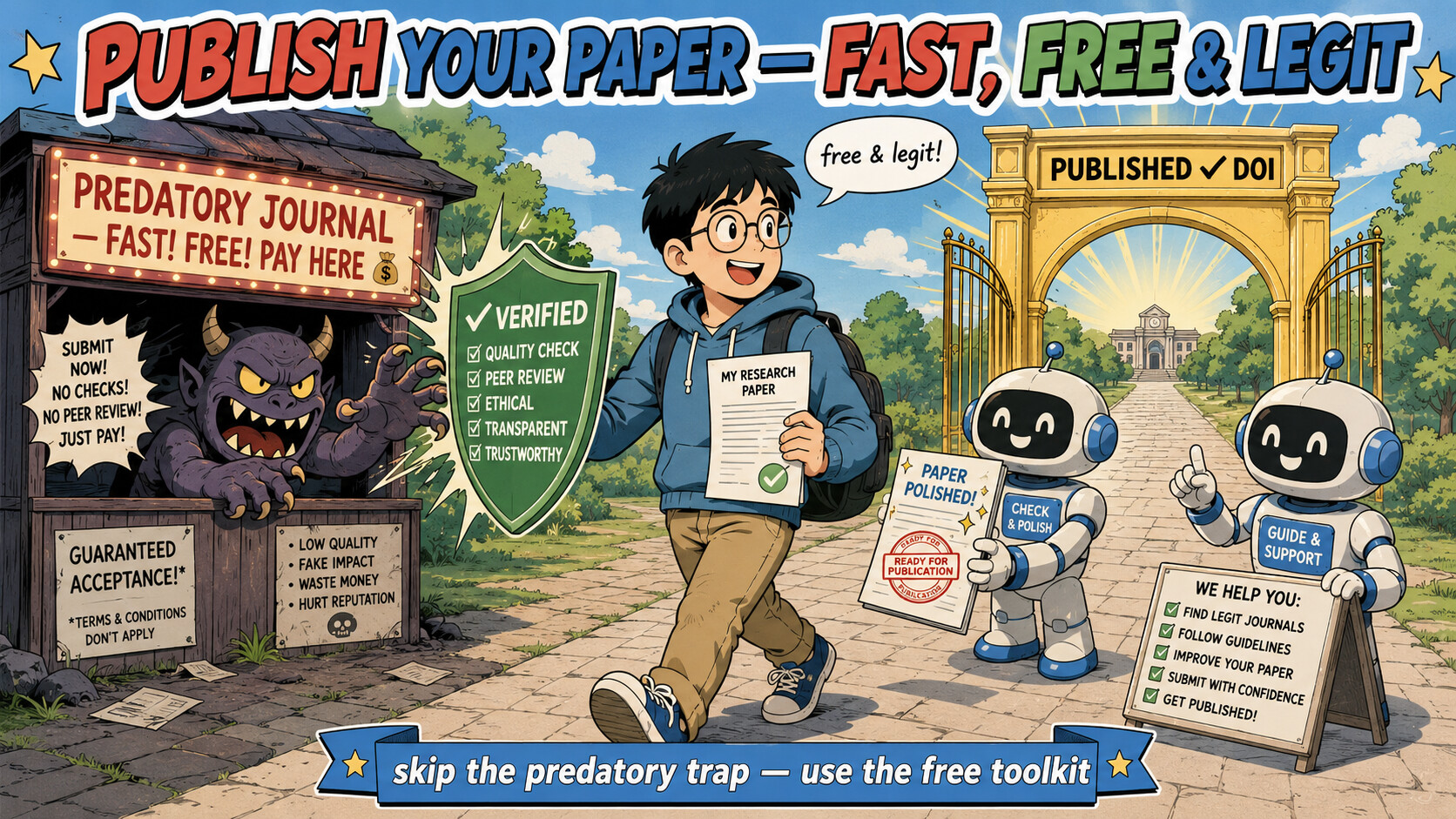
 — you’ve got the roadmap down. So instead of repeating it, here’s the free toolkit the roadmaps skipped — the stuff that makes paper
  Read this first — “fast + free + reputable” is exactly what predatory publishers advertise. They spam beginners promising all three, take a fee, and your paper lands in a fake journal that ruins your CV. So before you submit anywhere, run the venue through these (30 seconds, free):
 Think-Check-Submit — the checklist →
  IEEE Publication Recommender — matches IEEE venues and shows how long each takes to publish →
  pubscope — gives each journal a Trust Score, DOAJ-filtered →
  Never miss a deadline → ccfddl (live CS conf countdowns)
  The actual “FREE” part — three routes most beginners never hear about
 Kill the
  Bonus — full lit review from ONE paper you like: drop it into Connected Papers (
 Two power-moves for paper
  !
!