 Free Access to Millions of Declassified Government Documents
Free Access to Millions of Declassified Government Documents Where Researchers Actually Find Declassified Files
One-Line Flow: Free access to millions of declassified docs the government hoped you’d forget exist.
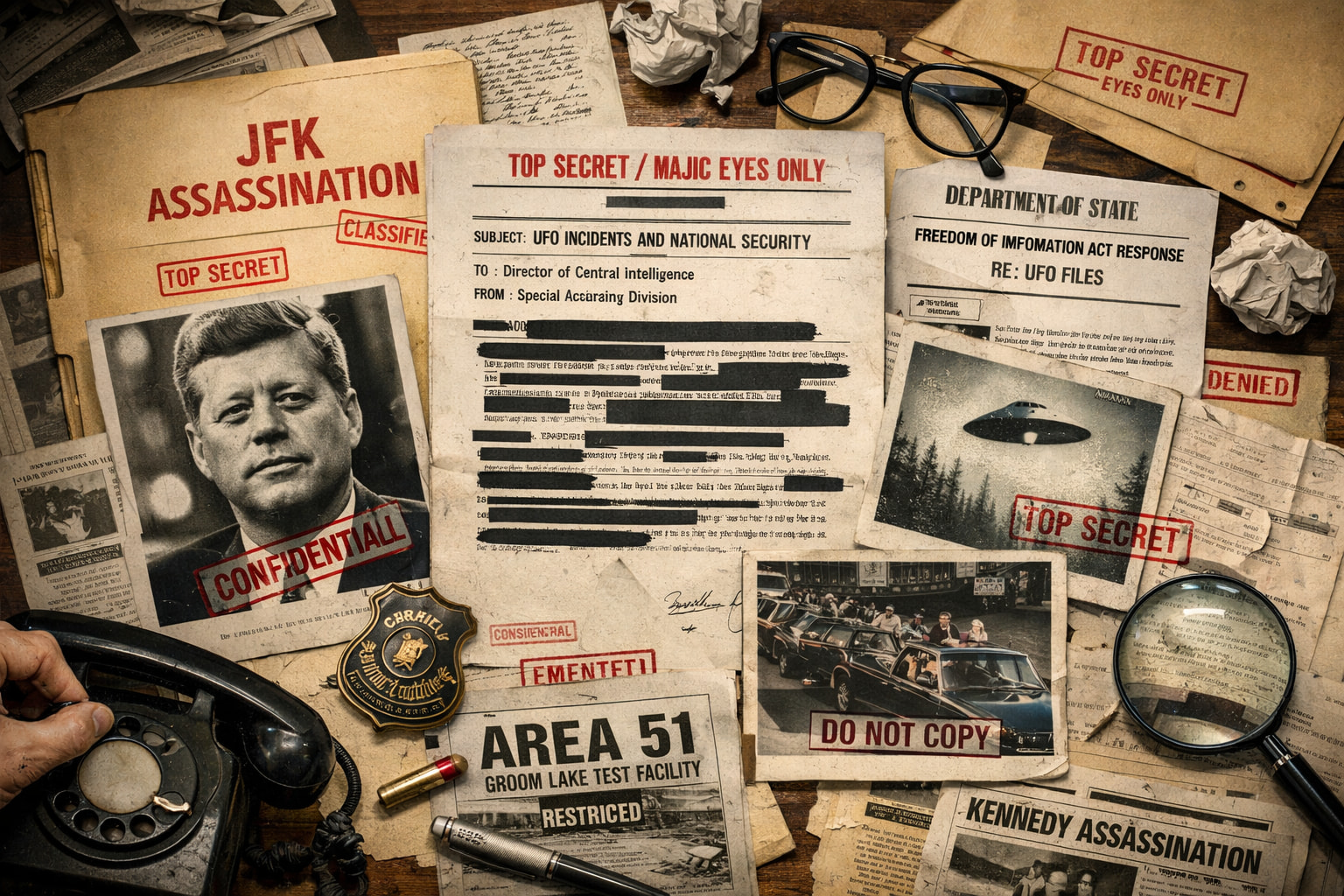
 Why You Need This Folder
One guy spent 28+ years filing FOIA requests so you don’t have to. UFOs, CIA mind control, JFK files, FBI surveillance, nuclear experiments on humans — all searchable, all free. This is the “they didn’t want you to see this” folder, except it’s legal and organized. Whether you’re a researcher, journalist, conspiracy-curious, or just bored at 3am — this is your rabbit hole with receipts.
🏆 The Main Event — The Black Vault
Your conspiracy phase just got receipts — 3 million+ docs, zero paywalls, 28 years of FOIA requests already done
What’s Actually In Here:
- JFK Files — the good stuff, not the redacted cope
- UFO/UAP Documents — decades of “weather balloons” exposed
- CIA & FBI Vaults — MKUltra, COINTELPRO, the paranoid years
- NSA, DIA, Military — surveillance, experiments, Cold War insanity
- Paranormal Investigations — yes, the government looked into this
How to Use It:
Search bar works. Pick a rabbit hole. Download PDFs directly. Cross-reference dates, names, projects. Better than any conspiracy subreddit because it’s actual source documents.
 The Deep Cuts (What The Black Vault Links To)
🥇 Tier 1: Government-Run Archives (The Big Boys)
These are the official source databases. The Black Vault often pulls from these, but you can go direct.
1. CIA CREST — 12+ Million Pages
The crown jewel. MuckRock sued the CIA for 3 years to get this online. Previously you had to physically visit Maryland to access it.
- STARGATE psychic experiments (yes, Uri Geller bending spoons for the government)
- Kissinger’s 40,000 pages of papers
- Invisible ink recipes
- Secret Soviet beer (name redacted to “protect sources and methods” lmao)
- Open source news they collected about themselves
2. AARO.mil — Pentagon’s Official UFO Office
This didn’t exist until 2022. Now they’re releasing actual military UAP footage as it gets declassified.
- Infrared sensor footage from military encounters
- Case resolution reports (some say “birds”, some say “insufficient data”)
- Congressional testimony transcripts
- The “jellyfish video” everyone was talking about
3. DOE OpenNet — 495,000+ Nuclear References
Manhattan Project to modern day. Human radiation experiments. All 36 volumes of the Manhattan District History.
- 147,000+ declassified documents
- Nuclear test records from 1945 onwards
- What they did to people without telling them
4. Nuclear Testing Archive — 346,000+ Documents
- 40,000+ documents on human radiation experiments
- 100 unclassified nuclear weapons test videos
- Everything the Atomic Energy Commission did
5. FBI Vault — 6,700+ Scanned Files
The FBI’s own FOIA reading room. Browse by category or search.
- “Unexplained Phenomenon” section (yes, really)
- Famous cases and investigations
- Surveillance files on… interesting people
6. State Department FOIA Library — 550,000+ Diplomatic Records
Cables, telegrams, correspondence. The stuff diplomats actually said to each other.
- Special projects releases
- Discretionary declassifications
- 1973-1979 telegrams
7. NSA Declassification — Special Topical Reviews
When the NSA decides to dump documents on specific events:
- Gulf of Tonkin incident
- USS Liberty attack
- UKUSA agreement (Five Eyes origins)
🥈 Tier 2: Crowdsourced + Researcher-Operated
Where the document nerds actually hang out. These people file FOIAs for fun.
1. MuckRock — 170,000+ FOIA Requests
The GOAT move: don’t file your own FOIA. Clone someone else’s successful request.
- See what worked and what got denied
- Piggyback on others’ research
- FOIA March Madness (agencies compete on response times, not joking)
- They sued the CIA and won
2. Government Attic — The Weird Stuff
Thousands of obscure FOIA’d documents nobody else thought to request.
- NASA’s extraterrestrial sample request database
- FBI high-visibility memos
- DoD “which magazines can military bases sell” reviews
- Government “bloopers”
- FOIA logs (FOIAs about FOIAs)
3. DocumentCloud — 5+ Million Documents
Where journalists store their source documents. Built by ProPublica and NYT.
- Snowden Archive is hosted here
- Panama Papers were processed here
- Bad Redactions Add-on — reveals text under poorly redacted sections
- AI-powered search across massive dumps
4. National Security Archive — 100,000+ Declassified Records
“The world’s largest non-governmental collection” according to the LA Times. Based at George Washington University.
- Electronic Briefing Books on 450+ topics
- They’ve been doing this since 1985
- Their blog “UNREDACTED” tracks FOIA news
🥉 Tier 3: International + Cold War Specialists
When you need what OTHER governments were saying.
1. Wilson Center Digital Archive — 143 Countries, 215 Institutions
The only online source for some of this material. Translated.
- Indian government archival documents (exclusive)
- Soviet/Chinese Cold War communications
- What Mao actually said to his Albanian counterparts
- Nuclear proliferation history from all sides
- Data visualization tool to map connections
2. End of Term Web Archive — Full .gov Snapshots
Every presidential transition since 2008, the entire federal web gets archived.
- 250TB downloadable if you’re insane
- Websites that disappeared during transitions
- What agencies said before they changed their minds
3. GovWayback.com — Instant Archive Access
Stupid simple trick: add wayback.com after any .gov URL
www.epa.gov → www.epa.govwayback.com
Redirects to archived version from before January 20, 2025.
4. Columbia Declassification Engine — Open Access Search
Millions of declassified docs in one searchable database. Academic project, no paywall.
🛠️ Tier 4: The Tools Researchers Actually Use
The techniques behind the findings.
OSINT Framework — osintframework.com
30+ categories of intelligence gathering tools. The menu for everything.
Google Dorks — Advanced search operators
site:cia.gov filetype:pdf "classified"
site:fbi.gov filetype:pdf "surveillance"
inurl:admin site:*.gov
Find stuff that’s technically public but not linked anywhere.
MuckRock FOIA Log Explorer
170,000 archived FOIAonline requests. See what everyone’s been asking for.
DocumentCloud Bad Redactions Add-on
Agencies sometimes just put black boxes over text without actually removing the data. This reveals it. Legally.
Hunchly — hunch.ly
Auto-captures every webpage you visit during research. Timestamps everything. Evidence-grade.
🧠 Tier 5: The Meta-Technique
The move the pros use:
FOIA the FOIA logs.
Every agency tracks what people request. Request those logs.
Why this works:
- See what’s already been released → request the same docs (faster response)
- Find patterns in denials → know where they’re hiding stuff
- See what journalists are researching before stories drop
The uncomfortable truth:
MuckRock found that 60% of federal agencies won’t release their own FOIA procedures. The document explaining how they handle document requests is… denied.
That’s where the interesting stuff hides.
📚 Quick Reference: All Links Ranked
Start here (easiest wins):
- The Black Vault — one guy’s 28-year FOIA collection
- FBI Vault — browse by category
- CIA Reading Room — search by keyword
Go deeper:
4. MuckRock — clone others’ requests
5. Government Attic — weird obscure stuff
6. AARO.mil — official UAP footage
For serious research:
7. CIA CREST — 12M+ pages
8. DOE OpenNet — nuclear history
9. National Security Archive — largest non-gov collection
10. DocumentCloud — journalist source docs
International/Cold War:
11. Wilson Center Digital Archive — foreign government docs
12. End of Term Archive — archived .gov snapshots
Utility:
13. GovWayback.com — quick archive access
14. State Dept FOIA Library — diplomatic cables
15. Nuclear Testing Archive — weapons tests + human experiments
Your tax dollars funded these secrets. Might as well read them. 
 !
!