 The FCC Just Voted To Kill the $20 Burner Phone — Your ID Now Rides Every Number
The FCC Just Voted To Kill the $20 Burner Phone — Your ID Now Rides Every NumberThe gas-station prepaid phone you buy with a fistful of cash? That quiet little loophole just got a “Know Your Customer” tag stapled to it.
FCC rule 26-27, adopted April 30, 2026. Every carrier AND internet-calling app now has to grab your name, home address, a government ID number, and a backup phone number before they’ll switch your line on — or renew it.
Prepaid. Postpaid. Some random calling app. Doesn’t matter. If it makes a call in the US, your legal name is now bolted to it — reported first by 404 Media.
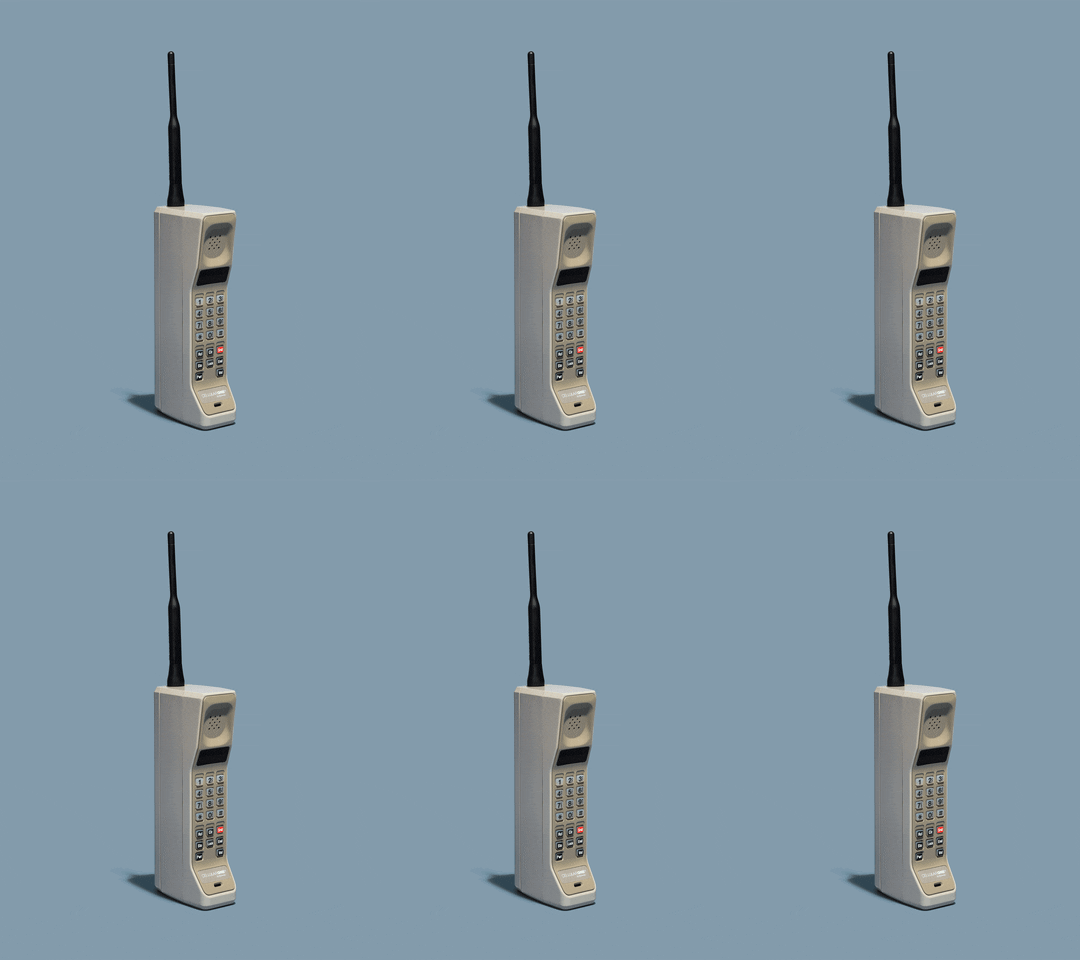
Right, so here’s what’s actually happening. For about thirty years you could walk into a corner shop, drop twenty bucks cash, and walk out with a working phone that had nobody’s name on it. That’s a burner. Journalists used them. Abuse survivors used them. Broke people who just didn’t want a two-year contract used them. And now the FCC — the US agency in charge of phones — has decided that’s over. Kids these days won’t even know the thrill of a $15 flip phone with zero paperwork. Let me translate the whole thing before something breaks at 3 AM.
🧩 Dumb Mode Dictionary — plain-English version
| Fancy term | What it actually means |
|---|---|
| Burner phone | Cheap phone you buy with cash. No name attached. Toss it when done. |
| KYC (“Know Your Customer”) | A rule that forces a company to check your ID before it’ll serve you — same thing your bank does |
| Prepaid / MVNO | Smaller, cheaper phone brands (Mint, Cricket, Boost) that rent the big networks |
| VoIP | Phone calls made over the internet — think WhatsApp calls, Google Voice |
| eSIM | A SIM card that’s just software. No little plastic chip to pop in |
| FCC | The US government agency that makes the rules for phones, radio, and internet |
📜 How we got here (the boring-but-important part)
- The FCC’s stated reason: fighting robocalls, text scams, fraud, and “national security threats.” Noble-sounding stuff.
- The rule (numbered 26-27) was quietly adopted April 30, 2026. Coverage from Android Authority and Fortune broke it down.
- It doesn’t ban burners with a big red BANNED stamp. It just makes them impossible — because you can’t buy one anonymously anymore.
- Boing Boing put it bluntly: this basically makes the anonymous phone illegal without ever saying the word “illegal.”
🔧 What they actually want you to hand over
Right, here’s the shopping list every carrier now has to collect before flipping your switch:
- Your full legal name
- Your physical home address
- A government-issued ID number (driver’s license, passport, that kind of thing)
- An alternate phone number to cross-check you against
Translation: your prepaid gas-station phone now knows exactly as much about you as a two-year contract does. The “anonymous” part — the entire point — is gone. And they don’t just check it and forget it. They store it.
🚨 Why the privacy folks are losing their minds
Here’s the part that makes any sysadmin who’s ever run a database go cold.
- Telecoms get breached. Constantly. T-Mobile alone has leaked customer data over and over. Now you’re telling them to hoard government ID numbers too?
- You’re building a single, government-mandated list of every American’s name tied to their phone. That’s a honeypot. Hackers dream about databases like this.
- Real people who need anonymous phones: domestic-abuse survivors hiding from an ex, journalists protecting sources, whistleblowers, and folks who just don’t want their name permanently welded to a number.
- The EFF has spent years warning that “collect everyone’s ID to catch a few bad guys” always, always ends with the giant pile of IDs getting stolen.
Is the goal (fewer scam calls) reasonable? Sure. Is the method — build the biggest identity honeypot in history and pray nobody cracks it — going to break at 3 AM? Oh, absolutely.
📊 The receipts — old world vs. new world
| Before rule 26-27 | After rule 26-27 | |
|---|---|---|
| Buy prepaid with cash |  Yes, no name Yes, no name |
 ID required ID required |
| Anonymous number | Easy |
Basically gone |
| Internet calling apps (VoIP) | Mostly no ID | ID now required |
| Where your ID lives | Nowhere |  Stored in carrier databases Stored in carrier databases |
| Breach risk | Your number leaks |  Your number + gov ID leak Your number + gov ID leak |
Cool. So the Anonymous Phone Is Basically Dead in the US… Now What the Hell Do We Do? ( ͡ಠ ʖ̯ ͡ಠ)
Here’s the thing about a rule that closes a door: it always leaves a window cracked open somewhere, and the first people through that window make money. This rule is US-only, it takes time to enforce, and “a phone number” is a much looser idea than the FCC thinks it is. Five plays while the suits are still writing the enforcement memo.
🌍 The Border SIM Runner
The FCC controls US carriers. It does not control a data-only eSIM sold by a phone company in Estonia or Thailand. A ton of foreign travel eSIMs give you working mobile internet with no US-style ID check — and once you’ve got internet, you’ve got calling apps. Bridge that gap for people who can’t figure it out.
 Example: A 26-year-old reseller in Portugal buys regional data eSIMs in bulk through Airalo’s partner program, bundles setup instructions, and sells “US-usable anonymous data lines” to privacy buyers on forums for a $25 markup each. Moves 40 a week.
Timeline: First sales in ~1 week. Works great for 4–8 months until a big provider tightens up or the FCC leans on eSIM resellers.
🪟 The Patch-Window Panic-Buy
Rules take months to actually enforce at the register. Right now, today, you can still walk into shops and buy pre-activated prepaid SIMs with cash. There’s a short window before every checkout system gets the ID upgrade. People who realize that later will pay a premium for stock that was activated the old way.
Example: A 22-year-old in Mexico near the US border buys cash-activated US prepaid kits in the legal early window, then lists them to buyers who missed the cutoff. Clean, pre-KYC lines resell at 3–4x. He logs which stores upgraded last so he knows where to grab final stock.
🧩 The Frankenphone Kit
Most people hear “no more burners” and give up. But a phone number is just two Lego pieces: data (internet) + a number (a calling app). Stack a no-ID data eSIM with an app-based number from services like JMP.chat or Silent.link, and you’ve rebuilt a low-footprint phone. Sell it as a done-for-you kit so grandma-level users can do it too.
Example: A 24-year-old in the Philippines packages a step-by-step “Frankenphone” setup — data eSIM + JMP number + how to top it up — and sells the walkthrough plus 20 minutes of screen-share setup for $40 a pop on privacy Discords. 15 sales a week, zero inventory.
📇 The Slow-Carrier Scout
Big rule, thousands of small phone brands (MVNOs). They will NOT all flip the ID switch on the same day. Some will drag their feet for months. The person keeping a live, updated list of “which carriers still activate with minimal info this week” is holding pure gold for privacy shoppers.
Example: A 28-year-old in Poland runs a simple tracker page testing signup flows on 30 US MVNOs, marks which still activate with light info, and charges $5/month for access to the always-current list. 300 subscribers = grocery money that pays itself.
🔔 The Breach Bet
Cynical but dead-on: once every carrier hoards gov ID numbers, breaches stop being “your number leaked” and become “your identity leaked.” That’s a bigger, scarier event — and scared people pay for early warning. Set up a niche alert service for one high-value group (realtors, crypto holders, small landlords) that watches breach dumps for their carrier’s data.
Example: A 27-year-old in India wires up free breach-monitoring feeds like Have I Been Pwned’s tools into a simple alert bot for a niche of 500 real-estate agents, charging $9/month for “your carrier got breached, lock your line NOW” texts. Recurring, sticky, boring-in-a-good-way.
🛠️ Follow-Up Actions
| Move | First step today |
|---|---|
| Test foreign eSIMs | Compare plans on eSIMDB |
| Build a Frankenphone | Grab an app number at JMP.chat |
| Check your own exposure | Run your number through Have I Been Pwned |
| Understand your rights | Read the EFF’s surveillance guides |
| Follow the rule’s fallout | Bookmark 404 Media |
 Quick Hits
| You want to… | Do this |
|---|---|
| Keep a low-ID number |
Stack a data eSIM + JMP.chat app number |
| Know if your carrier leaked |
Set alerts on Have I Been Pwned |
 Lock down your privacy Lock down your privacy |
Follow the EFF’s how-to guides |
 Flip the loophole Flip the loophole |
Resell no-ID foreign eSIMs via Airalo |
 Track enforcement Track enforcement |
Read Fortune’s breakdown |
They didn’t ban the anonymous phone. They just made sure it comes with your name on the receipt — and a copy of your ID in a database somebody’s already trying to crack.
 !
!