 A Farmer With No Degree Figured Out What 50 Years of Scientists Couldn’t
A Farmer With No Degree Figured Out What 50 Years of Scientists Couldn’tWhat if the dissatisfaction isn’t yours — what if it was built for you?
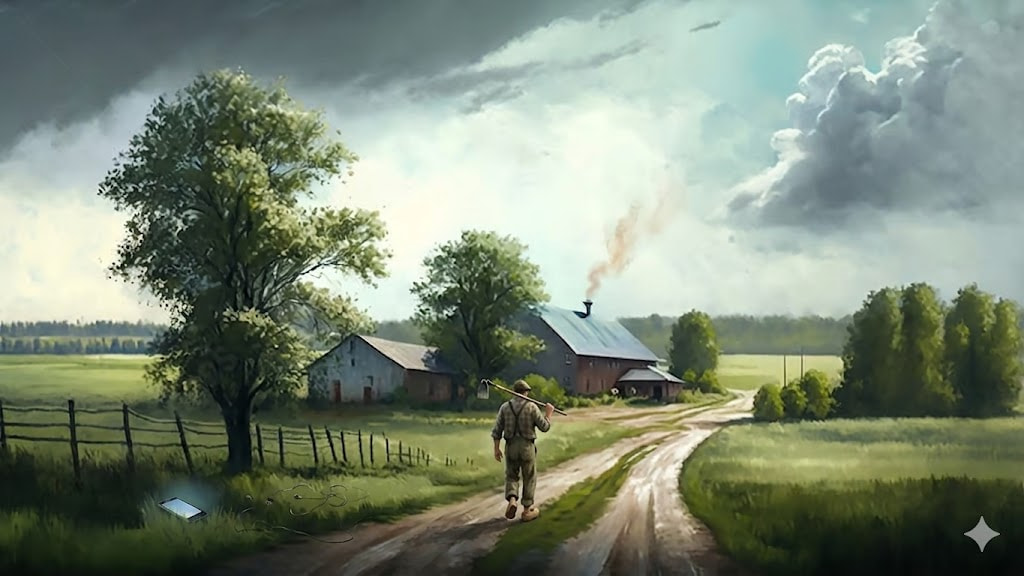
You’ve felt it. That thing where you work all day and feel like you built nothing. Where you buy something and the excitement dies before the box is open. Where you scroll for an hour and can’t remember a single thing you saw.
Every new technology promises to save time. But nobody’s got any time. Every new product promises satisfaction. But nothing feels like enough. What if that’s not a failure of willpower — what if that’s the design working exactly as intended?
Somewhere in rural France, there’s a man who works only in the afternoons. He grows his own grain, bakes his own bread, built his own house from stones and mud, carves his own shoes from wood, and drinks cider he pressed from his own apples. He’s done this for 30 years. He says money is poverty. He says a field of rye is wealth. He says farming is a love affair — and the answer isn’t in words.
This post isn’t about him. It isn’t about farming. It isn’t about moving to the countryside.
It’s about a cycle most of us are stuck in without knowing it has a name.
We’re calling it The Chase Trap.
🎬 See It First — Two Days With the Last Real Farmer in Europe
Two filmmakers — months apart — each spent a full day with the same man in central Brittany, France. What they captured is raw, unscripted, and unlike anything else on YouTube.
 The Big Picture (~45 min)
https://www.youtube.com/watch?v=9_QL7uQtcow
His childhood. The ruin his family bought with caravan money. 35 tiny fields on 6 acres. How he grows grain by hand, bakes bread in an oven he failed twice before getting right, and stuffs rye straw into hand-carved wooden shoes for warmth. Why his neighbor joked about stealing his food when society collapses — and why his answer was “share, not hoard.”
The Hands-On Day (~40 min)
https://www.youtube.com/watch?v=cvToBi9l9jY
The working version. Learning to use a hoe. Sharpening a scythe on an anvil. Hauling hay with pitchforks and wheelbarrows. Why he threw away all his plastic gardening supplies. Potatoes cooked over an open fire. Homemade cider that both filmmakers called the best they’ve ever had. And the moment where he says: “Every human being should have the chance to love their soil.”
One filmmaker called him “a mentor I was desperately looking for.” The other said “this is something I admire and respect very much.”
Watch both. Then come back here.
🧠 Why Something Feels Off — And It's Not Your Fault
Let’s start with one number.
The modern food system burns 13 calories of energy to deliver 1 calorie of food to your plate. That’s like driving 13 miles to pick up something 1 mile away.
A farmer using just a hand tool — no tractor, no fuel, no chemicals — gets back 10 to 20 calories for every 1 calorie of effort. The guy with the hoe is over 100 times more efficient than the billion-dollar system that replaced him.
That’s not just about food. That’s a picture of how everything works now. We replaced simple things that worked with complex things that cost more, depend on more, and — here’s the strange part — leave us feeling less satisfied.
“When I was 20 I just felt like a complete alien on the earth. I needed some appliance, some technology, everything seemed so synthetic.”
Why does it feel this way?
Think of it like this. Imagine a dog in a cage that gets a small electric shock through the floor. The dog tries to escape. Can’t. Tries again. Can’t. After enough failed attempts, the dog lies down and stops trying — even if someone opens the cage door.
That’s a famous psychology experiment from the 1960s. For 50 years, scientists called it “learned helplessness” — the idea that the dog learned to give up.
But in 2016, the same scientists came back and said: we had it backwards.
The dog didn’t learn to give up. Giving up is the default. What has to be learned is the feeling of being in control. When a living thing faces a problem it can’t solve, the brain’s natural response is to shut down. Not because it tried and failed — because it never learned what “having control” feels like.
Here’s the flip side. Every time you successfully do something with your own hands — cook a meal, fix a broken thing, grow a plant, build something — your brain registers: I had control over that. And that signal gets stronger every time.
“I chased after all the wrong things throughout my life — clubbing, drinking, partying. I thought that’s what you had to do to live a fulfilled life in the city. Now what brings me joy is spending a whole day picking food or sewing seeds.”
A study gave stressed-out people two options: read a book indoors, or garden for 30 minutes. The gardeners felt calm and happy afterward. The readers actually felt worse. Why? Because gardening gives your hands something to control. Reading doesn’t.
That background hum of “something isn’t right”? It’s not weakness. It’s your brain saying: I haven’t felt in control of anything real in a long time.
🔄 The Chase Trap — The Cycle Nobody Talks About
Here’s the cycle. Four steps. Once you see it, you’ll recognize it in your own life.
Step 1 — You work inside someone else’s system.
Your time, your energy, your ideas — they go into a structure you don’t own. You might get paid. But getting paid isn’t the same as owning what you built. Getting paid is renting your time to someone else’s project.
Step 2 — Because you don’t own the result, your brain never gets the “finished” signal.
Here’s a weird experiment. Scientists asked people to build simple furniture. The builders valued their own creations 63% more than identical store-bought ones. But — and this is the key — when the scientists took the furniture away and destroyed it, that extra love disappeared completely.
Build something and keep it = deep satisfaction.
Build something and lose it = nothing.
Most jobs are the second one. You build all day. Someone else keeps it.
Step 3 — Because satisfaction never comes, you look for it somewhere else.
More shopping. More scrolling. More food delivery. More streaming. Each one gives you a tiny hit of excitement — but it fades fast. So you do it again. And again.
That’s not a willpower problem. Your brain has two separate reward systems:
- The “wanting” system — gives you a rush of excitement before you get something. This is what makes you click, scroll, add to cart.
- The “having” system — gives you calm, deep satisfaction after you finish something. This is what makes you feel peaceful after cooking, building, or creating.
Modern apps and products are built to keep the “wanting” system firing constantly — and to make sure the “having” system never kicks in. No finish line. No “done.” Just… more.
The guy who invented infinite scroll later said 200,000 human lifetimes are wasted every single day because of it. He regrets it.
Step 4 — Because you’re always chasing, you never have time to build something of your own.
And the cycle starts again.
“Every technology is always to save time but nobody’s got any time.”
How deep does this go?
In 1948, when workers got more productive, their pay went up equally. Fair deal.
But since 1979, worker productivity went up 72% — and pay went up only 9%. The machines saved time. But the saved time went to the people who own the machines, not the people who use them.
Farmers 700 years ago worked about 1,620 hours a year. Modern workers do 1,949. The farmer with no electricity had more free time than you do.
“You’ve sided the field, you’ve got your cider, you lie on the bank — you’re not stressed because you’re not paying anything. You’ve done the work and now you’re enjoying it.”
“You’re always paying. Having a shower — where does the water come from? You’re paying. Reading a book, the light’s on, you’re paying. That’s why you can’t just enjoy.”
⚙️ Four Machines That Keep the Cycle Spinning
The Chase Trap isn’t random. It runs on four machines. Each one is simple once you see it.
Machine 1 — The Never-Ending Task
Ever had a song stuck in your head? It stays there because your brain never heard the ending. That’s how your brain treats everything unfinished — it holds on, using up mental energy in the background, waiting for the ending that never comes.
Modern products are designed to never end. Infinite scroll has no bottom. Netflix auto-plays. Subscriptions renew silently. You never get the relief of “done.”
Compare that to baking bread: plant → grow → harvest → grind → bake → eat → done. Your brain files it as complete. You feel calm. That’s not nostalgia — that’s how the brain is built to work.
“I used to have a plastic greenhouse. After 10 years it broke in the snow. And I just saw plastic. Broken pots, plastic string, plastic bags. A pile of junk. And all the crops I had grown were forgotten about.”
When his plastic system broke, it forced him to see what he’d actually built: garbage. Now he plants seeds directly in the soil. No plastic. No pots. Just seed and earth.
Machine 2 — You Are What You Buy (And That’s the Problem)
A thousand years ago, your job was your name. Baker. Smith. Weaver. Carpenter. You were what you made.
Today, most people define themselves by what they consume. The brands. The shows. The aesthetics. But those things are designed to go out of style. If your identity depends on things with built-in expiration dates — your sense of self expires with them.
“I’m not really bothered about the crops. It just has to be beautiful. If I put on a net or something — I’m sad inside because it’s not beautiful anymore.”
A study of over 7,000 people found that those who make things with their hands — any craft — feel more satisfied with life. Not because crafts are magical. Because making gives you an identity that doesn’t expire.
Machine 3 — Too Big to Feel
Your brain can handle about 150 real relationships. Beyond that, everyone becomes a stranger. This number shows up everywhere — old villages, military units, online friend groups. It’s a hard limit.
Most people work in systems of thousands or millions. Your effort disappears. Nobody — including you — can tell whether it mattered. That’s why motivation dies quietly.
“Every human being should have the chance to love their soil. How can you deprive a human being of that love? It’s who we are.”
Machine 4 — Shrinking the Clock
Companies think in 90-day quarters. Social media thinks in minutes. Everything pushes you to want results now. Quick rewards feel exciting but don’t satisfy. Long-term work feels boring at first — but satisfies deeply over time.
“I’m planting a tree and my grandchildren’s generation is going to chop it down and have a house. Something to live for.”
“You’re always paying. Having a shower, reading a book — you’re paying. That’s why you can’t just enjoy.”
🔍 What One Life Proved Without Reading a Single Book
The man in France never read a psychology textbook. He left school at 9. He learned to read late. He draws pictures instead of writing.
And yet — without knowing it — he built a life that matches exactly what scientists say a satisfied human needs.
But forget the science for a second. Here’s what a day actually feels like:
You wake up. No alarm. You walk outside and the air smells like wet grass and woodsmoke. You spend the morning drawing or printing books — the work that pays. In the afternoon, you hoe a field. The rhythm is slow. You can talk while you work. You and your dad discuss the news, or history, or nothing. Your neighbor stops by. A robin watches from the fence. By evening, you light a fire, cook potatoes you dug up an hour ago, and drink cider you pressed last autumn. You sit. You’re not stressed — because you’re not paying for any of it. You did the work. Now you’re enjoying it. The cycle is closed. The day is done.
“After a day’s hoeing, it’s just pure meditation. It takes your mind off elsewhere.”
“I can’t call it work. It was so fun. It feels rewarding doing what we just did.”
That’s not a fantasy. That’s a Wednesday.
Now — here’s what the research says about why that feels so different:
| What research says you need | What he actually does |
|---|---|
| Feel in control of your work | “My first love’s my land. But a good second place.” |
| Tasks that actually finish | “This is pure joy. You could spend all your time here just pulling up a weed.” |
| Beauty and meaning over profit | “It just has to be beautiful. The food can’t compensate for losing the beauty.” |
| Small community, real bonds | “There’s a certain bond between people that like to get wet in the rain.” |
| Enough, not more | “For me, wealth — the money is poverty. This is wealth.” |
| Others matter, not just you | “If somebody’s starving, I can’t just sit there and eat.” |
| Learning by doing, not by diploma | “I learned to read late. I’m waging an anti-word campaign.” |
| Thinking in decades, not days | “A real teacher offers his knowledge for free. By definition, you have spare time.” |
He didn’t prove the science right. He proved you don’t need science to get there. Give someone land, time, and no one telling them they can’t — and they’ll arrive at the same place the experts spent 50 years mapping.
🪞 Count Your Own Dependencies — A Quick Mirror
Not to judge. Just to see clearly.
How many things between you and your survival do you actually control?
| You need… | Who controls it? |
|---|---|
| Water | A utility company |
| Food | Supply chains across 5-15 countries |
| A roof | A landlord or a bank |
| Heat and light | A power company |
| Money | An employer or a platform |
| Getting around | A fuel company or transit system |
| Talking to people | A telecom company |
| Health | An insurance company or hospital |
| What you see and know | An algorithm |
Every row where the answer is “someone else” = a thread someone else can pull.
“I don’t believe in the sustainability of their supply chains. I feel stressed out if I’m dependent on it. The day all the lorries stop on the road, I’m in the same boat as everyone else.”
A study across 16 countries found people in cities have 38% more mental health problems than people in rural areas. More dependency = more anxiety.
Think about it — we outsource our food, our water, our shelter, our warmth, our transport, our entertainment. We even outsource our exercise — we go to a gym to move in place, doing motions that accomplish nothing, inside a building we pay to enter. Then we drive home.
“I spent years going to the gym. It was the only thing that made me feel human. Now I grow my food — I get exercise while I’m doing it. And I’m like, what was I doing? Like a hamster in a wheel.”
“People talk about habitat loss of insects, losing the world’s birds. What’s the human being’s habitat? We’ve also lost our habitat.”
🔑 This Starts Tonight — You Don't Need Land, Money, or Permission
Here’s what this does NOT require:
 A farm
- Moving to the countryside
- Quitting your job
- Money you don’t have
- Skills you haven’t learned yet
Here’s what it requires:
 One thing you do with your own hands that completes
- That’s it
Cook dinner from scratch tonight. Not a meal kit. Not a delivery. Actual ingredients, actually cooked. When you eat it, notice how it feels different from ordering in. That’s the “having” system kicking in. That calm. That quiet “I did this.” That’s what’s been missing.
Then maybe next week, grow one herb on a windowsill. Fix something you would have thrown away. Write something by hand. Build a shelf. Learn to bake bread. Make a gift instead of buying one.
None of this costs money. All of it closes a loop. Every closed loop makes the next one easier.
“I spent many years going to the gym and it was the only thing that made me feel human — it raised my heart rate when I was living in modern cities. Now I grow my food, I get exercise while I’m doing it, I go for a walk in the woodlands. And I’m like — oh my god, what was I doing? Like a hamster in a wheel. You can’t even exercise naturally anymore.”
The man in France didn’t start with 35 fields. He started with a patch of cabbages and a plastic greenhouse at age 11. He calls that version of himself “trophy veg for the summer.” It took him 20 years to become what he is now. And he’ll tell you — 17 years in, his soil is still recovering from the industrial farming that came before him.
This isn’t fast. But it’s real. And real compounds.
“It’s all very fine. But the day that all the lorries stop on the road, I’m in the same boat as everyone else. So I’ve got to make my own seed. I’ve got to make my own system.”
The point isn’t to become self-sufficient overnight. The point is to notice how different you feel when even ONE loop closes. When one small thing in your day was yours — start to finish — and nobody else controlled it.
That difference? That’s the door opening.
🗺️ Five Questions Nobody Can Answer For You
Not advice. Just questions. If someone else answers them for you — you’re back in a system you don’t own.
1. What do you work on that you’ll still own tomorrow?
Not your job. Not your employer’s project. Something that stays yours no matter what. It doesn’t need money. It needs time — and the decision that some of your time belongs to you.
2. When did you last finish something — start to end?
Not “completed a task at work.” Actually finished. Held the result. Ate the result. Said: I made that. It’s done.
3. How many people can you actually see your impact on?
Not followers. Real people. Probably under 5. That’s not small — that’s where meaning lives.
4. What would you do if nobody could see it?
No likes. No metrics. What would you still do? That thing is what your brain actually wants.
“I’ve got a competition with my neighbor. I gave her some seed. She planted as much as I had. So I came back and planted three more rows.”
5. What does “enough” look like?
The moment you can answer this clearly — most of what you’re chasing becomes irrelevant. Not all. Just most.
Enough isn’t poverty. It’s clarity. The gap between what you need and what you’ve been trained to want — that’s where The Chase Trap lives.
🌍 People Who Already Did This — No Farm Required
This isn’t just one man in France. People have built their own systems in every part of life — and none were rich when they started.
| Area | What someone built |
|---|---|
| Software | Free programs that run most of the internet — anyone can use, improve, and share them |
| Housing | Homes from recycled materials — zero bills, produces its own water, heat, and food |
| Education | Kids learning by following their interests — 72 out of 75 adults said benefits outweighed drawbacks |
| Land | Regular people pooling money to buy farmland — 360 farms, 800 farmers, nobody gets evicted |
| Making things | Free blueprints for 50 machines — everything needed to run a small civilization |
| Money | Local currencies that keep $10M+ circulating in the community instead of draining out |
| Food | After losing its oil supply, one city grew 90% of its own fresh food within 10 years |
None of them waited for permission. They just built.
“Together we’re stronger. It’s generous, but also cunning — because if I’m successful, I’m going to be even stronger. Richer in knowledge, and in community.”
The real question isn’t what tools you use. It’s: do your tools serve you — or do you serve your tools?
🤝 This Isn't About Being Alone — It's the Opposite
The biggest criticism of “build your own system” is that it sounds selfish. Like pulling up the drawbridge. Like hoarding while the world burns.
He has the opposite view.
“It’s all very well doing this. But we’re a big family. If one person’s unhappy in the world, we’re all unhappy. One person’s starving — it’s like we’re all starving. You can’t just say ‘I’ve got my garden.’”
“On top of that — you’ve got the water, which is shared. The rain, which is shared. Air quality, which is shared. And the ecosystem. One person by themselves is too small. You have to always have the idea that you’ve got to have a wider project.”
This is the part most “self-sufficiency” content misses. Building your own system isn’t the goal. It’s the starting position. You get grounded first — then you look outward.
“I’ve already got a surplus and I’ve got something to share. I haven’t got enough to share with seven billion — but I’ve got something to share with one or two people. And that’s something rather than nothing.”
“A real teacher offers his knowledge for free. Because if you’re a master at your craft — by definition you have spare time. It’s proof that my farming works. And I know that together we’re stronger.”
He teaches free courses. He prints books and sends them around the world. He shares seed with neighbors. His idea of wealth isn’t a full barn — it’s a full community.
The Chase Trap isolates people. Building your own system reconnects them. Not through a platform. Through the oldest network in human history: I grew this. Want some?
📚 Words That Hit Different After All of This
“The ultimate goal of farming is not the growing of crops, but the cultivation and perfection of human beings.”
— Masanobu Fukuoka, Japanese farmer (1975)
“Every increase of needs increases one’s dependence on outside forces — and therefore increases fear.”
— E.F. Schumacher, economist (1973)
“People need tools to work with — not tools that work for them.”
— Ivan Illich, social thinker (1973)
“Without care for the soil we can have no community. Because without care for the soil we can have no life.”
— Wendell Berry, farmer and poet (1977)
“Consumer society thrives as long as it keeps the non-satisfaction of its members permanent.”
— Zygmunt Bauman (2007)
“A manner of living that is outwardly more simple and inwardly more rich.”
— Duane Elgin (1981)
“Every human being should have the chance to love their soil. How can you deprive a human being of that love? It’s who we are.”
— Samuel Lewis, Brittany, France
“I explain to every girl I meet that my first love’s my land. But a good second place.”
— Samuel Lewis
 Quick Hits
| If you’re thinking… | Consider this |
|---|---|
 “Why do I feel empty after a full day?” “Why do I feel empty after a full day?” |
Your brain needs to feel in control of something real. Build one thing you keep — anything |
 “Why does nothing feel like enough?” “Why does nothing feel like enough?” |
Products are designed to never let you feel “done.” Cook a meal. Finish something. That calm is real |
 “Am I addicted to scrolling?” “Am I addicted to scrolling?” |
Infinite scroll was built with no stopping point. 200,000 lifetimes wasted daily. It’s not you — it’s design |
 “Where did all my time go?” “Where did all my time go?” |
Farmers 700 years ago worked fewer hours than you. The machines saved time — for someone else |
| “Do I need a farm?” |
No. You need one thing you control, one cycle you finish, one skill that stays yours |
 “Where do I start?” “Where do I start?” |
Watch the two videos above. Then ask: what do I work on that I’ll still own tomorrow? |
The door was always open. You just hadn’t been taught to see it.

 !
!