 Your own email address — for the price of a domain
Your own email address — for the price of a domain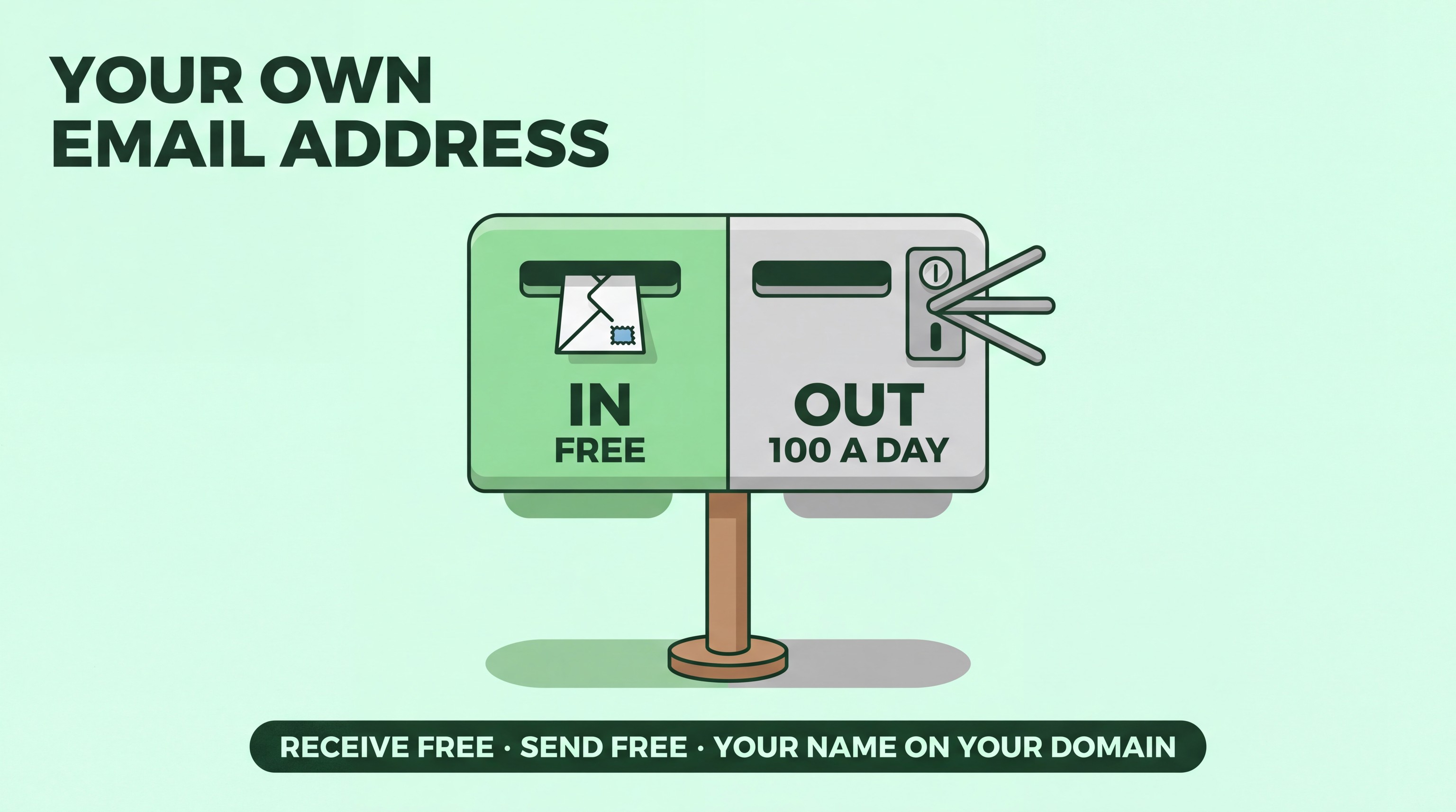
Ten dollars a year, and your mail says [email protected] instead of yourname@gmail.
That is the whole pitch. No per-seat bill, no server humming in a corner, no monthly charge that quietly multiplies when your team grows. Somebody built a real inbox that lives inside a Cloudflare account you already own — and the free path is not a catch-laden trial, it is how the thing is meant to run.
 Why it matters: a proper inbox — folders, rules, attachments, a calendar, even a public booking page — on your own address, for about the price of the domain.
 What makes it unique: nothing runs on your hardware. No Postfix, no port 25, no reputation to earn over months. Cloudflare and Resend send from infrastructure the internet already trusts.
 Why you should care: the address follows you forever, it survives every job change, and it costs less than a coffee for the whole year.
How the two halves work
Picture a letterbox on your own front door.
    [email protected]
            |
      +-----+-----+
      |           |
     IN           OUT
    free          free
  Cloudflare     Resend
  Email Routing  or Amazon SES
Mail comes in through Cloudflare Email Routing. It is free on every plan, it runs on the Cloudflare DNS you may already have, and Cloudflare’s own promise is that it “will not store or access the emails routed to your inbox”.
Mail goes out through a sender you pick, separately for each domain. Resend and Amazon SES both come with free tiers that genuinely work. That detail is exactly where most reviews trip — more on it below.
 Four surprises worth knowing
1. The licence is AGPL-3.0, not MIT. The bookmark that led here said MIT, and so do plenty of write-ups. The repository’s own LICENSE file says otherwise, and GitHub agrees with the file. Anyone planning to run a modified copy as a paid service should read that clause first.
2. “It is not really free” is a half-truth about one send path. Cloudflare’s own sender does need the $5/month Workers plan — a genuine cliff, on one of three routes. The README says the quiet part plainly: “set up Mailflare, receive mail, and send mail for free.”
3. Resend gives 3,000 a month — and only 100 a day. The daily number is the one that bites, and it counts mail you receive as well as mail you send. Three domains are included. Your other free door is Amazon SES: a $200 starter credit, roughly 2 million emails.
4. The README is more honest than the website. The marketing page promises “zero recurring subscription fees” and then sells a branding-and-team upgrade, while shared mailboxes sit behind the Team licence. The repository prints the real table instead. Trust the table, every time.
 Why this beats running a mail server
Because the hard part was not the software. Four gates stand in a fixed order: SPF, DKIM, DMARC, then reverse DNS, then a clean blocklist, then port 25, which most hosts simply block. Miss one and your message looks sent and quietly vanishes. As one 2026 write-up puts it, email “depends on something you cannot install: reputation.”
Mailflare skips all four by handing the sending to a relay. That is the entire trick — and it is why a project five months old can stand in for a per-seat subscription.
 Grab these
- Mailflare — the app itself: 4,957★, AGPL-3.0, one-click deploy
- Its README — the author’s own cost table: where free ends
- Cloudflare Email Routing — the free receiving half
- Cloudflare routing limits — the caps, straight from the source
- Resend’s free limits — 3,000 a month, 100 a day, 3 domains
- The hands-on review — fit, trade-offs, what setup really takes
- ImprovMX — forward-only and free: 1 domain, 25 aliases, 500 a day
- Forward Email — free forwarding with 10 GB of storage
- Zoho Forever Free — 5 real mailboxes, no IMAP or POP
- mailcow vs Stalwart vs Mailu — the heavier route, where you own the reputation problem too
 The honest fit
Delightful for anyone already using Cloudflare for DNS who enjoys a little tinkering. Less so for anyone wanting hands-off mail with a support line, or mail the host cannot read — yours lives in your own Cloudflare account, which is ownership rather than end-to-end encryption.
Connect a domain, and from tonight your mail carries your own name. Receive free, send free, 100 a day, about $10 a year — and it belongs to you alone.
 !
!