 95-Million-Year-Old “Hell Heron” With a Foot-Long Skull Blade Found in the Sahara
95-Million-Year-Old “Hell Heron” With a Foot-Long Skull Blade Found in the SaharaA team of 20 scientists, 64 armed guards, and a Tuareg motorbike guide just pulled the first new Spinosaurus species in over a century out of the Saharan sand — and it had a giant keratin sword growing out of its head
Spinosaurus mirabilis: 95 million years old. 10-14 meters long. One scimitar-shaped crest. Found 620 miles from any ancient ocean. Published in Science with 31 co-authors.
WAIT. So everything Jurassic Park told you about Spinosaurus? Wrong. Everything the latest paleontology told you about it being an aquatic diver? Also wrong. This thing was wading around in 3-foot-deep rivers like a 40-foot heron from actual hell — and it had a blade growing out of its skull like some kind of Cretaceous unicorn. I am not okay.
🧩 Dumb Mode Dictionary
| Term | What It Actually Means |
|---|---|
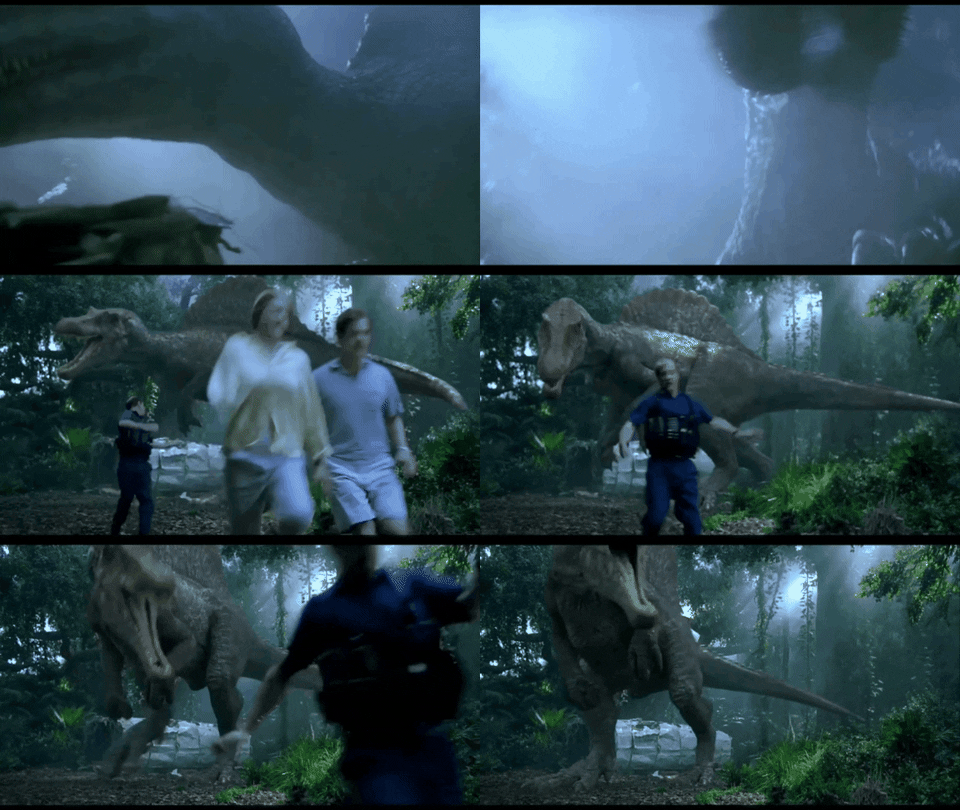
| Spinosaurus | Sail-backed dinosaur with a crocodile snout — think the one that killed the T. rex in Jurassic Park 3 |
| Scimitar crest | A curved, blade-shaped horn on top of its skull, like a sword growing out of its head |
| Keratin sheath | Same stuff your fingernails are made of — probably covered the crest and made it colorful |
| Cenomanian stage | A chunk of the Late Cretaceous period, roughly 95 million years ago |
| Riparian habitat | Fancy word for “near rivers” — forested areas crisscrossed by waterways |
| Stellar occultation | When an asteroid blocks a star’s light — used to track tiny orbital changes (that’s the other article, but it’s cool) |
| Interlocking teeth | Upper and lower teeth that mesh together like a trap — perfect for catching slippery fish |
| Paleoart | Professional scientific illustration of prehistoric life — it’s a real job and people get paid |
📖 The Backstory — How Do You Lose a Dinosaur for 100 Years?
OKAY SO here’s what’s wild. The last time anyone found a new Spinosaurus species was over 100 years ago. One hundred. Years. The original Spinosaurus fossils were discovered in Egypt in 1912 and then destroyed when the Munich museum housing them got bombed in WWII. Since then, paleontologists have been working with scraps.
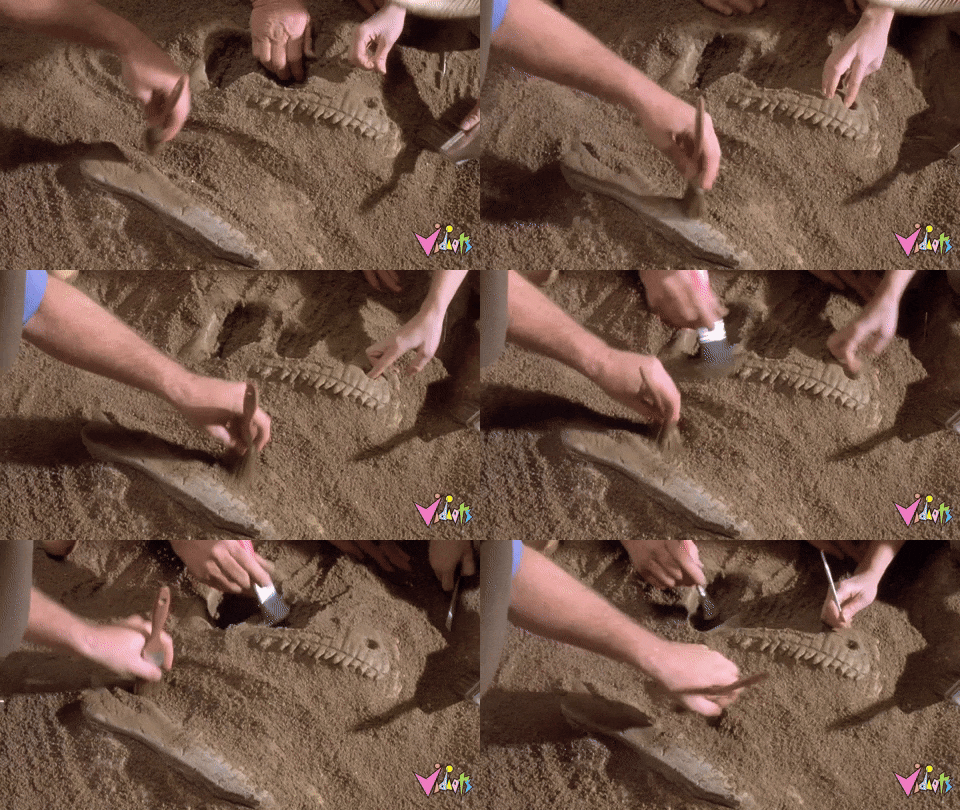
Paul Sereno, a paleontologist at the University of Chicago, followed a reference from the 1950s to a site in Niger called Jenguebi — a place that had probably never seen a paleontologist before. A local Tuareg guide found the fossil field by motorbike. The first expedition in November 2019 pulled up some crest fragments and jaw pieces, but the team didn’t even realize what they had. It took a second expedition in 2022 — with two more crests popping out of the ground — for it to click.
(Imagine finding a dinosaur sword and going “hmm, weird rock” and leaving.)
🗣️ The Expedition Was Absolutely Bonkers
This wasn’t some casual dig. Sereno brought nearly 100 people into the central Sahara: 20 scientists, filmmakers, guides, and 64 armed guards. They drove for a day and a half through open desert to reach Jenguebi. The team excavated over 100 tons of fossils. They assembled 3D digital bone models using solar power in the middle of the desert.
Sereno’s own words: “You feel like you’re in an Indiana Jones movie.”
The site held not just the new Spinosaurus but also partial skeletons of massive long-necked sauropods — titanosaurs and rebbachisaurids — buried in the same river sediments. These were inland animals. Forest dwellers. Not ocean creatures.
📊 The Numbers
| Stat | Value |
|---|---|
| Age | ~95 million years old (Cenomanian) |
| Length | 10-14 meters (roughly school-bus sized) |
| Crest length | ~1 foot (curved, blade-shaped) |
| Distance from ancient ocean | 500-1,000 km (310-620 miles) |
| Years since last new Spinosaurus | 100+ |
| Co-authors on the paper | 31 |
| Team size in the field | ~100 people |
| Armed guards | 64 |
| Tons of fossils excavated | 100+ |
| Wading depth | ~2 meters (6.5 feet) max |
| Prey fish size | 9+ feet long |
🦴 What Makes This Thing So Weird
Three things make S. mirabilis absolutely insane:
1. The Blade Crest. A scimitar-shaped horn curving upward from the skull, sheathed in keratin (like a toucan’s bill), and probably brightly colored. Nothing like it on any known Spinosaurus. Sereno’s team believes it was a visual display — think a neon sign for attracting mates or scaring rivals.
2. The Fish-Trap Teeth. The lower jaw teeth protrude outward and slot between the upper teeth, creating an interlocking cage. This is the same mechanism used by crocodiles, ichthyosaurs, and pterosaurs. Built specifically to catch slippery fish. The rivers it lived near contained coelacanths and other fish measuring 9+ feet.
3. The Location. Every previous Spinosaurus fossil came from coastal deposits near ancient seas. This one was found 500-1,000 km inland, in river sediments, next to long-necked herbivore dinosaurs. That’s like finding a seal skeleton in Kansas.
😤 Why Hollywood and Scientists Both Got It Wrong
Quick history of getting Spinosaurus wrong:
- Jurassic Park 3 (2001): Giant land predator that kills a T. rex. Problem: its skull was too fragile for that kind of combat. It ate fish, not tyrannosaurs.
- Recent paleontology (2010s-2020s): Aquatic diver, like a prehistoric seal, spending most of its time underwater. Supported by coastal fossil locations and bone density studies.
- Jurassic World Rebirth: Fully aquatic diver. More aligned with the science… until now.
- S. mirabilis (2026): A wading “hell heron” in 3-foot-deep rivers, hundreds of miles from the ocean. Not a diver. Not a land predator. A patient, shallow-water stalker.
Sereno’s description: “I suspect that this animal was fishing largely in about 3 feet of water.” It could stand in deeper water without floating, but it wasn’t chasing prey underwater. It was waiting for them. Like a heron. From hell.
💬 Reactions
The paleontology community is losing it (in a good way):
- The paper dropped in Science — one of the two most prestigious journals on the planet
- Replicas are already on display at the Chicago Children’s Museum as of March 1
- CT scanning and full digital skull reconstruction were done at UChicago’s Fossil Lab
- The “hell heron” nickname stuck immediately and is now everywhere
- 31 co-authors from institutions worldwide, confirming this wasn’t one lab’s hot take
The find doesn’t just add a species — it rewrites the entire story of how spinosaurids spread across continents. The paper’s full title is “Scimitar-crested Spinosaurus species from the Sahara caps stepwise spinosaurid radiation” — meaning this was the endpoint of a long evolutionary chain spreading inland from the coasts.
Cool. A Dinosaur With a Sword Head Is Metal as Hell. Now What the Hell Do We Do? (⊙_⊙)
🦕 Sell 3D-Printed Dinosaur Models and Replicas
Paleontology museums and researchers are increasingly using 3D scanning to digitize fossils — and those digital models end up on platforms like Sketchfab where anyone can download them. You can take open-access fossil scans, 3D-print detailed replicas, and sell them to educators, collectors, and museums that can’t afford original casts.
 Example: A maker in the Netherlands (4Visualization) was contracted by paleontology institutions to scan and 3D-print fossil replicas for exhibition. Individual Etsy sellers move resin-printed dinosaur skulls for $40-200 each. With S. mirabilis going viral, a scimitar-crested Spinosaurus skull model would sell itself.
Timeline: 2-3 weeks to source files, test prints, and list. First sales within the month if you ride the news cycle.
🎨 Freelance Paleoart Commissions
Every new species discovery needs art — and fast. Museums, publishers, documentaries, and science journalists all need illustrations of what these animals looked like alive. Paleoart is a real profession and people charge real money. One artist reported it as their primary income for 5+ years with growth every year.
Example: Dani Navarro created the official reconstruction art for the S. mirabilis paper in Science. Freelance paleoartists on platforms like ArtStation charge $500-3,000 per commission. When a discovery goes viral, the demand for fresh interpretations spikes hard. You don’t need a biology degree — you need anatomy skills and a portfolio.
📱 Build a Dinosaur AR/VR Experience
Every time a major dino discovery hits the news, parents Google it with their kids. An AR app that lets you point your phone at your living room floor and see a life-sized S. mirabilis wading through a virtual river would print downloads. Apple’s ARKit and Google’s ARCore make this shockingly doable for a solo dev.
Example: A developer in Bogotá built a “Dinos in Your Room” AR app after the T. rex feathers controversy in 2024. Hit 80K downloads in two weeks and monetized through a $2.99 “full museum” in-app purchase. Made roughly $12K before the news cycle cooled.
📝 Write Science Explainer Content
Science publications, YouTube channels, and educational platforms are desperate for people who can turn papers like this into content humans actually want to read. If you can explain what “interlocking dentition adapted for piscivory” means in normal words (it’s teeth that trap fish), you have a marketable skill.
Example: A former biology student in Nairobi started writing dinosaur explainers for a popular science YouTube channel in 2025. She now writes 2-3 scripts per month at $300-500 each and gets credited on-screen. The S. mirabilis discovery alone will fuel dozens of videos across channels like PBS Eons, SciShow, and smaller creators.
🛠️ Follow-Up Actions
| Step | Action |
|---|---|
| 1 | Read the actual Science paper (or its free summary) — know more than the headlines |
| 2 | Search Sketchfab and MorphoSource for open-access spinosaurid 3D scans |
| 3 | If you draw: post a S. mirabilis reconstruction on ArtStation/Twitter with the #paleoart tag while it’s trending |
| 4 | If you code: grab a free dino 3D model and prototype an AR scene this weekend |
| 5 | If you write: draft a 500-word explainer and pitch it to a science blog or YouTube channel |
| 6 | Check the Chicago Children’s Museum exhibit page for reference photos and public engagement angles |
 Quick Hits
| Want… | Do… |
|---|---|
 See the actual paper See the actual paper |
Search “Scimitar-crested Spinosaurus species” on Science.org — it’s the Feb 2026 issue |
 See the official art See the official art |
Look up Dani Navarro’s reconstruction — it’s being shared everywhere |
 Print a fossil replica Print a fossil replica |
Check Sketchfab for “spinosaurus” — multiple open-access 3D scans available |
 See it in person See it in person |
Chicago Children’s Museum — replicas on display since March 1, 2026 |
 Watch the Jurassic Park version Watch the Jurassic Park version |
JP3, the river scene — now hilariously inaccurate in a whole new way |
They sent 64 armed guards into the Sahara and came back with a dinosaur that had a sword on its head. Paleontology stays undefeated.
 !
!