 Fat-Tailed Dwarf Lemurs Drop 45°F in a Day and Don’t Even Flinch
Fat-Tailed Dwarf Lemurs Drop 45°F in a Day and Don’t Even FlinchWhile you’re reaching for a blanket at 68°F, these animals are crashing their own body temp to near-freezing — on purpose.
A fat-tailed dwarf lemur can swing its internal temperature by 45°F (25°C) in a single day. Scientists now say way more mammals pull this trick than anyone realized.
Look, we walk around at 98.6°F like it’s a law of nature. Turns out it’s more like a suggestion. A growing pile of research says tons of mammals and birds can dial their body temperature up and down like a thermostat — and it might be the biggest survival hack in the animal kingdom that nobody talks about.

🧩 Dumb Mode Dictionary
| Term | What It Actually Means |
|---|---|
| Homeothermy | Keeping your body temp locked at one number. That’s you. That’s me. Boring. |
| Heterothermy | Flexing your body temp up or down when it suits you. The bag play. |
| Torpor | Slamming your metabolism down to almost nothing. Like sleep mode on a laptop, but for your whole body. |
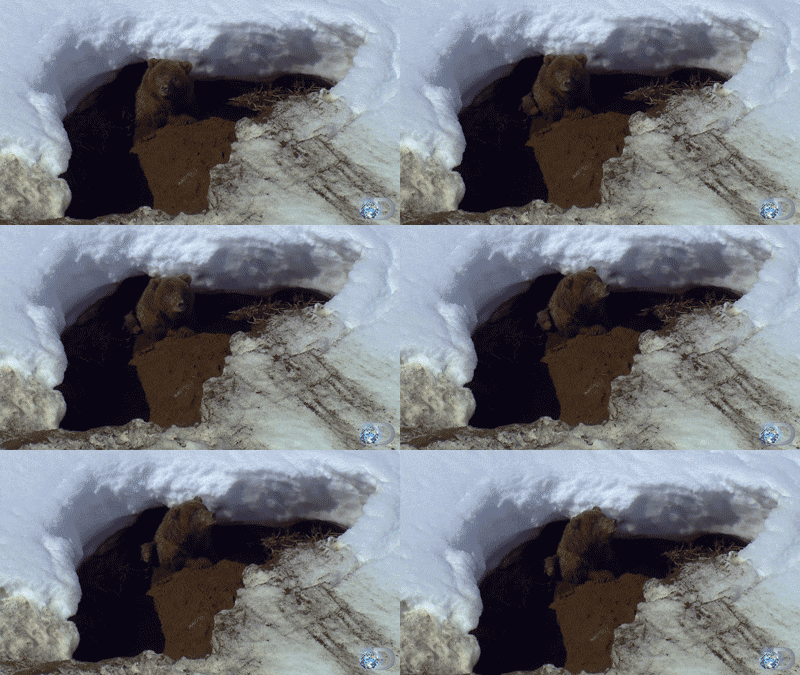
| Deep Torpor | The hardcore version. Body temp drops to near-freezing for weeks. Classic hibernation. |
| Shallow Torpor | Quick dip in temp and metabolism. Hours, not months. The tactical nap. |
| Fat-tailed Dwarf Lemur | A tiny primate from Madagascar that swings 45°F in a day like it’s nothing. |
| Ecophysiologist | A scientist who studies how animals deal with their environment physically. |
📖 The Backstory — We Assumed Wrong for Centuries
Real talk: scientists spent centuries thinking mammals were basically all the same when it came to body heat. You eat food, you burn calories, you stay at 98.6°F. Done.
In 1774, a British physician named Charles Blagden literally sat in a room heated to 200°F (93°C) and watched his body stay at 98°F. He was thrilled. That experiment basically locked in the idea that mammals are temperature-rigid machines.
But here’s the thing. That’s just humans being humans — assuming everything works the way we do.
“Because we’re homeotherms, we assume all mammals work the way we do.” — Danielle Levesque, University of Maine
Turns out the tech wasn’t there before. Old tracking equipment couldn’t follow small wild animals for long enough. Now it can. And the results are wild.
📊 The Numbers — How Far These Animals Drop
| Animal | Temp Swing | What They Do |
|---|---|---|
| Fat-tailed dwarf lemur | ~45°F (25°C) per day | Daily heterothermy in tropical Madagascar |
| Classic hibernators (ground squirrels, etc.) | Drop to just above freezing | Deep torpor for weeks/months |
| Hummingbirds | Nightly drops of 30-50°F | Enter torpor every single night to save energy |
| Edible dormouse | Near-freezing for months | Can hibernate up to 11 months in bad years |
| Humans | ~1-2°F max | We panic and grab a sweater |
(I personally can’t handle my apartment going below 72°F. These lemurs are out here doing a 45-degree swing before lunch.)
🔬 What's New — Way More Animals Do This Than We Thought
The flip here is that scientists used to think torpor was a niche trick — just bears, ground squirrels, and a few oddballs.
Now, with better tracking tech (miniaturized temperature loggers, remote monitoring), researchers are finding heterothermy in animals all over the planet. Tropical species. Desert species. Things that have no business hibernating.
Fritz Geiser, a comparative physiologist at the University of New England in Australia, puts it simply:
“It’s extremely complicated.”
The current thinking is that torpor isn’t one thing. It’s a spectrum:
- Deep torpor on one end (classic hibernation, weeks/months)
- Shallow torpor on the other (quick metabolic dips, hours)
- And a whole range of strategies in between
Many mammals can deploy short bouts of shallow torpor whenever they need to — storms, floods, predators, food shortages. It’s not seasonal. It’s tactical.
🗣️ Why This Matters — Survival in a Heating World
Look, this isn’t just a cool party fact. The play here is survival.
Animals that can drop their metabolism and ride out a crisis have a massive edge. Food runs out? Drop your temp 20 degrees and burn almost nothing. Predator nearby? Go so still your heat signature basically disappears.
And with climate change pushing ecosystems into more extreme weather events — longer droughts, worse storms, unpredictable seasons — animals with this thermostat trick might be the ones that make it.
The researchers are now asking: how many species have we completely miscategorized? How many animals sitting in zoos right now have metabolic tricks we’ve never documented because we only watch them in controlled environments?
Real talk: if you only study an animal in a lab at room temperature, you’ll never see its survival mode.
⚡ The Tech Upgrade That Changed Everything
The reason we’re learning all this now and not 50 years ago comes down to hardware.
Old telemetry gear was big, heavy, and drained batteries fast. You couldn’t stick a temperature logger on a 60-gram lemur and get data back. Now you can.
- Miniaturized implantable loggers — tiny enough for small mammals
- Remote data transmission — no need to recapture the animal
- Long-duration battery life — track for months, not days
- Field deployment — works in Madagascar, Australia, the Arctic
This is a straight-up case of better tools revealing biology that was always there. We just couldn’t see it.
Cool. Animals Are Secretly Temperature Hackers… Now What the Hell Do We Do? ( ͡° ͜ʖ ͡°)
💰 Hustle 1: Bio-Inspired Energy Management Software
Build a SaaS tool that applies heterothermy principles to data center cooling — variable temperature zones that ramp up and down based on server load instead of keeping everything at one flat temp 24/7.
 Example: A DevOps engineer in Nairobi built a thermal cycling algorithm for a mid-size hosting company’s server room. Used sensor data to create “torpor zones” for idle racks. Cut cooling costs by 22%. Landed a $4,500/month consulting contract within 6 weeks.
Timeline: MVP in 2-3 weeks using existing IoT sensor APIs + a simple dashboard.
📱 Hustle 2: Wildlife Monitoring Hardware Kits
The researchers said miniaturized loggers changed the game. There’s a market for affordable, open-source wildlife temperature tracking kits sold to universities, conservation NGOs, and citizen scientists.
Example: A hardware tinkerer in São Paulo assembled ESP32-based temperature loggers with 3D-printed waterproof housings. Sold kits at $35 each to ecology departments across Latin America. Moved 200 units in the first month via a simple Shopify store. $7,000 gross.
🎓 Hustle 3: Science Explainer Content Channel
Real talk: “animals that hack their own body temperature” is top-tier YouTube/TikTok content. The fat-tailed dwarf lemur alone is a viral thumbnail waiting to happen.
Example: A biology grad student in Manila started a TikTok series called “Animals That Cheat Physics.” The hibernation episode hit 2.1M views. Within 3 months she had a $1,800/month Patreon and a sponsorship deal with a nature app.
🔧 Hustle 4: Adaptive HVAC Scheduling Tool
Take the heterothermy concept and apply it to home/office HVAC. Instead of maintaining a flat 72°F all day, build a scheduling app that mimics natural temperature cycling — cooler during low-activity hours, warmer during active ones. Studies already show mild temperature variation improves sleep and alertness.
Example: A solo dev in Kraków built a Nest thermostat integration that cycles temps based on occupancy patterns and circadian rhythms. Listed it on Product Hunt. 850 upvotes. Now charges $3/month per household. 1,200 subscribers in 2 months = $3,600 MRR.
💡 Hustle 5: Survival Gear Content + Affiliate Play
Heterothermy is basically nature’s survival manual. Package the science into a “survival biology” newsletter or blog that reviews cold-weather gear, emergency blankets, and outdoor tech through the lens of how animals actually handle temperature extremes. Affiliate links to REI, Amazon, etc.
Example: An outdoor blogger in Bucharest launched “Torpor Mode” — a weekly newsletter mixing animal biology with gear reviews. Hit 4,000 subscribers in 8 weeks. Affiliate commissions averaging $1,100/month from sleeping bag and base layer reviews alone.
🛠️ Follow-Up Actions
| Step | Action |
|---|---|
| 1 | Read the full Knowable Magazine feature for deeper research angles |
| 2 | Search Google Scholar for “heterothermy” + “climate resilience” — the papers are piling up |
| 3 | Check if any open-source wildlife tracking projects exist on GitHub (they do — fork and improve) |
| 4 | Look up Danielle Levesque’s lab page at University of Maine for latest publications |
| 5 | Scope the IoT sensor market — temperature loggers for wildlife are a real niche |
 Quick Hits
| Want to… | Do this |
|---|---|
| Understand heterothermy |
Read the Knowable Magazine / Ars Technica feature linked above |
 Monetize the science Monetize the science |
Bio-inspired energy tools or wildlife hardware kits |
 Build an audience Build an audience |
“Animals That Cheat Physics” content series — the hooks write themselves |
 Apply it to tech Apply it to tech |
Adaptive thermal management for servers or smart homes |
 Go deeper Go deeper |
Search “torpor spectrum mammals” on Google Scholar |
These lemurs drop their body temp 45 degrees before breakfast. You can’t even handle your office AC being set to 74.
 !
!