 Scientists Found ‘Vowels’ in Sperm Whale Clicks — 8,719 Recordings Prove They Talk Like Us
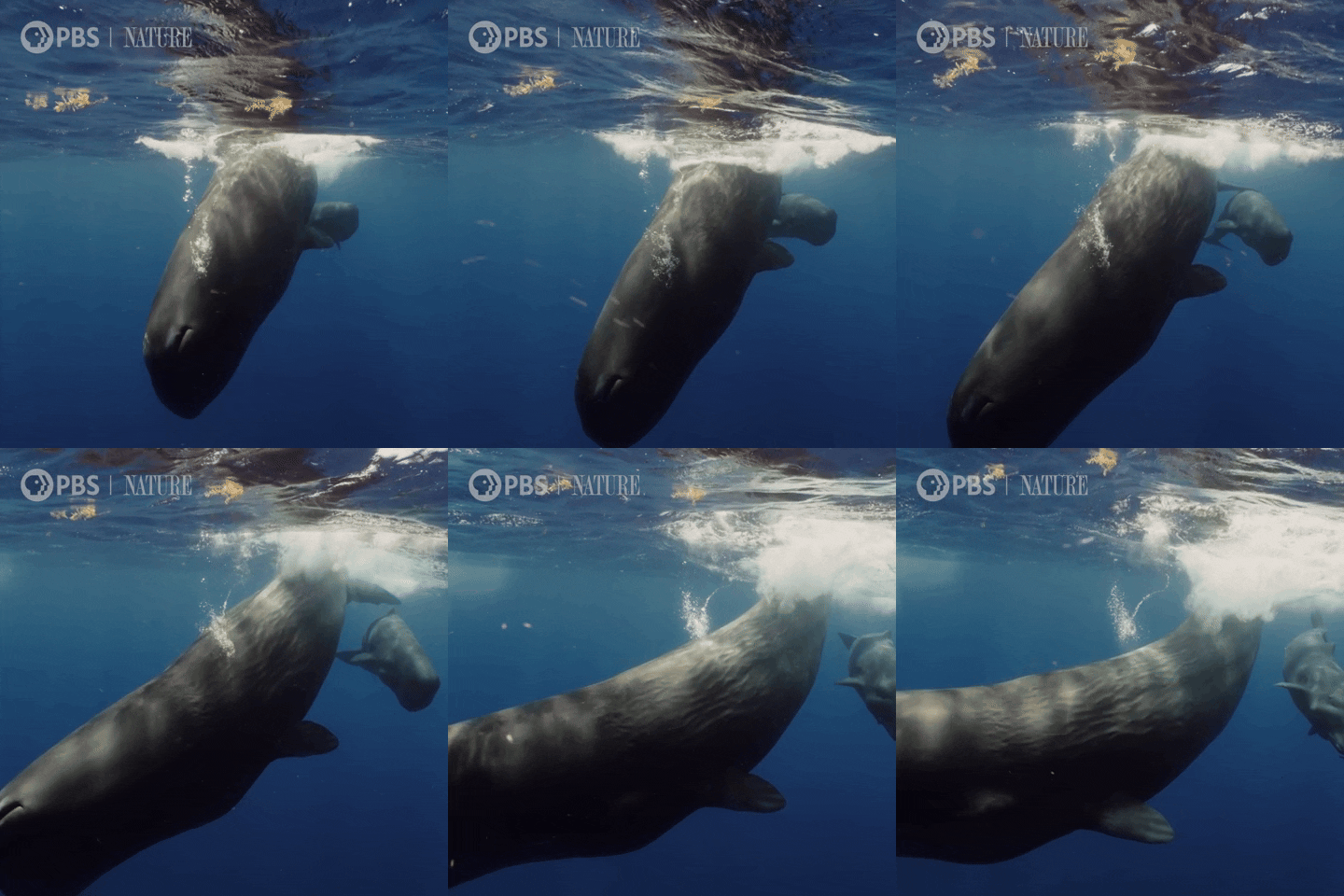
Scientists Found ‘Vowels’ in Sperm Whale Clicks — 8,719 Recordings Prove They Talk Like UsA team of linguists, marine biologists, and AI researchers just proved that the biggest-brained animal on Earth has been speaking a structured language this whole time. We just couldn’t hear it.
8,719 coda recordings. 60+ individual whales. 5 phonological properties that mirror human speech. And two actual “vowels” — an “a” sound and an “i” sound — buried inside clicks we’ve been ignoring for decades.
A new study published in Royal Society Proceedings B (April 2026) from UC Berkeley and Project CETI just dropped the most detailed analysis of sperm whale communication ever. And it says their click patterns aren’t morse code. They’re closer to language — with vowels, rhythm rules, and something that looks a lot like grammar.
🧩 Dumb Mode Dictionary
| Term | What It Actually Means |
|---|---|
| Coda | A short burst of clicks that whales make to “talk” — like a word |
| Phonology | The rules for how sounds are organized in a language (like which letters go together) |
| Vowel (whale version) | A change in the sound frequency inside clicks — similar to how “a” and “i” sound different when you say them |
| Diphthong | Two vowel sounds mashed together (like the “oi” in “coin”) — whales do this too |
| Coarticulation | When one sound bleeds into the next — like how “don’t you” becomes “doncha” — whales have this |
| GAN | A type of AI that learns patterns by trying to fake data and checking its own work — used here to decode whale sounds |
| Project CETI | Cetacean Translation Initiative — a team trying to literally translate whale language using AI and drones |
🔬 What Exactly Did They Find?
The research team, led by Berkeley linguistics professor Gašper Beguš (Project CETI’s linguistics lead), found 5 specific properties in whale clicks that directly match how human languages work:
- Two distinct vowels — “a-codas” and “i-codas” based on sound frequency patterns
- Length matters — a-codas last longer than i-codas (like long vs. short vowels in Latin)
- Short and long versions — i-codas come in two lengths, just like how some human languages distinguish “bit” from “beat”
- Individual voice differences — each whale has its own baseline coda length (like how everyone’s voice is different)
- Coarticulation — when a click at the edge of one coda doesn’t match its own “word” but matches the next one, like how humans slur words together in fast speech
All five have direct parallels in human phonetics. The researchers called it “one of the closest parallels to human phonology of any analysed animal communication system.”
📊 The Numbers That Matter
| Stat | Number |
|---|---|
| Codas analyzed (2024 study) | 8,719 |
| Individual whales recorded | 60+ |
| Years of recordings | 2005–2018 (13 years) |
| Distinct click patterns identified | 156 |
| Vowel types discovered | 2 (a-coda, i-coda) |
| Diphthong-like patterns found | Multiple |
| Project CETI’s goal | Translate 20 whale expressions in 5 years |
🛠️ How They Figured It Out
This wasn’t just marine biologists with microphones. The team used:
- Tags attached to whales — underwater recording devices stuck to their skin
- Aquatic drones — unmanned submarines that follow whale pods
- Aerial drones — to track which whale is making which sound
- Buoys with hydrophones — permanent listening stations in the ocean
- GANs (AI models) — generative adversarial networks that were trained to spot patterns in whale sounds that human ears miss
When they sped up whale codas and removed the silences between clicks, the sounds literally looked and sounded like human vowels on a spectrogram. Beguš put it plainly: “We have a case of underwater vowels — in a very different world from ours, the communication system appears very similar to our speech.”
🗣️ Why This Is Different From Every Other 'Animal Language' Claim
Here’s the thing nobody mentions: we’ve had “animals can communicate” stories for decades. Dolphins, parrots, gorillas with sign language. But those usually show animals using signals — one sound = one meaning, like an alarm call.
This is different. The data shows structural rules governing how sounds combine. That’s not signaling. That’s phonology. The whales aren’t just saying “danger” or “food.” They’re modulating frequency, varying length, and blending sounds together in ways that follow consistent patterns across individuals and over 13 years of recordings.
The 2024 Nature Communications study already showed combinatorial structure — meaning whale codas can be mixed and matched to create new meanings. Now this 2026 paper adds that the sounds themselves have internal structure. It’s the difference between knowing someone uses words and finding out their words have syllables.
📰 What People Are Saying
- David Gruber (Project CETI Founder): Current understanding is like “a two-year-old, just saying a few words” — but expects “five-year-old proficiency” within years
- Gašper Beguš (UC Berkeley): “Their calls are more like very, very slow vowels. This suggests a complexity that approaches human language.”
- Scientific consensus: Published in both Open Mind (MIT Press) and Royal Society Proceedings B — peer-reviewed twice, two different journals
- The skeptic’s take: We’re still a long way from “talking to whales.” Identifying phonological structure doesn’t mean we know what any of it means yet. But the foundation is solid.
Cool. Whales have vowels. Now What the Hell Do We Do? (⊙_⊙)
🎧 Build a 'Whale Sound' Content Channel Before Everyone Else Does
The whale communication story is going to blow up across TikTok, YouTube, and podcasts. There’s a massive gap right now: almost nobody is making accessible, entertaining content explaining animal bioacoustics (the science of animal sounds). Most existing content is either dry academic lectures or clickbait trash.
Start a channel that takes published whale recordings (many are publicly available through CETI) and breaks them down like a music producer would — “here’s the a-vowel, here’s the i-vowel, here’s a mom talking to her calf.” Mix it with AI-generated visualizations of sound waves. The niche is wide open.
 Example: A 19-year-old marine biology student in Portugal started a TikTok channel in 2025 breaking down dolphin click patterns with spectrograms overlaid on underwater footage. Hit 340K followers in 4 months. Now gets paid by aquariums and nature docs to consult.
Timeline: 2–4 weeks to launch, 3 months to build an audience. The Nature/BBC content pipeline always needs fresh explainers when a big paper drops.
🤖 Train a Niche AI Model on Animal Bioacoustics Data
Here’s where it gets interesting. Project CETI used GANs to find patterns humans couldn’t hear. But their models are specialized and not publicly available as plug-and-play tools. There’s a gap: researchers in marine biology, ornithology (birds), and bat ecology all need similar audio-pattern-recognition tools but don’t have the ML skills to build them.
Build a simple wrapper service around open-source audio ML models (like BirdNET for birds or AVES from Earth Species Project) that lets non-technical researchers upload animal recordings and get pattern analysis back. Charge $50–200/month per researcher.
Example: A data science freelancer in Kenya built a custom bird-call classifier for a university conservation project using BirdNET’s open API. Charged $3,000 for a 2-week project. Now has 4 recurring university clients across East Africa doing the same thing for different species.
🎓 Sell 'Animal Communication' Curriculum Kits to Schools
Every time a big animal intelligence story drops, teachers scramble for classroom material. This paper is perfect for biology, linguistics, and even physics classes (sound waves, frequency analysis). But there’s almost nothing pre-made that’s grade-appropriate.
Package a kit: simplified spectrogram activities, downloadable whale recordings with worksheets, a 15-minute video explaining the study, and a teacher’s guide. Sell it on Teachers Pay Teachers or directly to school districts. Price it at $15–25 per kit.
Example: A former teacher in Manila created a “Dolphin Math” curriculum kit in 2024 after a viral dolphin cognition study. Sold 2,800 copies at $12 each on TPT within 6 months — $33,600 from a Google Doc, a PDF, and some audio files.
💰 Flip Underwater Audio Hardware to Marine Research Labs
Project CETI uses hydrophones (underwater microphones), aquatic drones, and specialized recording tags. Marine research labs worldwide are about to get funding requests inspired by this paper. But here’s the thing nobody mentions: most labs don’t know where to source this stuff efficiently. The supply chain for marine research hardware is a mess — scattered across tiny specialty manufacturers.
Become the middleman. Source hydrophones and underwater recording equipment from manufacturers, mark them up 20–30%, and sell curated “whale research starter kits” to small labs and independent researchers. Bundle the hardware with a setup guide.
Example: A marine engineering grad in Lisbon started reselling refurbished oceanographic sensors on eBay in 2025 after noticing researchers were paying 3x retail because they didn’t know the manufacturers. Made €18,000 in 8 months with zero inventory — just dropshipping from the supplier.
🧠 Build a 'Whale Translator' Demo App and Sell the Hype
You don’t need to actually translate whale language (nobody can yet). But you CAN build a proof-of-concept app that visualizes whale coda patterns, labels the known vowel types, and lets users “explore” whale conversations from public datasets. Think of it as an interactive data visualization, not a real translator.
The name sells itself. “Whale Translator” or “CetaceaLang” as a web app gets press coverage, goes viral on Product Hunt, and attracts marine biology organizations as partners. Monetize through sponsorships, premium data access, or pivot into educational licensing.
Example: A developer in São Paulo built a “Bird Language” web app in 2025 that visualized BirdNET data on a map. Got featured on Product Hunt, picked up by National Geographic’s digital team for a collaboration, and landed a $40K contract to build a custom version for a conservation NGO.
🛠️ Follow-Up Actions
| Want To… | Do This |
|---|---|
 Hear whale codas yourself Hear whale codas yourself |
Visit Project CETI’s site for public recordings and research updates |
 Read the actual studies Read the actual studies |
Royal Society paper (2026) and MIT Press paper (2025) |
 Play with animal sound AI Play with animal sound AI |
Try BirdNET (free) or Earth Species Project’s AVES on GitHub |
 Teach this in a classroom Teach this in a classroom |
Search “whale communication” on Teachers Pay Teachers — or make your own first |
| Support whale research |
Project CETI accepts donations and publishes open datasets |
 Quick Hits
| Want To… | Do This |
|---|---|
| Understand the study in 30 seconds |
Whales make clicks. Inside those clicks are vowels. Those vowels follow grammar-like rules. That’s never been proven in any non-human animal at this level. |
| Know why AI matters here |
Humans can’t hear the patterns — GANs (a type of AI) found the vowels by analyzing thousands of recordings |
 See the strongest number See the strongest number |
8,719 codas from 60+ whales over 13 years. This isn’t a fluke sample — it’s the biggest dataset of whale communication ever analyzed |
 Know what comes next Know what comes next |
Project CETI wants to translate 20 whale expressions within 5 years. If they do, it changes every conversation about animal rights, ocean policy, and intelligence |
The biggest brain on Earth has been talking for 30 million years. We just finally built the right microphone.
 !
!