 Sperm Whales Have Vowels, Tones, and Grammar — Scientists Just Decoded Their 20-Million-Year-Old Language
Sperm Whales Have Vowels, Tones, and Grammar — Scientists Just Decoded Their 20-Million-Year-Old LanguageForget “clicks and beeps.” These animals have been speaking a tonal language — like Mandarin — for 20 million years. And we just figured it out.
The data: UC Berkeley and Project CETI identified 2 distinct vowel types, multiple diphthongs (double-sounds), rising/falling tones, short vs. long vowel contrasts, AND coarticulation — where one “word” bleeds into the next. That’s 5 out of 5 features of human phonology found in a whale.
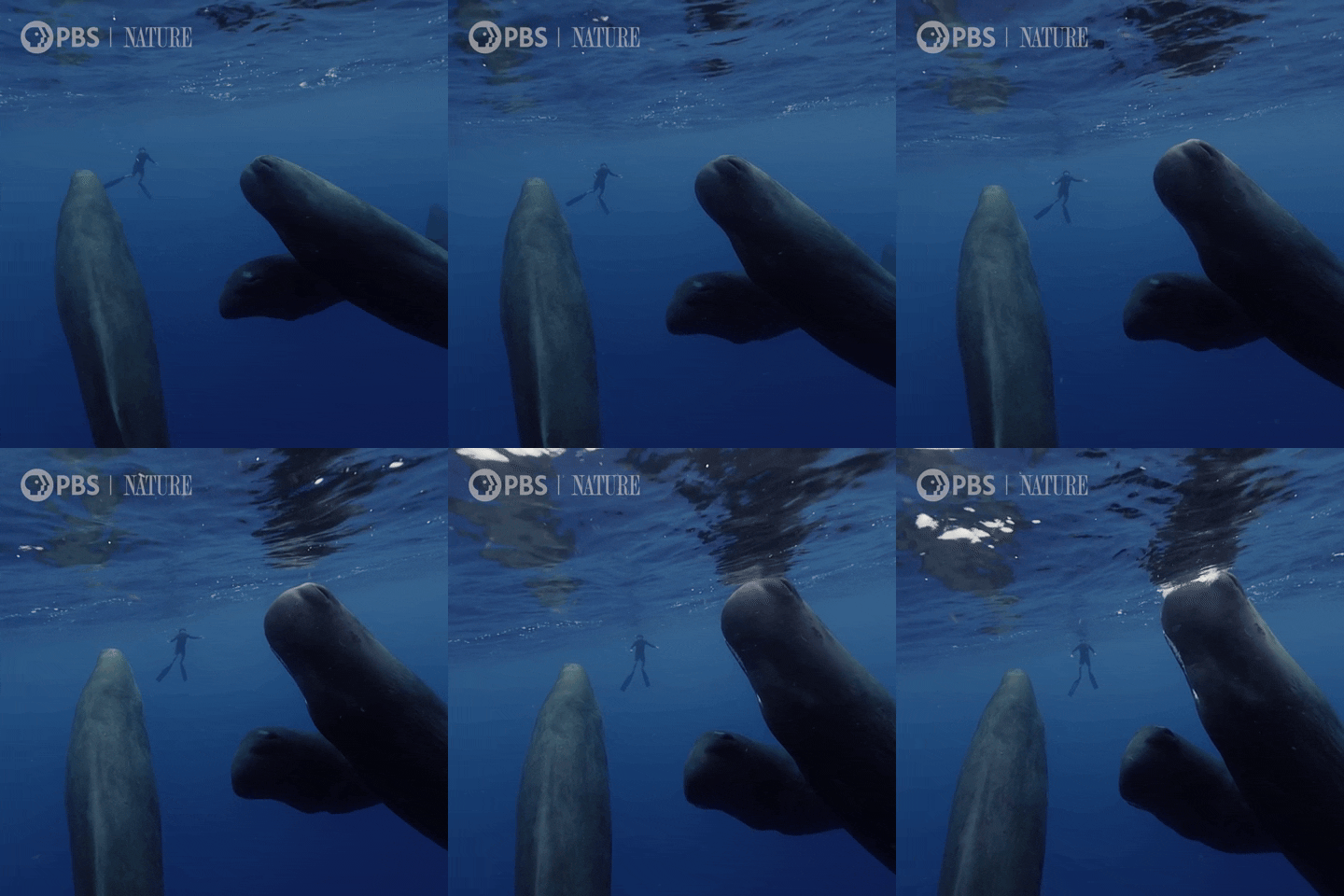
Published in Proceedings of the Royal Society B, April 2026. Researchers analyzed 1,100+ codas from 15 whales off Dominica using machine learning. The conclusion: sperm whale communication is “one of the closest parallels to human phonology of any analysed animal communication system.” Period.
🧩 Dumb Mode Dictionary
| Term | What It Actually Means |
|---|---|
| Coda | A short burst of clicks that whales use like a word or syllable |
| Phonology | The rules for how sounds work in a language (like how “th” works differently in “the” vs “think”) |
| Diphthong | Two vowel sounds smushed into one syllable — like the “oi” in “coin” |
| Tonal language | A language where the same word means different things depending on whether your voice goes up or down (Mandarin has 4 tones) |
| Coarticulation | When you’re saying one word and your mouth is already shaping the next one — like slurring sounds together naturally |
| Bimodal distribution | Two clear groups — short version and long version — not a random mess in between |
| GAN (Generative Adversarial Network) | An AI that learns patterns by having two programs compete against each other |
🔍 What They Actually Found
The old model: researchers thought whale clicks were basically morse code. Dot-dot-dash. Simple.
The new model: these clicks contain spectral patterns that behave exactly like vowels in human speech.
Specifically:
- Two vowel types: “a-vowels” and “i-vowels” — acoustically distinct categories
- Length contrast: short i-codas vs. long ī-codas (like “bit” vs. “beat” in English)
- Tones: regular codas = level tones, increasing intervals = falling tones, decreasing intervals = rising tones
- Diphthongs: double-pitch patterns within a single coda, like Mandarin tonal shifts
- Coarticulation: edge clicks that don’t match their own coda but DO match the adjacent one — the whale is already “pronouncing” the next word
Professor Gašper Beguš (UC Berkeley Linguistics, Project CETI lead): “In the past, researchers thought of whale communication as a kind of morse code. This paper shows that their calls are more like very, very slow vowels.”
📊 The Numbers That Matter
| Metric | Value |
|---|---|
| Codas analyzed | 1,100+ |
| Whales studied | 15 females and calves |
| Location | Off Dominica, Eastern Caribbean |
| Human phonology features matched | 5 out of 5 |
| How long whales have been doing this | ~20 million years |
| Project CETI goal | Decode 20 behavioral expressions within 5 years |
| Method | GANs (AI) + statistical analysis + hydrophones |
But here’s the thing nobody mentions: the a-codas are systematically longer than i-codas. This isn’t random noise. It’s the same structural rule you see in dozens of human languages where different vowel classes have different inherent durations.
🗣️ What Researchers Are Saying
Mauricio Cantor (Marine Mammal Institute, not involved in the study):
“Sperm whale communication involves multiple interacting layers of structure, organized in ways we didn’t fully appreciate before.”
David Gruber (Project CETI founder):
“A future where we fully understand whales and communicate with them is totally within our grasp. We’re currently like a two-year-old saying few words.”
The counter-argument worth mentioning: having structure that PARALLELS human language doesn’t mean whales are having philosophical debates down there. We still can’t translate a single “sentence.” We just know the architecture looks shockingly familiar. That’s a huge deal for linguistics — but we’re probably years away from a whale dictionary.
🧠 Why This Matters Beyond 'Cool Science'
Three things make this different from the usual “animals are smart!” headline:
-
Independent evolution. Whales split from our common ancestor ~90 million years ago. They evolved these language features completely separately. That suggests tonal + vowel-based communication might be a universal solution for complex social species — not a human accident.
-
AI made it possible. The GAN models spotted patterns that human researchers missed for decades. This is one of the first cases where AI genuinely unlocked a scientific discovery that wouldn’t have happened otherwise.
-
Legal implications. If whale communication meets the structural definition of “language,” it strengthens arguments for whale personhood and could affect international whaling policy. New Zealand already granted legal personhood to a river. A whale with proven language isn’t far-fetched.
The 2024 Nature Communications paper from the same team showed the codas are context-sensitive and combinatorial. This new paper shows they also have phonological rules. That’s two of the three main features of human language confirmed.
Cool. So Whales Speak Mandarin Underwater. Now What the Hell Do We Do? ( ͡° ͜ʖ ͡°)
🎧 Build an AI-to-Whale Translation API Before CETI Open-Sources Theirs
Project CETI will release their dataset eventually. But right now there’s ZERO commercial infrastructure for bioacoustic translation. Build the middleware layer — the API that takes raw hydrophone audio, segments it into codas, classifies vowel type/tone/length, and outputs structured data.
Every marine biology lab, every documentary crew, every eco-tourism operator will need this when whale “translation” goes mainstream. The team that owns the developer tools wins.
 Example: A solo developer in Portugal built a bird-call identification API using BirdNET’s open model, licensed it to 3 birding app companies, and pulls €4,200/month in API fees — zero marketing, just being first to package the tooling.
Timeline: CETI’s 5-year decoding goal means you have 2-3 years before the market exists. Build now, own the pipes later.
🐋 Sell 'Whale Listening' Experiences to High-End Eco-Tourism
The study happened off Dominica. That’s a small Caribbean island with existing whale-watching tourism. But nobody is offering “listen to whale conversations in real-time with AI annotation” as a premium product yet.
Partner with a local boat operator. Drop a hydrophone. Run the audio through a basic coda-classifier (the 2024 paper’s code is on GitHub via MIT CSAIL). Display the “vowels” and “tones” on a tablet screen while tourists listen. Charge 3x the regular whale-watching price.
Example: A marine biologist in Iceland partnered with a boat tour company to add “underwater microphone experiences” — no AI, just raw audio — and their tours sell at $180/person vs. the standard $65. With AI visualization, that premium doubles.
📱 Create a 'DuoWhale' Language-Learning App (Meme Marketing Play)
This sounds stupid. That’s why it works. Make a Duolingo-style app where humans “learn whale.” Daily lessons on coda patterns. Streak counts. Leaderboards. It doesn’t need to be scientifically rigorous — it needs to be viral.
The hook: “Sperm whales have been speaking for 20 million years. You’ve been speaking for maybe 30. Who’s the beginner?”
Monetize with premium tiers, merch, and brand deals with marine conservation nonprofits who want younger audiences.
Example: A developer in Berlin made “Lingo Deer” as a meme project for learning Korean through deer-themed lessons. Hit 2M downloads in 8 months because the absurdity drove TikTok shares. “DuoWhale” has even more meme potential — the content writes itself.
🎵 Generate 'Whale Phonology' Music Samples for Producers
Sperm whale codas have rhythm, tone, pitch variation, and duration contrasts. That’s literally music theory. Nobody is selling whale-communication-derived sample packs categorized by vowel type, tone direction, and tempo.
Download public hydrophone recordings (NOAA has thousands of hours free). Classify them using the vowel/tone framework from this paper. Package them as production-ready WAV files labeled by “a-vowel rising,” “i-vowel short,” “diphthong falling,” etc. Sell on Splice or Bandcamp.
Example: A sound designer in Cape Town took public-domain rainforest recordings, classified them by frequency band, and sells “Biome Textures” packs on Splice — $800-1,200/month passive income. Whale codas with linguistic labeling is a fresh niche nobody has claimed.
🛠️ Follow-Up Actions
| Step | Action | Resource |
|---|---|---|
| 1 | Read the full study | Royal Society B paper |
| 2 | Explore Project CETI’s public data | projectceti.org |
| 3 | Access whale audio datasets | NOAA Passive Acoustics |
| 4 | Study the 2024 coda classification paper | Nature Communications |
| 5 | Check UC Berkeley’s linguistics resources | Berkeley announcement |
| 6 | Monitor eco-tourism pricing in Dominica | Search “Dominica whale watching” for baseline rates |
 Quick Hits
| Want to… | Do this |
|---|---|
| Understand the science |
Read the National Geographic explainer |
 Hear actual whale codas Hear actual whale codas |
NOAA’s free passive acoustic archive has thousands of hours |
 Play with the AI models Play with the AI models |
Check MIT CSAIL’s whale research tools |
 Go deeper on whale cognition Go deeper on whale cognition |
Scientific American coverage |
 Find the business angle Find the business angle |
Build on top of public data before anyone else packages it |
They’ve been talking for 20 million years. We just started listening last Tuesday. And we needed a robot to translate.
 !
!