 High School Kids Built $150 Robot Birds to Catfish Real Birds Into Mating
High School Kids Built $150 Robot Birds to Catfish Real Birds Into MatingA robotics team made dancing fake grouse out of meal-kit packaging and fishing feathers — and the government is actually using them to save a species
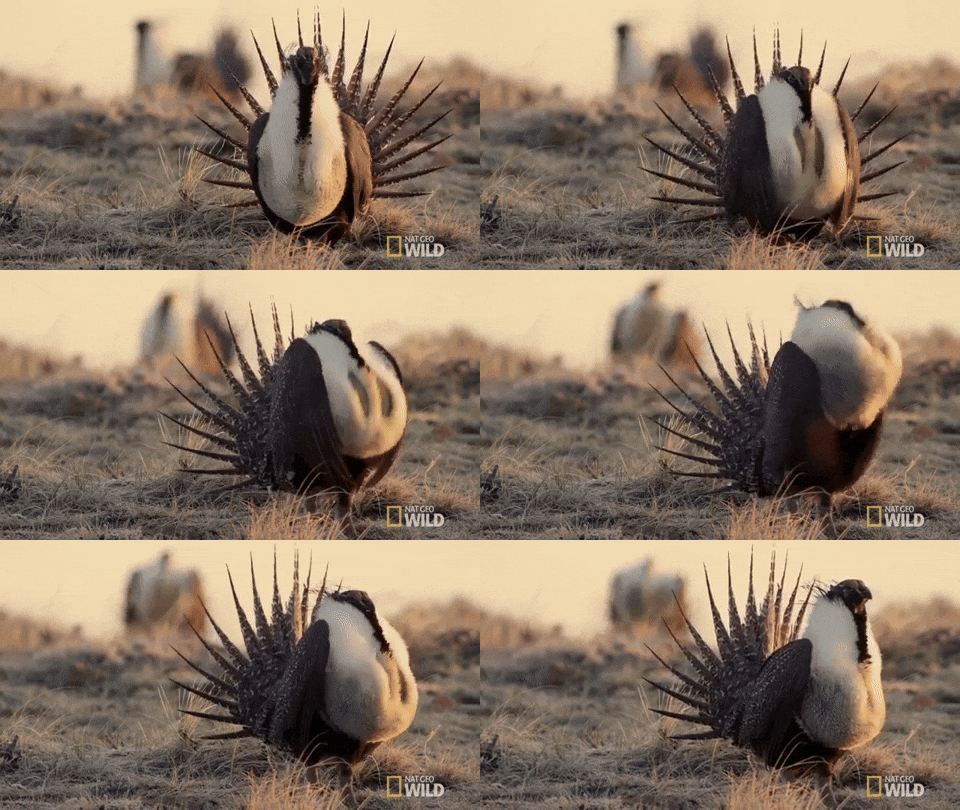
Only 3 male sage grouse showed up to breed at Grand Teton last year. Down from 73. The park’s solution? Let teenagers build robo-birds for $150 each out of Hello Fresh foam and an Arduino.
I mean. We spend hundreds of millions on conservation programs and the move that might actually work is a Frankenbird made by sophomores using leftover meal-kit packaging. The birds wake up at 5 AM, play a sexy grouse soundtrack, and do a little dance. If that’s not the most unhinged science project you’ve ever heard of, you’re not paying attention.
🧩 Dumb Mode Dictionary
| Term | What It Actually Means |
|---|---|
| Sage Grouse | A fat, fancy bird that lives in the American West and does an insane mating dance every spring |
| Lek | The bird version of a nightclub — a patch of ground where males show up to dance and impress females |
| Arduino | A tiny cheap computer board ($5-30) that hobbyists use to control motors, lights, and servos |
| Genetic Bottlenecking | When a species’ gene pool gets so small that everyone’s basically cousins and the whole population gets weaker |
| Decoy | A fake bird used to trick real birds. Like catfishing, but for conservation |
| Servo Motor | A small motor that can rotate to exact positions — the thing that makes the robot bird’s wings flap |
📖 The Backstory: Why Are There Only 3 Birds Left?
Okay so here’s the thing. In 1900, there were roughly 16 million sage grouse in North America. By the 1960s the population was dropping about 2.3% every year. Cattle ate all their food. Developers paved their habitat.
But the Grand Teton population got hit with something extra stupid: someone built an airport in the middle of their dating spot. Jackson Hole Airport is literally the only commercial airport inside a US national park. Between 1994 and 2013, planes struck 32 grouse. The birds that survived are now so inbred they have “some of the lowest genetic diversity of any grouse population” according to Teton Raptor Center conservation director Bryan Bedrosian.
Last spring? Three males showed up to the lek. Three. Down from 73 in the 1950s.
🔧 Meet the RoboBroncs: The Kids Who Built Frankenbird
The Jackson Hole High School RoboBroncs — that’s their actual robotics team name — partnered with Grand Teton National Park and the Teton Raptor Center to build robot grouse decoys.
The mentor is Gary Duquette, a former engineering teacher who now runs robotics projects through a nonprofit called the Wonder Institute. Students like sophomore Connor McCarter, plus River Ryan, Becky Hawkins, and about 10 others built multiple robots.
Duquette describes the creations as “kind of a Frankenbird.” And honestly? That tracks.
⚙️ What's Inside a $150 Robot Bird
| Part | Where It Came From | I’m Serious? |
|---|---|---|
| Wings | Real grouse wings from hunter surveys via Wyoming Game & Fish | Dead serious |
| Body feathers | Fly-tying supplies from a fishing store | Yep |
| White breast feathers | Hello Fresh packaging foam | I KNOW |
| Head | 3D printed | Normal-ish |
| Brain | Arduino controller on a breadboard | Standard nerd stuff |
| Body shell | Modeled on taxidermist forms, made at a Riverton plastics lab | Okay that’s cool |
| Yellow air sacs | Decorative accents for authenticity | Chef’s kiss |
| Power | Car batteries + solar panels | Practical |
| Total cost | ~$150 per bird | Absolute bargain |
🎵 How the Robot Bird Actually Works
Every morning at 5 AM, the robots wake up and start performing. They play recorded breeding calls — clucking and cooing sounds — through speakers. The motorized ones physically move: “They kind of do a turn, turn, turn, then do their wing, wing, wing” as Duquette put it.
They run from 5 AM to 9 AM during breeding season (through mid-May). Trail cameras snap photos every five minutes to catch any real grouse that show up.
The whole thing almost didn’t work. Voltage spikes kept frying the servo motors. McCarter said “There was a bunch that went wrong… kind of frustrating.” The team had to learn the difference between voltage and amperage on the fly, then wire a voltage converter inline with the Arduino to fix it. Real engineering. Under a real deadline. With actual stakes.
💰 The Numbers Behind This Whole Operation
| Stat | Number |
|---|---|
| Historical sage grouse population (1900) | ~16 million |
| Males at Grand Teton lek in 1950s | 73 |
| Males at Grand Teton lek in 2025 | 3 |
| Habitat restored over 8 years | ~100 acres |
| Airport wildlife mitigation budget | $680,000+ over 7 years |
| Next 2 years wildlife budget | $150,000 |
| Cost per robot bird | ~$150 |
| Grouse struck by planes (1994-2013) | 32 |
| Annual population decline rate | 2.3% per year |
🗣️ What People Are Saying
Gary Duquette (mentor): “Students don’t really get to experience real-world problems” in traditional classrooms. This project changed that.
Connor McCarter (student): “There was a bunch that went wrong… kind of frustrating.” — Said like a true future engineer.
Bryan Bedrosian (Teton Raptor Center): The Jackson Hole grouse have “some of the lowest genetic diversity of any grouse population.”
Slashdot commenters went absolutely feral. Half of them wanted to know if the robots could be weaponized. The other half wanted to know why we can’t do this for every endangered species. Both valid questions honestly.
Cool. Some Teenagers Just Out-Engineered a $680K Government Program With Meal-Kit Foam… Now What the Hell Do We Do? ᕕ( ᐛ )ᕗ

🐦 Build Conservation Decoys for Your Local Wildlife Agency
Most state fish and wildlife departments are underfunded and desperate for cheap solutions. If you have any robotics, 3D printing, or Arduino experience, you can pitch a similar decoy project for locally threatened species — piping plovers, prairie chickens, whooping cranes. Reach out to your state’s wildlife agency or local Audubon chapter with a prototype proposal and a $150 cost breakdown. Governments pay contractors $10K+ for this kind of work.
 Example: A maker in New Mexico pitched a 3D-printed burrowing owl decoy system to BLM land managers for $200/unit. They got a $12,000 pilot contract to deploy 40 units across three counties. Total material cost: under $2K.
Timeline: 2-4 months from pitch to pilot contract
🎓 Launch a 'Conservation Robotics' After-School Program and Sell the Curriculum
The RoboBroncs just proved that high schoolers can build functional wildlife robots. Most schools have zero curriculum for this. Package a 6-week lesson plan — Arduino basics, servo control, 3D printing animal forms, field deployment — and sell it to schools, makerspaces, and 4-H clubs. Price it at $49-99 per license. The Hello Fresh foam angle alone makes it go viral on teacher TikTok.
Example: A former biology teacher in Oregon created a “Build a Pollinator Drone” kit curriculum for middle schools. Sold 200 licenses at $79 each through Teachers Pay Teachers in the first semester. That’s $15,800 from a Google Doc and some wiring diagrams.
📱 Sell 'Wildlife Cam Monitoring' as a Remote Micro-Job Service
This project uses trail cameras snapping photos every 5 minutes for weeks. Somebody has to review thousands of images to check if real birds showed up. Most parks don’t have the staff. Set up on Zooniverse or pitch directly to conservation orgs: you’ll train a small remote team (or use AI-assisted tagging with Roboflow) to classify wildlife cam images at $0.02-0.05 per image. Parks generate tens of thousands of images per season.
Example: A college student in the Philippines trained a YOLOv8 model on public trail cam datasets and offered image classification to three US wildlife nonprofits. Processed 80,000 images in a month at $0.03 each — $2,400 from a laptop.
🛠️ Flip Broken Robotics Club Equipment Into Conservation Tools
Schools constantly trash old robotics competition parts — servos, Arduino boards, 3D printer filament, motors. The RoboBroncs proved you can build a functional wildlife decoy for $150 in parts. Hit up local FIRST Robotics teams after competition season (May-June) and ask for their surplus. Refurbish it into conservation decoy kits and sell to wildlife agencies, parks, or eco-tourism operators who want interactive animal exhibits.
Example: A maker in rural Montana collected discarded FIRST Robotics parts from three high schools, rebuilt them into animatronic bird decoys, and sold four units to a Montana state park gift shop as “educational displays” at $400 each. Total cost: $80 in new components plus free salvaged parts.
🛠️ Follow-Up Actions
| Want To… | Do This |
|---|---|
| See the actual robot grouse |
Follow Teton Raptor Center for trail cam results through mid-May |
 Build your own Arduino animal Build your own Arduino animal |
Start with Arduino’s official starter tutorials — free |
 Learn about sage grouse conservation Learn about sage grouse conservation |
Read WyoFile’s full deep dive on the project |
 Find local wildlife agencies to pitch Find local wildlife agencies to pitch |
Search your state’s Fish & Wildlife department directory |
 Get into conservation tech Get into conservation tech |
Check out Wildlabs.net — the global community for conservation technology |
 Quick Hits
| Want To… | Do This |
|---|---|
| Watch sage grouse dance |
Search “sage grouse lek dance” on YouTube — it’s absolutely unhinged mating behavior |
| Build a cheap Arduino robot |
Grab an Arduino Uno starter kit for ~$30 and follow the servo motor tutorial |
| Read the full story |
Check the Popular Science article or WyoFile’s detailed report |
 Support the project Support the project |
Donate to the Teton Raptor Center — they’re coordinating the whole thing |
| Pitch your own conservation robot |
Contact your state wildlife agency with a cost breakdown under $200/unit |
Sixteen million birds became three. And the ones fighting to bring them back aren’t PhDs with grants — they’re teenagers with soldering irons and leftover dinner packaging.
 !
!