 High Schoolers Built $150 Robot Birds — Now They’re Catfishing Real Grouse in a National Park
High Schoolers Built $150 Robot Birds — Now They’re Catfishing Real Grouse in a National ParkA robotics team made fake birds out of Arduino boards, Hello Fresh packaging foam, and fly-fishing feathers. Grand Teton just deployed them to save a species.
A lek that had 73 males in 1950 is down to 3. The airport next door averages 98 flights a day. The fix? Robot birds that wake up at 5 a.m. and dance for four hours straight.
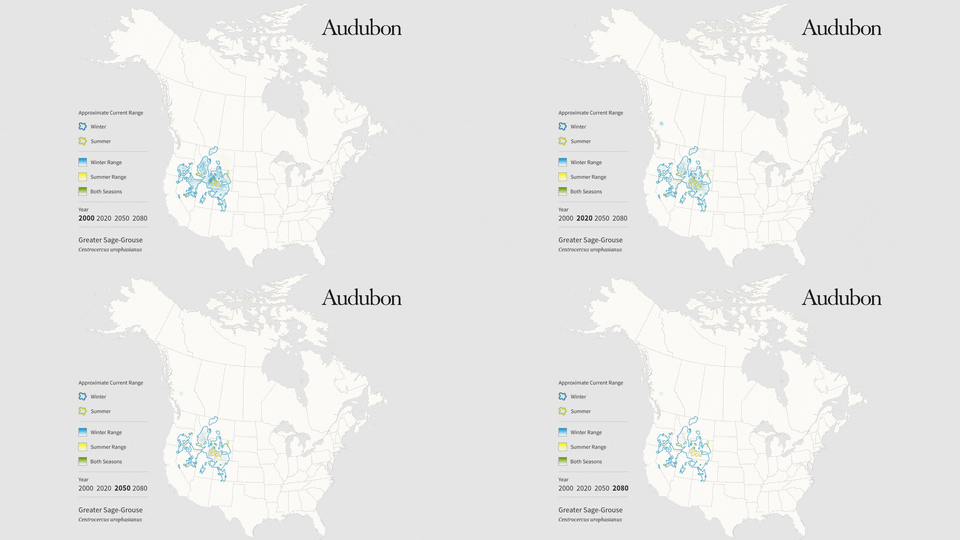
Jackson Hole High School’s robotics team — the RoboBroncs — built mechanical sage grouse decoys for about $150 each. Grand Teton National Park is now using them to lure real birds back to restored habitat. The robots strut, puff their chests, bob their heads, and blast recorded mating calls from hidden speakers. Trail cameras are watching to see if actual grouse show up.
🧩 Dumb Mode Dictionary
| Term | Translation |
|---|---|
| Lek | A spot where male birds gather to do their mating dance (think: bird nightclub) |
| Sage grouse | A chunky bird native to the American West. Males puff up yellow air sacs on their chests to impress females |
| Arduino | A tiny, cheap computer board you can program to control motors, lights, sensors — basically the brain of every DIY robot project |
| Servo motor | A small motor that can rotate to a precise position — what makes the robot head turn and wings flap |
| Extirpation | When a species disappears from a specific area but still exists elsewhere (local extinction) |
| BT.2020 | Just kidding, that’s from a different article. Ignore this row |
📖 Backstory: Why Fake Birds?
OKAY SO here’s the deal. Jackson Hole Airport is the only commercial airport inside a U.S. national park. It sits right next to Grand Teton. And between 1994 and 2013, planes struck 32 sage grouse. The birds’ breeding grounds — their leks — are dangerously close to the runway.
The park spent eight years restoring about 100 acres of former cattle pasture into sage grouse habitat. Five years just removing exotic grass. They rebuilt it from scratch. But getting the birds to actually move to the new spot? That’s the hard part. Sage grouse are creatures of habit. They return to the same lek their whole lives.
So someone had an idea: what if we trick them?
🔧 How the Frankenbirds Work
Robotics mentor Gary Duquette (formerly an engineering teacher, now with the nonprofit Wonder Institute) calls them “kind of a Frankenbird.” Here’s what goes into one:
- Brain: Arduino controller on an electronic breadboard
- Power: Car batteries (the big ones)
- Head: 3D-printed
- Body shell: Molded at a plastics lab in Riverton, Wyoming
- Wings: Real sage grouse wings from Wyoming Game and Fish hunter surveys
- Body feathers: Fly-tying supplies from an angling store
- White breast feathers: Packaging foam from a Hello Fresh meal kit (I am not making this up)
- Yellow air sacs: Accent detail to mimic the males’ chest display
Some robots are stationary decoys. Others are powered — they turn, flap wings, and bob their heads to imitate the mating dance. Every morning at 5 a.m., they activate. Recorded breeding calls (clucking and cooing) play from concealed speakers. The show runs until 9 a.m. Trail cameras snap photos every five minutes.
📊 The Numbers
| Stat | Value |
|---|---|
| Males at the lek in 1950 | 73 |
| Males at the lek in 2025 | 3 |
| Cost per robot bird | ~$150 in parts |
| Daily airport flights | 98 average |
| Airport grouse investment | $680,000 over 7 years |
| Habitat restored | ~100 acres |
| Exotic grass removal | 5 years |
| North American sage grouse (early 1900s) | ~16 million |
| Annual population decline (since late 1960s) | 2.3% per year |
| Distance of new lek from airport | ~3 miles south |
😤 The Voltage Disaster
WAIT — the best part. Right before deployment, the servo motors started burning out. Voltage spikes were frying the electronics. With the breeding season deadline approaching, the students had to figure out the difference between voltage and amperage in real time.
Sophomore Connor McCarter and the rest of the team wired a voltage converter in line with the Arduino controller. “We pulled through and got it done in time,” Duquette said. He also pointed out that in school, students “don’t really get to experience real-world problems” where failures lurk. The $150 in parts is cheap. The education? “Priceless.”
(Honestly this is like the best argument for project-based learning I’ve ever heard. Forget worksheets. Give a teenager a car battery and a deadline to save a species.)
🗣️ What People Are Saying
- Gary Duquette (mentor): “Kind of a Frankenbird… The kids had to learn the difference between voltage and amperage”
- Emily Davis (park spokesperson): “The idea is to encourage birds to begin displaying and mating at the restored site”
- The Independent: Suggested similar robotic systems could eventually be used in other national parks
- Slashdot commenters: Already making “birds aren’t real” jokes (obviously)
🔮 What Happens Next
The 2026 breeding season runs through mid-May. Trail cameras are rolling. If real sage grouse respond to the robots — if they actually show up and start dancing alongside fake birds made of Hello Fresh foam and fishing feathers — then Grand Teton has proof of concept for a bonkers new conservation tool.
Park officials say similar robotic systems could be deployed in other national parks facing wildlife management challenges. That’s a big deal because sage grouse aren’t the only species losing ground near human infrastructure.
The birds aren’t federally listed as endangered (yet), but local populations face extirpation risk. If the lek at Jackson Hole goes from 3 males to zero, that breeding site is gone forever.
Cool. A bunch of teenagers just catfished an endangered bird with Hello Fresh packaging. Now What the Hell Do We Do? ᕕ( ᐛ )ᕗ
🐦 Build Wildlife Decoys for Conservation Orgs
Conservation groups and wildlife agencies are desperate for low-cost solutions. If you know Arduino, 3D printing, or basic electronics, you can prototype robotic decoys for other threatened species — whooping cranes, piping plovers, least terns. The materials are dirt cheap. The demand is real.
 Example: A mechatronics student in Christchurch, New Zealand, built 3D-printed kiwi bird decoys with embedded audio playback for a DOC (Department of Conservation) pilot program. She landed a $12K grant from the local council and now sells kits to three other regional conservation offices.
Timeline: 2-4 weeks to prototype. Conservation grants often fund materials. Start with your local Audubon chapter or wildlife agency.
🎓 Launch a Conservation Robotics Workshop for Schools
Duquette’s model is extremely replicable. A mentor, a robotics team, a real-world problem. Schools are hungry for STEM projects that aren’t just “build a line-following robot.” Conservation robotics gives students portfolio material AND press coverage AND actual impact.
Example: An after-school program coordinator in São Paulo, Brazil, started running “BioBot” workshops where students built Arduino-powered acoustic monitors for Atlantic Forest bird species. Two schools signed up. Then eight. He now runs weekend camps across three cities and charges R$200/student (~$40 USD).
🛠️ Sell Custom 3D-Printed Wildlife Decoys on Etsy/Shopify
There’s a niche market for realistic, 3D-printed bird decoys — not just for conservation, but for photographers, birdwatchers, and nature centers. Most commercial decoys are mass-produced plastic junk. A custom, detailed, 3D-printed model with optional servo movement? That’s a premium product.
Example: A maker in rural Portugal started selling 3D-printed bird models (European bee-eaters, hoopoes) on Etsy. He added a small speaker module that plays species calls. Average price: €45. He moved 380 units in 2025 and now does custom orders for two wildlife photography tour companies.
📱 Build an Open-Source Wildlife Monitoring Platform
The trail camera + Arduino + species-specific trigger setup is useful way beyond sage grouse. Package this into an open-source kit — hardware specs, Arduino code, 3D print files, camera integration guide — and you’ve got something wildlife researchers worldwide would use. Monetize through consulting, custom builds, or Patreon.
Example: A freelance developer in Nairobi, Kenya, built an open-source acoustic wildlife monitor using Raspberry Pi and uploaded the plans to GitHub. A UK university found it and contracted him for $8,000 to build 50 units for a bat monitoring project in Scotland. He now maintains the project and gets regular contract work.
💼 Offer STEM-to-Conservation Consulting for Parks and Agencies
National parks, wildlife refuges, and state agencies need tech solutions but don’t have in-house engineering. If you can bridge that gap — proposing, prototyping, and deploying Arduino/robotics/sensor projects for conservation — you’re looking at contract work that pays well and looks incredible on a resume.
Example: A mechanical engineering grad in Adelaide, Australia, cold-emailed her state’s Department of Environment about acoustic lure systems for threatened parrots. She got a $15K pilot contract within two months. After a successful deployment, the department added her to their vendor list for ongoing projects.
🛠️ Follow-Up Actions
| Want to… | Do this |
|---|---|
| Learn Arduino basics |
Start with the Arduino Starter Kit — $80, includes servo motors and sensors |
 Get into 3D printing for wildlife Get into 3D printing for wildlife |
Download free bird STL files from Thingiverse, print on any Ender 3 ($180) |
 Find conservation grants Find conservation grants |
Check the National Fish and Wildlife Foundation, local Audubon chapters, and state wildlife agencies |
 Start a school robotics program Start a school robotics program |
Contact FIRST Robotics for mentorship resources and team registration |
 Follow the sage grouse project Follow the sage grouse project |
Watch for Grand Teton NPS updates through mid-May 2026 when breeding season ends |
 Quick Hits
| Want to… | Do this |
|---|---|
| Save a bird species on $150 |
Arduino + 3D printer + Hello Fresh foam. Seriously. |
| Give students real engineering problems |
Partner with a local park or wildlife agency for a conservation robotics project |
 Build something weird that actually matters Build something weird that actually matters |
Pick a declining local species, research its behavior triggers, prototype a decoy |
 Monetize conservation tech Monetize conservation tech |
Sell kits, offer consulting, or build open-source platforms that attract contract work |
A bunch of Wyoming teenagers just taught us that saving a species doesn’t require millions in funding — it requires a car battery, a meal kit box, and the nerve to catfish a bird at 5 a.m.
 !
!