 Sperm Whales Have Vowels Now — Scientists Found 5 Structures Matching Human Speech
Sperm Whales Have Vowels Now — Scientists Found 5 Structures Matching Human SpeechA team of linguists pointed machine learning at whale clicks. Turns out the ocean’s been running its own group chat for millions of years.
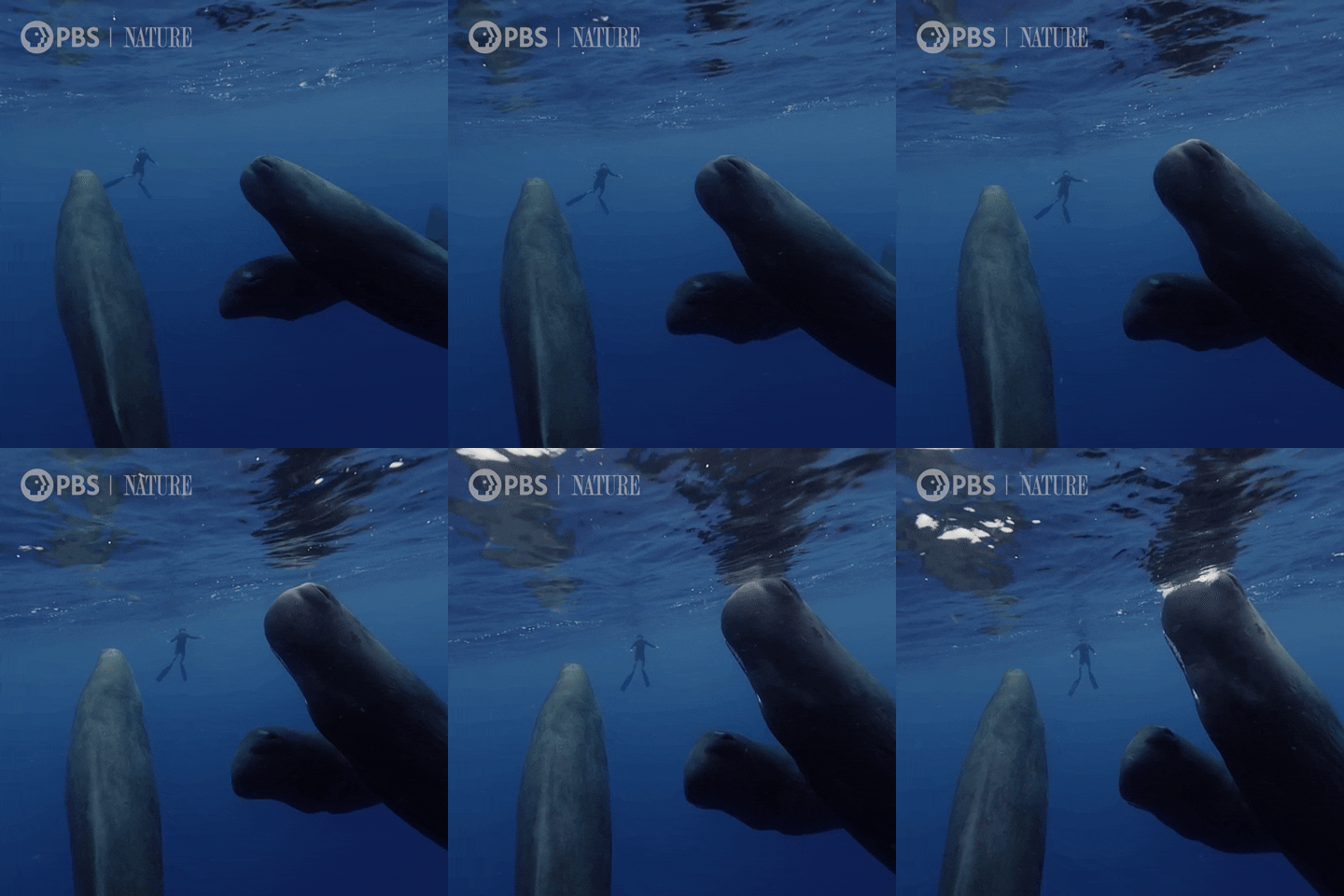
Researchers analyzed 1,100+ whale calls from 15 whales off Dominica and found five structural features that directly mirror how human languages work — after 90 million years of completely separate evolution.
Published in Proceedings of the Royal Society B on April 14, 2026. Not “animal sounds that are kinda interesting.” Actual phonological (sound structure) rules that work the same way as Mandarin, Latin, and Slovenian.
🧩 Dumb Mode Dictionary
| Term | What It Actually Means |
|---|---|
| Coda | A short burst of clicks whales make — their version of a word or syllable |
| Phonology | The rules for how sounds work in a language (like “th” in English, tones in Mandarin) |
| Vowel | A sound you can hold — “ahhh” or “eeee.” Whales have their own version using clicks |
| Diphthong | When a vowel slides into another vowel mid-sound — like how “cow” isn’t just “ah” |
| Coarticulation | When the sound you just made changes the next sound coming out. You do this every time you talk, you just don’t notice |
| GAN | A type of AI that learns patterns by generating fake versions and comparing them to real ones. Like a music student copying the teacher |
| Project CETI | A research group trying to decode whale language. CETI = Cetacean Translation Initiative |
🌊 How We Got Here
so let me set the scene. for decades, scientists thought sperm whale clicks were basically morse code. dot-dot-dash type stuff. simple signals like “food over here” or “danger.” boring, right?
then Project CETI showed up — a crew of marine biologists, linguists, and machine learning nerds who said “what if we actually listen properly?” they planted recording equipment near a family of whales off the Caribbean island of Dominica and started collecting thousands of calls.
in 2024, they discovered rhythmic click sequences that form something like a phonetic alphabet. by late 2025, they found vowel-like elements. and now in april 2026? the full paper drops and it’s way bigger than anyone expected.
the vibes are immaculate and the science is cooked (in the good way).
🔬 The Five Parallels — The Receipts
Berkeley linguist Gašper Beguš and the team found these five features in whale codas that directly match human speech:
| # | Feature | Human Example | Whale Version |
|---|---|---|---|
| 1 | Vowel-like sounds | “a” and “i” in every language on earth | Two distinct coda types that function like our vowels |
| 2 | Diphthongs | The “ow” in “cow” slides between sounds | Whale vowels rise and fall within a single call |
| 3 | Length changes meaning | Hungarian: “bor” (wine) vs “bór” (boron) — same sound, different length, different word | A-codas last way longer than i-codas. Short “i” vs long “ī” = different meaning |
| 4 | Coarticulation | You say “handbag” but it sounds like “hambag” — the next sound reshapes the current one | A whale’s first click changes shape based on whatever click came before it |
| 5 | Vowel-tone pairing | Mandarin: same syllable + different tone = totally different word | Certain whale vowels pair with specific rising/falling tones |
“In the past, researchers thought of whale communication as a kind of morse code. This paper shows their calls are more like very, very slow vowels.” — Gašper Beguš
📊 The Numbers
| Stat | Detail |
|---|---|
| Codas analyzed | 1,100+ (from 3,948 total recordings between 2014-2018) |
| Individual whales studied | 15 females and calves |
| Years since shared ancestor | ~90 million |
| Vowels identified so far | 2 (“a” and “i” equivalents) |
| Project CETI’s 5-year goal | Understand 20 whale expressions (diving, sleeping, socializing, etc.) |
| Chattiest whale | “Pinchy” — described as “very chatty, very structured” |
these numbers are wild when you sit with them. 90 million years of totally separate evolution and they independently invented the same speech tricks we did. convergent evolution is lowkey the most humbling thing in science.
📡 How Machine Learning Cracked It
here’s the part that hits different for the tech crowd.
Beguš used generative adversarial networks (GANs) — the same type of AI that powers deepfakes and image generators — but instead of learning faces, these GANs learned whale. they listened to thousands of codas and learned to generate fake whale calls. then the researchers compared the fakes to real calls and mapped out the structural rules the AI had figured out.
it’s the exact same way a human baby learns language: listen, imitate, refine. except the baby is a neural network and the language is clicking noises from a 60-foot animal that can hold its breath for 90 minutes.
the key insight: the patterns weren’t random acoustic noise. they showed “complex hierarchical order” — rules stacked on rules, exactly like grammar.
🗣️ What The Timeline's Saying
Gašper Beguš (UC Berkeley, linguistics lead):
“This suggests a complexity that approaches human language.”
David Gruber (Project CETI founder):
“I think it’s another humbling moment that we’re not the only species with rich, communicative, communal and cultural lives.”
Maël Leroux (evolutionary biologist):
“The fact that they show coarticulation is one of the most striking points.”
Beguš on legal implications:
“We’re thinking deeply about what finding these human-like structures means for the legal rights of animals. What is language? Is there anything uniquely human about language, or is it just a continuum?”
the legal angle is lowkey the sleeper story here. if whales have language — not “communication” but actual structured language — the implications for animal rights law are enormous. the 1970s “Save the Whales” movement changed conservation forever. this could do the same for animal personhood.
🧠 Why This Isn't Just a Cool Nature Fact
i know what some of you are thinking. “cool, whales talk. so what?”
here’s so what:
-
for AI: the GAN approach used here is a new framework for analyzing ANY non-human communication. birds, dolphins, elephants, bats — all of them suddenly become solvable problems. the same ML techniques that decode whale clicks can be pointed at any acoustic signal.
-
for linguistics: this challenges the fundamental assumption that language is uniquely human. if sperm whales independently evolved the same phonological rules, “language” might be more like “flight” — something evolution discovers repeatedly because it’s just that useful.
-
for the ocean: sperm whales are endangered. proving they have language-level communication makes the conservation case way stronger. you can ignore “they make interesting sounds.” you can’t as easily ignore “we’re driving a species with its own language to extinction.”
this is one of those papers that’s going to look different in 10 years. right now it’s a cool finding. later it might be the moment we realized we weren’t alone in having something to say.
Cool. Whales have vowels and the ocean is a group chat we’ve been ignoring for 90 million years. Now What the Hell Do We Do? ( ͡° ͜ʖ ͡°)
🎣 The Bioacoustic Arbitrage
Public whale recording datasets (like The Dominica Sperm Whale Project archives and NOAA passive acoustic data) are free. But nobody’s processing them into usable labeled datasets for ML researchers. Every AI lab working on animal communication needs clean, tagged audio — and right now they’re all doing it manually.
Build a pipeline that takes raw hydrophone (underwater microphone) recordings, isolates individual codas using open-source tools like Koogu, and sells labeled datasets to marine research labs and AI companies. You’re the bridge between free raw data and the expensive labeled data researchers actually need.
 Example: 26-year-old data science student in Lisbon downloads 400 hours of free NOAA hydrophone data, uses Python + Koogu to auto-segment whale codas, manually verifies 10% for quality, sells labeled packs on Hugging Face datasets at $200/pack to three marine AI startups. Clears $2,400/month as the only supplier before larger companies set up their own pipelines.
Timeline: First labeled dataset published in 2 weeks. Revenue in 3-4 weeks. Window lasts ~6 months before open-source communities catch up and automate the whole chain.
🕳️ The Whale Tourism Intel Play
Whale watching is a $2.1 billion global industry. Tour operators in the Caribbean, Sri Lanka, and the Azores live and die by whether customers actually see whales. Right now most operators guess routes based on season and vibes.
Here’s the angle: hydrophone data + basic ML pattern recognition = real-time whale location predictions. You don’t need to decode the language. You just need to detect when whales are clicking (which means they’re nearby and active). Package this as a daily “whale probability forecast” that tour operators subscribe to. They charge tourists $150/head — paying you $30/month for intel that fills their boats is nothing.
Example: 29-year-old marine biology dropout in the Azores (Portugal) buys a $300 used hydrophone, drops it off the coast, runs a basic audio detection script on a Raspberry Pi. Sells daily “whale activity alerts” to 14 local tour operators at €25/month each. Makes €350/month passive income that scales every tourist season. One operator reports 40% more successful sightings.
📡 The Cross-Species GAN Toolkit
Beguš’s GAN approach works on whale codas. Nobody has packaged it into a user-friendly toolkit that works on bird calls, dolphin whistles, bat echolocation, or any other animal audio. The actual ML technique is published and reproducible. The paper’s methods section is your blueprint.
Build a simple web tool or Python library: upload animal audio, get structural analysis. Market it to wildlife researchers who can’t code, conservation nonprofits running field studies, and university departments that don’t have ML expertise.
Example: 24-year-old ML engineering grad in Kraków (Poland) reads the Beguš paper, reimplements the GAN pipeline as a Streamlit web app, makes it free for basic use and $15/month for batch processing. Posts it on r/bioacoustics and academic Twitter. Within 6 weeks, 200 researchers using it — 35 paying. That’s $525/month from a niche nobody else is serving, and it becomes the go-to citation tool.
🪟 The Animal Rights Content Window
This paper is going to kick off a massive public conversation about animal personhood, animal language, and whether whales deserve legal rights. That conversation hasn’t peaked yet. The legal/ethical angle is where the public attention will land in 2-4 months as journalists, lawyers, and activists pick this up.
The play: become the first person to create a comprehensive, well-sourced, visually clean resource page — a “whale language wiki” — that explains the science in plain language and links to every study, every recording, every legal precedent. Own the SEO for “whale language” and “animal communication rights” before the wave hits. Monetize with newsletter sponsorships from eco-conscious brands (sustainable apparel, reef-safe sunscreen companies, etc.).
Example: 22-year-old environmental studies student in Cape Town builds a free Notion site + Substack newsletter called “Coda Report” — weekly updates on whale communication research and animal rights developments. Posts the five-parallels chart from this paper as the anchor content. Within 8 weeks: 4,000 subscribers. Gets sponsored by a sustainable ocean brand at $400/issue. Two issues per month = $800/month, growing as mainstream media picks up the story.
🎰 The Acoustic NFT-Minus Play
forget “NFTs” — nobody wants another monkey jpeg. but here’s what people DO want: real, verifiable, unique recordings of identified individual whales. The research team literally named these whales (Atwood, Fork, TBB, Pinchy). Each has a unique vocal signature, like a voiceprint.
License or record unique whale vocalizations, pair them with the individual whale’s identity and backstory, and sell them as premium audio collectibles to ocean conservation supporters. Not blockchain grift — just genuine rare audio with provenance (proof of where it came from), sold as high-quality downloads with donation splits to actual conservation orgs like Project CETI.
Example: 27-year-old sound designer in Reykjavik partners with a whale research station in Iceland that has hours of identified whale recordings gathering dust. Creates a Bandcamp page selling “Whale Voice Portraits” — 3-minute high-fidelity recordings of individual whales with liner notes about who the whale is, their family, their vocal quirks. Prices at $8-$15, 30% goes to the research station. Moves 600 units in the first month after one viral tweet from a marine biologist. $3,360 revenue, $2,350 kept.
🛠️ Follow-Up Actions
| Want To… | Do This |
|---|---|
| Read the actual paper | Royal Society B — full text |
| Listen to whale codas | The Dominica Sperm Whale Project archives |
| Learn about Project CETI | projectceti.org — they take volunteers |
| Try bioacoustic ML | Koogu on GitHub — open source animal sound detection |
| Access free hydrophone data | NOAA Passive Acoustic Data |
| Follow Beguš’s work | UC Berkeley linguistics department |
| Explore whale watching data | IWC whale watching overview |
 Quick Hits
| Want To… | Do This |
|---|---|
| Hear whale “vowels” yourself |
Download free coda samples from Dominica Sperm Whale Project archives |
 Run the same AI on animal audio Run the same AI on animal audio |
Clone the Koogu repo, feed it any .wav file |
 Understand the full paper Understand the full paper |
Read the ScienceAlert summary — same facts, human words |
 Find the money angle Find the money angle |
Label bioacoustic datasets → sell to marine AI labs via Hugging Face |
 Actually help whales Actually help whales |
Volunteer with Project CETI — they need data taggers, not just marine biologists |
90 million years of separate evolution and they still ended up saying “ahhh” and “eeee” just like us. maybe language isn’t a human invention — it’s just what happens when you have something worth saying to each other.
Source: National Geographic · Study: Proceedings of the Royal Society B
 !
!