 A folder of files is not a library.
A folder of files is not a library. Aryan — an offline eBook reader for Windows that keeps your shelves, notes, highlights and reading progress right beside the book itself.
I keep my books across three drives. Every reader I tried wanted me to move them into its own library, re-import everything, and then keep the originals somewhere safe as a second copy.
Aryan reads them where they already sit.
 EPUB EPUB |
 PDF PDF |
 MOBI MOBI |
|---|---|---|
 AZW3 AZW3 |
 CBZ CBZ |
 CBR CBR |
Multiple drives, and your original files are never touched.
 The part that keeps the book alive
A book you finish and forget is a file. A book you remember is a library. These are the parts that turn one into the other:
| Feature |
 What it does for you What it does for you |
|---|---|
| Shelves & lists |
Group books however your brain actually files things |
 Notes Notes |
Your own words, attached to the page they came from |
 Highlights & clips Highlights & clips |
Save the exact lines worth keeping, recover them in seconds |
 Progress & history Progress & history |
Never lose your place across weeks of reading |
 Authors, series & tags Authors, series & tags |
Follow an author or a whole series without hunting |
 Search, filters & cleanup Search, filters & cleanup |
Find one book among thousands, then clear the duplicates out |
 Backup, restore & CSV export Backup, restore & CSV export |
Your library leaves with you, in a format you can read |
 Offline-drive awareness Offline-drive awareness |
Spots a drive that dropped out and helps you recover from it |
 A dictionary that works with no internet
English ⇄ Myanmar and English ⇄ Hindi, entirely offline. Long night, spotty connection, aeroplane — the word is still one tap away.
   📖 page open
        │
        ├── 📝 your note
        ├── ⭐ your highlight
        └── 🌐 Right click any word ──►Define──► English/ Myanmar / Hindi, no signal needed
 Built on a short list of promises
source       = open
install      = portable
internet     = not required
account      = none
tracking     = none
subscription = none
Those five lines are the whole design. My other Windows apps follow the same list, and Aryan follows it too.
Aryan is young. It is already the reader and library I wanted for myself, and it keeps getting better.
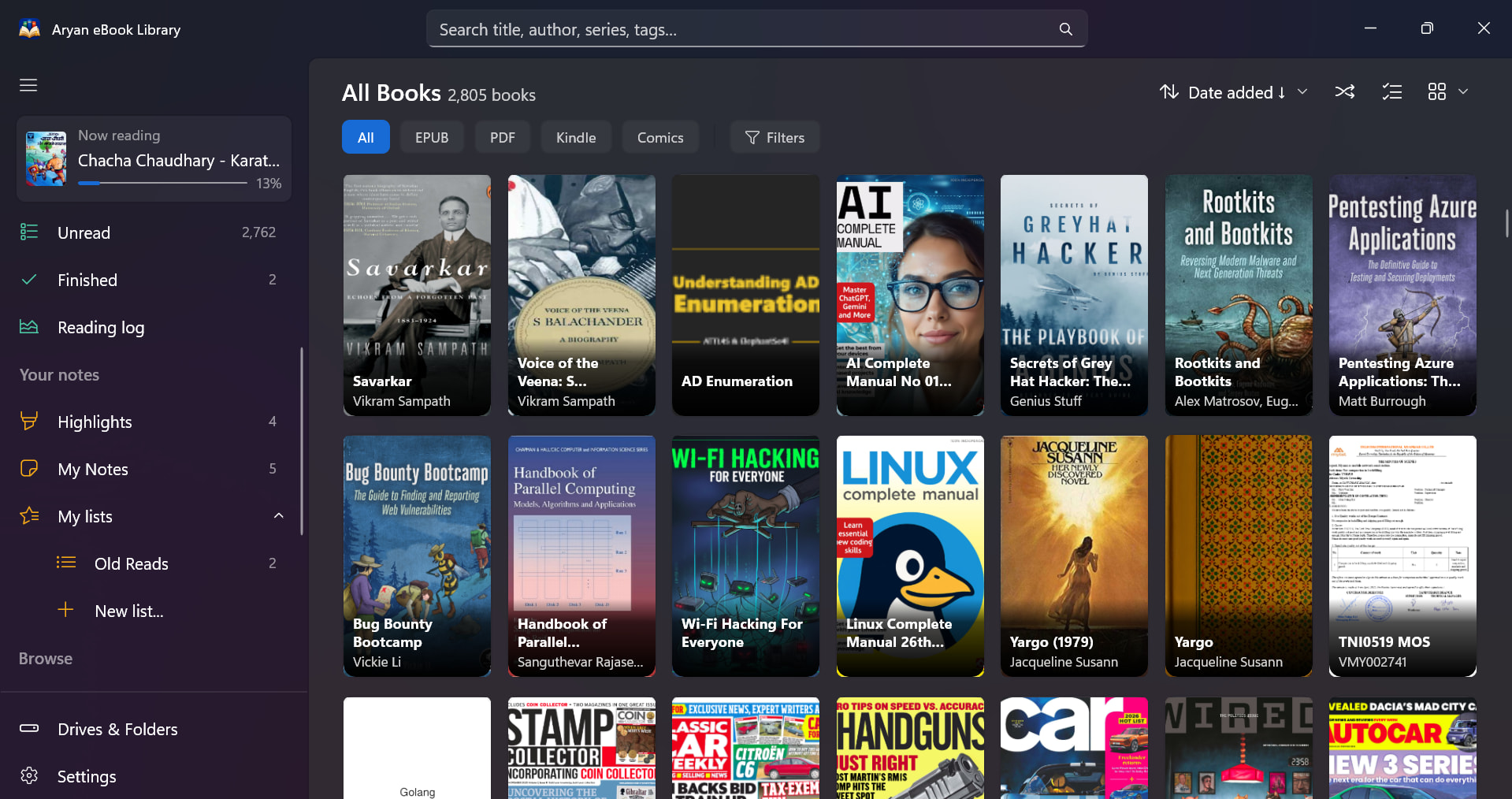
Your books stay yours — on your drives, in your hands.
[About the App name]
Aryan (आर्यन) is my son’s name; he is one year old. In India and across South Asia it is a common given name, meaning “noble” in Sanskrit and Hindi. The app has nothing to do with the racist misuse of the word in 20th-century Europe, which I reject completely.
 !
!